
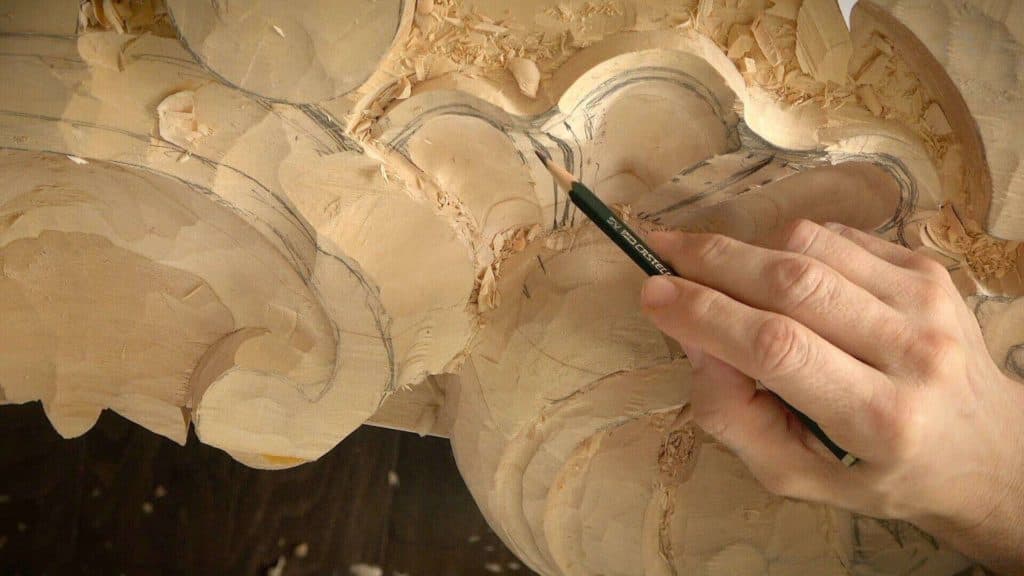
Alexander Grabovetskiy, woodcarver, School of Woodcarving · Published 2023
What does a wood carver mean by "the rules"?
Quick answer: In Venice Room workshop 5, part 6, I spoke of following "the rules" and then of edges with little curvature. The part does not name the rules. Other lessons of mine put the same word near a design, slicing, the number of motions and a line that grows from a center.
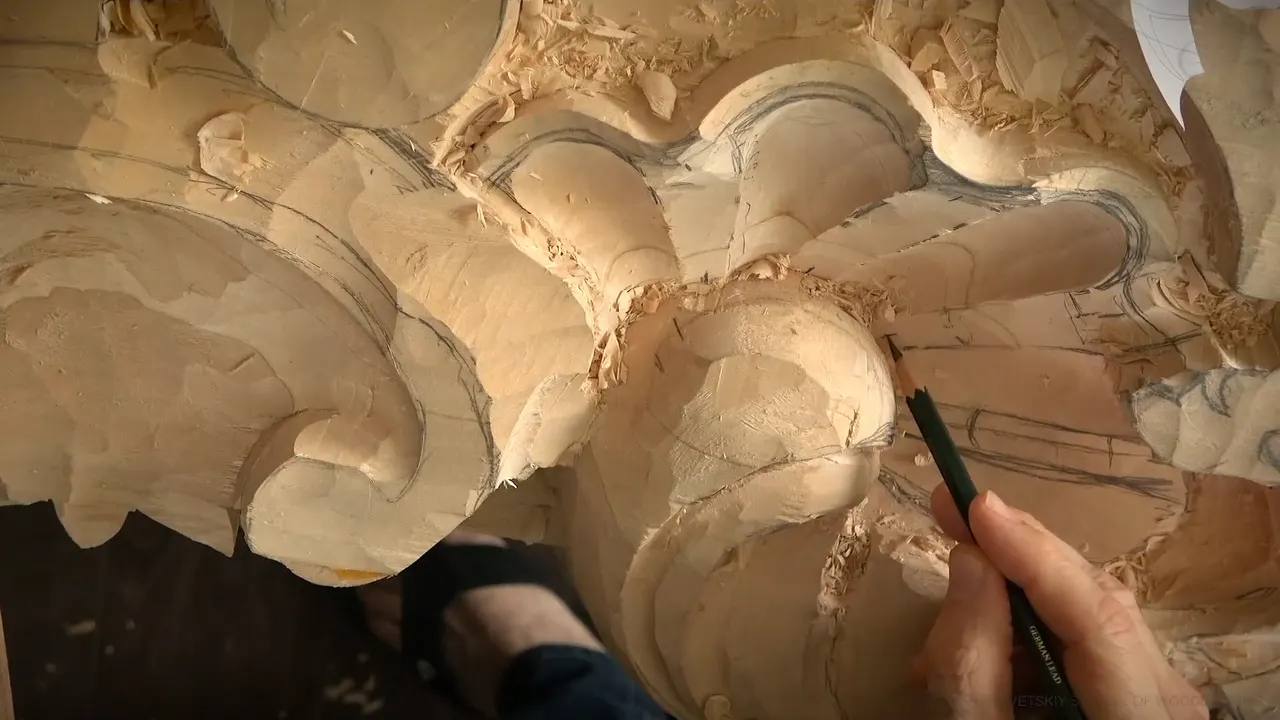

In part 6 of Venice Room workshop 5 I said "So I really want to follow the rules" and my next words were about edges where I did not see a lot of curvature. That part does not say which rules I mean. Other lessons of mine use the same word near a design, a way of slicing, a count of main motions and a line that grows from a center. I linked each lesson that has a public page, and a table near the end lists them all.
Ever drawn a line on wood and found it too straight? Ever picked a pencil that did not show on the wood? Both happen in part 6. The words below come from my own talk, from part 7 and from lessons in other courses.
What this page holds
- My words in part 6, in the order I said them.
- The widths I gave for each convex.
- A colored pencil, a red one, charcoal and a marker.
- Lessons where the word sat by a design, a way of slicing or the number of motions.
- A table of those videos, so you can find each one fast.
What came right after I mentioned the rules?
Part 6 opens with "Now, let's see what I have to fix. Not to fix, but I want to make sure I'm doing the right thing right here." Then comes the line itself, "So I really want to follow the rules." Edges come next: "if you look at that edge and that edge and all of those edges, I don't see a lot of curvature, which I don't like."

Next I planned to find the middle point between those two lines "everywhere" and I said "This is going to be a little less." For the center line at the bottom I said I needed "a little bit of a curvature, not as straight." Two phrases name the shape, "Just a slight curvature like that" and "Just create movement like that." The next spot got "Exactly the same."

I said "it is better for me to take care of it right away before it is too late." After that: "It's still going to go to the center, but I'm going to have a really nice curvature." And later: "And maybe, let me see. This is not enough. This one needs to be a little more."
Maybe it doesn't make sense why I'm doing it for now, I said, but "you'll see that in the overall picture." Later: "I'm actually just doing a middle line." A check followed, "Okay, let me double-check this. This one is not too nice" then "This needs to be right here a little more" and "That is good."

Part 7 returns to curvature. "Let me double-check my curvature," I said there, and "Really important for me to have a really beautiful curvature and still create the illusion that that goes to the same point somewhere." Then came "I don't know why I didn't do that right away, because logically I should." The next step, I said, would be "probably number 9 or number 11 even" and "I could use 3 millimeters, in this case, number 11, and create the concave cuts on the side" (3 mm is 0.12 in).
How wide did each convex start, and where did it end?
Each convex, in my plan, was to start a half inch wide and narrow toward a quarter inch. Of the middle I said "Convex, convex, convex, and convex." The start was "approximately half an inch wide, about 13, 14 millimeters, something like that" (half an inch is 12.7 mm, so my 13 or 14 is a round figure). My word for the method was "eyeball it."
The end was "approximately a quarter inch, six millimeters right there" (a quarter inch is 6.35 mm). A correction came on the spot: "some spots maybe a little less, five millimeters, but pretty close" (5 mm is 0.2 in). Then "that is what I want to see."

The middle got its own figure, "3/8 somewhere in the middle," which I also said as "Ten millimeters" (3/8 in is 9.5 mm). After it: "five millimeters and five millimeters apart." After the red pencil I gave the sizes again.
Which pencil showed the middle line?
A red one was better, in my words. First I said "I don't really see this line" then "I need to probably use a marker or colored pencil." The colored pencil failed: "It does not work. I can't really see." My next words were "Let me use a red one" and then "Okay, that is better."

The same trouble came back late in the part. "I'm kind of having trouble to see this one," I said, and "Maybe I'll just use a charcoal." My verdict on that was "it's really not that good idea" and it would be "hard to clean." The last caption line of the part is "Maybe I'll just use a marker."
Can a curve go down in small strokes?
Before the curve line I said I was about to create my curvature line. Then I spoke of the artists. Some of them "would say that is not the right way to draw just the small strokes" and you are "supposed to just do one big swoop like that when you draw." My answer was "but not really. Not in three-dimensional world."

On accuracy I said "it's almost impossible sometimes to do really accurate." A verdict followed, "I kind of like that." My job was "I have to just connect that." The sizes I named were half, three-eighths and a quarter-inch, and the next word was "wonderful."
One more line shows my stage: "I don't worry right now that I do have a mess, a little bad underneath of here, because I'm still at that stage when that doesn't really matter." Then: "let me do the last one."

Where did the same word sit in my design lessons?
Furniture Panel 1, part 1, has a smaller board. I told the viewer they can "follow the steps on a smaller board, follow principles, follow rules, follow the laws of the design" and said "you'll achieve really good results with that."
Part 2 calls those rules "really important" and adds "I don't try to invent the wheel." Of what you design I said "Doesn't matter if you design composition of a photo, or a fine art, or carving especially." The three-dimensional world came up there too: "In wood carving, there's a three-dimensional world."
Furniture Panel 2, part 2, gives the word a result I do not claim to explain. "somehow when you follow those rules, those laws, those principles," I said, "your artwork is actually looking really good." Next came "I don't know how is it working" and "Inside of your brain, probably you're wired that way." The result I named was "pleasing to your eye, appealing to your brain."

Tray of Blessing 6, part 1, puts the word in a list, "the 10 rules of the design." Beside it I said you must "remember about the law of repetition" then "to repeat the same detail" and "but on a smaller scale." One more could go in, "another one, but on a micro scale in this area."
Hashemi Flowers 6, part 1, has a plan with a number nine in it. Freehand carving was the plan, with the law of flow still in force, and "Maybe I can actually use a number nine." Just before it I said the middle line would sit "closer to the higher side."

Which rules came with a tool in my hand?
The Carving Hazelnuts course uses the word about slicing, in part 2 of lesson 7. "you don't have to have a back bent," I said, and any flatter tool will do, but "the back bent gives you a lot more chance to make it nicer and cleaner." Then "even with the back bent, I follow the rule of slicing, which means I'm not pushing."
To prove the point I planned "any flatter tool, like maybe number three." That gouge would "just go right underneath, but still slice it."

Lesson 3, part 2, has a count. For my husk I used the word again, and the same stretch names the Fibonacci sequence and "five main motions." The count ran "one, two, three, four, and I need to introduce one more." The reason I gave was "that way it's going to look more natural, if you wish."

Part 3 of lesson 7 has "Let me just draw the center line how I want to see it" and then my plan to follow the golden ratio, with this reason: "it's going to look more pleasing to the human eye." Lesson 8, part 1, says the word about a leaf line: "It has to come from the center of the bunch. I mean how it grows." After it I said "It doesn't have to but it's gonna look much better I think."

Cutting Board 3, part 2, is a bird. "Now it's the time to refine the main movement," I said, and "like I said, that's going to be stylized." The rule I named was "the rule of ancient way to stylize it." Then "And they love to stylize everything." The tail brought the same rule again, with "make it stylized."

Lesson 7 of the same course, part 2, has it differently. "You could go deeper," I said, and that you do not have to stay with a rule like "3/32nds" (3/32 in is 2.4 mm). My figure for deeper was "about maybe 3/16ths, about five millimeters deep" (3/16 in is 4.8 mm). Edge work got "I barely create any pressure right now at the edge of it."

The Grape Vase course has a plan in its first video. "We're going to create together pretty much right on the fly, right on the piece of wood. But we're going to follow some rules."
Did the rules change with the piece?
In places, yes. In Venice Room 92, part 7, I was making a few concaves and convexes on leaves. They were not acanthus, I said, so "I don't have to follow" the acanthus rules, but "they still have to look good or somewhat good." I said I would use "number seven and 14 millimeters" (0.55 in), a size I also put as a half inch.

Grape Onlay 9, part 1, gives me a way out. I wanted "the same movement going downhill" and about the arc I said "you don't really have to follow those rules if you feel like that's too much."
Part 3 of Venice Room 63 says it the other way. With high relief, I said, "if you know a little bit about high relief," there are still "some type of rules" to follow. My example was an upper part with one side exposed and sides that are not much exposed. The same rule asked me to chop "a little bit of those guys" with a brake: "I don't want to lose a feel of it."

Sometimes the rule was what others had carved. Venice Room 96, part 11, has "the people, they used to carve acanthus." Of an oak: "what they carved, they divided each leaf in three main parts." My own line was "I'm going to follow what they've done."

The Rosette workshop has a design to follow. There is no original piece, and I said "All I have is just a picture of the rosette." The picture is my guide, "actually, pretty much."
Greek Acanthus 2, part 3, is the one with grain. "And there is a laws of course you have to kind of keep. So you're working with the grain, not against the grain." Then "But I do have a habit to break that law, because when I'm working on a complicated pieces, you really can't always follow the laws."

Which videos carry the word, and with what?
Every video below carries the word, with a note on what sat beside it.
| Video | Beside the word |
|---|---|
| Venice 5-6 | Edges that showed little curvature |
| Panel Design 1-1, 1-2 and 2-2 | Principles, a photo, a canvas and a pleasing look |
| Tray 6-1 | The law of repetition, on a smaller scale |
| Hashemi 6-1 | Freehand cuts and the law of flow |
| Hazelnuts 3-2, 7-2, 7-3 and 8-1 | A husk, slicing, a center line and a leaf line |
| Cutting Board 3-2 and 7-2 | A stylized bird, and a depth near 3/32 in (2.4 mm) |
| Grape Vase 1-1 | A design made on the piece of wood |
| Venice 63-3, 92-7 and 96-11 | High relief, leaves that are not acanthus, and an oak |
| Grape Onlay 9-1 | An arc, and a rule I could skip |
| Rosette 1 | A design that came as a picture only |
| Greek Acanthus 2-3 | A grain rule I could not always keep |
Where can you watch part 6?
You can watch part 6 inside workshop 5 of the Venice Room course. The whole lesson sits on one page, Venice Room 5. Everything on the site sits inside the tuition.
Where on your own board does a line run too straight? Pick up a pencil in a color you can see, look for the middle between two lines, and give the line a slight curve for your wood carving.
How it's done
- Look at the edges. In part 6 I said the edges showed little curvature, which I don't like.
- Mark the middle. My plan was the middle point between two lines, everywhere.
- Bend the center line. The center line at the bottom needed a slight curvature, not as straight.
- Set the widths. Each convex was to start near a half inch and narrow to a quarter inch.
- Pick a pencil you can see. The first colored pencil did not work, and a red one was better.
- Connect the strokes. My job was to just connect them, with half, three-eighths and a quarter-inch as my sizes.
Frequently asked questions
Which pencil showed the middle line in part 6?
A first colored pencil did not work: "I can't really see." My own words were "Let me use a red one" and then "Okay, that is better." Charcoal came up at the close, hard to clean, and a marker ended the part.
How wide did a convex start?
A half inch at the start, about 13, 14 millimeters. It was going to narrow to a quarter inch, six millimeters, with a few spots near five. For the middle I gave 3/8, ten millimeters, and my word for the method was eyeball.
What did I say about drawing in small strokes?
Artists, I said, would call it the wrong way and prefer "one big swoop." My answer was "but not really. Not in three-dimensional world." I added that it is almost impossible sometimes to do really accurate.
What to carve next