
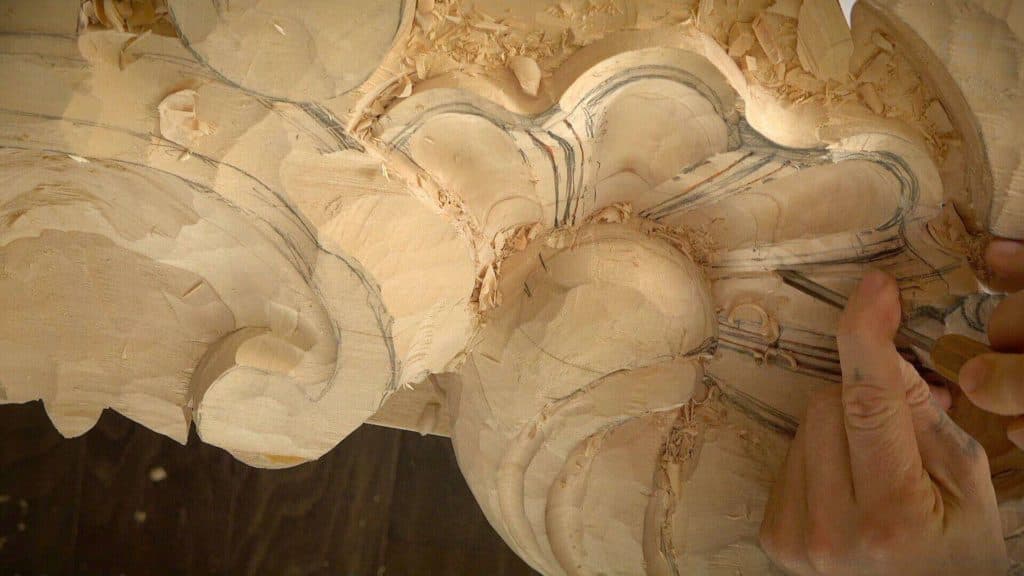
Alexander Grabovetskiy, woodcarver, School of Woodcarving · Published 2023
What does a wood carver mean by "an eighth"?
Quick answer: In Venice Room workshop 5, part 7, I told myself to keep away by about 3 mm (1/8 in), and I added that I wanted to be safe. Other lessons of mine use the same distance beside a line, a grain and a depth.
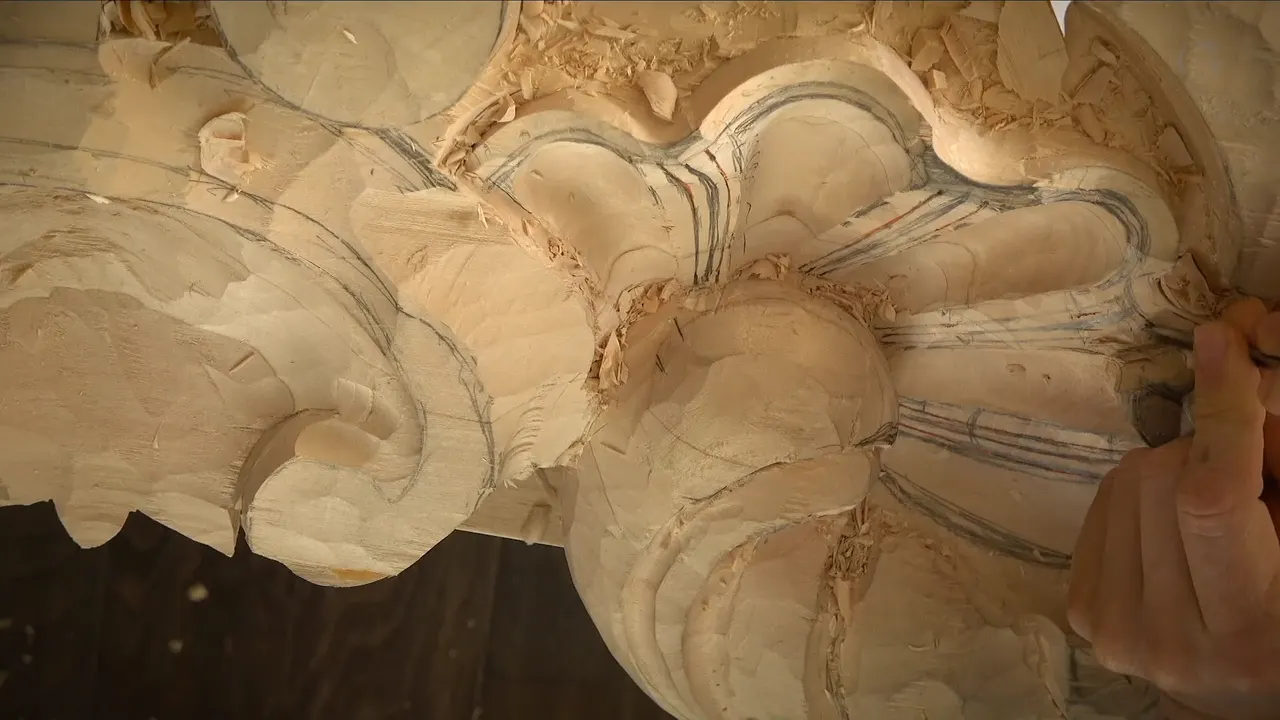

In part 7 of Venice Room workshop 5 I said, "Okay, need to make sure I'm not pressing too far. So I'm supposed to keep away approximately eighth of an inch, about 3 millimeters. I want to be safe." Earlier in the same part I had named a line. This page follows that distance through my own words in other lessons.
Ever stopped a gouge short of a pencil line and wondered if you stopped too soon? Ever pressed a little too far and felt the wood let go? Below are my words from part 7, from the parts beside it, and from lessons in several other courses. Each lesson I name is linked, and a table near the end lists the videos.
What this page holds
- My words in part 7, in the order I said them.
- Parts 6 and 8, where the convex gets its width and its depth.
- Lessons where the distance sits next to a line.
- Lessons where it sits next to a depth.
- A table of those videos, so you can find each one fast.
Which words came before the distance in part 7?
A count of lines opens the part: "I just got too many lines." Then "let me double-check my curvature." Next came a wish: "Really important for me to have a really beautiful curvature and still create the illusion that that goes to the same point somewhere."
A short aside followed. "I don't know why I didn't do that right away, because logically I should." My plan was this: "the next step for me would be, I would just take probably number 9 or number 11 even." Then a size: "I could use 3 millimeters, in this case, number 11, and create the concave cuts on the side." That size is 0.12 in.

The line comes up next. "But also, I don't want to forget that I'm not supposed to touch outside of this line right here," I said. Then, "Okay, so I'm not supposed to touch it." After that came "Okay, let me start this one" and "Carefully going to go toward the center."
One tool might fail, I said. "And maybe straight gouge not going to work, but we'll see." If it does, my plan was to switch: "just use something different."
What did I say about smooth transitions?
Then a choice. "I could create a sharper transition, but I really like smooth idea, and I would say even original idea." On tools, I said "veiners and gouges, they create beautiful transitions, smooth transitions."

About one tool I said "Maybe this one is a little too small for this operation" and then "I can always get to the bigger tool." Depth got its own line. "And kind of deep. That's what I want to do, because I really want to see really good convex."
Where does the distance sit in part 7?
The distance came after a check on myself, and "I want to be safe" closed it. One inch is 25.4 mm, so 1/8 in is 3.2 mm, and my 3 is a round figure.

That sentence does not say what I was keeping away from. Earlier I had named a line, and I do not join the two. Then I turned to grain: "see this is a weak side, and it just breaks away. So keep an eye that you would not break the good side."
The shell itself got a word, too. "Those shells, they look beautiful, and there is just so many variations." And "You can do that on the furniture. You can do that in architectural carving," I said, then "I've done some shells on bed headboards." The part ends on a check: "And I constantly have to check if it is a really nice curvature I create."

How wide and how deep were the convex parts beside it?
Part 6 gives the width. "This convex, it's going to be starting from approximately half an inch wide, about 13, 14 millimeters, something like that." That half inch is 12.7 mm. It narrows after that: "it is going to narrow to approximately a quarter inch, six millimeters right there."
Seeing the line was a problem in part 6. "I don't really see this line," I said, and "Let me use just a colored pencil for this middle line. It does not work." My next try was "Let me use a red one" and the verdict was "Okay, that is better."
Part 8 opens on the chunks beside the groove. "Those chunks, they're supposed to be lower. At the same level actually pretty much as that groove." I named number five first, then number three, "actually also good in a quarter inch" (6 mm), and I said "I'm afraid with the number three, I can create the damage to the side of future convex."
Part 8 also has an apology: "I apologize that I am covering with my hands, but there's just no way I can position anywhere else my camera." Then "Just wait until I finish my cut and you'll see."
Later in part 8 came the reason for going deep: "So it has to cast a lot of shadows." I wanted "deep cuts" and a convex "really almost half a round." Then the warning: "I start digging too deep, and I can damage the sides of my future convex."

Which lessons put an eighth beside a line?
Greek Acanthus 3, part 1, has me planning a small bevel and then one pass to follow the line. "If you don't feel safe to do the cut right on the line, like I mentioned before, so you can actually just make about eighth of an inch away, about 3 millimeters, I would say, and you should be fine." Then my own choice, to work on the line itself: "I feel comfortable."

One more remark came from that pass. "When I'm making that type of cut, I'm referencing my hand on a piece of wood itself. And it's not in the air otherwise."
Greek Acanthus 2, an earlier lesson of that course, makes the same offer with a wider range. "If you feel more safer that way, that's absolutely fine." I put the distance at "up to 3/16, up to five millimeters away from the main picture, it's safe." Three sixteenths of an inch is 4.8 mm. About the knife I said "I found with the knife, especially on the limewood, sometimes it's the quickest just to go this route."

I was close to a line in Hashemi Flowers 1, part 3: "I am really close to the line." My first distance was "you can always just step away about a 16th of an inch" (1.6 mm). The next one was an eighth (3.2 mm), which I called "safer, definitely" and I added "That is a fact" and for my own close pass, "But I feel okay. I feel comfortable."

The space does not stay the same in part 5 of that lesson. At one spot I left an eighth (close to 3 mm), and at another "I started to leave a little more, about maybe a quarter of an inch." That second figure is 6.4 mm. "And let me make it gradually," I said, and of the tools, "when you're using bigger tools, your cut is absolutely clean."

A concave sits in Venice Room 63, part 1, and there I was "staying away" an eighth or so (3.175 mm) "from the line." It tapers as I go up, I said, "but it's going to be deeper concave right there." Then "Got to be careful right here."

Three millimeters is the figure in part 5 of that workshop. "Approximately about three millimeters away," I said. Then I gave the same gap in inches, an eighth (3.18 mm), "away from our initial cut." Next, "Let me also use a long bent and approach that line in the same matter," for "really continuous line."
A black marker is the plan in Carving Plate with Butterflies 2, part 3. "I'm gonna stay away approximately 1/8 of an inch three millimeters from my Cut line." Then "Like I said, we're gonna introduce some leveling." Last, "That is not the final design."

Modern Acanthus 1, part 2, has a size: "I left approximately I don't know inch and a half" (38 mm), and in the middle "it's gonna be an inch" (25 mm). Care came next. "Be careful when you're working about tiny spots like this. Really important not to destroy that." Then "Stay away approximately maybe about 1/8 of an inch. Maybe three millimeters two millimeters." The line after it is "just don't get too close to that line later on. You will have a chance to clean that."

Where does the distance meet the grain?
Venetian Flowers Rosette 1, part 3, puts the distance next to grain. First a depth: "it's pretty close to half an inch deep in this case" and then "I'll see if I need to go deeper." Next I gave the distance I would stay away by, "approximately about one-eighth of an inch" (a little over 3 mm), then "maybe a little less" and "from the line."

Right after that came a warning. "Have to keep an eye because right now I'm running along the grain." The reason was about breaking: "I'll break this piece," I said, if I force it. Part 7 has a cousin of that.
Which lessons put an eighth beside a depth or a boundary?
Two lines sit in Beginner in Woodcarving 2, part 2. "I'm going to do approximately quarter-inch line from the edge," I said, and for the second one, an eighth (3.18 mm). I called the result "my boundary line, if you wish to call that" and said the design lines are "not going to cross this line." A quarter inch is 6.4 mm.

Three numbers sit in one video of Lily Box 4, part 9. The first was a gap: "close to the line, but not right on the line. I'm going to leave approximately maybe, I would say, one millimeter away." Next, a depth, "I've got about one-eighth of an inch deep right now." Later, for a tip, "Maybe about three millimeters, three and a half millimeters away as of now."

Smaller tools came up there as well. "For smaller area, for this section, I will have to use a smaller number nine." Of an even smaller one I said "I could use actually even micro tools. Like maybe a 3/32 of an inch" (2.4 mm).
A depth gauge appears in the Antique Style Rosette course, workshop 3. "Just take, let's say, a nail or a screw," I said, then screw it all the way through and leave it at an eighth (close to 3 mm). "That way, you can always check the background," I said. Then "It is not that critical because with just the eyeballing, I'm really close to it."
An eighth to a line is in Roman Acanthus 16, part 1, where I had "another" eighth (about 3 mm) "to the final line." My next thought was "by now, I probably should already remove that background completely and make it to the final line." For tools I said "I could actually use just the number seven" and "I have a big number eight."

The Hazelnuts course has it in lesson 6, part 1. I had left a gap of an eighth (3 mm) to the final outline, so "I can safely say 25 millimeters" between two spots on the piece, about 1 in.

Which videos carry the distance, and with what?
Each video below carries the distance, with the words that sat next to it.
| Video | Beside the distance |
|---|---|
| Workshop 5, part 7 | Keep away, then a weak side that breaks away |
| Workshop 5, parts 6, 8 | A convex that starts near 13 mm (0.5 in), then a number three |
| Greek 3-1 | A bevel, with a safe option |
| Hashemi 1-3 | A step away, and a feel okay |
| Hashemi 1-5 | A space that grows toward a quarter inch (6 mm) |
| Venice Room 63-1 | A concave that tapers as it climbs |
| Venice Room 63-5 | A long bent that follows the line |
| Butterflies 2-3 | A black marker, for a second butterfly |
| Modern Acanthus 1-2 | Tiny spots, and a chance to clean |
| Venetian Rosette 1-3 | Running along the grain, with a piece that can break |
| Beginner 2-2 | A boundary line, and a second line |
| Lily Box 4-9 | A depth, then a tip about 3.5 mm (0.14 in) away |
| Rosette workshop 3 | A nail left at one depth |
| Roman Acanthus 16-1 | Another eighth left to the final line |
| Hazelnuts 6-1 | A gap, then a span of 25 mm (about 1 in) |
Where can you watch part 7?
Watch part 7 inside workshop 5 of the Venice Room course. Its lesson page is Venice Room 5. Everything on the site sits inside the tuition.
Where on your own board would you keep a pencil line safe? Pick up a chisel or a gouge, stop short of it, and give the wood one pass of wood carving.
How it's done
- Check the curve first. "Let me double-check my curvature" is what I said in part 7.
- Name the tool for the side cuts. A number 9 or a number 11 was the pair I named, and the 11 could be 3 millimeters (0.12 in) wide.
- Remember the line. I said I did not want to forget, and then I named the line.
- Keep the distance. Keep away was my phrase for it, followed by the distance in inches and in millimeters.
- Watch the weak side. Of the weak side I said it breaks away, and I told you to watch the good one.
Frequently asked questions
Which words came right before the distance in part 7?
"Pressing too far," a check on myself, came first. The distance followed in the next breath, and the word "safe" closed it. A line I had named came earlier in the same part.
How many millimeters did I give with it?
Three millimeters, said right after the inches. An inch is 25.4 mm, so an eighth is 3.175 mm, and my 3 is a round figure. A wider range, up to five millimeters, sits in the earlier lesson Greek Acanthus 2.
What did I say about tool size in part 7?
"Maybe this one is a little too small for this operation." I added "I'm talking about too small of a tool," and "I can always get to the bigger tool."
What to carve next