
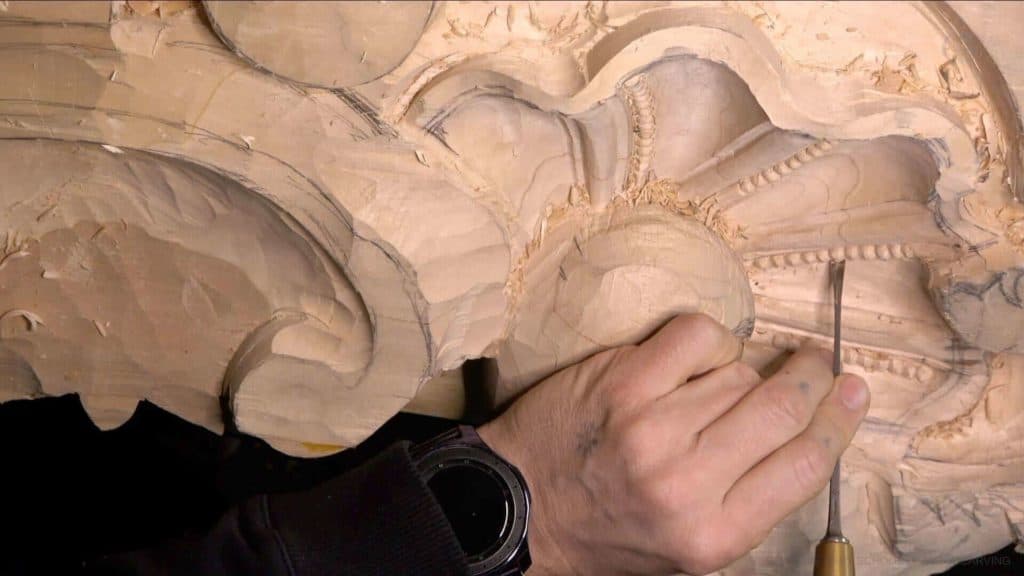
Alexander Grabovetskiy, woodcarver, School of Woodcarving · Published 2020
What does a wood carver mean by "flying out"?
Quick answer: In the first video of Venice Room workshop 7 I said a chip that stays means my cut is not deep enough, and that all I have to do is go in for a deeper cut. In other lessons they sit beside a V tool, or beside a rule about forcing a chip, and each lesson is set below.
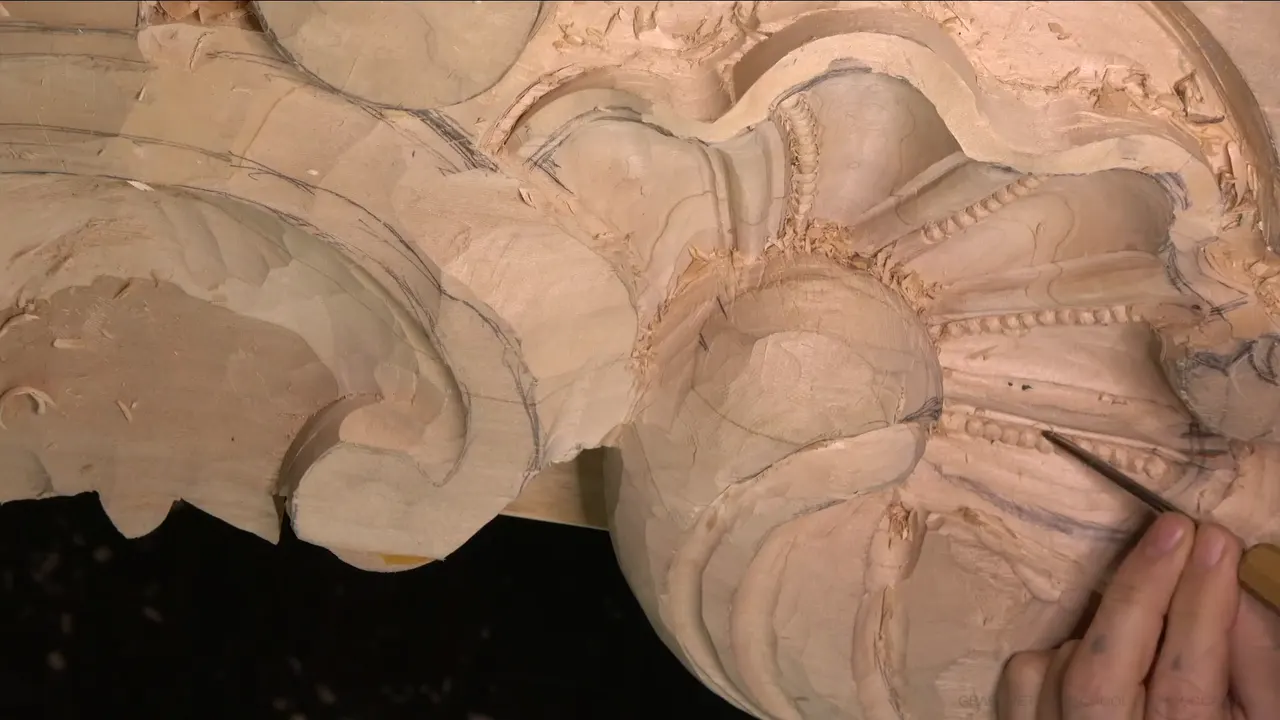

In part 1 of Venice Room workshop 7 I said "Again, if it's not flying out, it means my cut is not deep enough, and all I have to do, just go back and create a deeper cut." I was cleaning the inside, next to a row of beads, when I said it. Similar words came up in lessons from other courses, beside a V tool, and next to a seven and a second pass straight down.
Ever carved a hollow, looked inside, and seen a chip still sitting there? Maybe you pushed harder, or maybe you picked the tool up for another pass. Below is how I worked in that video, the words I gave in the videos beside it, and the lessons where my words came back.
What this page holds
- The first video of workshop 7, with my clean-up and the side I wanted to see from a distance.
- Remarks on a chip that will not come out of the cut.
- The next move in lessons from other courses.
- Where a chip that stayed was fine with me, and why.
- A table with one note for each lesson, so you can find my words fast.
What did I carve first in part 1?
I opened with "But before going too far, I have to clean on inside right here. I just don't like how it looks." I planned a number 11 of one millimeter (about 1/25 in). In another spot I said "Maybe I should use number 11 and three millimeters because it just doesn't look too good." I would follow with the one millimeter and "remove little more deeper right here until I'm happy."

Some of the waste I thought I could get out with my side cutting tool. Before I moved on I said "I'm almost not creating any pressure" and added "So my tool is really sharp." Then it was "Okay, let's move to the next one" and "exactly the same, I'm going to just remove those, whatever the waste I see."
Next came what to do if a chip would not leave. "I have to just go back to the previous tool and cut little deeper, like in this area right here." My plan was a number seven again, to excavate a little deeper, which was "not going to hurt."
Pressing inside the wood showed me something else. "I still create a lot of pressure, and you can see it becomes a really deep cut." A gap opened. "Sometimes it's kind of scary," I said, but "you shouldn't be scared because it will close back." That takes a little time, "like a day or so."

The other side needed the same clean-up. First I said 11 and three millimeters (about 1/8 in), then "I need to use a spoon." A spoon gouge was "another way I could do that," I told you, and "That is just one more way." I named the size as 3 millimeters, one-eighth of an inch.
The number did not have to be a three. "It could be number five. Even number seven, I would still get the same result." Then "Let me use the same spoon and attack from this side" and "on this side, I could use a little bigger one."
The sentence I opened this page with came out in that stretch, and it ended with "Go in. Just like that."

One side had to be clean for a reason. It would show from that direction, and "every little bit of it is going to be visible." My next line was "Yeah, it's going to be visible from a distance, but still." I finished on "even little give more undercut on this side."
What did the two videos beside it say?
Part 2 has me saying "I think those beads looking really nice." About how I make them I said "it's just not perfect round. It's actually like a diamond." The sides and tool marks "casts some shadow." I apologized for blowing on the waste, and said "it's better, of course, to use just a brush. Brush out all that waste."

Further on I said "Got to be careful not to overdo it" and later "Need to create a little deeper excavation." Getting closer, "I could actually use a little bigger," maybe a seven of half an inch (about 13 mm). My words were "It just gives me really uniform look."
Part 3 has a brush too: "Let me brush out so I can see what needs to be done." Then I planned a 1-millimeter (0.04 in) 11 and "exactly the same thing what I did before in other areas, create a little deeper cut right inside of it."

Another undercut was possible there, and I said "I could undercut this way and undercut that way" and then "for now, I'm going to leave it like that." I also said "Maybe one more pass with the number eight back bent, which I don't think I actually even needed."
Later in that video I planned to start a concave with a seven of half an inch, 14 millimeters approximately (about 0.55 in), and then said "maybe number seven is not enough."
What about the small chips in part 6?
Part 6 of the same workshop has a number nine of a quarter inch (about 6 mm) on my list, and I said maybe even a quarter inch would be a little too big. Close to the beads I planned to use just the side of my tool. Then came "I don't worry about if it's not flying out, some small parts, small chips, because I can always clean that with a different tool."

My goal there was "a really consistent long cut." That is why I was "just sliding my tool and let it catch if there's some high spots."
How did my words sound in other courses?
In Butterflies 6, part 3, the part that stuck was "holding something." Part 2 of that same lesson has "that means something holding" and then "I can always cut a second time inside of the same cut." Part 1 has "I'm not as deep as should be" and "on that side also until it's gonna fly out."

Over in Butterflies 3, part 2, I said I was "gonna repeat my cut because it does not fly out." I took the same seven that I used before. Further into that video I said "like I said if it does not fly out. Recreate the cut and that should fly out."
The beginner course on the Kitchen Cutting Board has more. Workshop 4, part 4, gives "Refine" then "repeat the same cut a few more times until the chip is flying out." Workshop 5, part 1, gives "I need to refine this cut" and "nothing wrong to come back and make a double cut or triple cut." The curve there was "just done with the knife."
Workshop 10, part 3, gives a different move for a chip that held on: "just make a second straight down 90 degrees cut until it just snaps out, just like that." A little further on I said "it's deep enough for me" and that I went about a quarter of an inch (about 6 mm) down.

Which move came next when a chip stayed?
In Roman Acanthus 16, part 1, I said "Careful" and then "Bring it to the previous cut." After that came "I can always go back and kind of cut it like this, and that's going to give me clean cut."

A different tool shows up in Greek Acanthus 6, part 1: "I'll take a V tool again and work my way in."
A loose chip is the subject in Butterflies 8, part 2. "I always have a chance to recreate my cut. So I feel, you know, it's loose and I can take the chip out." Further on, "Don't worry about those loose chips."
Butterflies 13, part 1, gives "I can create my previous cut. And that is what I'm after."
Venice Room 57, part 11, has me saying "It did not pop, but I still created my cut with the same tool, kind of going in." Later in that part I said "I'm not pushing too hard" with a plain number 7 of 4 millimeters (about 5/32 in). Whatever was not popping out, I could recreate.

When did I say not to force it?
The Lily Box course, workshop 2, part 11, calls it "a really important rule, don't force" it. Then came "it's better to cut it again, not force it" and "Don't remove it."
The Tray of Blessing course, workshop 8, part 1, has "Like I said, if it doesn't fly out that chip, don't force it."

Modern Acanthus 4, part 2, has "do not remove too much." Next I said I would use just a corner of the tool, and "recreate the cut without pushing too hard."

When was a chip that stayed fine with me?
The clearest one is Furniture Panel 21, part 2: "which in this case it's a good thing, a really good thing." That meant, I said, my straight down cut had not gone all the way to one-eighth of an inch (about 3 mm). Then I added "That's exactly what I want to do." I also said "I don't want to go all the way" right now.

Another line from Venice Room 57, part 11, is "Some of them flying out. That's okay." The reason came next: "it is better not to do too deep of a cut than do too deep and create too weak of a spot."
And Venice Room 6, part 12, has "it would help if those chips would fly out right away. But not always the case."

When did the chips fly out on their own?
Grape Onlay 12, part 3, shows it: "so you can see those chips are flying out right away. That way it's cleaner on inside and you're able to see much better on inside." The tool was an 11 of 2 millimeters (about 5/64 in).

The words in Lily Box 3, part 3, are "in my case, it's flying out, but that's just because I already cut previously with number 11." A tiny number three could go "extremely underneath," I said, and I could take the 11 again "and remove the waste I just created underneath."

How did I see what was still holding?
With a brush. Part 9 of that Lily Box lesson has "let me clean little bit with the brush. That way I can see exactly" what stayed in the cut. A brush shows up in parts 2 and 3 of workshop 7, as you read above.
One spot in part 2 of workshop 7 did not please me. "I know you don't see which one I'm talking about," I said, and "it still doesn't look too good to me, but that's okay." And in part 3 came "I apologize that I am covering with my hands."
Which lesson holds which words?
Every lesson below holds my words, with a note on what sat beside them.
| Where I said it | What sat beside my words there |
|---|---|
| Workshop 7-1, Venice | A previous tool, then a number seven for more depth |
| Workshop 7-6, Venice | Small chips I did not worry about, and a different tool later |
| Workshop 6-12, Venice | Chips that leave fast help, and a remark that it varies |
| Workshop 57-11, Venice | Some chips left, some stayed, and both were okay with me |
| Workshop 16-1, Roman Acanthus | A clean cut brought to the earlier cut, and a way back |
| Workshop 6-1, Greek Acanthus | A V tool again, to work my way in |
| Workshop 3-2, Butterflies | A repeat planned with a seven, and a cut recreated |
| Workshop 6-1, Butterflies | A spot that was not as deep as it should be |
| Workshop 6-2, Butterflies | Something holding, and a second cut inside the same cut |
| Workshop 8-2, Butterflies | A loose chip I could take out, and a note not to worry |
| Workshop 13-1, Butterflies | The earlier cut, which I could create once more |
| Workshop 4-4, Cutting Board | Repeating the same cut a few more times until the chip leaves |
| Workshop 5-1, Cutting Board | Refining the cut, with nothing wrong in a double or triple pass |
| Workshop 10-3, Cutting Board | A second pass straight down at 90 degrees, until it snaps out |
| Workshop 2-9, Lily Box | Brushing first, to check what stayed in the cut |
| Workshop 2-11, Lily Box | A rule about forcing, and a second cut instead |
| Workshop 3-3, Lily Box | Chips leaving because I had cut with an 11 before |
| Workshop 21-2, Furniture Panel | A cut that I wanted left shallow, and called a good thing |
| Workshop 4-2, Modern Acanthus | A repeat of the cut with no hard push, using just a corner |
| Workshop 8-1, Tray of Blessing | A stubborn chip, and my call to leave it unforced |
| Workshop 12-3, Grape Onlay | Chips that left on their own, and a cleaner inside |
Where can you watch part 1?
Part 1 sits inside workshop 7 of the Venice Room course. The other videos of that workshop sit beside it on the lesson page, and everything on the site sits inside the tuition.
Which chip on your bench is still sitting in its hollow? Brush the hollow out, look at it, and pick up a gouge once more for some wood carving.
How it's done
- Clean the inside. The first video opens with a clean-up inside, a number 11 of 1 millimeter (about 1/25 in), then 3 millimeters (about 1/8 in).
- Brush the waste out. Part 3 has a brush, then my plan for a 1-millimeter (0.04 in) pass.
- Look at what stays. I said a chip that stays points to a cut that is too shallow.
- Carve deeper. My words were to go in, and in other lessons to repeat the cut.
- Leave force out. The Lily Box and tray lessons both say to skip the force.
Frequently asked questions
Which words did Venice Room 7-1 give about a chip that will not leave?
I said to go in for a deeper cut. Earlier in the video I planned a seven again, to excavate a little deeper, which I said was not going to hurt.
Did I say to force a chip?
Lily Box 2-11 calls it a really important rule, and says to cut it again. The tray lesson has the same call, and Modern Acanthus 4-2 has my plan to repeat the cut with no hard push.
Does a leftover chip mean a mistake?
In Furniture Panel 21-2 I called it a good thing, since my straight down cut was still shy of an eighth of an inch (about 3 mm). Workshop 57-11 says it is better not to go too deep than to make too weak a spot.
What to carve next