
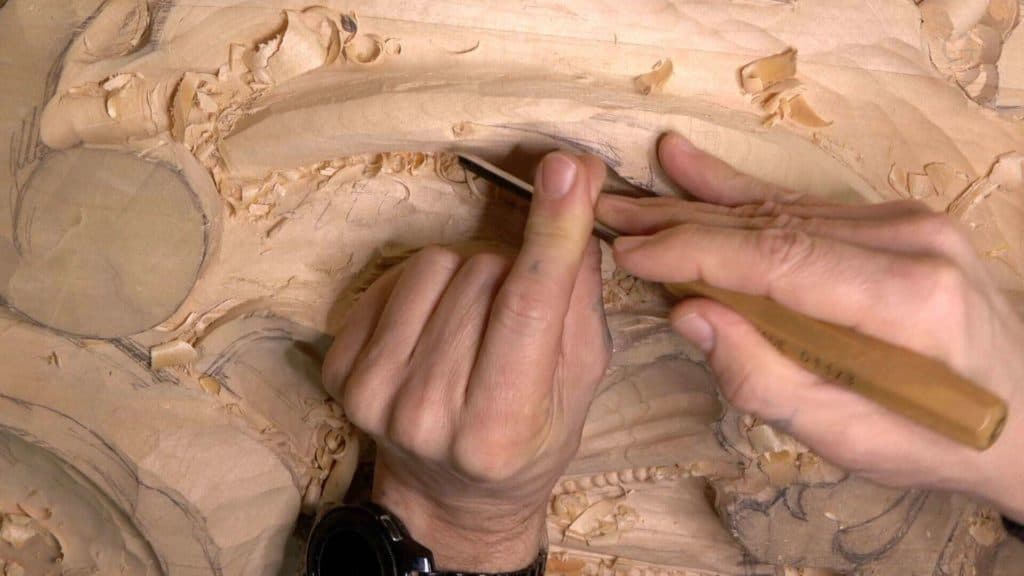
Alexander Grabovetskiy, woodcarver, School of Woodcarving · Published 2020
What does a wood carver mean by "on inside"?
Quick answer: My Venice Room 7-11 video has a mess to clean, a spoon, and a smaller number nine planned for the eye. Other lessons of mine put the same two words, on inside, next to a clean cut, a deeper shadow and an eye, and each lesson is set out below.
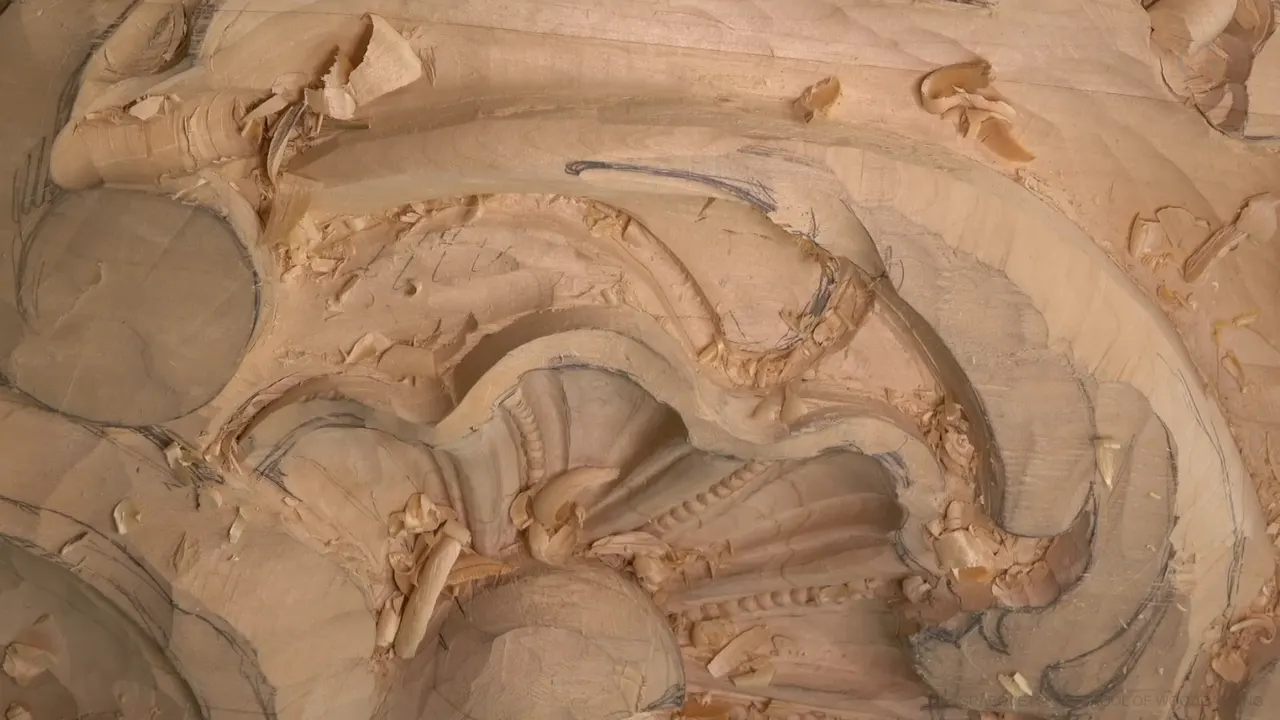

In part 11 of Venice Room workshop 7 I said "Now I need to clean all that mess on inside." I picked a number 11 spoon for it, and the same two words came back later in that part. They also turn up in other lessons of mine, beside other jobs.
Ever looked into a hollow you just dug and wondered how finished the inside has to look? Below is what I said in part 11, what the two videos beside it add, and the lessons where I used those words again.
What this page holds
- My words in part 11, from the mess to the small chips, in the order I said them.
- Parts 10 and 12, where the inside comes up again.
- Lessons from other courses, grouped by what I was doing there, so you can compare.
- A table with one note for each lesson, so you can find my words fast.
What did I say in part 11?
My plan for the tool was "number 11," used "again" as "a spoon." Carefully, I planned to "cut underneath" and I said "I need to find the right position."

Then "Yes, I want to go in, but not as much." The next words were "Not in this case, at least. Not on this leaf." "I don't want to lose the feel I'm after," I said, and then "Let me get a little deeper right here."
The eye came up: "I really want to see this eye." Some viewers did not know the word yet, so I gave it as "just that intersection when one part separates to another one, and one part just flips above another one." Before touching it I said "I need to make sure the position of the eye" and "logically right." Of the movement: "looks like I do have to move it slightly." Then "Well, actually, no, it looks okay."

On size: "Should I do the big eye or small one? Let me do a quarter-inch eye" (about 6 mm). Of big eyes: "I really like, actually, big acanthus eyes" and "it's my opinion, okay?" A "3 millimeters number 11" (about 1/8 in) was my plan, and my cut would go "all the way to the eye." Next: "I could go actually deeper if I wish."
A check followed: "I also have to keep an eye my overall tangency." The line "has to be tangent line" and the curvature was "supposed to be nice and tangent." My verdict on the curve: "looks like it is still not. So let me take care of it. It has to flow really nicely."
Then "let me excavate on inside, although I need to use a smaller number nine, not the 11." "11 would be mistake right there," I added. For the eye: "I'm going to excavate my eye deep and create really beautiful shadow" and "I'm going to make it the illusion of a really deep shadow, like a real separation."

The side next to it: "fix a little bit this side." After that: "just probably number three and blend, and make it little lower." The eye still needed cleaning, though "it does look good." The way: "I'll just create a small 45-degree notch this way" (a 45-degree angle), and "let me clean a little more from this side."

Then "I think I should leave it for now like that, except all the junk has to be gone." Two ways were on my mind: "get them out," or "push them in if I wish" and the junk was "All those small chips." The plan was "Just use a piece of wood, and I'll just try to push everything in." The last words of the part: "That's going to be clean."

What do the two videos beside it add?
Part 10 has "I also want to make sure I have a really clean cut" and the place, "right here" and then "I know you don't see how clean it is," though it would be "visible from the bottom." "it's really important that cut is really nice and smooth on inside," I added. About a spot nobody would see: "Even if it would be invisible and all, but still, I really want to make sure all of my cuts are perfect." Then "at least as clean as possible."

For tools I named "Spoon number 11" and a "smaller spoon," which I put at "approximately seven millimeters" (about 0.28 in). Some digging there was in my plan too.
In part 12 I said I had to "clean a little better on inside right here" with "number 11, same number 11 that I used before, 7 millimeters" (roughly 0.28 in). "I know you don't see what I mean, but later on you will," I added. Then "Maybe even smaller, number 11, 5 millimeters" (near 0.2 in). On the eye: "Still kind of don't like how the eye develops" with a plan to "just create a secondary cut right here and excavate a little more."

When on inside meant a mess to clean
Take Hashemi Flowers 37, part 1. There I said "And just clean on inside" with "number five on one inch" (about 25 mm). A knife came up ("I can use probably just a knife"), and then "I can attack from the backside and remove that wall." A "smaller number five, like a quarter inch" (6.4 mm) was next. Then "Just remove the majority of the mess."

In Venetian Flowers Rosette 2, part 3, my words were "you can see there is some mess" with the mess sitting "on inside." With the straight tool, I said, I would not be able to get it out, and I would "need some kind of spoon gouge," a "small spoon gouge, like number seven or so" to "get that mess out." Size: "Number seven, 10 millimeters" (just under 0.4 in).
Over in Venice Room 67, part 9: "Yes, on inside, you don't see it, there is some mess." Some stuff was still waiting to be "taken out," I said, with "spoon number 11, 5 millimeters" (close to 0.2 in), and a try at "dig in, okay, from two sides." Then "That's what I just removed." And "Beautiful cut."

Hashemi Flowers 22, part 2, has "we're going to need the small spoon to clean little bit on inside." A different option sat beside it: "before the spoon, I could actually remove the waste right here." Then "maybe number three or number four will work" and "Let me try number four at 10 millimeters" (about 3/8 in).
Where I wanted a deeper shadow on inside
Venice Room 63, part 6, has "I need to create a much deeper shadow on inside." Then "Much deeper" and "I also have to make sure it's really accurate." The spot was "really close to a face."

Eyes came up in Venice Room 62, part 8, where I planned "number nine, go in" and "a plug cut." "It's too early right now," I said, and I still had to "clean everything." And "that shadow that I'm after."
Venice Room 76, part 4, praises a tool: "That's why I love those back bends." The back bend "allows me not to damage opposite side because it just rides above it." With it I "can create really deep excavations on inside of those eyes or any other undercutting parts" and "open up even bigger on inside. Even deeper shadow it's going to cast."

Floral and Molding for the Panel, workshop 8, part 1: "excavate right on inside" with "2 millimeters, number eight" (about 0.08 in), then "maybe 1 millimeter" (about 0.04 in), to "excavate even deeper." "I going to have a chance later on to undercut that from the backside. But see how deep shadow it creates?" And "a really, really nice and interesting move, which you don't really see from above."

Look at Hashemi Flowers 44, part 2: "this is going to go downhill" and "my concave cut." Then "Most of my cuts going to be on inside, just like that." A knife was an option "as a preliminary cut" and I would "create a concave even deeper on inside."

Hashemi Flowers 19, part 2, brings a flip. "this is supposed to look like it's flipping," I said. A tool I probably could use: "number eight and a quarter inch in the beginning" (roughly 6 mm), "little by little." "I'm using smaller tool right now because I don't have much support," I said, and "kind of flimsy, although I could actually clamp it right here."
When the inside had to wait
Part 3 of Venice Room 70 is about a plug cut for "quick material removal." "I got to be really careful," I said, with this plug cut. Then "I still have to be mindful how deep I want to do it, because later on, on inside, I have to clean it."
Part 11 of Venice Room 72 has "of course" then "clean on inside," but "I don't worry too much yet about that inside." Beside it: "I achieved what I was trying to achieve, create beautiful convex on this side."
Down in Hashemi Flowers 47, part 3, I said "Definitely" then "clean little later on inside, but let me concentrate on this piece." Next I looked at a natural crack: "I still want to hide that."
Furniture Panel 23, part 2, puts the inside first. "step number one would be probably start undercut a little bit on inside, okay, with the one millimeter number 11" (0.04 in). And "I could wait until later, but it's okay" and "I can probably do it right now."
Where a smaller or bent tool went
In Venice Room 66, part 5, "Now I'm safe, I should say, to excavate on inside." The area was "kind of hard" and I named "long bent number 11." Then "Well, actually, you know what" and "I can use a smaller tool," "because it's against the grain" and "then clean with the bigger tool." Maybe about "10 millimeters, number 11" (nearly 0.4 in).

Workshop 73, part 2 (Venice Room 73): "without losing overall feel." About the convex: "I don't want to lose the overall feel of the convex." Then "a couple of ways I could probably achieve that. I could use micro tools" and a size of "5 millimeters, 3/16 of an inch."

In In Hashemi Flowers 20, part 4, came "visible on inside" and "I have to remove all that waste." The tool was "a small gouge, really small, like 3/32 of an inch" (about 2.4 mm), with "multiple cuts straight down."
Workshop 78, part 8 (Venice Room 78), was a little cleaning: "on inside, all that." And "I could get an extra concave. Maybe about five millimeters or so, like 3/16 of an inch. But I got to be careful how I do it."
Part 6 of Furniture Panel 20 has "this one is number seven" then "whatever fits in the profile" at "about 5/8 of an inch, 16 millimeters." Next: "now I can clean" on the inside, and "work around." And "It's far from done" and I would probably need the magnifier lamp.
Where a clean, finished cut was the aim
In Furniture Panel 21, part 5, I put a big gouge on the job: "20 millimeters, number 7" (about 0.8 in). It "automatically gives me" a clean cut, I said. Then "Not going to force it." My verdict: "it just created nice, finished cut on inside. Beautiful."

Chamomile and Bow Rosette 3, part 2, praises the number 11: "the beautiful thing about number 11s, you can get right underneath, and my tool is positioned on the side, and I create a really clean cut on inside." Then "clean from opposite side."

In Venice Room 74, part 8, I looked at a tool: "that is little too big. I need to use a little smaller tool, clean it on inside, whatever I created, that digging mark, digging tool mark."
Which lesson holds which words?
Every lesson below holds my words, with a note on what sat beside them.
| Where I said it | What sat beside my words there |
|---|---|
| 7-11 (Venice Room) | Spoon for the mess, another tool planned for the eye |
| 7-10 (Venice Room) | Clean cut that shows from below |
| 7-12 (Venice Room) | Same tool as before, maybe a smaller one |
| 37-1 (Hashemi Flowers) | Wall I could remove from behind, then a smaller number five |
| 20-4 (Hashemi Flowers) | Line that must show, and a very small gouge |
| 44-2 (Hashemi Flowers) | Downhill movement, with my concave cuts on inside |
| 47-3 (Hashemi Flowers) | Cleaning planned for later, while I look at a natural crack |
| 19-2 (Hashemi Flowers) | Part that should look like it flips, and weak support |
| 22-2 (Hashemi Flowers) | Small spoon to try, after the waste comes off |
| 62-8 (Venice Room) | Eyes, and a plug cut that is too early for now |
| 63-6 (Venice Room) | Much deeper shadow, close to a face |
| 66-5 (Venice Room) | Hard area against the grain, a smaller tool first |
| 67-9 (Venice Room) | Mess you don't see, and a spoon I would try from two sides |
| 70-3 (Venice Room) | Plug cut where I watch the depth |
| 72-11 (Venice Room) | Convex I wanted, and an inside I don't worry about yet |
| 73-2 (Venice Room) | Overall feel of a convex, and micro tools I could use |
| 74-8 (Venice Room) | Tool that is a little too big, and a digging mark |
| 76-4 (Venice Room) | Really deep excavations I can make in eyes with a back bend |
| 78-8 (Venice Room) | Little cleaning, and an extra concave I could get |
| 20-6 (Furniture Panel) | Tool that fits the profile, then the magnifier lamp |
| 21-5 (Furniture Panel) | Big gouge and a clean, finished cut |
| 23-2 (Furniture Panel) | First undercut planned, with the one millimeter tool |
| 3-2 (Chamomile and Bow Rosette) | Number 11s that get right underneath, tool on its side |
| 2-3 (Venetian Flowers Rosette) | Mess that a straight tool could not get out |
| 8-1 (Floral and Molding for the Panel) | Tiny gouge, maybe a smaller one next, and a deep shadow |
Where can you watch part 11?
Part 11 sits inside workshop 7 of the Venice Room course. Its neighbors sit beside it on the lesson page, and everything on the site sits inside the tuition. Sizes here come in millimeters and inches, my own figure first.
Which hollow of yours still has chips in it? Look inside, pick the smaller spoon knife or gouge that fits, and clean what the wood is hiding, for some wood carving.
How it's done
- Name the mess. Part 11 begins with my plan to clean the mess, with a spoon.
- Pick the tool. I planned a number 11 spoon and a careful way underneath.
- Position check. I said I needed to make sure the position of the eye was logically right.
- Go smaller. My words were a smaller tool than the 11, for the eye.
- Deal with the junk. For the small chips the plan was a piece of wood, to try pushing them in.
Frequently asked questions
Which tool did I name for the mess in part 11?
A number 11 again, a spoon. An 11 would be a mistake for the eye, I said, so a number nine was the plan.
What did I say about a clean cut on the inside in Venice Room 7-10?
That you don't see how clean it is, yet it shows from the bottom. I also said that even if a spot stays invisible, I want my cuts as clean as possible.
Which tools came up beside on inside in Venice Room 7-12?
The same number 11 I used before, then maybe an even smaller number 11. On the eye, the plan was one more cut, a secondary one, and a little more excavating.
What to carve next