
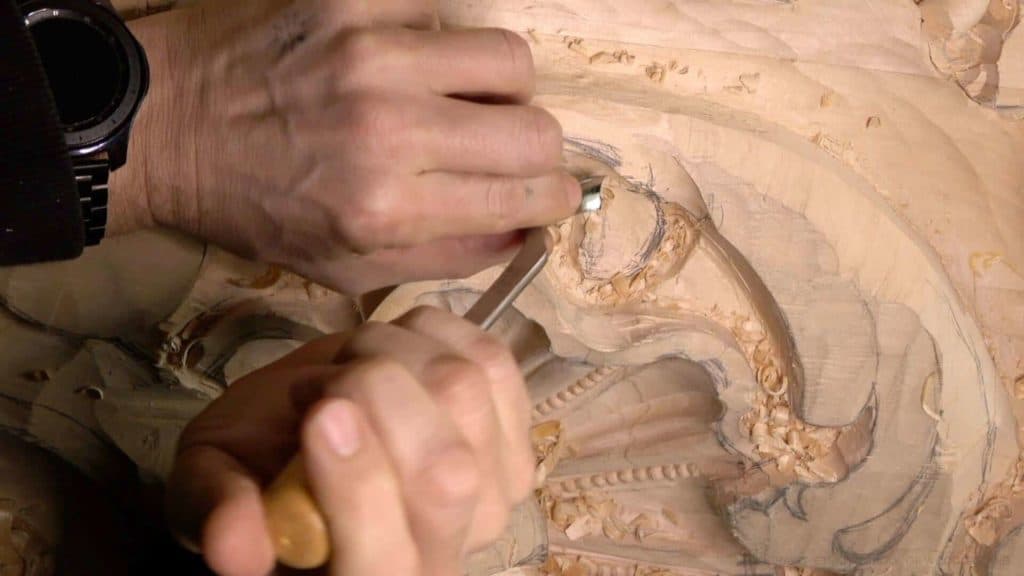
Alexander Grabovetskiy, woodcarver, School of Woodcarving · Published 2020
What does a wood carver mean by "what the grain does"?
Quick answer: Watching the grain is a check I said in Venice Room 7-12, beside my plan for a number seven spoon gouge. Going on, I said, would "make damage." Other lessons of mine set the same check beside a knife, or a change of position. Each one is below.
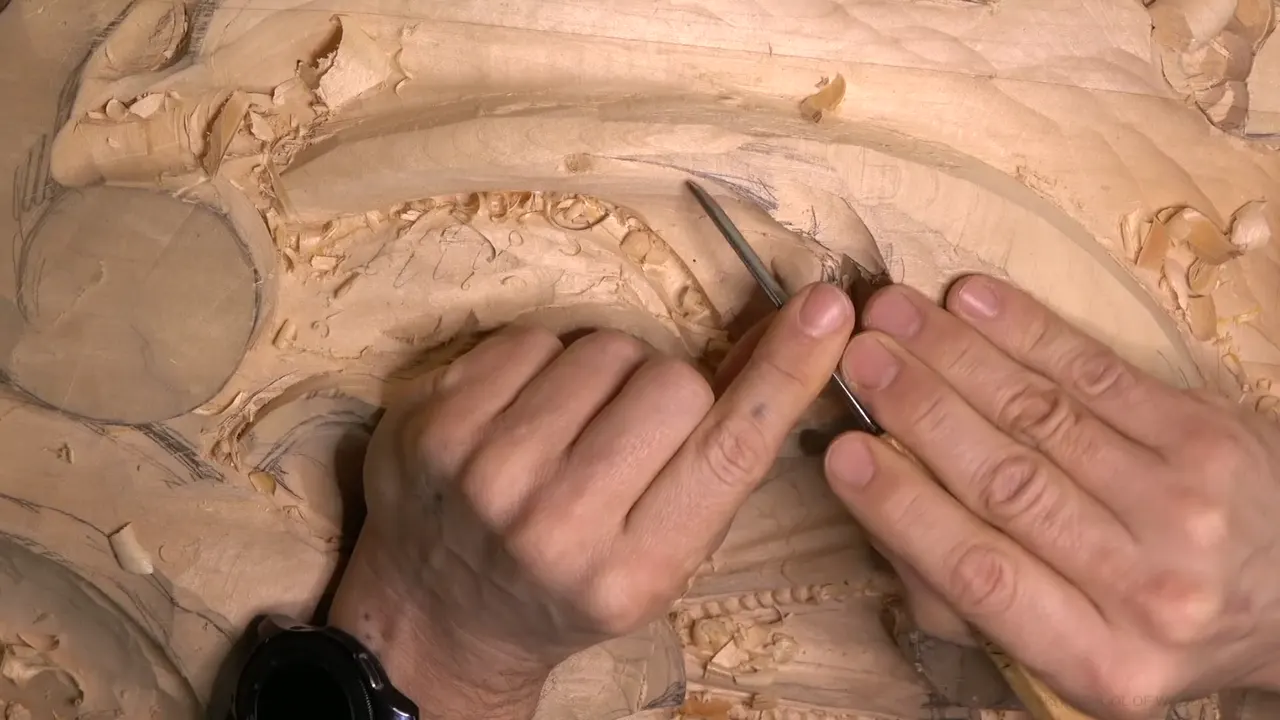

In part 12 of Venice Room workshop 7 I said I also had to watch the grain, right after "And go upward." The first concave got a number seven in my plan, a spoon gouge. The same few words come back in other lessons of mine, beside other tools, other woods and other jobs.
Ever started a pass and watched the wood tear where you did not expect it? Did the grain turn against you halfway down a line? Below is what I said in part 12, what the two parts beside it add, and the lessons where I said the same thing again.
What this page holds
- My words in part 12, in the order I said them.
- The two parts next to it, with a tool plan and a line about a curve.
- Lessons from other courses, grouped by what I was doing.
- A table with a note for each lesson, so you can find my words fast.
What did I say in part 12?
Part 12 opens with "number 11, 1 millimeter" (about 0.04 in). Further on: "So now it's really sharp and nice." Then "let me use again number three and create a little nicer movement right here."

Next came "probably now I can develop some details." On every acanthus, I said, "there's supposed to be separations, and I want to make sure I'm creating them." About the count: "one, two, three main ones. Sometimes it's five, sometimes it's three. It all depends."
Light cuts were next, as in "relieve it first with probably number 11, I would say." And "number 11 and the 7 millimeters, just create little relieving cuts, preliminary ones" (7 mm is about 0.28 in).

Then a size: "I would say number seven. Number seven will work in this case, or number six will work also." Next in line was "let me do number seven and create my first notch" and then "Oops, that's not enough relief I did, but that's okay." And "I've got to relieve it much better" with "let me remove that triangle carefully."
After that: "Let me think how I can further develop it." Then "that would be my center line somewhere right here." And "There's going to be a micro pipe going on" with "another movement, a micro pipe right here." Then came "I have to create a concave cut, and I have to create another concave cut on this side" and "I have to be really careful how I create those concaves."

Where in part 12 did the grain come up?
It came up while I was planning the first concave. It started with "Let me use number seven for the beginning" then "the first concave right here." After "And go upward," came the line itself: "But I also have to keep an eye on what the grain does. Okay."
Then: "See? And if I'm going to continue cut, I'm going to make damage. I don't want to do that." The words after that were "I have to turn on this side and kind of blend that cut in."

Soon after, "that probably going to be a little too big of a tool, but let me try first." Then "It's kind of catching." And "I should probably use a smaller tool. Okay. A quarter inch" (about 6.4 mm).

Later in part 12 I said I was going to take "number 11, same number 11 that I used before, 7 millimeters" (a little over a quarter inch). Then "Maybe even smaller, number 11, 5 millimeters" (about 0.2 in), and the verdict "And it is good." About the eye: "Still kind of don't like how the eye develops." Next I said I probably had to make "a secondary cut right here and excavate a little more."

What do parts 10 and 11 add?
Part 11 has a line much like the one in part 12, with a different thing to watch: "But I also have to keep an eye my overall tangency. Okay? So it has to be tangent line." It also has a tool call: "I need to use a smaller number nine, not the 11. 11 would be mistake right there."

Next to it, part 10 has "Maybe we're going to need the heavier mallet. And attack from two sides." One edge waited: "I did not develop this edge yet, because I crank often against that one when I'm developing this side."
On tools, part 10 says "Number seven would be too big" then number six, and "it feels like even number six is a little too big. But let me try first." It ended with "looks like number six is fine." Along the way I said "I have to constantly switch to different tools."

When did I check the grain before the tool went in?
In several lessons that check comes up as I get ready to carve, and the lines below show it. Roman Acanthus 16, part 3, has "just the knife I showed you at first." Right after, I told the viewer to be careful with the grain direction, and the line I want you to read is "Check before you make a really deep cut."

An edge came up in Hashemi Flowers 1, part 4. I would not go all the way to it, I said, because "the edge is still kind of rough." I planned to leave "about maybe eighth of an inch for now" (about 3 mm). Then "So be careful" and "if you have to change the direction, just do it."

"You can use number nine" is a line from Acanthus over Moldings 7, part 3, with "this one is a fishtail." Before the tool goes in, "I almost barely barely create the cut" and "when I get the feel" for where the grain goes, I can "create little more pressure." Then "I'm not gonna Force."

Between "Just a rough shape" and "And let me give a shape to this one," Lily Box 13, part 1, has the grain line. Close by came "yes, I do like to use a knife when I can because it's just much quicker for me."

A second concave was my plan in Venice Room 118, part 1: "almost underneath." Then "Got to be careful how I do it" and "it's always better just to do it little by little."
"Same number nine what I used previously, 10 millimeters, 3/8 of an inch," came up in Floral and Molding for the Panel 2, part 3. For me it is "really important not to cross those lines, those two lines" and "So I really have to attack that from the opposite direction."
Where did I correct a word about my own grain?
A few times I stopped to correct myself. In Hashemi Flowers 8, part 6, I changed "you have to feel" to "I have to feel" and it is me who feels what my grain does, "because I'm the one who's carving it right now."
The big tool was "about one inch" (about 25 mm) in Hashemi Flowers 9, part 4, and "I'll just remove that chunk of it." Of the grain: "the grain goes this direction, and I have to be keeping an eye on what my grain does." Then "I will need smaller" and "number eight."

"Removing from the center outward" was the plan in Lily Box 2, part 7, then "I could use number eight also." A moment later I fixed a word: "Not my grain, but grain of the wood."
"I mean, the grain of the wood, not my grain" is from Venice Room 141, part 3. After it: "back bent would help much better in this case." And "even with the straight tools, it's still possible to do a good job."
How did I handle a grain that worked against me?
Several lessons give the same fix: come at the wood from another side. In Byzantine Acanthus 2, part 2, I said "If it's working against you, change the position, rotate the piece, and work opposite direction." Also "slow motion," "I'm not doing really the right way" and "try slowly first."

"Don't push it if it fights you change the position attack from other angle and you're gonna be safe" is how I put it in Modern Acanthus 3, part 2. About one side, "It's much better in my case."
A tear showed up in Hashemi Flowers 14, part 5. First came "I'll take a back bend, and that's sweep number eight, and that's six millimeters or a quarter inch." Then "you can see some tear, and I don't want to see that tear. So I'll just attack it from opposite side."
"It's better to attack from different points of view," I said in Grape Onlay 4, part 3, along with "I'll take my time" and "plenty of the material." In Grape Onlay 5, part 3, it was "it's better for me to remove from inside and from outside."
"No force whatsoever" is from Grape Onlay 11, part 3. Also "If it fights you don't force it." Also "approach from two sides," from Grape Onlay 12, part 3, adding "You don't have to dig really deep at the one cut." The sizes: "three millimeters is good" (about 0.12 in), "then half a millimeter if you want to" (about 0.02 in).
"Approach from different positions" is from The Tray of Blessing 7, part 1, with "because you could catch it." The third part adds "You don't wanna damage it."
I could not change position because of the grain, as I said in Venice Room 69, part 12. Then "Here you go. I've got the feel of concave, and it casts some shadow, which is really good." And "But it doesn't feel good right here."

"Some kind of flat chisel, maybe just even number one," I said in workshop 59 of Venice Room, part 10. Then a word on the grain, and "without forcing." Next, "one millimeter, number 11" (about 0.04 in), and "get even deeper."
"It changes because it wraps around and the grain does all kinds of weird stuff" is from Venice Room 91, part 2.
When did a split worry me?
A split worried me in a few lessons. In Furniture Panel 16, part 4, I said "a good idea to do multiple relief straight down cuts with number eight or number nine." Of the split: "if it splits like that, it can go inside of the finished part, which is supposed to be finished part." And "Be really careful."

"Sometimes you can split that grain," I said in Furniture Panel 17, part 2. Also "not just a straight push, but reference one side." Later in part 5: "take about half an inch or 12 millimeters," "just little by little" and "And still keep a 90 degrees wall."
In Furniture Panel 27, part 2, I planned to stay away from the molding, "maybe a millimeter or so" (roughly 1/25 of an inch). Next, "the reason why I stand away." If the grain split, "I can create a big problem."
In the same lily box lesson, part 5, I said "with that type of wood, it's easy to make a split." Then "you'll make a big mistake which is impossible to fix." A size comes up in Plate with Butterflies 2, part 3: "Just outline it." Its other words: "If you feel not too safe about quarter inch. Do less. Make it like 1/8 of an inch is still gonna be good" (about 6.4 mm and 3 mm).
Which lesson holds which words?
Every lesson below holds my words, with a note on what sat beside them.
| Where I said it | What sat beside my words there |
|---|---|
| Venice Room 7-12 | A spoon gouge, number seven, for the first concave |
| Venice 7-10 and 7-11 | Two sides, a smaller nine, and a number six |
| Hashemi 1-4 | A rough edge, and a little wood left for now |
| Hashemi Flowers 14-5 | Some tear, then the opposite side |
| Byzantine Acanthus 2-2 | Slow motion, and a rotated piece |
| Roman Acanthus 16-3 | A knife before a really deep cut |
| Modern Acanthus 3-2 | Change position, attack from another angle |
| Lily Box 2-5 | Fibers that can split in that wood |
| Lily Box 13-1 | A rough shape, then the knife |
| Furniture Panel 16-4 | Cuts straight down, and a split that runs inside |
| Furniture Panel 27-2 | Staying clear of the molding, in case the grain splits |
| Grape Onlay 4-3 | Different points of view, with plenty of material |
| Grape Onlay 12-3 | Two sides, then smaller tools if you want |
| Tray of Blessing 7-1 | Different positions, because you could catch it |
| Plate with Butterflies 2-3 | Do less if you feel not too safe |
| Venice Room 69-12 | A concave that casts shadow, and no change of position |
| Workshop 118 of Venice Room | A second concave planned almost underneath, with care |
Where can you watch part 12 of this workshop?
This video sits inside workshop 7 of the Venice Room course, with its two neighbors on the lesson page. Everything on the site sits inside the tuition. Sizes here come in millimeters and inches, my own figure first.
Which pass of yours tore the wood last? Take your time, and when the wood fights you, attack from another angle, as I said in Modern Acanthus 3. That is my advice for some wood carving.
How it's done
- Plan the first concave. In part 12 the plan for the first concave was a number seven spoon gouge, going upward.
- Watch the grain. Before going on, I said a word on the grain, and that going on could "make damage."
- Blend the cut. Then I said I had to turn and blend the cut.
- Go to a smaller tool. I said the tool was "kind of catching," and that a smaller tool was probably the answer, a quarter inch (6.35 mm).
- Check the result. I then planned a number 11 at 7 millimeters (a bit over 0.27 in), then maybe one at 5 millimeters (nearly 0.2 in), and called it good.
Frequently asked questions
Which words came right after the grain line in part 12?
Not wanting to "make damage," I said I needed to turn. Those words came after my plan for the first concave, a spoon gouge, and the words "And go upward."
Which words did I use about a split in Furniture Panel 16-4?
I said "a good idea to do multiple relief straight down cuts with number eight or number nine." I also said "if it splits like that, it can go inside of the finished part." After it I said "Just be careful, okay?"
Why did I say I instead of you in Hashemi Flowers 8-6?
In the middle of a sentence I changed my wording, and gave my reason: "because I'm the one who's carving it right now." After that I said "I've cut all the way," and later "Let me take a back bent," with "3/8 or 10 millimeters."
What to carve next