
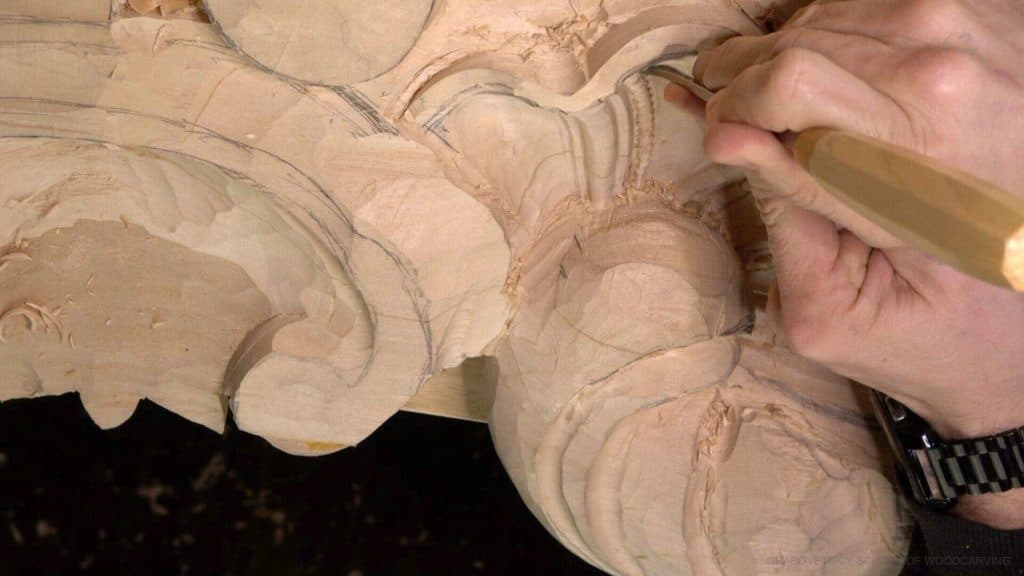
Alexander Grabovetskiy, woodcarver, School of Woodcarving · Published 2020
What does a wood carver mean by "like a diamond"?
Quick answer: In Venice Room workshop 7, part 2, I said my beads were not a perfect round, and I gave them the word diamond, with sides and tool marks that throw some shadow. Close words came up in the Hashemi, Lily Box, Modern Acanthus and rosette lessons, and each lesson is set below.
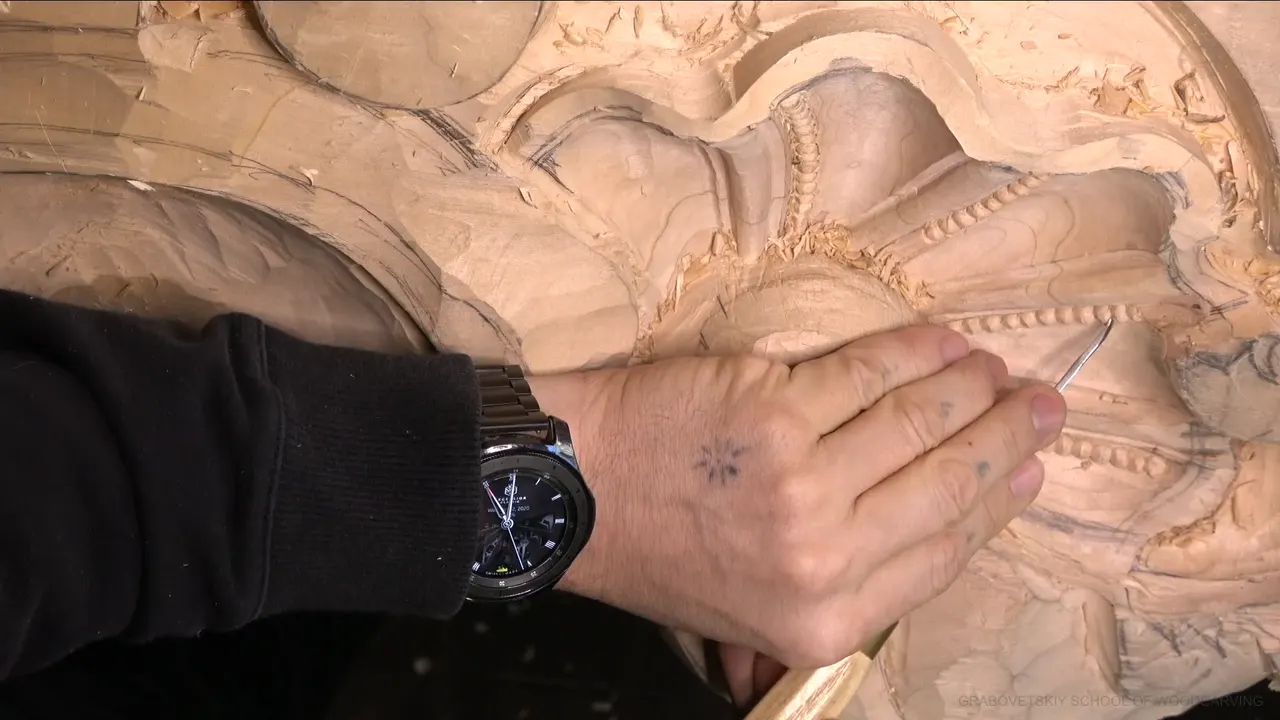

I spoke of the beads on the shell in part 2 of Venice Room workshop 7, and I used a word that comes back in other lessons: diamond. You will find it in the Hashemi, Lily Box and Modern Acanthus courses, a rosette lesson and a live stream. This page puts those places side by side.
Ever looked at a carved bead and wondered if it should be round as a ball? Cleaned a carving until it was smooth, then looked at it in a different light? Below you get my video, the two beside it, and the lessons where I used the same word.
What this page holds
- The video of part 2 in workshop 7, with my words on the beads, the shadow and the brush.
- Parts 1 and 3 of the same workshop, and what I did there.
- Other videos where a carved surface got the same word.
- The other diamond, the one on a paste, a rasp or a stone.
- A table with one note for each lesson, so you can find my words fast.
Which words did I use for the beads in part 2?
Here is how I put it in part 2: "And I think those beads looking really nice. And of course, I can go back." The line about their shape followed: "And the beautiful thing about those beads when I'm doing that way, it's just not perfect round." Next I compared them to a diamond.
I added "It does have some sides and tool marks which casts some shadow." When it casts the shadow, I said "just beautiful" and I used the words "diamond insert." My thought closed with "But still, I love that detail."

A plan came next, out loud: "Okay, let me create maybe little deeper cut on this side because I want to undercut a little bit inward from that point." And a note to myself, "But got to be careful not to overdo it."
One spot did not please me. "This one is not too good," I said, and "I know you don't see which one I'm talking about." It "still doesn't look too good to me, but that's okay."

"Beautiful." Then a wish: "I really want to get with the concave closer to the beads. That should be okay." I named my angle ("So let me attack that from this direction"), and I also said "Okay, wonderful."
Did I blow the waste out or brush it?
"Sorry when you hear my blowing." And then "So I don't want to be rude or mean." My better way: "to use just a brush. Brush out all that waste."
Then I said "But see, those beads are really popping out. So they giving me really good result." My plan was "Let me get from inside first, and then I'll go on outside of those beads." And "Maybe I should attack that from this side." Then came "Almost there."
Which tool came up in part 2?
I needed to create "a little deeper excavation," I said. Then "Get closer. You know what? I could actually use a little bigger. Maybe let me use a number seven and a half an inch." That would be a number seven, half inch wide (about 13 mm). I added "I think it's going to work out really good right here" and "It just gives me really uniform look." Then "Okay. Beautiful."
What else happened in parts 1 and 3?
Part 1 has me saying "But before going too far, I have to clean on inside right here. I just don't like how it looks." I planned a number 11 of one millimeter (about 0.04 in). In another spot I said "Maybe I should use number 11 and three millimeters because it just doesn't look too good." That size is 3 millimeters (about 1/8 in).

Pressure comes up too. "Again, I'm almost not creating any pressure," I said, and "So my tool is really sharp." About pressing inside the wood I said "I still create a lot of pressure." A deep cut can open a gap, yet "you shouldn't be scared because it will close back." That takes "a little time, like a day or so." One side had to be clean because "every little bit of it" would be visible.
Over in part 3 I said "I'm still working on development of the main idea" and "I can always go back and just spend more time and clean." Next came "Let me brush out so I can see what needs to be done." My plan, with a 1-millimeter number 11 (about 0.04 in), was "exactly the same thing what I did before in other areas."

About one more undercut I was unsure: "I could kind of undercut this direction, too, but I'm not sure should I or not." For now, "I'm going to leave it like that." Inside the big concaves I wanted "a concave on the side of the bead" and another concave on the side of "this side." About that I said "It was really common thing."

The tool question stayed open: "I'm not sure should I use number seven or number eight, but let me start with number seven first and half an inch." The size I gave was "14 millimeters approximately" (about 0.55 in), and I added "And maybe number seven is not enough."
Where did Hashemi 19 use the same idea?
In Hashemi Flowers 19, part 5, the beads come back: "Idea is still the same. Like we did those beads, just with the same tool." The line was "Get that around until it looks like it's a true sphere." Earlier in that part my tool was a number seven of 10 millimeters (about 0.4 in), and I said "I'll just round it around" and "It's preliminary."

Then the ridges: "you don't have to make it look absolutely perfect without any ridges, because those small ridges, they do create beauty. They look like small diamonds or precious stones. When the light hits every little small ridge, casts a shadow, and that creates the beautiful thing." Earlier in that part I talked about one detail sitting lower and one higher: "when you look from the sideway, you'll see the big difference."
What was the 3D printer line in Hashemi 24?
Hashemi Flowers 24, part 1, puts the word next to a 3D printer. "So there's no way a machine can undercut," I said, and "3D printer, yes, it can print in different materials, and that's probably future of art, I would say."

It would not be the same, I said, "when you take a piece of wood and you carve it yourself, and you create the shape, the form." For form and shape alone, "3D printer will work for you." Here is the line with the word: "if you want to work on a piece of diamond with all ridges, tool marks, then 3D printer not going to work for you." Then, "So that's the big difference."
What about a brush mark, or a clean surface, in Modern Acanthus 7?
In Modern Acanthus 7, part 1, I talked about the time cleaning takes: "it takes sometimes much longer to clean all of those facets then to carve the whole thing." I told of cleaning "to the Perfection" and said "then it just looks like plastic."

About brush marks I said "for me when I see a brush mark, it looks better." And the diamond part: "makes that piece like a piece of diamond. Okay just has different angles and the light going to hit from different points and it's gonna present different look."
How did a different light change the rosette?
In Venetian Flowers Rosette 3, part 4, I said "you can see how it looks in the shadows when I'm going to cast the shadows." Next came "And let me turn off the main lights" and then "Okay, here you go. I've got different light." And "let me rotate just to show you from different points of view."

I compared what I saw to a diamond: "Different looks from different sides. And I love it." One more line sat after it, a hope about the finish. Once it is clean and no chips are left, "it's going to be looking awesome."
Round or chamfer in the Lily Box course?
In Lily Box 11, part 10, the lily flower lesson, the rounding was not quite rounding. "It's not really true rounding what is going on right now, not true filleting. It's actually multiple chamfering." I wanted that roundness "from all the angles."

"You're still going to be able to detect some ridges, which actually creates beautiful look. I think it creates beautiful look because it's just like a diamond. It has some ridges also, and it catches some light and casts some shadow. Of course, that's on a micro level, but still." I said I would probably hit those ridges a little more, "Even if it's the backside." Saw marks came up too: "I've got saw marks" and just a couple of cuts would take those marks away. The small tool I named was "1/16 of an inch" (about 1.6 mm).
Lily Box 2, part 13, has "I almost don't see this line, and I need to exaggerate that." My tool plan was half a millimeter (about 0.02 in). I would try a little undercut inside, and then came a limit: "I don't want to overdo it again, but I need to see that shadow." After that, "And I am happy."

About the ridges I said "because it just looks like diamonds, just those ridges, those kinks, whatever you call them, okay? I need to make sure I'm rounding them nicely." About the tool I said "Maybe different tool" and then "Well, number five will do." And "sometimes I'm actually taking bigger tools, like maybe number seven. Let me see. Or even number eight." I wondered if eight would be too big, and said "But number seven will be good." I also said "even when I'm doing rounding, I'm still slicing."
Was the same word on a live stream?
In the video of April 5, 2020, on the April 2020 livestream page, a viewer said a rotary tool would not have the same effect as a chisel on the wood, and I said "Absolutely right." Then "It just leaves absolutely different finish. So with the chisels and the gouges, it leaves marking."

"Although I don't like to see too much tool marks, but they are like brush marks on an artist canvas. It just makes it unique and also catches the light." I compared those marks to a diamond, and a shorter line says it again.
When does diamond mean something else in my lessons?
On a tool, for one. In Roman Acanthus 16, part 5, I said a blue paste "is a more finer grit, okay? It is still diamond, but it's more finer." The Sharpening Straight Gouge lesson, part 3, has me saying "The diamond paste takes care of all the scratches and all the marks."

Venice Room 17, part 12, has me picking "the cheap diamond ones, which has some curvatures also" and "I know it's not going to leave any abrasive in the wood." Those were rasps. Part 6 of Venice Room 24 has "I can use diamond rasps on this side right here" and in Venice Room 36, part 8, I said "I could use just the diamond rasps I got." A stone shows up in Venice Room 69, part 6: "I'll take care of it with another diamond stone."

One use has nothing to do with tools. In Design Principles 3, part 3, I talked about a flower and "those seeds." I named a shape that was not a rectangle: "Diamond!" Then "look, inside of that sunflower, the movements go to the one direction and another moment go into another direction."

Which video holds which words?
Every lesson below holds my words, with a note on what sat beside them.
| Lesson and video | What sat beside my words there |
|---|---|
| Workshop 7-2, Venice Room | Beads that are not perfect round, a shadow, and a brush for the waste |
| Workshop 19-5, Hashemi Flowers | Small ridges, a true sphere, and the same tool I used for the beads |
| Workshop 24-1, Hashemi Flowers | A 3D printer, and a piece with all its ridges and tool marks |
| Workshop 7-1, Modern Acanthus | Facets next to a brush mark, with different angles and a different look |
| Workshop 3-4, Venetian Flowers Rosette | The main lights off, the piece rotated, and a different look on each side |
| Workshop 11-10, Lily Box | Multiple chamfering, some ridges, and some light with a little shadow |
| Workshop 2-13, Lily Box | Ridges and kinks, with a number five, seven or eight in mind |
| Livestream of April 2020 | Tool marks, an artist canvas, and light that gets caught |
| Workshop 16-5, Roman Acanthus | A blue paste that is a finer grit, still diamond |
| Workshop 3, Sharpening Straight Gouge | The diamond paste that takes care of the scratches and the marks |
| Workshops 17-12, 24-6 and 36-8, Venice Room | Diamond rasps, cheap ones, with some curvatures |
| Workshop 69-6, Venice Room | A wire edge, and another diamond stone |
| Workshop 3-3, Design Principles | Seeds inside a sunflower, and their shape |
Where can you watch part 2?
Part 2 sits inside workshop 7 of the Venice Room course. The other videos of that workshop sit beside it on the lesson page, and the tools I name sit in the tools course and the sharpening course. Everything on the site sits inside the tuition.
Which carved bead or ridge near you has flat faces and a few tool marks on it? Turn a lamp on it, or turn the lamp off, and look from a few sides before you reach for a gouge again for some wood carving.
How it's done
- Look at the bead. My beads in this part are not a perfect round. They have sides and marks from the tool, and those throw shadow.
- Brush the waste out. Use just a brush, I said, and brush out all that waste.
- Go inward a little. For one side my plan was to go deeper and undercut inward, with a note to stay careful.
- Round the ridges. In Lily Box 2-13 I said I need to make sure I round the ridges nicely, and that number five will do.
- Change the light. In the rosette lesson I said I would turn off the main lights and rotate the piece, to show different looks from different sides.
Frequently asked questions
How are my beads described in workshop 7, part 2?
They have some sides and marks left by the tool, and I said those cast shadow, which I called just beautiful. I said I love that detail, and I used the words diamond insert.
Do I say a carving has to be free of ridges?
Hashemi Flowers 19-5 says a carving does not have to look absolutely perfect, since small ridges create beauty. Modern Acanthus 7-1 says cleaning every facet takes sometimes much longer than carving the whole thing.
Where did I say a surface catches the light?
Ridges catch some light and cast a little shadow in Lily Box 11-10. The April livestream says tool marks make a piece unique and also catch the light.
What to carve next