
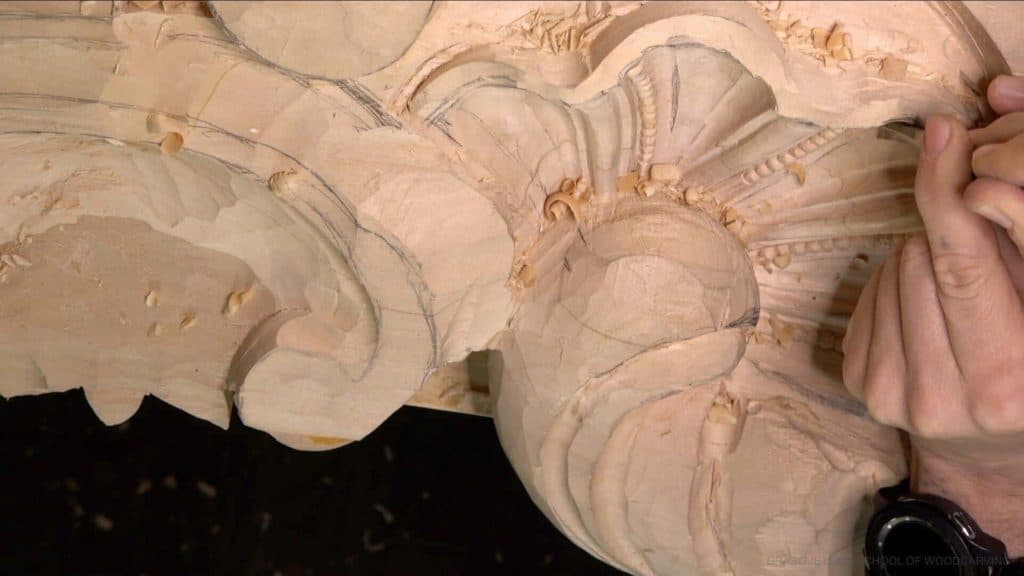
Alexander Grabovetskiy, woodcarver, School of Woodcarving · Published 2020
What does a wood carver mean by "turn to"?
Quick answer: In part 5 of Venice Room workshop 7 I wondered aloud whether an even deeper sweep was needed, a nine or maybe an 11, and then I tried the nine. In other lessons these words came beside a smaller tool, an angle, or the front of a piece.
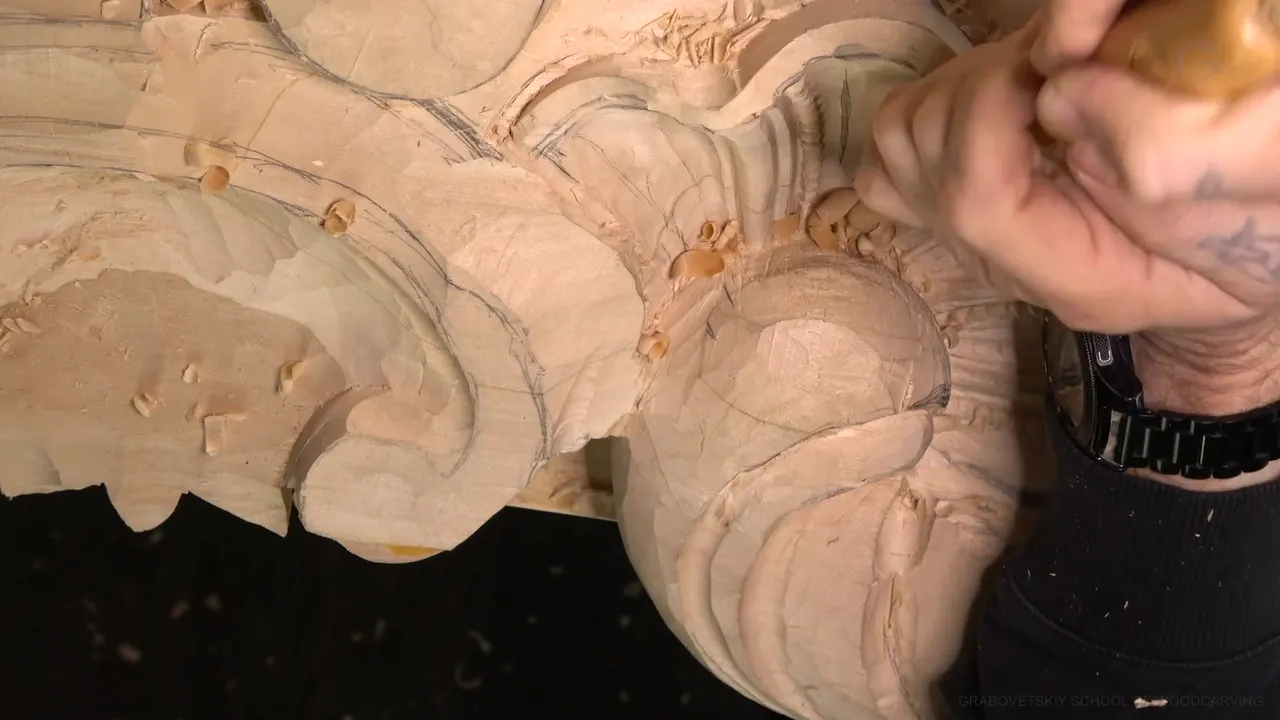

In part 5 of Venice Room workshop 7 I said "Maybe I have to turn to an even deeper sweep, like number nine or maybe even to number 11." I followed it with "We'll see. But as of now, I'm not too happy." Later in that video came "Let me turn to number nine, and we'll see how it's going to look."
Ever held a gouge over a hollow, looked at the wood, and felt the tool in your hand was not the one for the job? Below is what I did and said in that video, then what came after the same two words in my other lessons.
What this page holds
- Workshop 7, part 5, with a number eight, a nine and a number 11 in my hand.
- Smaller tools in Venice Room lessons, workshops 4 and 153 among them.
- The Furniture Panel, Lily Box and Grape Onlay lessons, where the words came back.
- Angles and knives, and the front of a piece.
- A table with one line for each lesson, so you can find my words fast.
What did I say about the sweep in part 5?
I opened with "All right. Let me use a smaller number eight, and let me actually even then do this side." I was using "10 millimeters right now," which I gave as "3/8 of an inch." Then came "Maybe it's about 11 millimeters or so" (about 0.43 in), with a plan for "a spoon gouge right there."

"I'm not sure," I said, then "I kind of still don't really like" and "That is not as distinguishable for me." The line from the top of this page followed, with "We'll see."
Next I said "let me remove at least some of it, and that's going to be much easier for me to use a different sweep." As for the eight, "I thought number eight will be enough, but looks like it's not" and "Definitely, for me, it doesn't look enough." Number nine came next.

Next to the nine I said "make a little deeper excavation" and that I would need to sharpen "this one a little bit." Later: "And yes, number nine gives me much nicer result."
Still, "something needs to be taken care of, and it still leaves a trail mark." Then "I need to probably just sharpen it better." Soon after, "Okay, now it's good."

After that point, "it becomes a little too big" and I planned "a different one, the smaller one, number nine." Of that one, "number nine looks like it works." Then "It gives me what I'm after, at least" and I said I would go with "a smaller one from that point on."

Next came "I think it looks really good, actually. I could attack a little bit closer to this end and get to my beads." Then "But I could do that with a different sweep just to get really close to the beads. But I think it gives me a really, really good result."
Later came "Oh yeah, that gives me a really good shadow. And that's what I'm after." What I would need next was "the smaller again."

Near the end I said "I'm sorry that you can't see sometimes what I'm doing" and "it's just impossible because the shell goes like that." My hands got a line too, "I am covering some of it with my hands when I'm carving." About my hold on the tool, "Usually you have to hold it closer to the blade" and "So the closer you get, the more control you get. But it's okay."

Part 4 of the same workshop says it too. "Every line now, it's almost final line," I said. Further in came "And it looks like it's a little too big," so I had to "turn to smaller one."
Part 6 has "Okay, and I'm going to need the smaller one again." Then "This one is actually already looking not that bad at all." Further in, "Number nine, and let me use a quarter inch from this point on" (a quarter inch is about 6 mm).
Which tool came next in my other Venice Room videos?
In workshop 4, part 7, the plan was to "turn to another tool" and use "a smaller number nine now." My next words were "We've got that triangle situation again at a couple spots."

Workshop 5, part 10, has "I do have a challenge." "I don't want to destroy the chunk of wood for future acanthus, but I still need to somehow attack this area. So I'll just turn to small one in this case," I said. My tool was "Small number three" and then "Maybe big again."

Over in workshop 6, part 7, I said "I definitely need deeper cut" and "I'm going to probably turn to," I went on, "number eight." Then "Okay, let me try number eight" and "that is much better, I think."
Workshop 8, part 4, opens with me saying I would "turn to 1 millimeter" (about 1/25 in). The next line is "Got to be careful." I added "I'll follow with the 1 millimeter" and "Challenge because everything is in my way."

At workshop 12, part 10, I planned to "turn to my number 11" and said "In this case, I can actually use a little bigger, I would say." Then "Maybe even five millimeters" (about 1/5 in), "I will have a chance to clean later" and "It's already giving me that shadow." Before that I said "I still want to see really smooth transition on inside."

The second Venice Room course has it too. In workshop 20, part 1, I said it was "not going to give me a chance to work around all the way because I do have this chunk" and I probably needed to "turn to a smaller tool." I would try "four millimeters" (0.16 in), then "Or actually, let me try first five millimeters" (close to 0.2 in), and "five millimeters should be good."

Part 7 of that workshop has "at a certain point, I should turn to different tools." The plan was "let me get number three, or even, maybe actually I should use number one in this case. Number one or number two." And "I need to outline this movement and hit that deep" with "That way it's going to be much easier for me to clean."
Over in workshop 48 (part 5) I said "And now probably have to" and then "turn to smaller, little smaller number 11s."
Workshop 59, part 9, has "I am really after that shadow." "I don't think I'm able to excavate more of it this way," I said, and that it would put "too much stress on my blade, on the gouge." Then "So I need to turn to number 11 in a spoon gouge" and "Probably should use 10 millimeters" (a little under 0.4 in) "and go uphill cut, just like that." Later, "I'll just show it to you a bigger picture" and "I think it's a good development."

From workshop 119, part 2: "I used number 11 and 5 millimeters" (a bit under 0.2 in), and a switch to "3 millimeters" (0.12 in). I meant to "turn to my 2 millimeters" (roughly 0.08 in), then "to 1 millimeter" (near 0.04 in), with "Carefully" and "excavate underneath" and "get that thing even deeper" and "Again, that's all for the shadow's sake."

Workshop 143, part 1, has "it's already too big" and then my "20 millimeters" (about 0.8 in). Next in that part came "I really want to make it smooth."

At workshop 153, part 3, I said "It's kind of hard with the big tool now" and named "smaller tools or more narrow tools, like number 11." After that came "I'm pretty close" and "about 16th of an inch, well, millimeter and a half" (about 0.06 in).

Which smaller tools came up in the other courses?
Furniture Panel 21, part 8, has "I really don't want to force anything." Then "So it's always better not to. Just turn to another tool, even smaller, like 1 millimeter" (about 1/25 in), and "try to get that material out with a smaller tool." The next one was "half a millimeter now. Number 11" with "Make it really nice and pronounced."

Part 11 of Furniture Panel 20 has "because we lowered that part, so now we are able to get deeper excavation or underneath." I said I could "turn to a smaller number eight, 16th of an inch, like 1.5 millimeters." Next I would "excavate deeper right here." I added "I'm not pushing that thing" and "I'm actually moving the whole body when I'm cutting that way."

Lily Box 11, part 5, has "One of the areas is kind of tougher." I needed "a smaller one, like a half a millimeter" (roughly 0.02 in), and later said "See? I'm all the way through."

Part 2 of Lily Box 12 has a maybe. "Maybe it's not going to work, and then I have to turn to something else." The plan was "let me check if number 11 will work."
Over at Lily Box 5, part 5, "I'm using 3/32 of an inch gouge," I said, and I could use "a flatter gouge, like number three again, and blend that to the cut what I just done" (3/32 in is about 2.4 mm). After it came "It looks good."

Grape Onlay 8, part 3, has my plan for a number 11 of two and a half millimeters (about 0.1 in), and "I'll get this undercut as deep as possible." I said I'd probably go "much smaller, like one millimeter" and that "that's gonna be little later."
Did I use the words for anything besides tools?
Lily Box 12, part 1, has "Sorry for you can't see that. Let me turn to different angle and you probably see that better."
Part 4 of Lily Box 13 has "it's kind of dense a little bit this side." "I'm really close to a blade," I said. "I could actually turn to the bigger gouge, but I also could use just a knife and take care of those facets or tool marks with the knife and then with the gouge." Next came "Turn to the front and take care of this side" and "Maybe I could use the same approach and use the gouge."
In Venice Room 6, part 8, I said that really soon I had to move to "different lights."
Which lesson holds which words?
Every lesson below holds my words, with a note on what sat beside them.
| Where I said it | What sat beside my words there |
|---|---|
| Workshop 4-7, Venice | A smaller number nine, with a triangle spot in view |
| Workshop 5-10, Venice | Small number three, and a chunk of wood I wanted to keep |
| Workshop 6-7, Venice | Number eight to try, then a remark that it was much better |
| Workshop 6-8, Venice | Different lights, which I said I had to reach really soon |
| Workshop 7-4, Venice | One smaller tool, after the first one looked too big |
| Workshop 8-4, Venice | One millimeter, said with a short note to be careful |
| Workshop 12-10, Venice | My number 11, with maybe five millimeters in mind |
| Workshop 20-1, Venice Two | Four millimeters, or actually five, in a smaller tool |
| Workshop 20-7, Venice Two | Different tools, starting with a number three, or a one or two |
| Workshop 48-5, Venice Four | Smaller number 11s, said with a probably in front of them |
| Workshop 59-9, Venice Five | Spoon gouge in number 11, after I said I was after that shadow |
| Workshop 119-2, Venice Ten | Two millimeters, then one, all for the shadow's sake |
| Workshop 143-1, Venice Twelve | Twenty millimeters, once the tool in my hand was too big |
| Workshop 153-3, Venice Thirteen | Narrower tools, like a number 11, once the big one got hard |
| Workshop 20-11, Furniture Panel | A number eight, only smaller, at 1.5 millimeters, with no pushing |
| Workshop 21-8, Furniture Panel | Another tool, even smaller, with nothing forced and my edges kept |
| Workshop 5-5, Lily Box | Flatter gouge, number three, blended to the area I just carved |
| Workshop 11-5, Lily Box | Smaller again, in a tougher area, and then through |
| Workshop 12-1, Lily Box | Different angle, so you could see it better |
| Workshop 12-2, Lily Box | Something else, if a number 11 would not work |
| Workshop 13-4, Lily Box | Bigger gouge or a knife, then the front of the piece |
| Workshop 8-3, Grape Onlay | Much smaller, like one millimeter, but a little later |
Where can you watch part 5?
Part 5 sits inside workshop 7 of the Venice Room course. The other videos of that workshop sit beside it on the lesson page, and everything on the site sits inside the tuition.
Which tool is on your bench right now, and which smaller one sits next to it? Pick up the smaller gouge and make one more pass of wood carving.
How it's done
- Start with what is in hand. Workshop 7-5 opens on a smaller eight at 10 millimeters (3/8 in), and a spoon gouge comes next in my plan.
- Say what you see. It was not as distinguishable for me, I said, and I was not too happy.
- Name the next sweep. A nine came up, or even an 11, and I said we would see.
- Check the edge. The nine left a trail mark, and sharpening it better was my next thought.
- Go smaller from there. I planned a smaller one from that point on, and later said I would need the smaller again.
Frequently asked questions
Which sweep came after the number eight in workshop 7, part 5?
A number nine. I had thought an eight would do, and then said it did not look like enough for me. The nine gave me a much nicer result, though it left a trail mark, and I said the edge needed work.
Which tools followed those words in my other lessons?
Workshop 4-7 names a smaller nine, and workshop 5-10 names a small three. Workshop 59-9 names a spoon gouge in number 11, while Lily Box 5-5 names a flatter gouge, number three.
What did I say about forcing a tool?
In Furniture Panel 21-8 I said I really did not want to force anything, and that it was always better not to. The tool I named next was even smaller, one millimeter (about 0.04 in).
What to carve next