
Alexander Grabovetskiy, woodcarver, School of Woodcarving · Published 2020
What does a wood carver mean by "different technique"?
Quick answer: In Venice Room 7-6 I named a second way in beside the beads, then named a 2 mm number 11 spoon gouge as a side attack I could use. Other lessons of mine put the same two words next to a plug cut, a skew chisel, a knife and carbon paper, and each lesson is set out below.
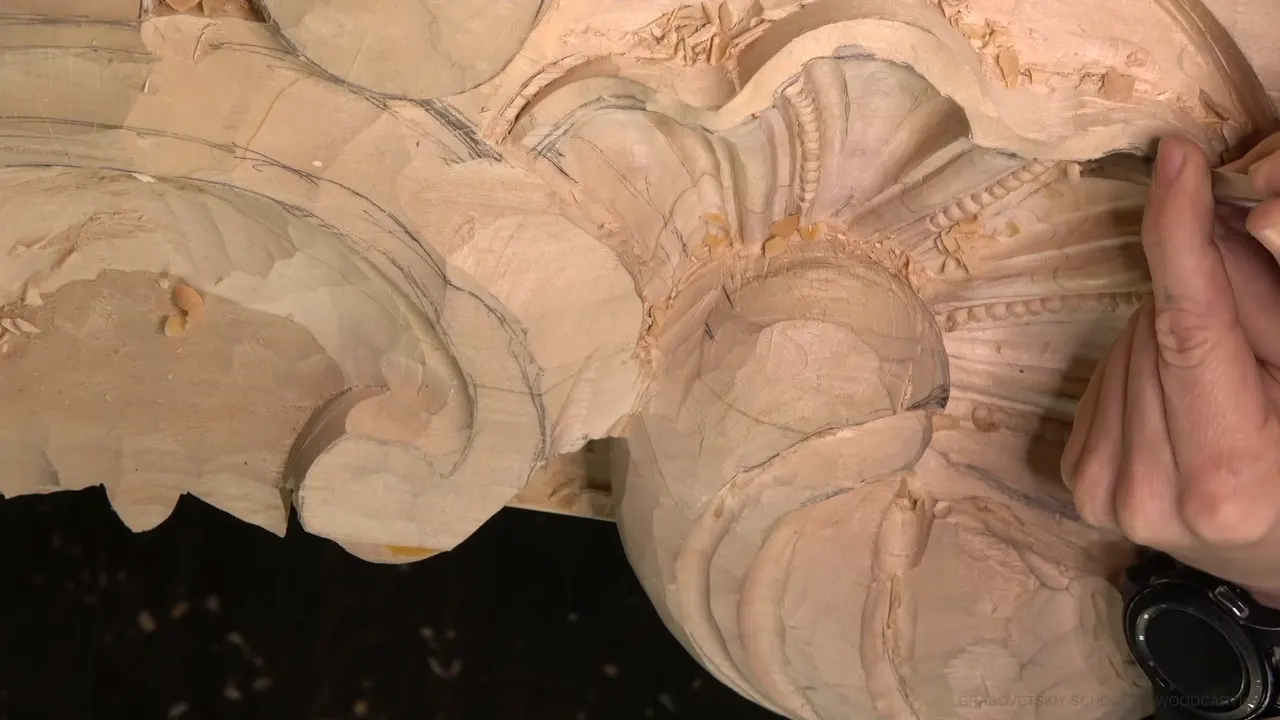

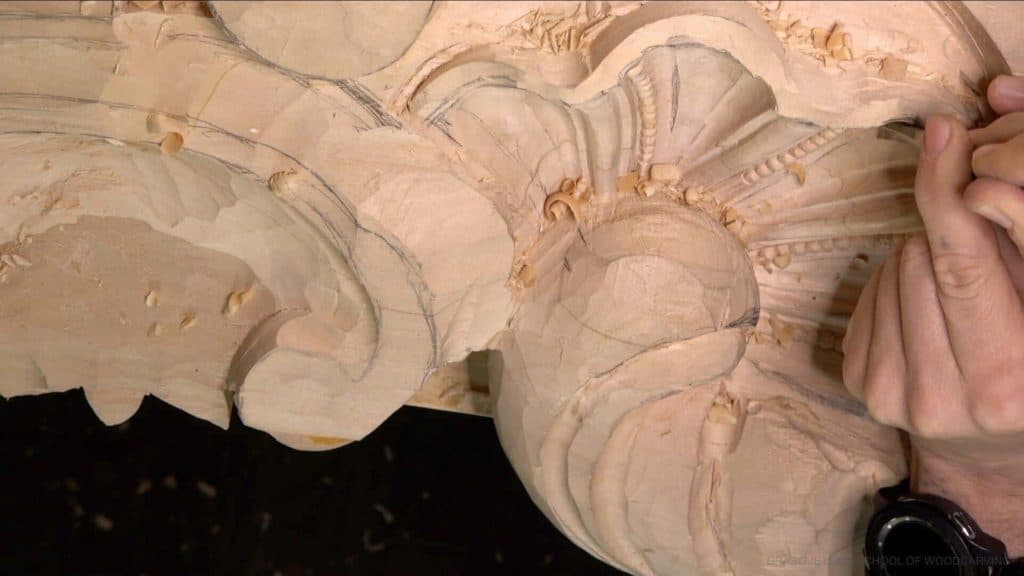
In part 6 of Venice Room workshop 7 I said "I could utilize different technique closer to the beads." I was carving beside a row of beads and had just called what I saw "really good." I named a different technique. First, I said, I would finish the cut in front of me. The same two words turn up in other lessons, beside other jobs.
Ever stood over a carving, sure your tool was working, and still wondered about a second way in? Below is what I said and planned in that video, my words in the two beside it, and the lessons where those words came back.
What this page holds
- My small gouges working next to the beads, in the sixth video of workshop 7.
- The neighbor videos, where I say what I might reach for instead.
- Lessons from other courses, grouped by what the other way was for.
- A table with one note for each lesson, so you can find my words fast.
What did I carve in part 6?
The video opens with "Okay, and I'm going to need the smaller one again." Soon after: "This one is actually already looking not that bad at all" and "I can get even deeper excavation right here."

Next: "Number nine, and let me use a quarter inch from this point on." A quarter inch is about 6 mm. My next thought was "Maybe in a quarter inch even would be a little too big anyway." A move nearer the beads followed: "I'll use just the side of my tool."

On small chips my line was "I don't worry about if it's not flying out, some small parts, small chips, because I can always clean that with a different tool." My aim was "a really consistent long cut." That is why I was "pretty much just sliding my tool and let it catch if there's some high spots." The check at the end of it: "So it looks like it is good now."

A little further on: "I can get really close to the beads on this side also." One spot did not please me. "I'm not too happy how it looks right here, but that's okay. Once we're going to develop this side, I can just attack that one more time, and I can make it perfect." My note on the rest of it was "But as of now, it looks good."
Next, an undercut idea. "Maybe I should undercut a little more underneath of those beads." Then "That is really good." The line this page started with came right after it, and then "Let me finish this one, and I'll probably do something else underneath of those beads."

A plan for the sides: "I will check my sides. And that's good. Yeah, right now, they're a little too sharp for my taste, those movements. We'll see. Maybe I'll just change a little bit and knock them out."

For under the beads I named a gouge and a size I could use. "What I could do, I could probably use number 11 and 2 millimeters spoon gouge and attack from the side a little bit." Two millimeters is about 5/64 in. Then "Just carefully." Near the end of the video, "It looks like I need to sharpen this one, too" and "maybe number seven, and clean the transition between those two cuts."

What do the neighbor videos say?
Part 5 has a close cousin of my line, a "different sweep just to get really close to the beads."
Next in the workshop, part 7 has "Number 3 spoon gouge is what I'm using, okay? And get rid of those small triangles." The plan was to go in carefully and "create kind of undercutting effect." My limit was "I still have to control how deep I go" and "I don't want to pop them out."
A 1 millimeter number 11 (about 1/25 in) came up: "And even let me try 1 millimeter, number 11." I wanted to see if it would go even deeper, and then "Maybe I even shouldn't. I think I should leave it like that." On overdoing it: "I can spend so much time just overdoing it, but I really don't need to."
Then "let me use number 7 and previous one, what I used before, and create my kind of undercut." The result, in my words: "I know it's almost impossible to see and detect on the camera, but what I achieved, I achieved the effect that those beads are, part of them, actually hanging over that concave." A little after: "I didn't have to do that, by the way."
Smaller tools came up: "I probably should use an even smaller tool" and "like maybe number 5 and 3 millimeters" (about 1/8 in). After that, "Now, I'm kind of happy." I added "I am ready to move to the next detail." That detail was a convex, and the plan was to "knock down those sharp edges."
Where do the words sit in part 6?
They stand beside the beads, after "That is really good" and before a side attack. The cues around them name a 2 millimeter spoon gouge and a number seven, each as something I could do. In the lessons below, the words sit beside very different jobs.
When my tool could not go where the carving needed it
Here is what I said in Venice Room 56, part 5: "I need to create somehow relief. I cannot do straight down because this is in my way, so I need to do a different technique." The plan: the "same number nine" to "relieve this area." Later: "one side, other side plug cutting. Okay? Without forcing."

In Venice Room 70, part 10, I was not sure how I would get inside. "I do have the main body already, so that would be kind of tough to undercut." But "it's not impossible." The next words were "different technique I should use." Afterward: "Really nice and deep" and "I went almost an inch deep," which I put at "around 25 millimeters or so."

In Greek Acanthus 8, part 3, a leaf part "kind of has to go underneath of that one." So "I have to be approaching that with a different technique." A tool followed: "probably just number five, which is 10 millimeters, let's say" (about 3/8 in). And "why don't we do some undercutting right now under this piece?"
The wood was the problem in Venice Room 39, part 1, and my words were "The grain is not in my favor. This case, I have to do a little different technique, but I don't want to do too much." Then "Just give a little movement."

Looking ahead, Venice Room 48, part 3, has me speaking of another lesson, on a smaller scale acanthus in the Byzantine style, one "designed for the gold leaf." Of it: "it's utilizing different technique." On that leaf: "the true Byzantine acanthus not done in one piece. They are actually a double layer."
When one job had more than one way to do it
Part 12 of Venice Room 17 has me planning "a big skew chisel" to "ride along this edge." The reason I gave: "there is different techniques to do that, but one of the sides is actually leveraging, cranking against the edge, and my cut much more smoother." And "much better control this way."

The same part carries a warning, over a skew chisel. "But your tool must be sharp. Otherwise, it's not going to help you." And "If it's dull, it's not going to help you at all."
Two tools sit beside one shape in Venice Room 46, part 4. "Straight with number seven, it's possible to do those volutes with no problem, but the effect is going to be different." "Right here, I've got effect like a dome underneath" and "It gives just a deeper shadow." Of the seven: "I could get just to the certain point." A pointer to another course followed: "in other course, Hashemi flowers, I have a high volute" and "that's different technique."

Furniture Panel 36, part 2, has two ways in one breath. I would place it "straight down" and make "multiple plug cuts." I added that I could use "a different technique" and "I could try to just remove like that some of the material." One limit: "there is limitation when I'm using that technique," although "plug cut gives me a lot more control."

Furniture Panel 37, part 1, put the easy way first. "The easiest way would be if you would just take a knife." Then "show you different technique." A number 11 came next: "I'll get two millimeters and let me start" (about 5/64 in). The cut was shallow: "I'm not going more than one millimeter" with "some kind of idea how it's supposed to be slanted."

The Rosette course, workshop 4, part 3, counts its ways. One was "method number two" then "There is another method." My words: "I'll change the angle, and I'll show you a different technique." The tool I named there was one of my own.

Blending the facets on a petal is the job in Hashemi Flowers 49, part 4. "What I'll do, I'll just blend it. And to blend it, there is many different techniques." For one: "I could take just the number three, move it upside down, and make my rotating movements like this." Those were "the micro moves" and "I'm not sanding anything."

Over in Greek Acanthus 10, part 1, undercutting is the subject. "There are multiple approaches you can take. And it's a good idea to try different techniques, whatever's going to be the best for you." Next: "I found this is the quickest and really accurate technique." Of a set of undercutting tools, "right hand, left hand, and a straight," I said "I'm not using it every day."
When the other way was not a gouge at all
The job in Venice Room 92, part 8, was moving a drawing onto the wood. "Transfer it by using just the carbon paper, or you could use different techniques to transfer it, like a graphite paper." Graphite gets praise: "It's actually even better, graphite paper. It's just like a pencil, very much." My own choice for that drawing, though, was this: "But I used carbon paper."

The Dining Table Apron course, workshop 5, has the same job. "I found myself it's the easiest way to transfer any patterns, any design to wood itself. Just a old carbon paper. Although there is a different techniques you could use." The other was a needle, which I said is what they used in the 18th and 19th century, poking holes along the pattern. My verdict: "it takes too long, in my opinion."

A smooth surface is the subject of Furniture Panel 19, part 1. "Most of the furniture makers, they used scrapers," I said, and some in the 17th and 18th century "still used reeds," which I put at about 400-grit sandpaper. I liked it better: "I like that way better than the sandpaper because it doesn't leave any abrasive inside of the wood." Why show it? "Just showing the different techniques, not that I'm going to do that everywhere."

Beginner Workshop 1, part 5, is about the knife: "We place that point away from ourselves, because it's a different technique." Depth: "maybe two millimeters down" (about 0.08 in).

Grape Onlay 2 brings the knife back. You could use just a knife for that, I said. "What I'm doing right now, I'm just showing you different technique." For tool, "just the number five and about half an inch" (about 13 mm). Then a warning about its corner: "you don't dig too deep."

Over in Venice Room 64, part 4, I put it on a whole project: "a lot of different techniques you can practice just on a small pieces of wood."
When I asked you to find your own way
Big pieces I could not rotate are the topic of Hashemi Flowers 47, part 9. "I have to attack from just the one point, from where I'm standing. And that's why I am actually developing. It naturally comes, different techniques, how you attack your piece, what hand you're using."

Lily Box 11, part 7, has a softer note. "If you just don't like my technique, don't judge." And "you got different technique and it works for you, I'm okay with that too."
Which lesson holds which words?
Every lesson below holds my words, with a note on what sat beside them.
| Where I said it | What sat beside my words there |
|---|---|
| 7-6 (Venice Room) | Something else beneath the beads, and a 2 mm spoon gouge I could use for a side attack |
| 17-12 (Venice Room) | Skew chisel along an edge, and a tool that has to be sharp |
| 39-1 (Venice Room) | Grain against me, so a small movement and nothing deep |
| 46-4 (Venice Room) | Volutes with a number seven, and a dome effect underneath |
| 48-3 (Venice Room) | Coming lesson on a Byzantine style leaf in two layers |
| 56-5 (Venice Room) | No straight-down cut, so a number nine, bit by bit |
| 64-4 (Venice Room) | Small pieces of wood to practice on |
| 70-10 (Venice Room) | Undercut that was tough, and a depth of almost an inch |
| 92-8 (Venice Room) | Carbon paper, or graphite paper, to move a drawing |
| 8-3 (Greek Acanthus) | A leaf part that goes underneath, and a number five on my list |
| 10-1 (Greek Acanthus) | Many ways to undercut, and trying them out |
| 47-9 (Hashemi) | A big piece I could not rotate, so one point to attack from |
| 49-4 (Hashemi) | Many ways to blend facets, and a number three turned upside down as an example |
| 4-3 (Rosette) | A method number two, and another from a new angle with a tool of my own |
| 1-5 (Beginner) | Knife held with its point away from me, maybe 2 mm down |
| 19-1 (Furniture Panel) | Scrapers and reeds instead of sandpaper |
| 36-2 (Furniture Panel) | Plug cuts, and the control they give me |
| 37-1 (Furniture Panel) | Easy way with a knife, then a 2 mm number 11 |
| 2-1 (Grape Onlay) | Same job with a knife, and a number five of about half an inch |
| 5 (Dining Apron) | Carbon paper, a needle, and a remark on time |
| 11-7 (Lily Box) | A technique that suits you, and a finger underneath |
Where can you watch part 6?
Part 6 sits inside workshop 7 of the Venice Room course. Its neighbors sit beside it on the lesson page, and everything on the site sits inside the tuition.
Which stretch of your wood is waiting for a second approach? Hold a gouge over it, look at the ridge or the beads beside it, and pick up the tool that fits the job, for some wood carving.
How it's done
- Start with the smaller one. Part 6 opens on the smaller gouge. Next came number nine and a quarter inch (about 6 mm), my plan from that point on.
- Check how it looks. It looks good, I said, and of one spot I said I was not too happy, but that's okay.
- Name the other way. The words were different technique, then a plan: probably something else beneath those beads.
- Try a small spoon gouge. My plan was a 2 millimeter (0.08 in) spoon gouge, a number 11, with a little attack from the side.
- Sharpen the tool. A note near the end: it looks like I need to sharpen this one, too.
Frequently asked questions
Which words did Venice Room 7-6 give about a different technique?
I named it right after saying it was really good. Later cues name a 2 millimeter spoon gouge in a number 11, and maybe a number seven to clean the transition between two cuts. Both stayed things I could do.
Is a different technique just a different gouge?
Venice Room 17-12 had a skew chisel along an edge, and Furniture Panel 37-1 a number 11 instead of a knife. Venice Room 92-8 had graphite paper in place of carbon paper, so the words cover more than gouges.
How did I handle grain that worked against me?
The grain was not in my favor in Venice Room 39-1, so I said I had to do a little different technique, but did not want to do too much. My words after that were to just give a little movement.
What to carve next