
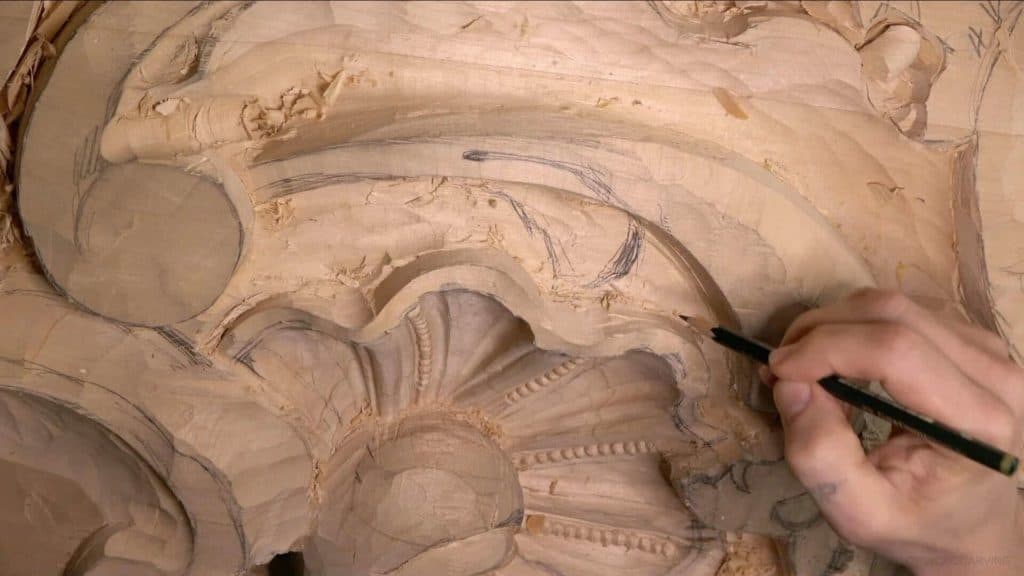
Alexander Grabovetskiy, woodcarver, School of Woodcarving · Published 2020
What does a wood carver mean by "more detailed"?
Quick answer: In Venice Room 7-8 I said the carving on screen was not yet the look I'm after, and that detail was still ahead. Other lessons of mine put the word "detailed" beside divisions, separations, a painted piece and people asking for less, and each lesson is set out below.
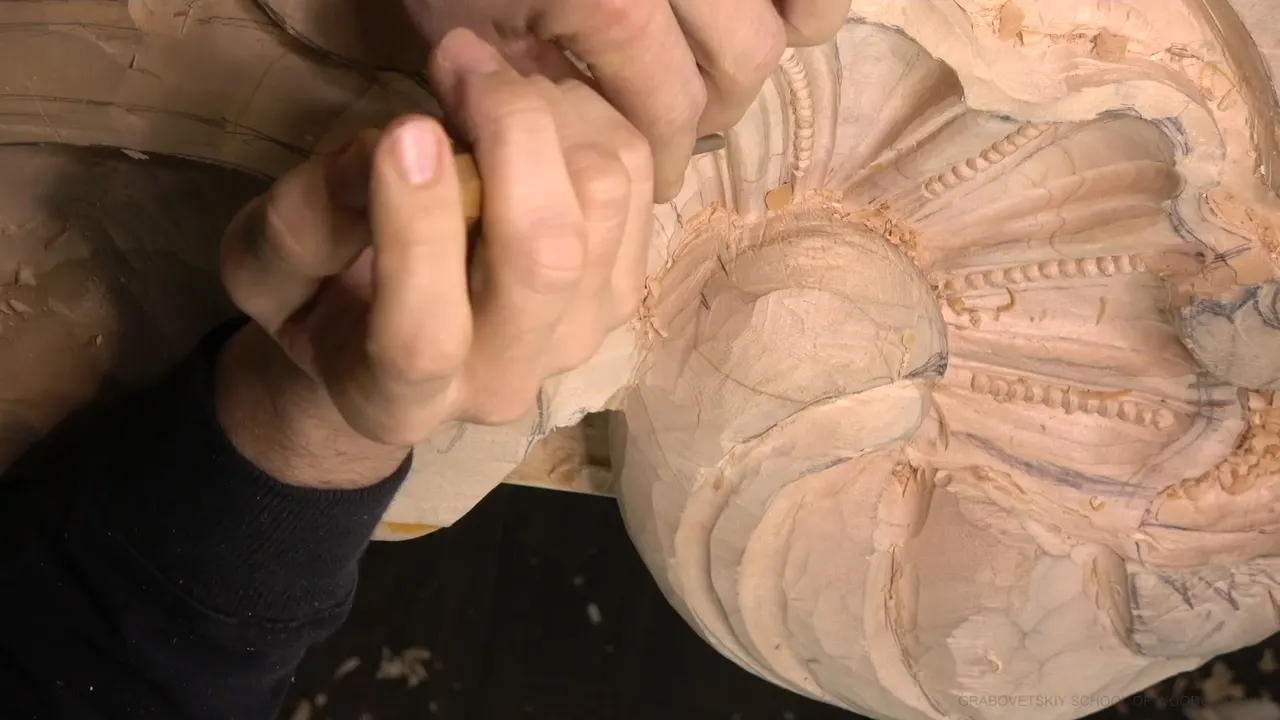

In part 8 of Venice Room workshop 7 I said, "it's not the final look what I'm after. Of course, it's going to look a lot more detailed and so on." The words came just before the turn to an acanthus leaf. Other lessons of mine put the same word beside divisions, a piece that gets painted, and a request for less.
Ever looked at a carving that has its shape but none of its small work yet? Below is what I said in that video, what the two parts beside it hold, and the lessons where I said "detailed" again.
What this page holds
- The cleaning and the rasps in part 8, before the leaf.
- The two neighbor videos, parts 7 and 9.
- Lessons from other courses, grouped by what the extra work was for.
- A table with one note for each lesson, so you can find my words fast.
What happened in part 8 before I said it?
Eight seconds in, I spoke about reach. After I develop those details, I said, I would have more ability to get to those areas. For the moment I would "leave it for now like that."

Next came a verdict. "And there it looks good." The rest of it: "It looks much better than what it was looking before." Of that verdict I said it was at least my opinion, and "You really don't have to agree with me." You would see it, I said, in the overall design.
A hard spot came up. "Really hard to get to that area. That's okay." Then a plan for "a little bit of cleaning" and later one thing bothered me: "That something weird. I don't like something here. Maybe I have to fix it later, but that's okay."

Then rasps. "Let me use my new rasps and see if I'm going to be able to make it look even better." Of the tool in my hand, a little later, I said "I don't really worry about the tool marks as of now." Then "It actually doesn't help too much. Let me use a different one."

"Well, yes. I think it looks good." The rest I can do off camera, I said, "all that stuff, because it's kind of boring." One area did not please me, and I said I would tell you later which one.

Then came the turn to the leaf. I would not do that now, I said, and would work on something else. "Start development of this overall acanthus" was the plan, and then "Let me develop this part."
The line this page started with came next, and with it a reason: "And I did not do that in 3D development because it just takes so much time, and I didn't want to spend too much time." After that I wanted "to think right now how I can develop it."
Plans for the leaf followed. I did not want to see "too much void right here." One of the leaves would go "this way" and an eye was planned for somewhere in the middle. On the look I said "it does have to look organic to the overall design" and next: "Let me see how it's going to look from all the positions."
"Please understand that is just the big chunk," I said near the end. Its final look would come later on. The goal was "to make it look three-dimensional" with the outline first and then "all the way down." My last words were "let me develop this one."

What do the two neighbor parts add?
Before part 8 comes part 7, and it names a "Number 3 spoon gouge" for a job: "get rid of those small triangles." A limit sits in it too. "I still have to control how deep I go, because I don't want to pop those bits." On a ridge I said "call it a detail" and added "I can spend so much time just overdoing it, but I really don't need to."
Then part 9 opens with a smaller scale: "a lot more tinier right here." I might add something else, but "I don't know yet" and of one spot, "later on, I have to make the divisions."
For the slope I named "number seven and one inch" (about 25 mm), and I said "transition gradually." One part of the leaf could be "a little higher than that one" with another "little lower," which would "make it feel like this is flipping a little above." Of my habit I said "It's just the way I usually develop the details." A number nine came up as a plan at "5/8 of an inch" (16 mm), then a spoon, and then "Maybe I should use a long bend."
Grain came up as a warning. "The upper part is against the grain. The lower part with the grain, but the upper part is not." Near the end of the video I said "I can see a glue line."
How did more detail show on a shell?
Divisions and separations come up all through the Venice Room, and my words name them.
Little divisions show in part 5 of Venice Room 45: "I could give little divisions right here, too, which is going to give me a more detailed look." Inside each division I planned number 11 and relief cuts.

Next, part 7 of Venice Room 54: "I can probably now develop more detailed separations and so on." The aim was "not the final details, but more separations" and I planned "to use a marker."

That lesson's part 11 holds "I am doing actually a more detailed work right now" with a wish to "concentrate on creating some more separations." My line on acanthus movement was "acanthus movement, it's all about separations."

A warning sounds in part 3 of Venice Room 34. A part would run "a little bit downhill" and "I need to subdivide the main head also." Skip that, and the head would not look as detailed.

An extra separation waits at the end in part 6 of Venice Room 29, "right there and right here." Then "even more detailed look." A small addition is in Venice Room 32, part 10, with "maybe I could actually add just a small" one, and "If I don't like it, I can always chop it out."

A farther separation is in part 10 of Venice Room 30: "carry that separation right here a little farther" and then "give even more detailed."
A shell part bothered me in Venice Room 71, because "that almost repeats inner part of a shell." I needed to "bring this part to a lot more detailed." Maybe, I said, just "extra movement on inside." Good from "all points of view" was my aim.

A volute sits in part 4 of Venice Room 87, "which you don't see." A detail would run "all the way this way," I said, but first I wanted to be sure my curvature is good.

When did I say the detail was still to come?
Venice Room 34 comes back in part 7: "my canvas is ready for just a more detailed work" and I planned to clean a little of one side.
Roman Acanthus 13, part 2, has a number three of "eighth of an inch" (about 3 mm) for a subdivision. Once I undercut it, it would be more detailed, I said. For now, "it's just preliminary."

Hashemi Flowers 7, part 4, has a warning: "I have to be really careful not to hit the main basket or grid design." I expected it to be more detailed afterward, and "I'll see exactly what is going on." My plan was "number eight and 5/16 of an inch only" (about 8 mm).

Over in Grape Leaves Vase 1, part 8, I called a stage "a preliminary outline, so it's not a detailed carving yet." The details came later in my plan.

Furniture Panel 18, part 7, says "We still have to work at that side." I knew, I said, "it's not as detailed yet."
Then Venice Room 48, part 10: "Not detailed yet, but that is somewhat what I want to see, right?" A plan came next: "Let me get little nicer division right here."

How much detail did I say a piece needed?
A limit comes in Venice Room 102, part 3. One cut was "more indication of a cut than anything else," I said, and then: "I really don't need to do super detailed stuff right here." The pipe blends in, and "that is really what I'm after."

Part 1 of Venice Room 103 sets no limit: "You can just get that as detailed as you wish." The project was to be painted with white paint, "So lots of details probably will be covered with the paint."
That lesson's part 4 calls the piece "paint grade" and "I really don't have to worry about too much and make it super detailed."
Over in Venice Room 163, part 2, a division could start on one piece and then on another. "Not going to be too detailed in this case."

Hashemi Flowers 6, part 4, asks for more. Most of the background leaves would be "not too much visible," I said, "but still, the more detailed you make them, the more beautiful the overall design."

A better view comes up in Venice Room 18, part 3. I planned to "move light a little bit to another side where I can see much better," because the work was "more detailed" than anything else.
More detail is the subject of part 6 of Venice Room 36. It was fully buffed, I said, and I needed to bring in more detail, while a border would stay, "approximately 5 millimeters, about 3/16 of an inch."
Care is the word in part 2 of Venice Room 126: "Let's work on this area a little more detailed and more careful, okay?" I planned "10 millimeters, number 11" (about 0.4 in).
Which old carvers gave less detail?
The Dining Table Apron lesson sorts old carvers into kinds. The number one type in England carved "for boats, for big ships" and "They didn't pay attention too much to the detail."
Carvers who worked on vehicles of those times "would carve nicer, detailed, but still not as detailed as the other ones." The road was the cause, I said, with its dirt and some abuse.
Of house carvers I said "So those guys are really detailed carvers." Furniture carvers were "really detailed-oriented guys" and "that is really important when you're doing furniture. It's really close to your eyes."
In the April 2020 livestream I told what hurts when people hear the true price. They say "Can you get less detailed?" I called it "the worst what the artist can hear." My answer was that I won't make it less detailed "just because they don't want to pay."
Which lesson holds which words?
Every lesson below holds my word "detailed" with a note on what sat beside it.
| Where the words sit | What sat beside my words there |
|---|---|
| 7-8 (Venice Room) | The acanthus chunk, and the look it would reach later |
| 45-5 (Venice Room) | Little divisions, and number 11 relief cuts inside them |
| 54-7 (Venice Room) | Separations, and my plan for a marker |
| 54-11 (Venice Room) | More separations on an acanthus movement |
| 34-3 (Venice Room) | Subdivision of the main head, or it looks plainer |
| 32-10 (Venice Room) | One small extra division I could chop out again |
| 29-6 (Venice Room) | An extra separation at the end of a movement |
| 71-5 (Venice Room) | Shell part that repeated its own concave |
| 87-4 (Venice Room) | Volute, and a curvature check before the detail |
| 34-7 (Venice Room) | Canvas ready for the detail work |
| 13-2 (Roman Acanthus) | A number three subdivision, with the undercut still to come |
| 7-4 (Hashemi) | A careful pass that spares the basket design |
| 1-8 (Grape Leaves Vase) | A preliminary outline, with the details still ahead |
| 18-7 (Furniture Panel) | A section that is close, with one side left |
| 48-10 (Venice Room) | One movement I liked, and a nicer division to add |
| 102-3 (Venice Room) | Cut that only hints at the movement |
| 103-1 (Venice Room) | Piece that will be painted white |
| 163-2 (Venice Room) | Divisions started on two pieces, not too many |
| 6-4 (Hashemi) | Background leaves, and how they shape the whole design |
| Livestream April 2020 | A request for less detail, and my answer |
| Dining Table Apron 17 | Four kinds of old carvers, and how much detail each gave |
Where can you watch part 8?
You can find part 8 inside workshop 7 of the Venice Room course. Its neighbors sit beside it on the lesson page, and everything on the site sits inside the tuition.
Which piece on your own bench has its shape but not its small work yet? Hold a gouge over it, ask what the next pass is for, and leave the rest for later, for some wood carving.
How it's done
- Leave it for now. After I develop those details I would have more ability to reach those areas, I said, so I would leave it like that for the moment.
- Look at the result. I said there it looks good, and much better than before, at least in my opinion.
- Change the tool. I said the tool in my hand actually doesn't help too much, and I wanted a different one.
- Name the stage. What you see is not the end result I'm after, I said, and detail comes later.
- Think about the leaf. I wanted to think about how to develop the leaf, with less void in that spot.
Frequently asked questions
What came right before that line in Venice Room 7-8?
Just ahead of it came my words on developing that part of the leaf. Then I told you the stage on screen was not the end result I wanted, and that more detail would come. My reason for skipping it in 3D development followed, and so did my plan for the leaf.
Why was that detail not worked out in 3D development?
Time was the reason I gave in part 8: the work takes a lot of it, and I did not want to spend much there. The line came right after my words on the look of the piece, and a plan for the leaf followed.
Does every part of a carving need super detailed work?
Not in Venice Room 102, part 3, where one cut was only an indication of movement. The project in Venice Room 103, part 1, was to be painted white, so lots of details probably would be covered with paint. In Venice Room 163, part 2, I also said that piece would not be too detailed in that case.
What to carve next