
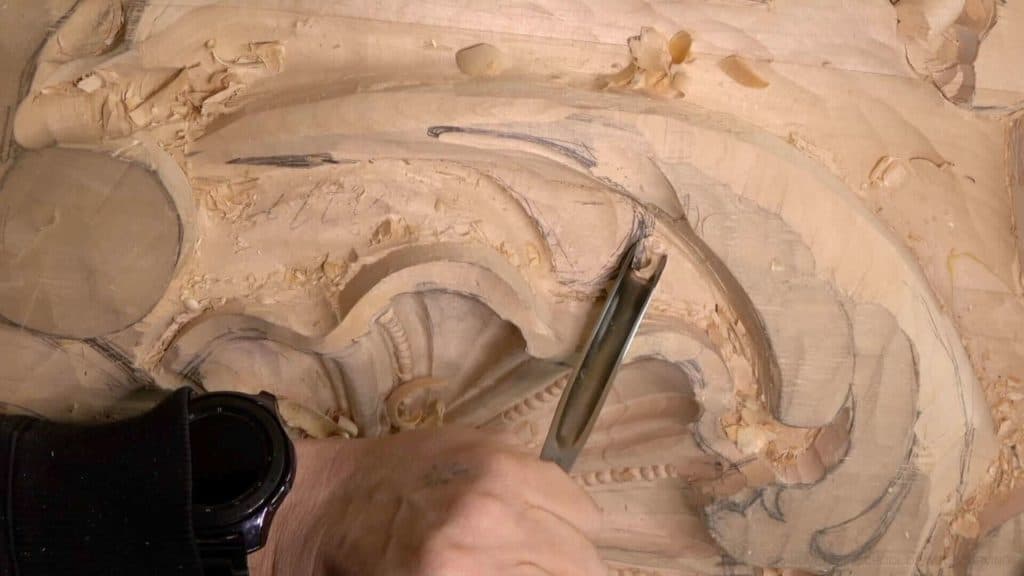
Alexander Grabovetskiy, woodcarver, School of Woodcarving · Published 2020
What does a wood carver mean by "minor changes"?
Quick answer: Part 9 of Venice Room 7 has me saying I plan to make some minor changes as I go, and I wouldn't call that a design change. Workshop 75 has me saying the overall movement stays and just minor details change. At a livestream I said I can do minor changes while I carve, but not a huge change.
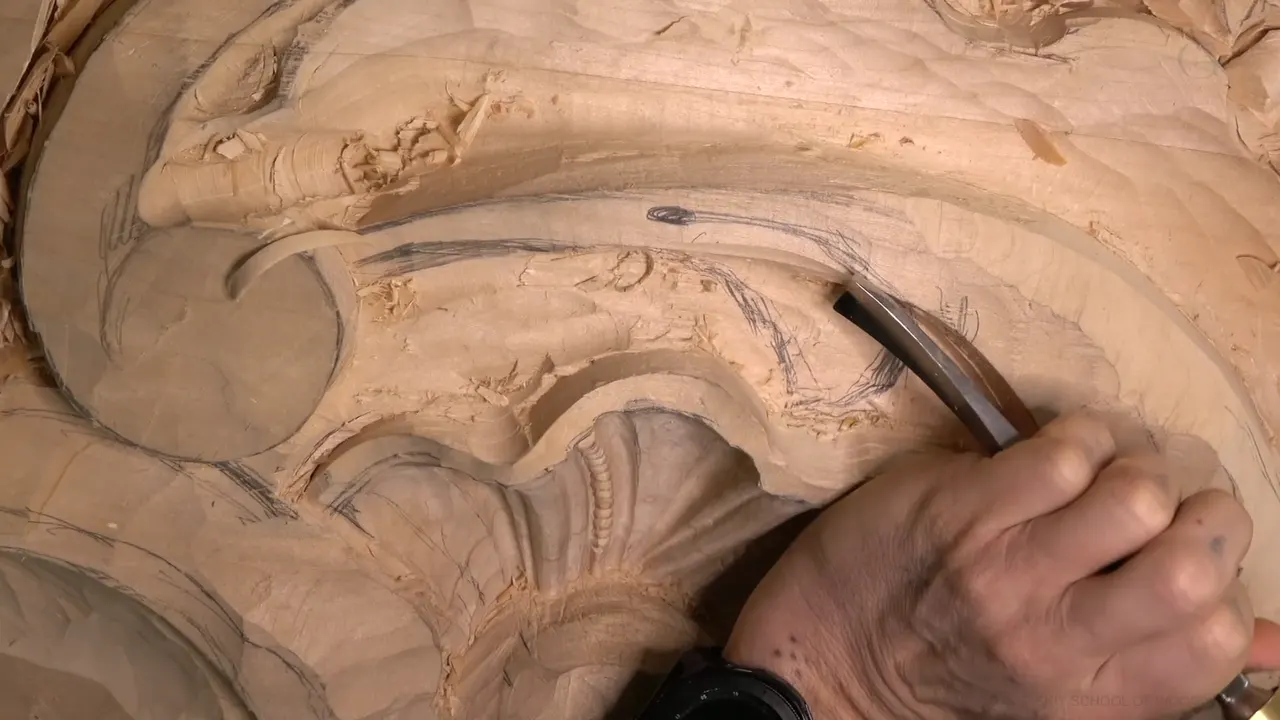

In part 9 of Venice Room workshop 7 I said "I plan to make some minor changes right on the fly." Moments before it I had said "I wouldn't call it a design change, I would say, because it's not." That word, minor, comes back in other lessons, beside other jobs.
Ever changed one small thing halfway through a job and wondered if you had broken your own plan? Below you get what I said in that video, what I said in the two videos next to it, and the lessons where I used the same word again.
What did I carve in part 9?
The video opens with "It's going to be, of course, a lot more tinier right here." Next I said "Well, definitely I could add something right here" and "And this one, later on, I have to make the divisions." About the background I was unsure: "I also can create some kind of small movement, but I don't know yet if I'm going to do that or not."
Number seven, one inch (25 mm), was my plan. A little later: "It's got to transition gradually."

Right after the line about minor changes: "It's just the way I usually develop the details."
Another detail came into view: "Okay. It's going to be another detail coming out right there."

Two parts followed. "I could make this part a little higher than that one, and let me use number nine, and make this part little lower." Then "Maybe just go right underneath" and "So that is going to make it feel like this is flipping a little above."
Roundness came after it: "And I want to also make sure this is rounding this direction. Okay. Number seven again. Going to give that roundness."

Next: "Now I need to separate this line, make it all really nice, and excavate little deeper this area, and we can further develop this part of the leaf."
For number nine I said "probably 5/8 of an inch" and beside it I gave 16 millimeters. Then "Oh, and maybe even a spoon." Soon after: "So it's time to switch to spoons." I gave the spoon as 15 millimeters, about 5/8 of an inch. "I could use long bend also, by the way."

"You know what? Let me use number 11, okay?" Then "little smaller, maybe about 10 millimeters" (about 0.4 in). Next, "Maybe not the spoon. Maybe I should use a long bend."
The grain got a line of its own: "The upper part is against the grain." The lower part runs with the grain, "but the upper part is not." I would not touch that side, and I want to make sure "I'm gradually moving downhill."

Near the end: "And I am again all the way to another layer. I can see a glue line."

What do the two videos next to part 9 say?
Part 8 holds a note on the look. "So now, what you see, it's not the final look what I'm after." Also: "I don't want to see too much void right here." On the 3D development I said "it just takes so much time, and I didn't want to spend too much time." I want to think "right now how I can develop it, okay?" The plan was to start with "this overall acanthus."
The closest line to part 9 sits in part 10. One leaf could go "little bit underneath of that one," I said, and "I think maybe I should." Then "Let me do that. But not much, just slightly, okay?" My words after it: "Because I don't want to create different from what I originally thought."
Later in part 10 a spoon was up for a choice. "Maybe number seven." Then "Well, actually, no." And "Number seven would be too big." For number six: "And it feels like even number six is a little too big. But let me try first." The last word was "It looks like number six is fine."

Where else did I say a change was minor?
Part 1 of Furniture Panel 21 starts with "I like what I see." Then "It did change little bit from original, but it's okay with me, because on the go, I usually change some stuff." I try to figure out, I said, what will look better and how it will be connected better. "That's why sometimes I'm just making minor adjustments."
Over in Venice Room 75, part 10, comes "I could actually do a little bigger eye. It would help also." Then "But like I said, I just looked at it, and it didn't make too much sense." And "So that's why I changed the design. It doesn't change overall movement. It just changes minor details."
Once in a while it is needed, I said, because "on a paper, sometimes it looks one thing, but in real life, it just doesn't look too good." Then "It looks okay, I would say, but it's not excellent." And "I really want to aim for excellency." A few lines later: "I'm not losing that overall convex. As you see, it's still there."

A viewer at my April 2020 livestream asked how often I change my original plan when I am carving. My answer began "I cannot change from original plan in most cases." Then "I can do minor changes if it makes more sense while I'm carving, but not a huge change." Last: "So I'm not change a lot."

How far can a change go?
Furniture Panel 16 holds a limit, in part 10. "It's okay when you're doing one panel like that, you can change the design," I said, "but it is not okay if you have to do multiple panels, like two panels which supposed to be symmetrical to each other."
For a pair of them: "So you can't really change too much." Then "Yeah, you could change to the certain degree."

Which details did I call minor?
Why do I not clean my pipes and my eyes on the design right away? Roman Acanthus 13, part 1, has my answer: "once I'm going to establish the minor, the smallest details, I still have to be cleaning that, and I don't have to do double work."

In Lily Box 11, part 1, I said "And now I actually want to blend a little bit to the sides, this cut, okay?" Then "I know it's a minor detail" and "those minor details, they make a big difference how your piece is going to look." Next came "Okay, I'll take three millimeters, number eight" (about 1/8 in). "It has to be almost invisible," I said, and "We want to pay attention to the convex, not the concave on the side."

Part 3 of Lily Box 9: "and then I have to deal with those minor ones."
A small flower in Lily Box 12, part 1, got these words: "I know it's not a big flower," I said of it. Then, about the same flower: "It's a really minor one, but I think everything counts. Every little flower counts."

Further on in that video: "Yeah, that is a small and minor flower, and I know sometimes you're paying attention to bigger details, but you're not careful with those small details, and that's a mistake, okay?" It's a fairly small box, I said, and "You can't make too rough cuts, okay? I should say." Then "In a big scale, you could do that, but not on that."

Where did I put minor next to major?
Part 1 of Furniture Panel 3 says "there is such a thing as a major and the minor." The major composition sits on "my outside border, so on a full dimension." For the inside: "on inside perimeter of the inner part, I have to find the minor." It is still the golden point, I said, and the two are located a little differently.

Part 2 of that lesson has "the minor square." Near its end: "So that is my major, major, minor, minor." Part 3 has "So for that minor focal point inside of those applied moldings."
A point I called "my minor focal point" sits in Furniture Panel 5, part 3. And Fibonacci turns up in Furniture Panel 1, third video: "there's a major Fibonacci number, there's a minor Fibonacci number."

Part 4 of Lily Box 12 talks about a major scroll: "you have to find a minor scroll." It runs in the opposite direction, I said.

Part 2 of that lesson has "Minor, major. So always like that." Right after it: "Okay, so this one complements that one. Now I need to create a complementary movement right there."
Which other lessons say little change?
Other lessons use other words for a small change. Venice Room 5, part 3: "And if I need to make little changes, I'll make them. Because I want to make sure the shell looks really nice."
Greek Acanthus 5, part 1, puts it as being slightly off my original design. That is not a big deal, I said. Then "I'll change the design." And "Overall, I didn't lose too much of the details."
Lily Box 6, part 1, has "Just a little change. Now, since I do have that material," followed by "I can actually extend it all the way like this."
Check Furniture Panel 9, part 3: "I know it's a little change of the design" and I think it will make more sense.
In Hashemi Flowers 14, part 5, I planned a little change to a ribbon and said "I'm not going to have extra flip."
Venice Room 127 has a plan in its third video. "So let me do something else to make it look a little lighter." The little change: a part goes underneath a line.
Furniture Panel 23, part 10: "I little bit don't like what I see." Then "Just make a little change" and I planned to lean it toward the right.
In Butterflies 10, part 2, the words "You know what" lead into a plan for "a little change from what I had before."
Grape Onlay 4, part 2: "I already got kind of deep under cut." Next, "That is just a slight change."
In Venice Room 97, part 1: "I do change on the fly, which I think it's okay." Then "And I'm glad that didn't excavate too deep."
Hazelnuts 7, part 3: "I don't worry about if I'm damaging slightly the edge of the leaf, as long as I have plenty of the material." Then "How it flows, as long as it's not too much, obviously."
In Venice Room 92, part 10: "I don't have too much space also." Further on: "Make a little change right here."
Which lessons hold my minor changes?
Every lesson below holds my words, with a note on what sat beside them.
| Lesson and part | What sat beside my minor changes there |
|---|---|
| 7-9, Venice Room | My plan for minor changes, and a first tool |
| 7-10, Venice Room | A leaf slightly underneath, so nothing differs from my first thought |
| 75-10, Venice Room | A bigger eye I could do, and details changed |
| 5-3, Venice Room | If little changes are needed, I make them for the shell |
| 127-3, Venice Room | Taking one part underneath a line, so it looks lighter |
| 92-10, Venice Room | Little space left, and one change right here |
| 97-1, Venice Room | Another eye planned, and glad I did not excavate too deep |
| 21-1, Furniture Panel | Minor adjustments, then my attack on one side |
| 16-10, Furniture Panel | One panel or two matching panels, and how far to go |
| 9-3, Furniture Panel | A small move of the design, and a better fit |
| 23-10, Furniture Panel | Not quite what I wanted, and a lean toward the right |
| 3-1, Furniture Panel | Major on the outside border, minor on the inside perimeter |
| 3-2, Furniture Panel | The minor square, then major, major, minor, minor |
| 13-1, Roman Acanthus | The minor, the smallest details, and double work |
| 11-1, Lily Box | Minor details, and a number eight of 3 mm (about 1/8 in) |
| 9-3, Lily Box | Separations, and minor ones left to deal with |
| 12-1, Lily Box | A really minor flower where every little flower counts |
| 12-2, Lily Box | Minor, major, and a complementary movement |
| 12-4, Lily Box | Major scroll, minor scroll, opposite direction |
| 6-1, Lily Box | Extra material at hand, so the part can extend |
| 5-1, Greek Acanthus | Another leaf going slightly underneath, details kept |
| 14-5, Hashemi | A ribbon with no extra flip |
| 7-3, Hazelnuts | Plenty of material, and a flow I can change |
| 10-2, Butterflies | A plan for one little change |
| 4-2, Grape Onlay | A deep undercut I called a slight change |
Where can you watch part 9?
Part 9 sits inside workshop 7 of the Venice Room course. The other videos of that workshop sit beside it on the lesson page, and everything on the site sits inside the tuition.
Which small change are you holding back on your own piece? Pick up a gouge and get on with some wood carving.
How it's done
- Name the change. In part 9 I called the plan minor changes, not a design change.
- Pick the tool for the spot. My plan said number seven for the slope, and number nine to make a part little lower.
- Mind the grain. The upper part runs against it, the lower part with it.
- Keep what holds the design together. Workshop 75: the overall movement stays, only minor details change.
- Check how far you can go. Panel 16: when two panels must match, change only to a certain degree.
Frequently asked questions
What was my plan in part 9?
Small ones, I said.
Which tools did I name in part 9?
Number nine at probably 5/8 in (16 mm), a spoon of 15 millimeters, number 11 at about 10 millimeters (about 0.4 in), a long bend, and number seven at one inch (25 mm).
How did the grain run in part 9?
The upper part ran against it and the lower part with it, I said. One side would stay untouched.
Can you change a design when two panels must match?
What to carve next