
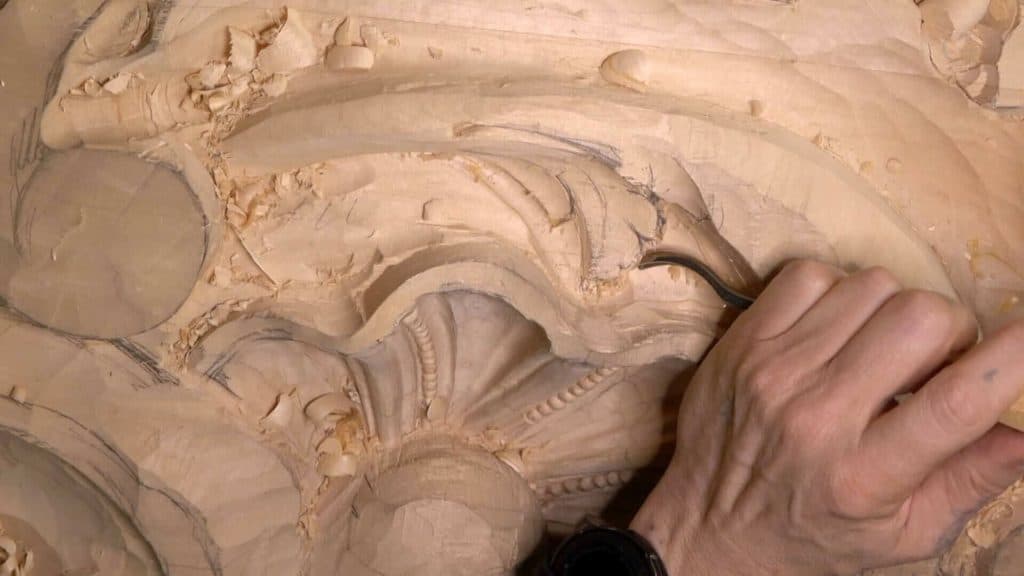
Alexander Grabovetskiy, woodcarver, School of Woodcarving · Published 2020
What does a wood carver mean by "avoid"?
Quick answer: In Venice Room 8-1, while talking through the cleaning of one part with number 11 in mind, I said to avoid sharp lines, with gold leaf and paint in mind. Other lessons of mine put the word beside a pencil, a square between grapes, a straight line, slippage and mistakes, and each lesson is set out below.
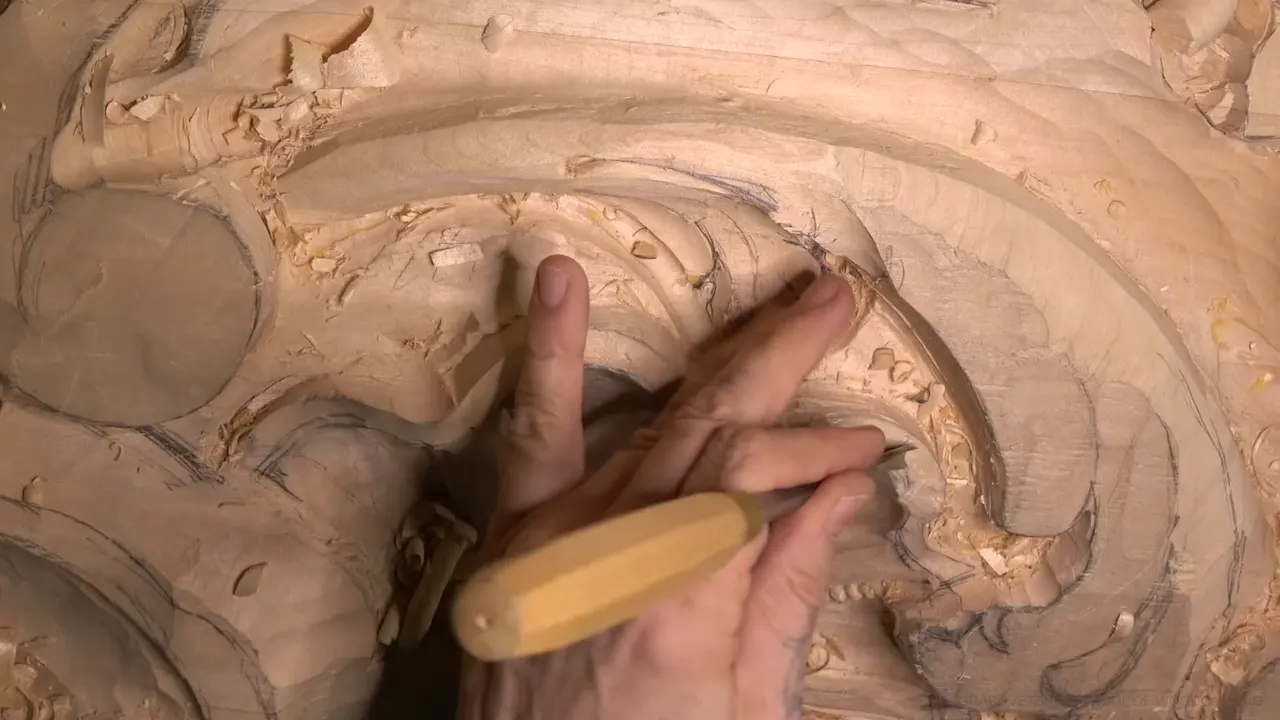

In part 1 of Venice Room workshop 8 I said, "you really want to avoid those sharp lines." The words came while I was talking through the cleaning of one part with a number 11, and the reason followed: "because gold is not going to stick to it." Other lessons of mine put the word beside pencil marks, squares, straight lines, slips of the tool and mistakes.
Ever stood over a carving and known which pass would leave a mess for later? Below is what I said in that video, what the two parts beside it hold, and the lessons where I said "avoid" again.
What this page holds
- The cleaning in part 1, from the first plan to the number 11.
- Parts 2 and 3 of the same workshop.
- Lessons from other courses, grouped by what I wanted to avoid.
- A table with one note for each lesson, so you can find my words fast.
What happened in part 1 before I said it?
The video opens with a plan: "I can actually develop more details on this one." Then comes "a few more separations" and with them "some curliness almost."

For the triangles I wanted a gentler start: "I'm going to relieve it much better, those triangles." My plan was "just straight down cut with number nine." The result would be "much safer." For the next tool I planned "number seven again, 14 millimeters" (about 0.55 in), and "I think will work."

The finish came up too. "I also have to keep in mind that I will have to paint that." About the paint I said "that's going to be original, like a chalk-based paint. Like it used to be in Europe, and even now, in a lot of parts of Europe."
One area did not please me: "I'm not really happy about overall movement right there." I planned "number five" and "big one." Then: "And yes, I think I like that." My plan was "If I can just chop down, just like that, straight down."

Next I planned to use the same number seven to "dig a little deeper and clean this area a little better." I would not remove much, "because who knows" and I planned to "look from far."
The cleaning of that part came next. "And yes, I'm not pushing too deep right now, the cleaning of this part, because it's always better to clean with kind of number 11." A couple of ways were open, and "I think number 11 would be a really good idea."

One way I weighed: "I could just angle the tool and just go underneath, but then it would create a really sharp point inside." It's going to be hard for paint, I said.

Gold leaf came into it: "if you just do something with the gold leafing." The line this page started with came next, and the reason behind it. Then the plan: "So you really need to get a really nice transition on inside, with the number 11 would be the best choice, I would say." The last words in the video are "Get this way."
What do the two parts beside it add?
Part 2 starts with a plan: "I also need to excavate this side a little deeper because I want to make it look like it's flipping even more this direction." The tool is "just number 11" and "You could use number nine."
Later in that part: "Let me stop removing too much of the material" with "inconsistency later on" as my worry. Then a notch: "I need to create some kind of notch. Otherwise, it just doesn't look right."
In part 3 I planned "Maybe number six" and gave a depth limit: "I don't want to create really deep concaves, but I really want to see those ridges, which also cast some shadows."
Round tips show up in part 3 as well: "When you look at the original Italian work, on those acanthus points, they never had the sharp points." And then "So never had any sharp points."

Which lessons used "avoid" for a pencil, a rule or a straight line?
Pencil comes first, in Hashemi Flowers 49, part 2: "I try to avoid as much as possible pencil use." The reason came next: "because the pencil marks and pencil itself just makes your carving dirty." Then a petal: "Let's undercut it underneath of this petal." The waste would go first: "I can remove most of my waste, and after that I'll take again 1 millimeter" (about 0.04 in).

"I am breaking some rules, which is not because I like to break the rules, but just because of the camera position." That is Furniture Panel 18, part 4. A little later: "if you can avoid breaking the rules that would be probably much better." And: "if you got sharp enough tools, so it should not be a problem."

A straight line shows up in Floral and Molding for the Panel 7, part 2: "right now it looks like a straight line, and it doesn't look good." Right behind it: "Straight lines. Okay? Just create some kind of wave."

A V tool is the subject in Venetian Flowers Rosette 2, part 2. I named it and said "I'm not sure if I should or not because on this project, I'm trying to avoid that." A little later: "But I'll use a V tool for now." Between the two I said "you can use just a V tool and create divisions."

Venice Room 142, part 1, has an opening in mind "to give some lighter feel." It should not look "exactly the same what I have on the opposite side" and I said "I want to avoid that."
Which grape lessons named a square to avoid?
The word turns up in the Grape Onlay course beside grapes. Part 1 of lesson 1 shows a mistake: "what people do when carving grapes and why is it, uh, so complex, uh, the intersection between those grapes." Then: "It has to be triangle."
I named the shape to skip, "like quad or square" and then "try to aim for the triangles."
Later in part 2 of that lesson: "yes, obviously sometimes you really do have those points." And "If it's impossible, if you really have to place that, uh, grape right there, it's not huge deal."

Four grapes sit "in a row" in part 3, and I said "that is the area I could not avoid, But it's okay." Next: "It's still possible to clean it. Little harder though."

Lesson 2, part 2, has "Here's a square" and then "but it's all right." Part 3 of that lesson has "junction spots" with a worry: "if I gonna do too much roundness, it would become really hard to clean." Just before it: "if you're going to overdo it, it's gonna be really hard to get in some of the spots and clean it."


What slips and hard touches did my lessons name?
Lily Box 3, part 3, has a finger "creating a stopping block" and "Just want to make sure I'm not slipping with my tool, okay?" Part 5 of that lesson has "I also use my pinky to limit myself, so I'm actually placing that right on the board." Then: "That way I know I can avoid slippage."

A touch comes up in Lily Box 4, part 12. I did not worry about the surface for the moment, "because it's not the final surface yet." And "avoid the hard touch, so just do that." Last, "harder to clean."

The grain is the subject in Lily Box 11, part 6: "I shouldn't say that is not good. That's normal, but I try to avoid. I don't want to break it."

A hold of the dentist kind comes up in Acanthus over Moldings 6, part 2: "If you do have a position to lock your hands like a dentist." Of that hold: "Somewhat safely, I would say, you know." On working toward yourself I closed with "try not to" and "would be smart."
Which mistakes did I say I could avoid?
Venice Room 27, part 4: "I'm not too happy that I broke my piece right here." Then "that's something I could avoid and I didn't. I guess I was rushing too much." After that: "let me excavate underneath where I can see much better what material I have."
Part 9 of Venice Room 41 has "It's not a complete huge mistake, but something to avoid, and I could, and I didn't." Next: "I have to be more careful, I should say." I added "Maybe I'm spending too much time in one spot, and when I'm doing it, I have a tendency to make the mistake." And "But I still do."

"I just made a mistake. Not a big mistake, but mistake I could avoid." That is Venice Room 54, part 2, and "I relieve it little deeper" came right after it. Soon after: "I really have to be a lot more careful."

One story is from a class in Tampa, in Venice Room 3, part 10. Before the story I said "I know some people don't get it." One of the guys said "I'm carving for a long time already, so I never done it. I never had any problem." And guess what happened? He "just messed up" and my question was "why would you fix something if you can avoid that in the beginning?"

When can you not avoid it?
Furniture Panel 22, part 2: "Be careful when you're approaching a detail like that." Then "Sometimes you can't avoid when you break stuff, but if it's possible not to break it, that would be better."
A piece I glued back is in Lily Box 4, part 2: "And that happens. Sometimes you just can't avoid that. It's not a mistake, okay?" Before it: "I can actually glue it back, and I should not have any problem." I added "I could be more careful, actually." My next line was "But like I said, the wood is really crunchy."

Part 11 of workshop 8 has a glue job: "And I really need to glue it, okay? I know I'm just trying to avoid that to the last moment, but I don't think it's a good idea." And "I can always clean up that mess."
Lily Box 6, part 10, runs the other way. I planned to start with my relief cuts, with "Number nine" and "Straight down cuts" and I said "if a quarter inch is too big, you can always use a smaller one" (a quarter inch is about 6 mm). Of the step itself: "if you work with basswood, it's not as critical. But if you work with the harder wood, I believe this step, you should not avoid. Really important step."
Which lesson holds which words?
Every lesson below holds my word "avoid" with a note on what sat beside it.
| Where the words sit | What sat beside my words there |
|---|---|
| 8-1 (Venice Room) | Sharp lines on the inside, and gold leaf |
| 49-2 (Hashemi) | Pencil marks that make a carving dirty |
| 18-4 (Furniture Panel) | Breaking rules because of the camera position |
| 22-2 (Furniture Panel) | Careful near a detail you could bump and break |
| 7-2 (Floral and Molding) | Straight line, then a wave or an arc |
| 2-2 (Venetian Flowers Rosette) | V tool on this project, and a plan to use it for now |
| 142-1 (Venice Room) | An opening that must not match the other side |
| 1-1 (Grape Onlay) | Quad or square where grapes meet |
| 1-2 (Grape Onlay) | Square connecting points that still clean up |
| 1-3 (Grape Onlay) | Four grapes in a row, and little harder to clean |
| 2-2 (Grape Onlay) | Square junction that is all right |
| 2-3 (Grape Onlay) | Too much roundness gets hard to clean |
| 3-3 (Lily Box) | Finger creating a stopping block, and a tool that must not slip |
| 3-5 (Lily Box) | Pinky placed right on the board |
| 4-12 (Lily Box) | Hard touch on a surface that is not final |
| 11-6 (Lily Box) | Catching grain, a little, on a lily flower |
| 6-2 (Acanthus over Moldings) | Hands locked like a dentist, working toward yourself |
| 27-4 (Venice Room) | Broke my piece, and a guess at the cause |
| 41-9 (Venice Room) | Mistake that I could, and did not, avoid |
| 54-2 (Venice Room) | Deep spot, and a mistake I could avoid |
| 3-10 (Venice Room) | Tampa class and a man who skipped the plugs |
| 4-2 (Lily Box) | Crunchy wood, and a glue job |
| 6-10 (Lily Box) | Relief cuts, a step you should not avoid |
| 8-11 (Venice Room) | Glue I put off to the last moment |
Where can you watch part 1?
You can find part 1 inside workshop 8 of the Venice Room course. Its neighbors sit beside it on the lesson page, and everything on the site sits inside the tuition.
Which cut on your own bench would leave a point you would have to clean later? Hold a gouge over it, look at where the tool would end up, and leave the rest for some wood carving.
How it's done
- Plan the triangles. I wanted a few more separations, and I planned to relieve those triangles much better.
- Take number nine. A straight down cut with the number nine was my plan, and the result would be much safer.
- Dig and clean. With the same number seven I planned to dig a little deeper and clean the area a little better.
- Look from far. I would not remove much, and I planned a look from a distance in case I wanted to add something.
- Pick the eleven. I picked number 11 for the inside of the carving, the best choice, I would say.
Frequently asked questions
What came right before that word in this video?
Two ways to clean the part were open, and one was to angle the tool and go underneath. I said that would create a really sharp point inside, hard for paint. Then gold leaf came up, and after it the word.
Why did I want no sharp lines on that carving?
In the video I said gold leaf won't stick to one, and a point like that inside is hard on paint too. I wanted a nice transition on the inside, and a number 11 was my pick for it.
Can a carver skip every square between grapes?
Not always. In the Grape Onlay course I called it not always possible, and one area with four grapes in a row was one I could not avoid. A square like that can be cleaned up, only a little harder.
What to carve next