
Alexander Grabovetskiy, woodcarver, School of Woodcarving · Published 2020
What does a wood carver mean by "glue it back"?
Quick answer: In part 11 of workshop 8 I said I really needed to glue a fragile piece, and I said I would clamp it and leave it overnight. In other lessons the same words come with a bead that pops out, an edge I did not mend and a Lily Box piece that came apart.

In Venice Room 8, part 11, a fragile piece needed glue, and I called the fix "nothing special." The same fix comes up in other lessons of mine, and this page walks through the ones I read, each with its place.
Have you ever watched a carver break a piece and wondered what he does next? Part 11 comes first, with the glue, the clamp and the night. After it come lessons where a piece gave way, from a bead that pops out to an edge I decided not to mend.
Where does the glue come in during part 11?
"But so far it works okay," I said, and then I named a side I would leave alone: "I don't want to touch other part because other part is very fragile." As for the side, "I'm talking about this side," with "Just whatever, if I can excavate."
Against the grain, it was tricky: "And here it's a little tricky because it is against the grain." Even so, "it's still possible." And: "But this is in my way also."
Next I went deep: "Oh, yeah. I got really deep, actually, with just a straight gouge, but I still have to take care of all of that mess somehow without breaking." My pick was "number nine, but the fishtail number nine, I guess."

"I want to remove waste," I said, and "See that is fragile, but I still have to do it somehow." The glue would go on the piece, "but I don't want to stop working yet," and it was for the night: "For overnight."
"So that's not going to stop me right now." Then: "Just go around and around. And around. And underneath."
Of one spot: "Anyway, right here it's too much waste." And: "I can go really deep if I need to."

A plan came next: "And let me make a relief cut in this future separation." Then: "And I'll just go in just like that." The tool: "with the same number nine, I'll just excavate like that, too."
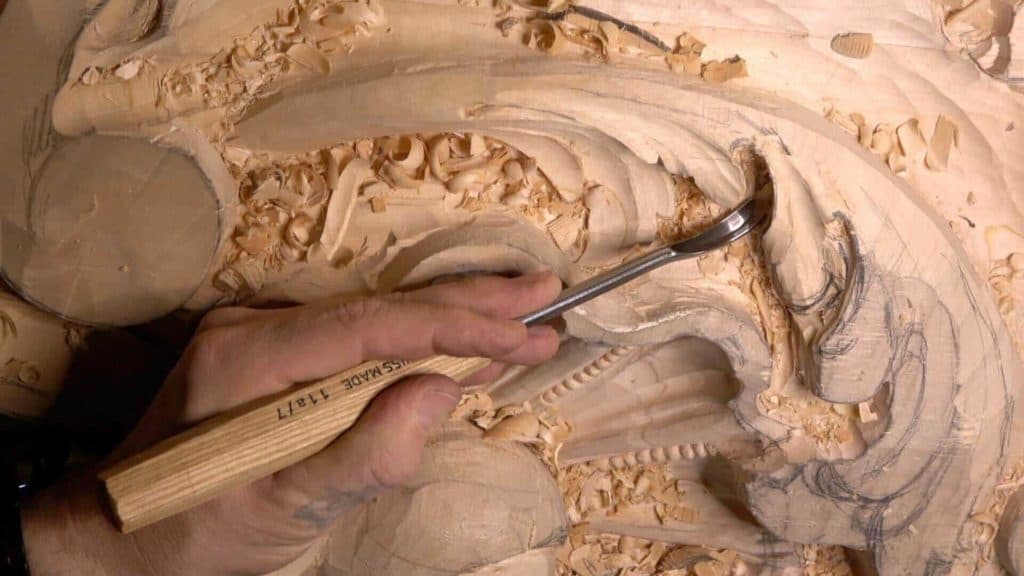
For the clean-up, "I'm going to use just probably a spoon gouge," and then "But not just a spoon gouge." About the skew: "Let me try first a skew." The thought: "I think I should use probably just number 11. Spoon gouge, number 11." Size was a question too: "Let me try seven millimeters first" (about 0.28 in), "and if it's going to be too big, I'll switch to a smaller one."
"And so far it is okay," and "It goes good." For the inside: "Clean on inside. Again, just because I have to paint, I have to think about it, okay?" The transition, in my words: "How it's going to be a transition on inside," and "And yes, I want to see it nice and smooth."
When did I stop putting the glue off?
"I really need to glue it, okay?" About putting it off: "I know I'm just trying to avoid that to the last moment, but I don't think it's a good idea." And then: "Okay, I really need to take care of it."
Next: "You know what, I'll just do that, okay, I'll just glue it." "Should I break it?" I asked, and the answer was "I don't think so." My plan was "I'll just put some glue and clamp it, okay," with "Let me get the glue inside."
On the amount: "And I'm not going to save on the glue, I can always clean up that mess, but I want to make sure it's glued all the way."
Right after that came this: "This actually answers your question, what do you do if something's broken, you just glue it back, yeah, nothing special."

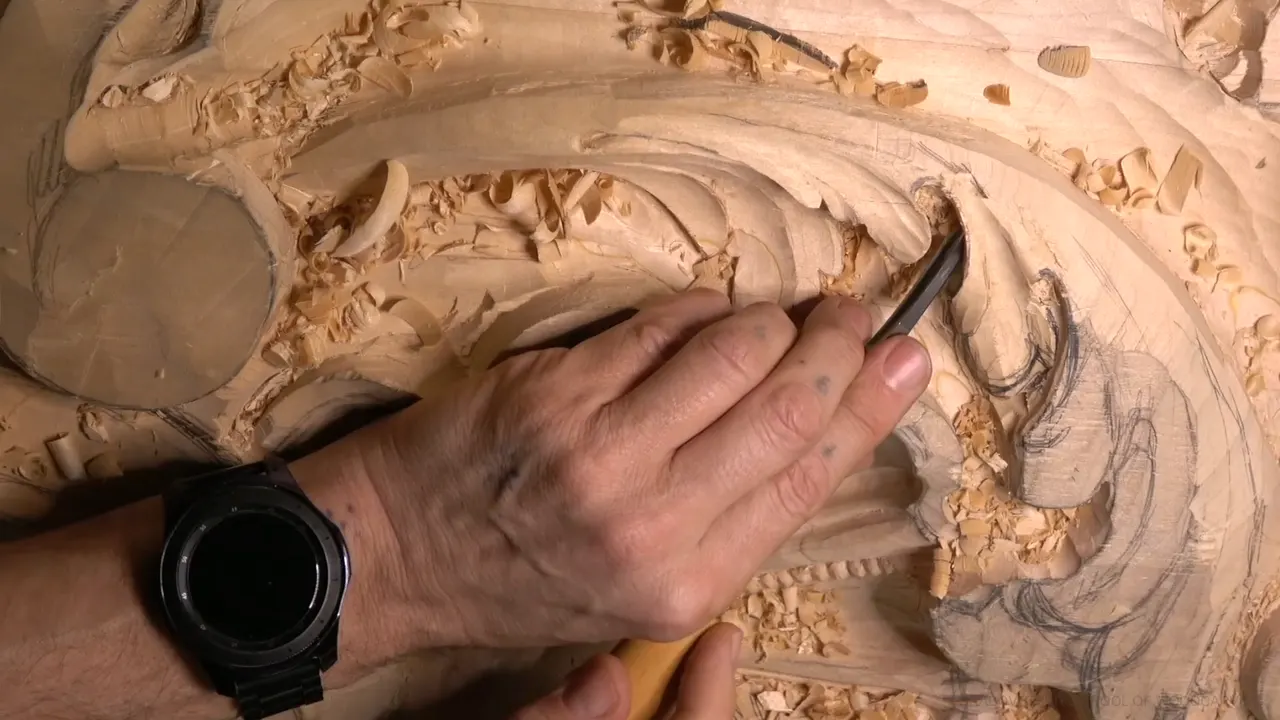
Next, the extra: "Let me wipe excess." The extra was the squeeze out, I said. The clean-up, I said, was for later: "I'll clean it with the gouges later, but I'll just clamp it."
"With the small clamp, you can see it squeezes out," and "I see a little bit of squeeze out, and it should be enough." My plan for the night: "I'm going to leave it for overnight."

Does part 9 of the same workshop mention glue?
Part 9 holds "See, I need to glue it," with "But let me work on that one, okay?" and "So let me leave it alone, for now, at least, okay?" Gluing was a plan there.
Further on came a spot I could not clean: "let me clean right here a little bit, but I can't because I made it too weak."
How did I say it in the first Venice Room course?
Beads came up in workshop 6, part 11: "I have to be really careful because it looks like it's an easy operation, and it is a kind of easy operation." The risk: "if I'm not careful, I can make a too deep of a cut, and then one of those beads can pop out."
"And yeah, you can glue that back, but if you can eliminate that pop out, just eliminate that from the beginning, okay?" Cause: "I've done that mistake multiple times, when you just press too hard on your tool."

Which breaks did I leave unmended?
A bigger separation was the plan in part 7 of workshop 13: "Just going to give a bigger separation, that's it." Nobody would hear about the break from me. Mending was possible: "Don't get me wrong, it's possible." Still, I did not want to.

A broken edge sits in workshop 102, part 4: "Oops, I just broke the edge." Next: "But it's okay, it's not okay." Then "but what can you do, I already broke it." What I would do instead: "I'll just recreate the shape," and "Okay, nobody's going to know, except you."

Workshop 143, part 3 has me saying "I think I could lose it, that's okay." Glue was an option I named, "but it's too preliminary, that's what I did, so oops, my bad."

In workshop 78, part 4 I had moved out a part I broke before. "It's less than a 16th of an inch thick" (less than 1/16 in, about 1.6 mm). Whether mending it was a good idea, I was not sure, but "for now, I'll just leave it alone," and "I'll go glue it off camera."

In Floral and Molding 7 a piece let go: "That happens sometimes, I'm okay, I'm all right, I still have some of the material left." The cause was "just pressing too hard." I would not glue it, "I don't really need it, I have plenty of material left." See lesson 7.
Where did I say a break could not be mended?
People will see the spot in workshop 16, part 9 from below. It was "kind of dangerous the way I'm doing right now," and a mistake could not be mended there, "because that's one of those areas that is better not to make mistakes."
"That's why I'm taking my time and think every cut." I gave the reason as "visible from the bottom."

Cutting off too much came up in Roman Acanthus 6, part 3: "if you subtract too much," I said, and "so you can't apply, you can't glue that back."
A question people had asked me before gets its answer in Greek Acanthus Leaf 11, part 1: "So what happens if you break something?" My answer: "Some stuff you can fix, some stuff you can glue back, but many times you really can't."

The Roman Acanthus 2 answer, in part 4, goes this way: "So someone asked me, what do you do if you break?" Then: "Well, in this case, sometimes you can glue it. So you can glue back the part which you broke, but not always."
"Not all of carving you can just glue back, and it's better not to glue anything." Then: "And yeah, I've done some gluing, but I prefer not to glue. And if I broke something, let it be." And: "That means it meant to be like that. Just redesign around that broken part."

What did I tell people who asked how to fix a break?
In the Q and A course the question was "how I fix it," and my answer was "pretty much glue," from "the small bottle of glue." Whether it ever happened to me, I said "Absolutely" and "I broke some stuff," and you can watch it in the Q and A course.
In Hashemi Flowers 41, part 1, I asked whether a piece would be fragile: "And definitely, yes. It will be really fragile." Could it break? "Yeah, and I've done it many times." Then "So what?" My answer was to glue it again. See Hashemi Flowers 41. And: "I've got the excavation inside about half an inch" (about 13 mm).

Roman Acanthus 16, part 1 has this: "Looks like I almost broke this part, which is not good." About the fix: "here you go. That's the fix." The fix was glue, and I added "Sometimes it happens."

Furniture Panel 32, part 3 has a piece that came loose. "Oops, that was little too much," I said, "I just sat down, dig too deep." The piece "became loose." I weighed it: "I could just remove it and cut little deeper," and "I don't wanna do that." The plan was glue, "and it's gonna look good." Of the mistake: "It was a big mistake on my part, but again, the only person who's gonna know it's just you."

Paint grade work comes up in workshop 42, part 10. The glue was the plan, "Although, I could leave it like that and just work my way in." I named the glue I used, a wood glue, and said it was "paint grade, so it should not be any problem." Then: "while it's drying, so I can probably develop this part right here."

How did the Greek acanthus and the Lily Box put it?
In Greek Acanthus Leaf 13, part 1, glue was the answer to a break in a fragile piece. Near a micro crack came "And I guess I made a mistake," with a glue repair to follow. "And I will."
Then I said what I meant: "you can see this is the weak point I was talking about, and now I made a mistake, so I got too close to it and I have to fix it. Okay. And what I'll do, I'll just put some glue right there and maybe just extra support and leave it for overnight." See lesson 13 of the Greek course.

Lily Box 4, part 2: "I lost detail." Then "That's exactly what I was talking about, so I have to be really careful at the edges." I said I could reglue it, "and I should not have any problem." And: "It's not a mistake, okay?" And: "like I said, the wood is really crunchy."

Lily Box 5, part 13 has a fragile area: "And that is a kind of fragile area. Really fragile, okay?" Then: "Came apart." And: "And there's no glue underneath, I can probably place some glue underneath also."
Why a piece comes apart, in my words: "that is happening sometimes, not because of the mistake of the wood carver, but because in the wood itself, there's small micro cracks, which sometimes undetectable." And: "I'm not even going to clamp it, clean around right away, squeeze out, and that can be carved out."

In Lily Box 7, part 2: "there is a lot of micro cracks on inside, and there is no glue, which I didn't want to put, but that's okay." A repair was coming, "and I can glue it directly to the background also." The break itself: "it happens, what can you do, it just happens." And the extra: "I didn't want to see any squeeze out, but I guess I have to just clean after." In Lily Box 6, part 10, my pick was a super glue: "I'll use super glue."

One row for each place I said it
| Lesson and part in the course | What happened | My words about the glue |
|---|---|---|
| 8.11 | A fragile piece, with a mess to deal with and no breaking wanted | Mend it, with no saving on glue |
| 8.9 | A spot that I could not clean because I made it too weak | A plan, with the spot left for now |
| 6.11 | A bead that can pop out when you press too hard on the tool | Possible, but avoid the pop out |
| 13.7 | A break, with a bigger separation as the plan | Possible, but not wanted |
| 16.9 | A spot that will be visible from the bottom | Not mendable there |
| 42.10 | Paint grade work, with a glue that dries while I work on another part | Glue, then work elsewhere |
| 78.4 | A part I broke before, less than 1/16 in (1.6 mm) thick | Maybe, but for now alone |
| 102.4 | A broken edge that nobody will know about except you | No glue, and a shape to recreate |
| 143.3 | A part that went too fast, which I thought I could lose | Too preliminary |
| Roman 2.4 | A question about breaking something | Sometimes it can be glued, but not always |
| Greek 13.1 | A weak point that I got too close to, with a fix for the night | Glue right there |
| Hashemi 41.1 | A piece that will be really fragile, and a break I have done many times | So what, mend it again |
| Lily 5.13 | A fragile area that came apart with no glue underneath it | Maybe place some underneath |
Where can you watch these lessons yourself?
This part sits on the lesson page for workshop 8, inside the first Venice Room course. The Venice Room lessons named above: 6, 13, 16, 42, 78, 102 and 143.
The Roman Acanthus ones are lessons 2, 6 and 16. Greek acanthus gives you 11 and 13, and Lily Box gives you 4, 5 and 7. Furniture Panel 32 sits here. I carve acanthus leaves in several of these courses, and the Venice room is the one this part belongs to.
Would you like to watch me stop in the middle of a cut and say what has to be glued? Do you want to hear what I do when a piece lets go? The whole Venice Room is open on one tuition plan, and this panel is waiting in it.
How it's done
- Name what is fragile. I called the other part very fragile and would not touch it.
- Say what needs glue. A piece really needed it, I said, even with work still to do.
- Get the glue inside. Put in plenty, and make sure it is glued all the way.
- Take off the extra. Wipe the excess, then clean the squeeze out later.
- Clamp it and wait. A small clamp, not too tight, and the piece stays overnight.
Frequently asked questions
What happened with the glue in part 11?
The fragile piece needed glue. I would not save on it, and the piece would stay overnight.
Which tool did I name for the clean-up?
Spoon gouge number 11, with seven millimeters (about 0.28 in) to try first, I said. The fishtail number nine was named earlier.
What about the extra glue?
Wipe the excess, clean it later, and hold the piece with the small clamp, I said.
Did other lessons end in glue every time?
What to carve next
- This part sits on the lesson page
- The first Venice Room course
- Workshop 6 and a bead that pops out
- Workshop 13 and a bigger separation
- Workshop 16 and a spot seen from the bottom
- Workshop 42 and a part for paint
- Workshop 78 and a thin part
- Workshop 102 and a broken edge
- Workshop 143 and a part gone too fast
- Roman Acanthus 2
- Roman Acanthus 6
- Roman Acanthus 16
- Greek Acanthus Leaf 11
- Greek Acanthus Leaf 13
- Hashemi Flowers 41
- Lily Box 4
- Lily Box 5