
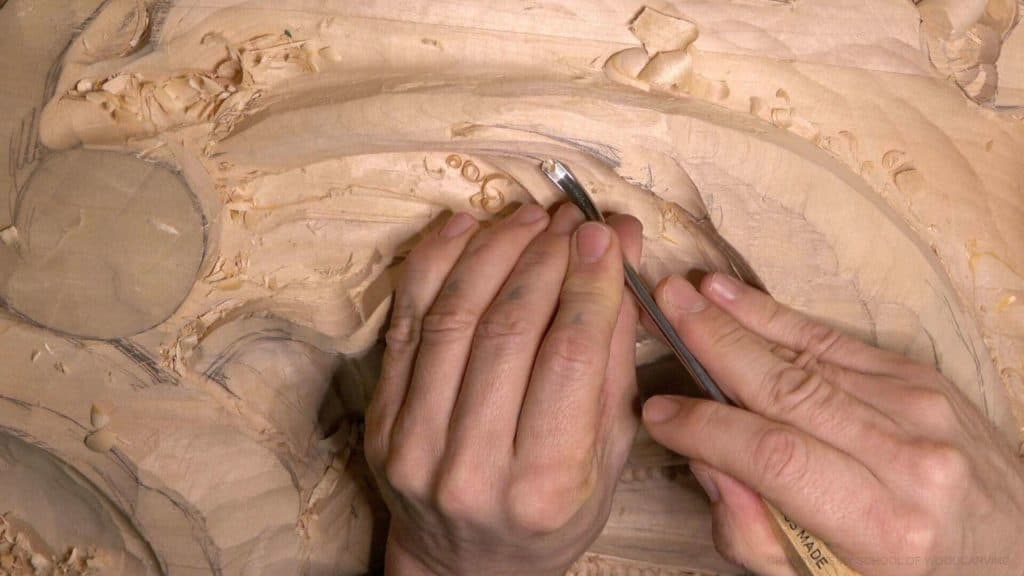
Alexander Grabovetskiy, woodcarver, School of Woodcarving · Published 2020
What does a wood carver mean by "Italian style"?
Quick answer: Italian style is the name I use for acanthus carving of old Venice, though I said Venetian is the more accurate word. In this part I said the Italian originals had no sharp points. Other videos add curls, close separations and smooth surfaces.
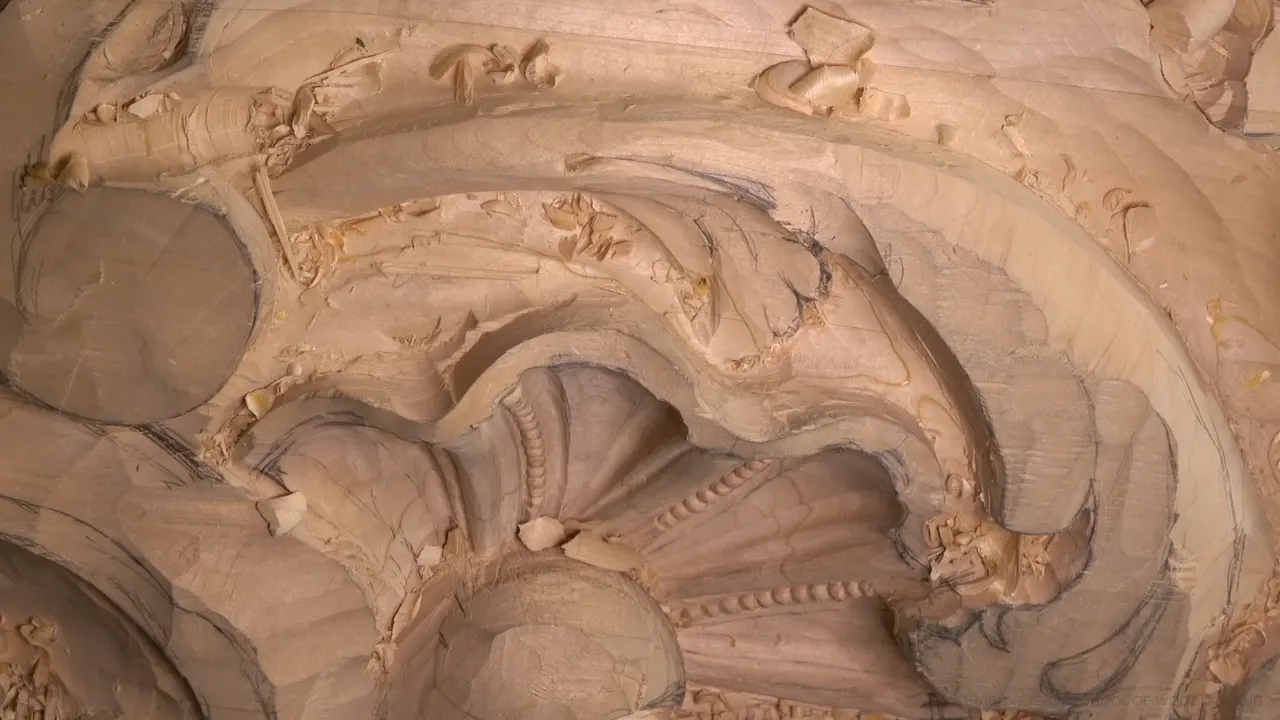

In Venice Room 8, part 3, I said that on the Italian originals the acanthus points had no sharp points, and that this is one detail to watch if you want to stay near the original design. I use the words Italian style a lot in my lessons.
Ever read those two words on a carved panel and wondered what the carver was looking at? Is it curls, a smooth surface, or only the shape of a point? In my lessons it points at a way of carving that I tie to the 15th and 16th century. I went back through my other lessons for every time it came up, and each one is here with its place.
What did I say about Italian work in part 3?
The remark comes just after the five minute mark, at 00:05:08, and a moment before it I was working on a notch. "I'm going to create that notch a little more nicer," I said, "with the smaller tool, much smaller tool." The tool I named was number three, since I was "going to use just number three."
Then came the aside. "And by the way, when you look at the original Italian work, on those acanthus points, they never had the sharp points." A second way to put it: "So never had any sharp points." What they had was "more like a roundy."
It matters for a reason I gave myself: "that is also one of the details you have to pay attention if you want to be really close to the original design." And right after came a limit: "So not every acanthus design has a sharp point."

In the wood again, "this is going to go underneath right there, on inside." Then "somehow and hide inside." A plan followed: "I can probably create preliminary undercutting on the sides." My last words in that stretch were "get that notch down" and "double check."
What was I carving around that remark?
The video opens with a plan. "I can start creating some of the movements on inside." Then comes "Okay, so concave, concave, and concave. All right." Next: "I don't have to do that, but I think it's always a good idea."
For the tool, "Maybe number six," because "I don't want to create really deep concaves, but I really want to see those ridges, which also cast some shadows." One job waited: "I still did not work on the pipe, but later on I will. Just preliminary."

I pointed at one ridge, then another ("One, and this one"). Next I said "I can actually unite those two," and also "I really don't need to separate all of them."
At 00:02:29 I admitted it was hard to see what I was doing. "But just believe me," I said, "every ridge will make sense. Once you're going to see that in the overall design, you'll see exactly why I've done what I've done."

A ridge bothered me again. "I still kind of don't like this ridge." Of a second one I said it "could be a little deeper," and that "I think I could make it slightly deeper if I need to." Then a shrug: "Maybe yes, maybe no." The decision was to "leave it for now like that" and "clean around the final design." I called what I had a "semi-final design."
Near the end I named what was still open. It was "something that just bugs me," a spot that looked "not organic for me, at least." There were "not enough shadows right there," so the leaf did not give me "that airy feel which I really like to see."
My plan was "to just create the cut around the number 11 and maybe just create extra shadow." The file ends with the words "I need to go with the smaller," maybe 2 millimeters (about 0.08 in). The next video, part 4, picks up the same hunt for shadow. There I tried number seven, and "number seven is much better in this case. It gave me extra shadow."

Is Italian style really the right name?
Not quite, and my own lessons say so in several places. Back in workshop 1, part 1, I said "I could say Italian design, but that would not be accurate." My reason was a plain fact about the 15th century. In a country like Germany or France, "we're talking about people living in just one town." And for this room, "it would be, let's say, Venice."

Those makers, I said, "developed their own techniques," even "to the design." "It's actually developed in every town." Proof came from nearer home: "I can prove it actually, even in the United States." Furniture of the first immigrants in Pennsylvania and in Boston had "exactly the same shell design," yet "when you look at those two different shells, they look different."
About this very room, workshop 6, part 2, is plain. It was "just original to the Italian in 15th century," I said, and added "it's supposed to be original to Venice." Those people "developed their own distinguishable approach."
Next comes workshop 14, part 6, and the order flips. "It's just a more Venetian style." It goes on: "I couldn't even say Italian style because it wouldn't be accurate." Right after, a kind word for Italy, with "big talented people" and "even modern work" to show for it.

Both names, then, sit in my lessons next to each other. One breath holds both names in workshop 52, part 7: "Venetian style, Italian style, authentic to 15th, 16th century." In my October 2020 livestream the acanthus I was working on was "applicable only to Italian style acanthus, to be exact, to 15th and 16th century."
That same part of workshop 52 has a wider point. "Acanthus is not just acanthus." "There's different types of acanthus, which is regionally developed." My examples were Morocco and Germany, and after those came France, Belgium and England.

Why were the curls on purpose?
A line about a whole panel sits in workshop 13, part 4. "I know it looks like a curly altogether, which is supposed to look like that." The proof offered: "If you look original Italian designs of that period, you will find that that's exactly the way they did it."
Early in the same video I put the Byzantine acanthus leaf first: "was before development of Italian." Then "this was adapted by Italian culture and actually made it even beautiful." Early Italian carvers, I said, "really love curliness," with "a lot of movement, a lot of curvatures," and "just a lot of divisions."

Where did the separations sit?
Part 9 of workshop 9 has a line I like. "On those Italian style, specifically on Venetian style, those separations in some of the spots, they're really close to the edge." Then I added more: "they really like to make the multiple separations."

What did I say about a smooth surface?
History comes into the third part of workshop 9. I named the style Italian and went on with "a little bit of history and culture." Greek and Roman cultures "really actually like smooth surfaces." Those makers "used to work with marble and stone," and "you never would see any rough marks."
So I thought about sanding for my panel. A little bit of it, I said, would be "even more authentic, I would say, to the original." My next words: "I don't have to, but I think I can create an even better look that way."
Shorter still, in workshop 10, part 3: "if it's Italian style, I guess I have to be authentic to the original, and they really liked sanding." Over in workshop 18, part 6, Italians "really like a smooth look," and "I think it's just probably even in the blood." Italian style furniture is "more smooth than rest of the European furniture."

What was the big idea of the leaf?
A small detail turns up in workshop 93, part 5, and the idea is the same one. "It's the same idea what I've done on the big pieces." "It is still the same Italian style acanthus, which means I have to have some kind of convex right inside."
How to get there: "To create that convex, I need to create two concaves." So "that is the main idea," or in my other words "the big idea of acanthus."

What about the big pipes?
Big pipes return in workshop 152, part 3: "I want to establish big pipe again, like I mentioned before, in this Italian style, they really exaggerated pipes." That is "applicable to more designs." And "they inherited, as I understand," pipes from Byzantine.
On the Byzantine side I gave a reason in the next breath. Orthodox churches of the Byzantine Empire, I said, "they use that exaggerated pipes just because it's a lot easier to apply gold leafing on it."

The Byzantine acanthus course has it too, in lesson 8, part 3. A deep cut had made "the beautiful pipe," which was "what I was talking about on Byzantine style and also Italian style." Then: "the most beautiful work in the Baroque style, it's Italian style." And "that's what they did, big pipe," or "over-exaggerated pipe, if you wish to call that name."

How does an Italian division differ from a French one?
The design principles course, lesson 4, part 1, asks where a division falls inside an acanthus leaf. It falls "on one of the Golden sections." Which one depends on who carves it: "It could go toward this if you're French. It can go this way if you're Italian."
"My division is going to be like Italian division," I said, and a plan came next: "Well, let's follow the logic of Italian." The French ones "put division closer to the center," and of that way I called it "still beautiful," just a way "to communicate different idea." And "Italians did that."

How did Italian style differ from Greek and Roman acanthus?
Part 7 of workshop 52 sorts old styles by their hollows and humps, one culture at a time. "In different cultures, there's a different concaves and different convexes." Early Greek acanthus "would be only concaves," with "a groove with a middle line." There "would not be any convexes." "Everything would be just like a V cut even."
A Roman leaf is a different case. They "actually used some kind of gouge, and that became just a concave cut." That is "also indication that acanthus leaf is more Roman style, not Italian. Even if it's in Italy."
One more limit, from workshop 94, part 5, about my own work: "It does not apply to all of acanthus in history there is lots of different acanthus. This is just more like Italian Venetian style."

Which tools did old Italian style call for?
In the October 2020 livestream I said a carving "has to be authentic to Italian style, and that's 15th, 16th century Italian style." Then: "I had to study what they used back then, and I'm trying to use the tools, what they used." Their kit, as I put it, held "a lot of gouges and veiners."
That day my pick was "number seven a lot, and 14 millimeters" (0.55 in), though it depends on the day: "another day, I'm going to throw that away. But it depends on the carving."
Where each video says it, one row each
| Venice Room video | What I pointed at in that video, in a few words | My words |
|---|---|---|
| 8.3, this one | The points of the acanthus on the original work, said in an aside | they never had the sharp points |
| 1.1 | Why Italian is not the exact word for one town of makers | it's not accurate |
| 6.2 | Where this panel comes from, and what the makers there developed | supposed to be original to Venice |
| 9.9 | Where the separations sit on a leaf in the Venetian way | the multiple separations |
| 9.3 | A smooth surface, with a little sanding to match the original | even more authentic |
| 10.3 | Sanding again on the same panel, for the same wish to be authentic | they really liked sanding |
| 13.4 | A curly look all over the panel, said to match the old work | a curly altogether |
| 14.6 | Which name fits the work, with a kind word for Italy as well | big talented people |
| 18.6 | Smooth work and smooth furniture, put down to something in the blood | absolutely gorgeous |
| 52.7 | Regional acanthus, and the curls and divisions of early Italian work | regionally developed |
| 93.5 | A small detail built on a convex made from two concaves, like the big pieces | two concaves |
| 152.3 | A big pipe, and where the exaggerated pipes were inherited from | they really exaggerated pipes |
| Byzantine course 8.3 | A deep cut made smooth into a pipe, with the Baroque named | big pipe |
| Design course 4.1 | Where a division falls on the Golden sections, Italian or French | Italian division |
| October livestream | The tools the old carvers used, and the tools of that day | gouges and veiners |
Where can you watch all of these videos yourself?
This part sits on the lesson page, inside the first Venice Room course. The same course holds workshops 1, 6, 9 and 10. The second course holds 13, 14 and 18.
Would you like to watch me round a point on a real panel, and hear me admit that it is hard to see? Do you want to learn which curls and which separations belong to the old work? The whole Venice Room is open on one tuition plan, and this leaf is waiting in it.
How it's done
- Start the inside movements. Begin with the movements on the inside: "concave, concave, and concave," as I put it.
- Pick a tool for the ridges. Maybe number six, I said, because I did not want really deep concaves and I did want to see the ridges.
- Unite what you do not need to separate. Two ridges could become one, and I did not have to pull every ridge apart.
- Make the notch nicer with a smaller tool. For the notch, a smaller tool: I was going to use just number three.
- Plan the first undercut. A preliminary undercut on the sides came next as a plan, and after it a "double check."
Frequently asked questions
Did the old Italian work have sharp points?
On those acanthus points, I said in this part, it "never had any sharp points." They had "more like a roundy." My limit came right after: not every acanthus design has one.
Is it Italian style or Venetian style?
Both names sit in my lessons. Workshop 14 says "I couldn't even say Italian style because it wouldn't be accurate," and names Venetian instead. Workshop 52 gives both names in one line, with a date for each.
Which tool did I plan for the notch in part 3?
Number three was my plan, a smaller one, to make the notch a little nicer. For extra shadow I planned a cut around the number 11, and I said I needed a smaller tool still, maybe 2 millimeters (about 0.08 in).
What to carve next
- Part 3 sits on this page
- The first Venice Room course
- Workshop 1 and the name Venice
- Workshop 6 and the original room
- Workshop 9 and the separations
- Workshop 10 and sanding
- Workshop 13 and the curls
- Workshop 14 and a Venetian style
- Workshop 18 and smooth work
- Workshop 52 and regional acanthus
- Workshop 93 and two concaves
- Workshop 94 and other acanthus
- Workshop 152 and big pipes
- Byzantine acanthus, lesson 8
- Design principles, lesson 4
- The October 2020 livestream