
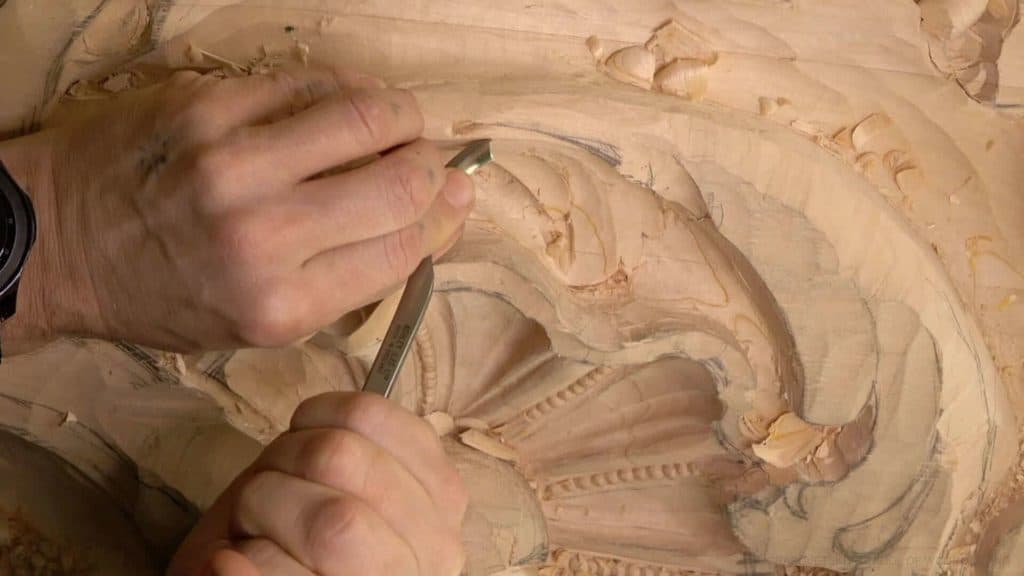
Alexander Grabovetskiy, woodcarver, School of Woodcarving · Published 2020
What does a wood carver mean by "calling it"?
Quick answer: In Venice Room 8, part 4, I said "That's not the big concave" and "I need to also move this line closer to the center," then named a number seven gouge to try. Other lessons of mine put my own names on a plug cut, a wall, a triangle and a pipe.
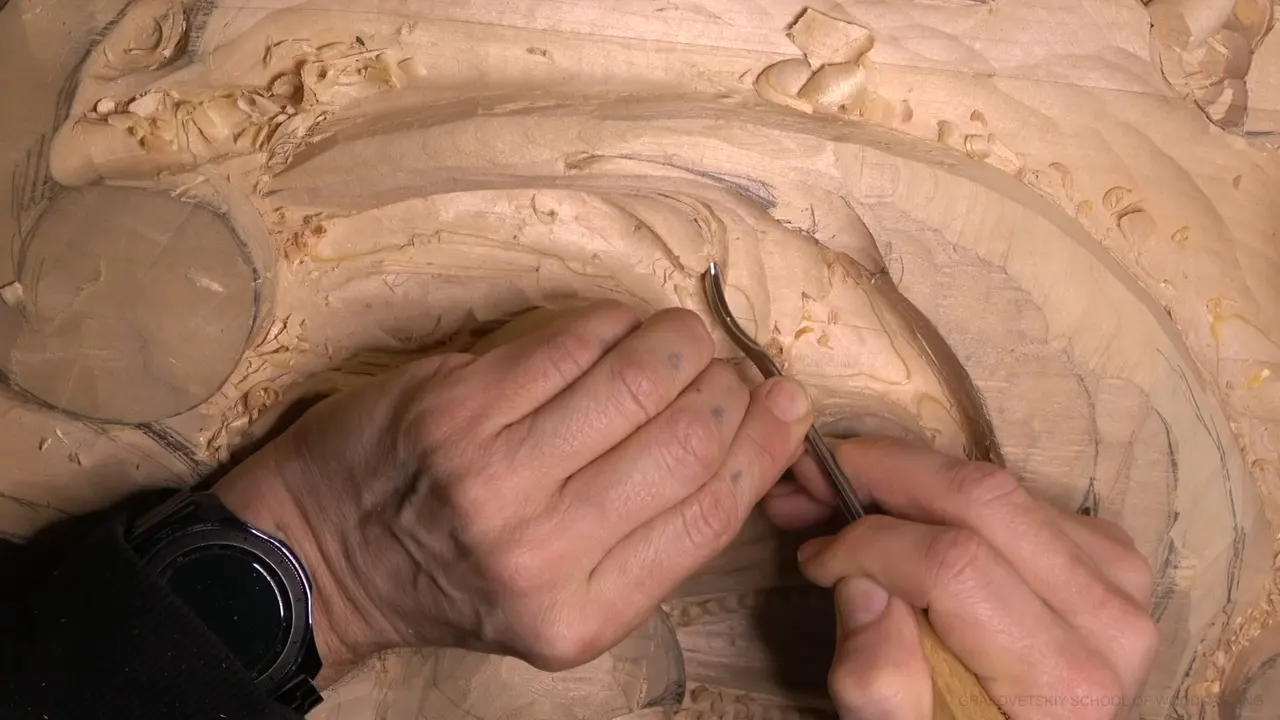

"It's not really concave, okay? I'm calling it concave," I said in part 4 of Venice Room 8. A ridge sat beside it, and a number seven gouge came into my words in the same part. Other lessons of mine hold my own names for cuts and parts, such as plug cut, wall, triangle and pipe.
Ever looked at a hollow in your own carving and not known what to call it? Below is what I said in part 4, what the two parts beside it add, and the lessons where I put a name on a cut.
What this page holds
- My words in part 4, in the order I said them.
- The two parts beside it, with the tools I named.
- Lessons from other workshops and courses, grouped by the name I used there for a cut, a part or a tool.
- A table with one note for each lesson.
What did I say in part 4?
My plan was to "turn to 1 millimeter" (about 0.04 in), and I said "Got to be careful." After that came "I'll follow with the 1 millimeter cut" and then a challenge: "Challenge because everything is in my way." Then "gradually move up."

About a spoon: "I do have a spoon, by the way" and "I should probably use a spoon on number 11 and 1 millimeter, but it's okay" (roughly 1/25 in). For the ridge I said "I need to fix this ridge. It's just not too appealing." For it I named a "number six spoon gouge" and "I can just go even deeper that way" followed.
The result looked "much better" to me, though "that is my opinion, of course" and I still said "not there yet." I planned "a spoon, a small one. So 1 millimeter" (near 0.039 in). Next, "I'm going to attack with the number six, with the same number six, maybe with the smaller one" and "I'm going to move a little bit the line."

Then came the concave. "Get that concave a little farther," I said, and the line at the top of this page followed. After it, "That's not the big concave" and "I need to also move this line closer to the center." The line I meant was the ridge: "I'm talking about this ridge." Then "And blend in" and "Blend in to the overall movement."
Next: "Maybe I can just exaggerate a little bit this concave" with "I think it's going to give me a better look." The plan for the concave: "Let me try number seven, okay" and "if I still don't like it, I'll just try number eight." The reason for seven was "because I'm still not too happy about it."

"I am taking my time because I'm creating something" and "I want to be proud of what I'm doing," I said. Then "number seven is much better in this case" and "It gave me extra shadow."
If anyone asked why I did not use it from the beginning, my words were "I have no idea, okay?" Then "Just trying to be safe." Of the movement: "beautiful, absolutely beautiful movement."
After that I said "you probably even don't see that" and "Don't pay attention the mess around" with "So we're going to clean it." The verdict was "not bad at all" and "Maybe number seven right here, too." Then "now I'm losing this line" and "I also don't see gradual disappearance of this one, so I need to use probably number 11 and 3 millimeters and just use the side" (roughly 0.12 in). And "I'll go like that."
What do parts 3 and 5 add?
Part 3 has "start creating some of the movements on inside" and "concave, concave, and concave." "I don't have to do that, but I think it's always a good idea," I said, and my pick was "Maybe number six." My reason was "I really want to see those ridges, which also cast some shadows."

The pipe came up: "I still did not work on the pipe, but later on I will" and "Just preliminary." Then "I can actually unite those two" and "I really don't need to separate all of them." One ridge I still kind of did not like, and another "could be a little deeper." Later came "Maybe I can just create extra cut, extra long, because it's not enough shadows right there" then "With maybe 2 millimeters" (near 0.08 in).
Part 5 has "And now I can start cleaning around," "a spoon gouge, of course" and "a two millimeters spoon gouge" (near 0.08 in). I called the spot "a really hard-to-get area because everything is in my way" with "some kind of undercutting anyway."

Then "Maybe it's a little too small" and "I use four millimeters" (close to 0.16 in), with "I don't want to go too deep on inside" and the reason was making it "too fragile." Next, "Let me use four millimeters first" and "Use a mallet."
Later I said "I really need to use a one millimeter" (close to 0.04 in) and "Kind of remove that waste right here" with "Just a micro notch." About the line: "I still don't like how this line moves," "I think I need to move it like that" and "look more natural that way."

The video ends with "Can't create too much pressure" and "I will make a mistake" and then "Okay, that's good," "Let me leave it" and "Otherwise, I can overdo it."
Which name did a plug cut get?
Part 7 of Venice Room 43 has a plug cut named "because I'm kind of removing like a plug." My warning was "I have to be careful, again, because it's different when you're cutting from a up-down position versus with the grain" and the plan was to "leave a little more material on this side and create little deeper cut right here."

Venice Room 52 adds "it's supposed to go downhill like that" in part 11. The movement: "I have to just match the direction of my cut, and place my tool, and start a rotation movement like this" then "I'm removing plugs" and "So that is a plug cut." Of the depth, "I can go as deep as I wish" and "it's a good idea to start with the smaller tool, but I don't have to in this case because I do have plenty of the material."

Rotation comes up in Venice Room 54, part 11, with "I'm using number nine." Of it I said "it's always like a half a round" and "If you rotate, it's going to create perfect round." For pressure I said "without pressing too much" and then "You're just removing small plugs." In that area, "I really want to create deep, really deep excavation" and "I am after deep shadow."

Venice Room 60, part 7, names "number 11" then "One-eighth of an inch" (3.2 mm), with "in this area especially, I got to be really careful." I also said "I could use number 9" and "you know what I'm calling that and why." And "I think number 11 did the trick."
Grape Onlay 8, part 2, has "like a plug cut right underneath of this sleeve because I wanna make sure I see a huge, big undercut" and the plug cut came with "somewhat like a drilling." On pressure: "don't create a lot of pressure" and "just rotate little by little, doesn't matter to the right or to the left." Find it at Grape Onlay 8.

The April 2020 livestream has "I'm using just the number nine." It was "a quarter inch, and that's a really, really small, tiny number nine" (a quarter inch is about 6 mm), and "only about 10 millimeters, about three-eighths of an inch sticking out." About that tool I said "that is one of my favorite tools." The carving itself: "I'm actually cutting on inside. Okay? And I'm calling it plug cut because I'm actually removing plug." And "rotate that, and drill that in."
The benefit of the tool, in my words: "the normal straight tool, I would not be able because the space between those spots, it's not allowing me." "But this tool, I am able to actually start my cut and actually raise up." And "Because the wider part is actually inside, if it makes sense."

How did a wall, a step and a pipe get named?
Over in Hashemi Flowers 10, part 12, I said "Can actually take a knife, probably" and then "attack that from the backside" with "there is a wall." I named it the wall: "it's a section like this, but also wall is right there, and I need to remove it."

Hashemi Flowers 33, part 4, has "it's all about just cleaning, cleaning, and refining that" then "And also undercutting." The tool was "number five and quarter inch" (6.4 mm), used on what I named walls: "just take those walls on the inside, just remove those walls." Next came "Maybe I'll use just a number seven in some spots, make it smoother a little bit, some spots. But not too smooth" and "every tool mark makes it look beautiful, in my opinion." More from that workshop sits on Hashemi Flowers 33.

In part 3 of Hashemi Flowers 3, I said "Use the number five again" and "I'll make step cuts." The reason for the name: "Because I can start on one side and make a step." About the flow: "I don't like the flow, so I want to make sure it's lower down a little bit." Then "Same tool, number five. I'll just go to the line."

Workshop 5 of Antique Style Rosette has "Okay, let's work on the pipes" and "what I'm calling pipe, I'm talking about this section right here. That's called pipe because it looks like a pipe." My tool: "But I'm using number 11. It's also called a veiner, because this is a really handy tool to make veins on a leaf." My hold: "I'm pretty much just putting my two fingers, just like that, to support my gouge, and I'm guiding with my left-hand side finger, just holding the position."

What sat beside a triangle or a subdivision?
Triangles sit in Venice Room 50, part 4, and I said "I always start with the relief cut. I am trying to relief those triangles." And "Those are triangles." Then "So those triangles need to be relieved." The tool was "number 11, seven millimeters, same number 11 what I used before" (7 mm is about 0.28 in), and "I don't use, in this carving, V tools."

My beginner course holds it in Curly Kitchen Cutting Board 15, part 1: "I'll repeat what is a triangle." Then "Those areas I'm calling a triangle area, and that's my point where I establish how deep my cut going to be." The depth limit was "I don't want to go deeper than 16th of an inch" (1.6 mm), with "I'm just eyeballing. I'm not measuring." And "everything else, I'll just start blending to that point."

Divisions sit in Venice Room 28, part 4, where I said "I try to logically figure out what is going to be the main division" with "usually three or five main divisions" and "subdivisions, which is inside of those divisions."

Which words went on a ring and a canvas?
Flower Rosette 3, part 2, has an outside ring: "you can see the outside ring" then "It needs to be lower a lot more right now" and "at least I can see the initial shape." Another way came with "There is another approach I could use. I could actually use a bigger gouge and just establish my dome first inside and outside, including the outside ring, and then reestablish the middle part also using a smaller gouge." And "It would also work." The whole workshop is Flower Rosette 3.

Part 1 of Flower Rosette 5 names channel cuts: "the same tool, I could actually go around and create channel cuts." Then "it's not really necessary in most of the spots" and "Just on the weak spots" with "the weak spot I'm calling those small pieces right here." The distance was "about 16th of an inch away from the main form" (1.59 mm), and "Cut little deeper right here."

A canvas is in Venice Room 72, part 6: "a canvas for myself to work" then "now I could probably refine my canvas, just clean a little bit and just to get a lot more details." After it, "right away, I can see what I could do" and "I can actually slope a little bit this way also." My words on symmetry: "it has to do with symmetry" and "If I've got movement upward this way, symmetrical movement would be either go that way also, it would just repeat, but downhill."

When did I keep a different name?
Furniture Panel 16, part 7, has "By the way, the name for this tool is macaroni tool" and then "I'm not calling it macaroni myself" with "I just prefer to call it number 23" and "it's just my preference."
Which lesson holds which words?
Every lesson below holds my words, with a note beside each one.
| Where I said it | Notes that sat beside my words there |
|---|---|
| 8-4 (Venice Room) | Hollow I call a concave, and a ridge to move |
| 8-3 (Venice Room) | Concaves with ridges that cast shadows, and a pipe for later |
| 8-5 (Venice Room) | Spoon gouge in a hard area, a mallet, a micro notch |
| 43-7 (Venice Room) | Plug cut, with a warning about the grain |
| 52-11 (Venice Room) | Rotation movement that removes plugs, going downhill |
| 54-11 (Venice Room) | Rotating a number nine, with a deep shadow wanted |
| 60-7 (Venice Room) | Number 11 at one-eighth inch (3.2 mm), and a name known by now |
| 8-2 (Grape Onlay) | Plug cut under a sleeve, with light pressure |
| April 2020 (Livestream) | Tiny number nine that removes a plug on the inside |
| 10-12 (Hashemi Flowers) | Wall to remove, with a knife as a maybe |
| 33-4 (Hashemi Flowers) | Quarter inch (6.4 mm) number five used on walls on the inside |
| 3-3 (Hashemi Flowers) | Step cuts with a number five, then a flow I did not like |
| 5 (Antique Style Rosette) | Pipe, a number 11 veiner, and two fingers holding the gouge |
| 50-4 (Venice Room) | Triangles to relieve, with a number 11 at seven millimeters (about 0.3 in) |
| 15-1 (Cutting Board) | Triangle area that sets my depth, about 1/16 inch (1.6 mm) |
| 28-4 (Venice Room) | Main divisions of a leaf, and subdivisions inside them |
| 3-2 (Flower Rosette) | Outside ring that has to go lower, and a dome |
| 5-1 (Flower Rosette) | Channel cuts, weak spots, and 1/16 inch (1.59 mm) from the main form |
| 72-6 (Venice Room) | Canvas to refine, with more details and a slope |
| 16-7 (Furniture Panel) | Tool name I do not use myself, and a number 23 |
Where can you watch part 4?
Part 4 sits inside workshop 8 of the Venice Room course. Its neighbors sit beside it on the lesson page, and everything on the site sits inside the tuition. Sizes here come in millimeters and inches, my own figure first.
Which line of your own carving still has no name? Pick a number seven as I did in part 4, and try it on some wood carving of yours, with a gouge and a mallet.
How it's done
- Turn to a small tool. My plan was a 1 millimeter tool (about 1/25 in).
- Take care of the ridge. My pick for the ridge was the six, a spoon gouge.
- Move the line. The line needed to blend in, nearer the center, I said.
- Name the next gouge. I named a seven for the concave, and an eight as the fallback.
- Look at the shadow. The seven gave me extra shadow, I said.
Frequently asked questions
Which gouge did I plan to try on the concave in part 4?
Number seven, with number eight as the fallback. Afterward I called the seven better. Asked why not from the beginning, my words were "I have no idea."
What did I say about the ridge in part 4?
The ridge was "not too appealing," and for the fix I said I would use a number six spoon gouge. Later I wanted the line moved nearer the center and said it was this ridge I was talking about.
How did I name a plug cut in Venice Room 52?
I started a rotation movement and said "I'm removing plugs," and then "So that is a plug cut." My reason in Venice Room 43 was that I was "kind of removing" a plug.
What to carve next