
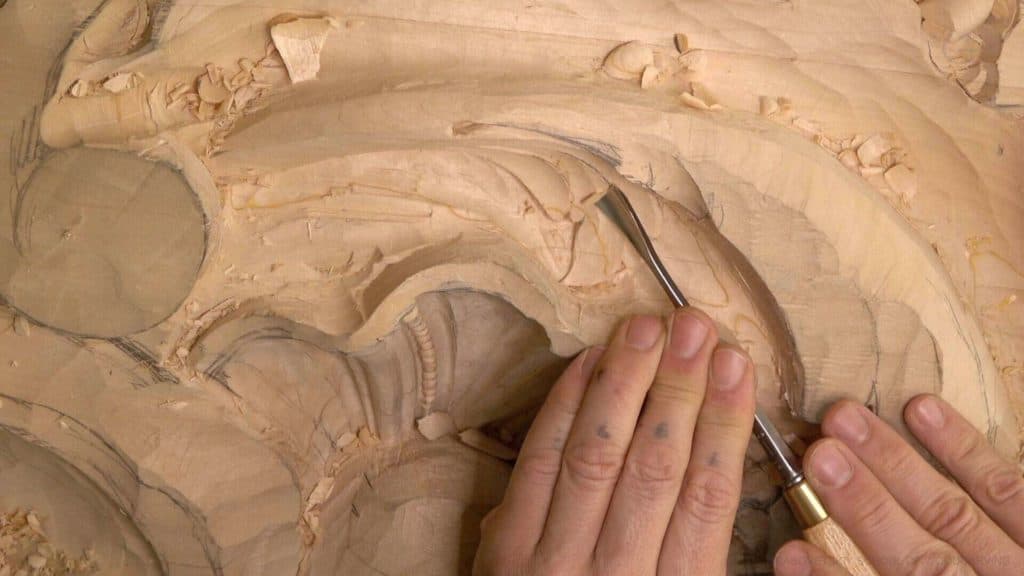
Alexander Grabovetskiy, woodcarver, School of Woodcarving · Published 2020
What does a wood carver mean by "how it behaves"?
Quick answer: In Venice Room 8, part 5, I planned a spoon gouge at four millimeters (near 0.16 in) and then said "Use a mallet." Later, in Venice Room 60, I said what "it" was: my wood. Other lessons of mine say the same words about grain, tool sizes and olive wood.
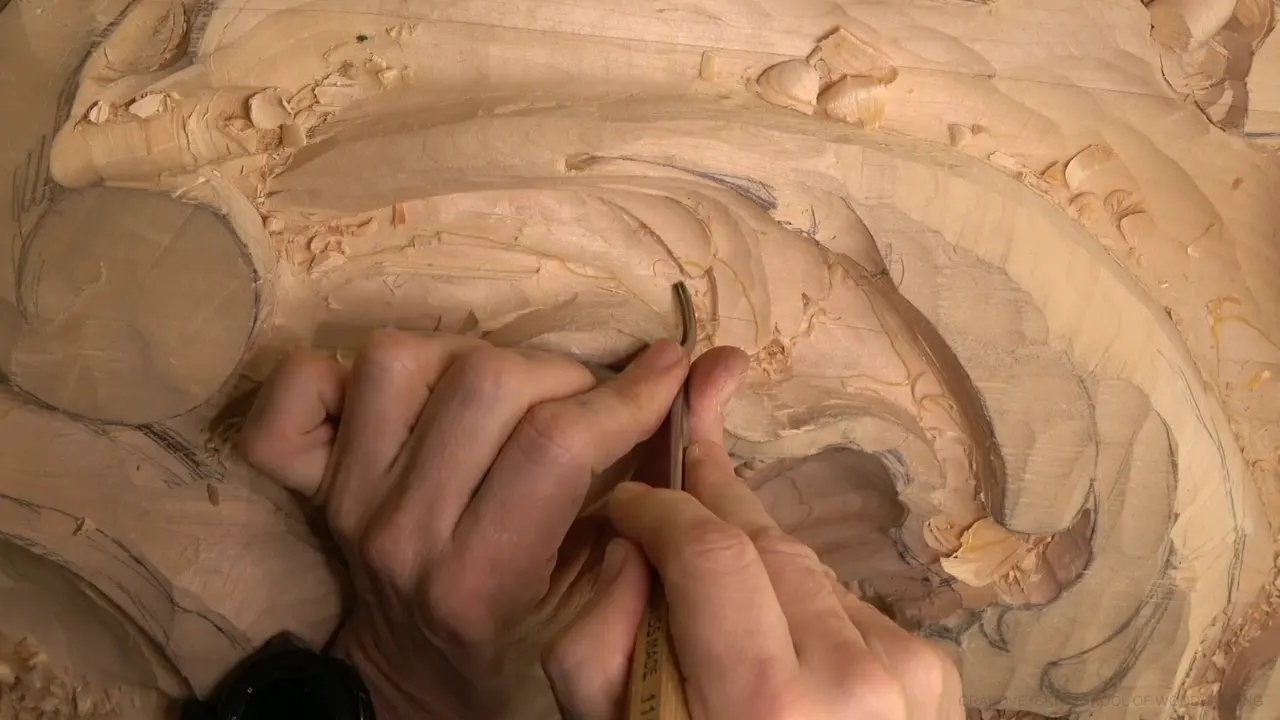

"Use a mallet. We'll see how it's going to behave," I said in part 5 of Venice Room 8. The tool in my hand was a spoon gouge at four millimeters (about 0.16 in), and I would go no smaller than that. Other lessons of mine hold the same line, and in workshop 60 I told you what "it" was.
Ever set a gouge on a spot you have never touched and had no idea what the wood would do under it? Below you get part 5 in the order I said it, a short look at part 4, and then the lessons where the same words came up.
What this page holds
- My words in part 5, in the order I said them.
- One short stretch of part 4, where I named a gouge before I used it.
- Lessons from other courses, grouped by what I was watching: wood, grain, or a tool size.
- A table with one note for each lesson.
Which words came around the mallet in part 5?
Part 5 starts with "Just gradually." Then comes "Okay, I think it's better, much better, at least, again, my opinion." After that, "And now I can start cleaning around" and "I need to use a spoon gouge, of course." My first size was "a two millimeters spoon gouge" (about 0.08 in).

The spot was "a really hard-to-get area because everything is in my way" and I still said "I really want to do some kind of undercutting anyway." Next, "Maybe it's a little too small," so "I use four millimeters" (near 0.157 in). Of the depth: "I don't want to go too deep on inside because I don't want to make it too fragile."
Then came "Same right here, let me remove the mess" and "Let me use four millimeters first." "I'm not going to use smaller than that" was my limit, and the mallet line from the top of this page followed it.

"And maybe this way a little bit" came next. Later I said "And that should be good" and "I'm not going to do deeper than that, at least for now." The mess came up too: "this mess needs to be cleaned, but I can take care of it once I work on this detail."

Still unhappy, I said "So still something not what I want to see." I added "Maybe what bugs me, what you don't see, but I do, I really need to use a one millimeter" (about 0.04 in), with "Kind of remove that waste right here." Then "I also want to create an extra notch" and "Just a micro notch."
Soon after, "I think that's going to complete this part at least" and "I'll use a one millimeter first to relief." My pick was "I can probably use, let me see, number four, I would say will do." And "I hope I didn't dig too deep inside of my background, but it's okay, it's still not finished background, okay?"

About a line: "I still don't like how this line moves." For it I said "I think I need to move it like that" and later "yes, it does look natural." The next plan was "I need to fix overall now, maybe number six again, let me see if number six will work."
The video ends with "And now I think it looks much better." My last words were "Can't create too much pressure, I will make a mistake" and "Okay, that's good, let me leave it, otherwise, I can overdo it."
What does part 4 add?

In part 4 I named a gouge before I used it, and I said what I would reach for if it failed: "Let me try number seven, okay" and "if I still don't like it, I'll just try number eight." Afterward I said "number seven is much better in this case, it gave me extra shadow."
Why not use it from the start? "I have no idea, okay?" Then "Just trying to be safe" and both parts sit on the lesson page for workshop 8.
Which wood did I mean in workshop 60 and 78?
Part 4 of Venice Room 60 has "let me start opposite direction movement" and a sentence much like my part 5 line followed. What I meant came next: "I'm talking about my wood, my block of wood, how it's going to behave, not the gouge." Of the gouge, "I'm keeping my gouge just really super sharp."

Part 4 of Venice Room 78 has "I'm going to do across the grain removal." "I guess I could," I said, and a line much like the one in part 5. Next I corrected myself: "along the grain, I should say, like that."

How did I talk about grain in other courses?
Part 11 of Furniture Panel 16 has my sentence once more, after I said I would try a pass along the grain. Then "Not much, I just want to make sure I'm not making mistakes" and "Chop this way."

In part 3 of Furniture Panel 19 I said "that is a little too dangerous, okay, when you're doing on a turn like this." So "one side could be good, and another side could be big mistake, right? So be careful, you've got to feel it, okay? How the grain of the wood behaves." Later, "there is a limitation how your blade travels, so you always have to attack from two sides."
Part 7, in that same lesson, has "Oh, by the way, not all pieces will behave the same" and with some of the woods, I said, you cannot go as deep. My undercut was "approximate to 3 millimeters deep, so one-eighth of an inch, and I feel comfortable with that." After it, "not all tools will allow you to do that."

Antique Style Rosette 1 has "That is my final cleaning stage." "I'm taking actually less than 10 millimeter" (roughly 0.39 in) came next, and then "now I am watching my grain and how my wood behaves, because right now I can't make mistakes." And "I'm just doing sweeping."

Venetian Flowers Rosette 6 has "Really important not to rush it" in part 1. Then "But like I said, keep an eye the grain" and the sentence ran on about the same thing. I planned to go "one-third of the way from the background." If "the grain creates the problem," I said, "you just attack from opposite side and go all the way to the point."
More from that part: "And sometimes it's a good idea to change the tool and get a smaller tool when you get all the way here."

Roman Acanthus 6 opens part 2 with "Keep an eye how your grain behaves." My tool was "number nine, and that's 10 millimeters" (0.394 in). "In my case, left side is a really clean cut, and that works with the grain, and opposite side works against the grain." Of tools, "they must, absolutely must have to be sharp."
Part 9 of Lily Box 7 has "I'm changing my positions just because of the grain and how it behaves." The rest: "when you're doing a gouge cut" and then "one of the sides is going to be rough and one of the sides is going to be clean," so "you still have to change position no matter what."
Which tool sizes did the Lily Box call for?

Part 7 of Lily Box 5 has "this part is also a kind of weak spot, especially with a small detail like this, so I've got to be really careful how I approach it." Then came "number nine and a quarter inch" (6.4 mm), with a sentence much like my part 5 line. I planned "about 10 millimeters from this ground" (roughly 0.4 in).
Part 3 of Lily Box 6 has "the preliminary concave cut, because I do have other parts coming really close." Next, "Let me try to use the two millimeters" and the same sentence once more. For a miss I said "I'll move down to one millimeter" (close to 0.04 in).

That part also has "This is the funniest spot, I mean, I can see lots and lots of cracks in the wood." Later, "I am spending a lot longer time than I would usually would spend in this area because of the grain."
Lily Box 7 opens part 1 on "I don't know yet" and the sentence came with "I don't know what kind of wood underneath." Next came my plan for a number seven. Then, "I still have to be careful with the small, tiny details like that, so maybe bigger tool is not such a good idea."

Next was "a little smaller, maybe about 10 millimeters" (about 0.39 in). Of it, "Still, it's kind of shaky." Then "if I can use bigger tool, if it's safe, it's always quicker." A catch came with it: "only if it's safe, and I don't think it's safe in this case, so I need to get even smaller." The next tool I named was "number five and a quarter inch" (about 6 mm).

Part 1 of Lily Box 9 has "maybe a big tool" with my sentence after it, this time about my wood. Then "I'm using number seven at three-quarter of an inch" (19 mm). Right away, "Oh, no, it's catching, it's a little too dangerous." For the next try I said "let me use number three and 14 millimeters, half an inch."
That one "still gives me resistance, a little too big," I said, and "I think I need something smaller even." Then "number three and six millimeters, quarter inch." Finally, "Okay, a little better."

What did I say about the wood itself in the Lily Box?
Lily Box 4 begins with "my olive slab was really curly" and I said I did not know yet what it would do. I hoped for the best, and "it should be all right." Right there I added "make sure you are slicing" and "don't just push your tool, okay?" Then "you start at one edge, then you make the rotation, and end on another edge."
The words took a second meaning in part 7 of Lily Box 10. "My biggest fear is how that olive wood is going to hold the detail." About it I said "what I mean by holding detail is not when you're banging at it, I'm talking about the natural movement of the wood" and the sentence came again, this time on the wood once it is dry.

Part 10 of the same lesson has "I'm going to attack this wall, it's old waste, so I need to remove it." For a tool I said "number one and double bevel" and the sentence followed. Soon after, "Yeah, that behaves okay" and "I'll go as much as I can, as long as it carves."
Part 12 has "clean the backside and maybe clamp it." Then "maybe I should use a gouge" with the sentence after it.

Part 2 of Lily Box 11 has "Let's move on the next one" and the sentence with "if I can attack that from this side." "it looks like I need to switch to a smaller backbend right here," I said, and "It has a little lower bevel, okay? So I can hit much better with this one."
Part 13 of that lesson has "start with the number nine" (a quarter inch, I said next), and the sentence came after it. On the wood: "I don't know yet, because I do have lots of voids in wood." Then "Well, I could use super glue and fill it, those voids."

"I don't know if I should or not, we'll see later on, if I don't like how it looks, I'll do that." I also said "maybe I'll just use plastic wood." And "if I would use hide glue, then I would just mix some of the chips together with the glue and just fill it, but hide glue is not as stable, of course, it's just my opinion, okay?"
Which lesson holds which words?
Every lesson below holds my words, with a note beside each one.
| Where I said it | Notes that sat beside my words there |
|---|---|
| 8-5 (Venice Room) | A 4 mm spoon gouge (5/32 in), a mallet, and a depth I held |
| 8-4 (Venice Room) | Seven to try first, with eight if I still did not like it |
| 60-4 (Venice Room) | Opposite direction movement, and the wood named as the thing I watch |
| 78-4 (Venice Room) | Across the grain as a plan, then a correction to along it |
| 16-11 (Furniture Panel) | Grain first, a small pass, and mistakes in mind |
| 19-3 (Furniture Panel) | A turn I called dangerous, and two sides to attack from |
| 19-7 (Furniture Panel) | Pieces that do not behave the same, and an undercut of 3 mm (about 1/8 in) |
| 1 (Antique Style Rosette) | Final cleaning stage, under 10 mm (0.4 in), and a watch on my grain |
| 6-1 (Venetian Flowers Rosette) | Grain that can change direction, and an attack from the opposite side |
| 6-2 (Roman Acanthus) | A nine at 10 mm (0.394 in), and a left side that cuts clean |
| 4-1 (Lily Box) | My curly olive slab, a hope that it holds, and slicing |
| 5-7 (Lily Box) | Nine at a quarter inch (6.35 mm) on a weak spot |
| 6-3 (Lily Box) | Two millimeters first (0.079 in), and cracks I could see in the wood |
| 7-1 (Lily Box) | Seven first, then a smaller tool, then a five |
| 7-9 (Lily Box) | Shifting position for the grain, one side rough and one clean |
| 7-13 (Lily Box) | Voids in the wood, and three ways I named to fill them |
| 9-1 (Lily Box) | Seven that caught, then a three at two sizes |
| 10-7 (Lily Box) | Olive wood and the way it moves once it is dry |
| 10-10 (Lily Box) | Number one with a double bevel on an old wall |
| 10-12 (Lily Box) | Gouge on a spot I wanted to keep from getting too weak |
| 11-2 (Lily Box) | Attack from this side, and a smaller backbend |
Where can you watch part 5?
Part 5 sits inside workshop 8 of the Venice Room course. The other parts of it sit beside it on the lesson page, and everything on the site sits inside the tuition. Sizes here come in millimeters and inches, my own figure first.
Which pass of your own would you like to watch before you commit to it? Pick a gouge the way I did in part 5, put a mallet beside it, and try a small pass on some wood carving of yours.
How it's done
- Start with a small spoon gouge. My plan in part 5 was a 2 millimeter spoon gouge (0.079 in), and then four millimeters (roughly 0.157 in).
- Reach for the mallet. The mallet came out after I set a limit on size, and we would see how it goes.
- Set a limit on depth. No deeper than that, at least for now.
- Let the mess wait. Cleaning the mess could come once I worked on this detail, I said.
- Leave it when it is good. I called it good and said I would leave it. Otherwise, I can overdo it, I said.
Frequently asked questions
What came right after the mallet line in part 5?
A small direction note first, then a verdict, and then a limit on depth. The mess could wait for a later pass, I said, until I worked on this detail.
What was "it" in workshop 60?
My wood, and "my block of wood" at that. The gouge, a different thing, stayed really super sharp.
Which sizes came up in Lily Box 9 when my number seven caught?
A number seven at three-quarter of an inch (19 mm) caught, I said. Then "let me figure out which tool I should use." Two sizes of a number three came next: 14 millimeters (half an inch, in my words), then six millimeters (quarter inch, in my words). The smaller one gave a better result.
What to carve next