
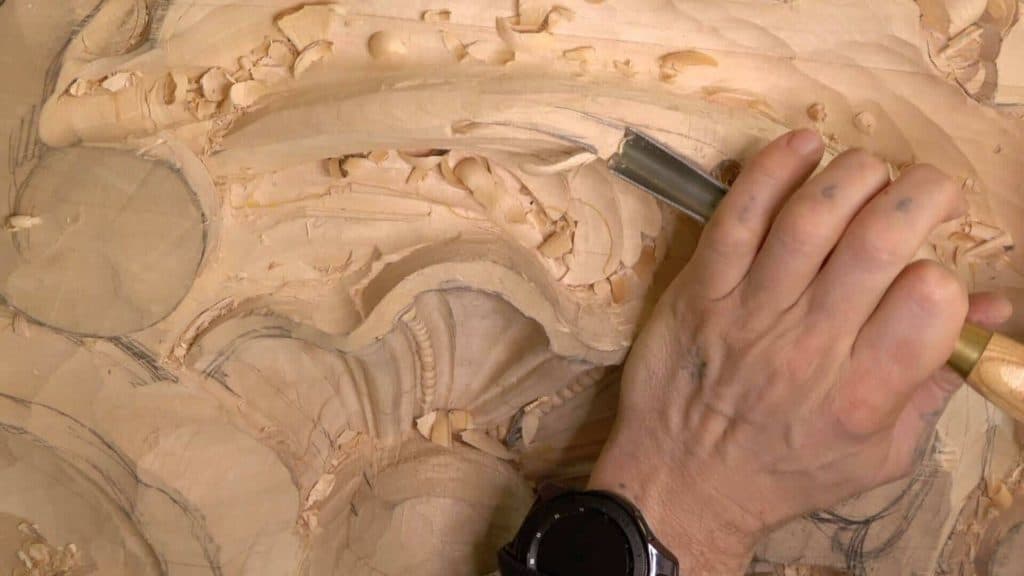
Alexander Grabovetskiy, woodcarver, School of Woodcarving · Published 2020
What does a wood carver mean by "I'd say"?
Quick answer: In Venice Room 8, part 6, I said "I'd say" after "more organic." In other lessons the same two words follow a size in millimeters, or a call on the look like "too sharp," or a tool such as "number five."
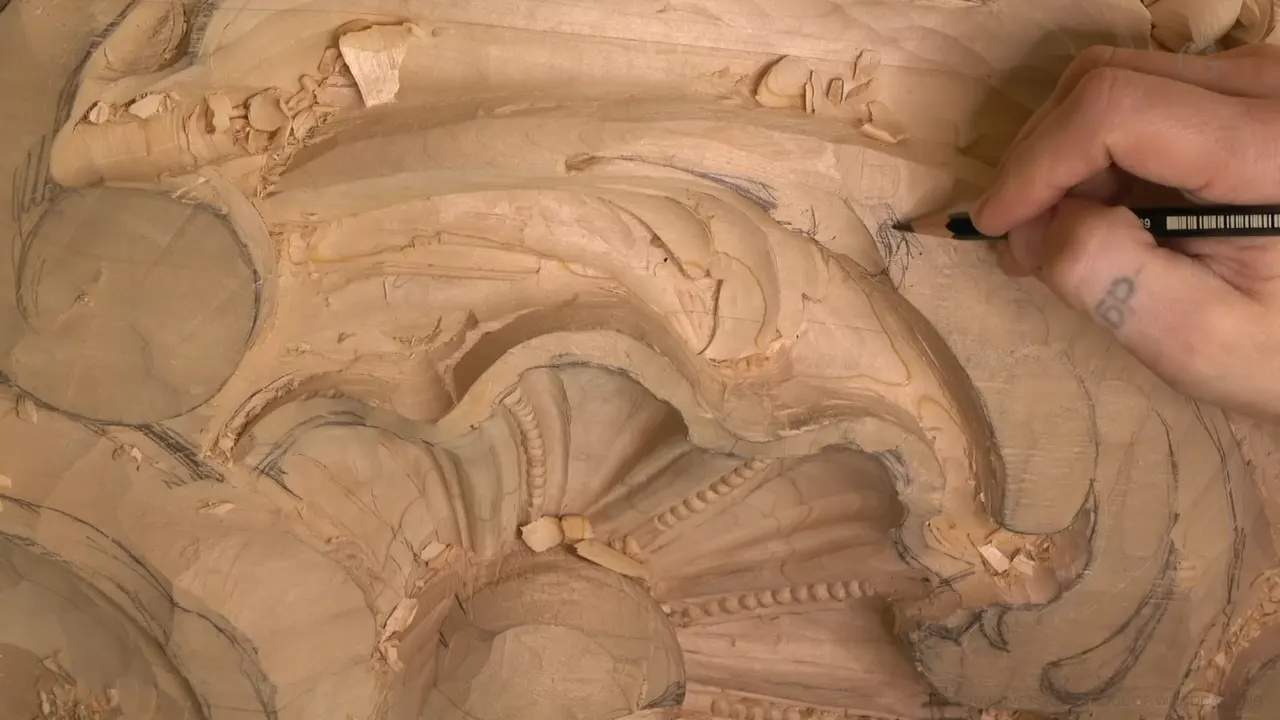

In Venice Room 8, part 6, I said "I'd say" while I planned to make a small movement go downhill and end in an eye. The same two words come after a size in some lessons and after a call in others, and each place has its own thing in front of it.
Ever heard a carver say those two words and wondered if the carver was sure? Is it a guess, a measure, or a taste? Here are the lines side by side: this part, and after it the lessons from other courses where the same words came up.
What was I carving when I said it in part 6?
The part opens with a plan: "I'm going to develop this section." I liked "this small movement I'm able to create," which would go "a little bit downhill," and end in "some kind of eye." Another line: "I could actually add another element."
Next came "Maybe I have to change something," and "Kind of not too happy what I see." One idea is a plan: this could become "the part of upper division," with "I can move it a little bit this way." Another part could be "going from underneath." I also said "don't jump to the conclusion" and "you'll see exactly what I'm developing."

How did I count the subdivisions?
"Maybe I should look at one, two, three and four. That is not enough." My need was plain, "I need to make another subdivision," and a spot for it was "Maybe just right there." The count then read "one, two, three, four, five. That could be good," and "That's good."
Not everything was settled. "I don't know yet about this one," I said, "but definitely I can start working on this small subdivision." That one would be "a pipe," and there would be "a middle part."

For the waste I named number nine. "Let me establish that eye," I said, and "I need to chop little bit right here." My plan was "I'm going to use number nine and remove some of the waste." A note on the flatter gouge followed: "I also want to make it move a little bit downhill, okay?"
What came around the words in part 6?
The call was "more organic, I'd say." After it: "that way it's not going to be a lot of digging for me to do underneath." Then "Otherwise, it's a little too much," and "big but controllable, okay?"
Trouble comes up as a thought right after. "It doesn't mean I can't do that. Of course, I am able to, but if I can eliminate a problem at the beginning, why should I create that?" Next: "let me recreate little bit the movement and make sure I do the right thing."

The eye came up as a plan. "Let me create a big eye right here," I said. The tool I named was "a quarter-inch number nine" (6.35 mm), with "straight down cut" and "Rotate, rotate, rotate."
I said "And yes, I am taking my time for thinking, okay? And just to make sure it makes sense." Right after: "So I'm taking time to think," and I also said "Or skip forward. No hard feeling." Next in the part: "Let me kind of create this blending." And "Okay, that is good."

Later in the part came "a separation," and "Maybe another small separation right there, just a small notch." Then "I still want to dig underneath." And "I want to create deep shadows."
The pipe comes up as well: "Right there is a pipe, convex part." A way to set that convex part apart is a plan too: "I could probably right away create concave cut on the side of it," and "make really distinguishable shadow." It ends on another plan: "to create that pipe, I can go ahead and probably just right away create convex movement."

Which sizes sit beside I'd say?
One is in Venice Room 1, part 14. I said I would use "a smaller number 11" and "half an inch." Soon after: "I'd say it's about half an inch. Maybe about 14 millimeters, I'd say" (0.55 in). The reason for the tool came right after: "Why I like the number 11 because it's a U shape."

Chamomile and Bow Rosette, lesson 2, part 2, gives two sizes. It opens with "a small number 11, one millimeter," and then "It's actually a little bigger than one and a half millimeter, I'd say." That is 1.5 mm (0.06 in). Later the talk is of "different small tools," and "Whatever you have, you can probably use it." A size follows as "one millimeter" (0.04 in), "or even two millimeters" (0.08 in), while "I'd say" comes just behind the second figure. Then "Two millimeters number 11."

Part 3 of Venice Room 90 has a size and a correction. Here is the cue: "Let me also do five-eighths of an inch," and then "Maybe about 17 millimeters" (0.67 in), with "I'd say. Not exactly five-eighths. One millimeter more."

Floral and Molding for the Panel, lesson 5, part 2, gives another one. It reads "I don't know, about six millimeters" (0.24 in) and then "I'd say. About a quarter inch." An idea comes next: "I can just pretty much just grab my drill and drill it. Why not?"

The limit sits in Venice Room 44, part 5. "I still need some material because I still have to develop this part." And "I got to stop somewhere." A size came next: "I left approximately, at the lowest point, about 20 millimeters I'd say" (0.8 in). It adds "That's what I left, about three-quarter of an inch of the material."

In the Carving Hashemi Flowers course, lesson 12, part 5, I said "Okay, let me think how much down I want to go." Then "Maybe just slightly higher than this movement." The figures came as "about maybe 5/8 of an inch overall thickness right here," and "about 16 millimeters" (0.63 in), with "I'd say" as the next words.
The Carving Greek Acanthus Leaf course, lesson 11, part 3, has a tool and a size. "Maybe I could use number seven," I said, and "This one is about 10 millimeters" (0.39 in), followed by "I'd say."
A depth comes in lesson 4, part 5, of the Lily Box course. The plan is "I'll use number 11 again to make my groove cut, or concave cut, I should say," and it "should not be too pronounced at the high spot." Then "I'm not going too deep with this cut. No more than one millimeter, I'd say" (about 1/25 in).

In lesson 7 of Floral and Molding for the Panel, part 3, the phone comes up: "I can hook my phone and show that by flying around." The figure was "it's actually one millimeter, no more." Then: "I'd say it's not really a wall because I still kind of undercut it, but that is how it looks as of now."

Which tools and angles go with it?
Tools get the words too. The line is in Venice Room 18, part 8: "I just like number 11 that I can use the sides of my tool, and I can lay on one of the sides." The reason comes with it: "gives me more flexibility, I'd say, how I use my tool." Number nine would "work also okay," and "Or even number eight will do."
Roman Acanthus 16, part 5, has a need. "It doesn't look too clean," I said of the inner parts. "I need to get smaller, like number five, I'd say." Then "I'll use my number five and kind of undercut a little bit."
An angle gets the words in the Grinling Gibbons class in Maine, lesson 15, part 3. I planned to introduce "that slightly on the angle," so it would be "more slicing" instead of "just pushing." Then "I'm gonna present it about 45 degrees I'd say and I'm gonna start blending."
Which calls on the look go with it?
There is one in Venice Room 12, part 6, said while I looked from the front and from below. "From the bottom, it's actually looking really good. When I look straight, it doesn't look too appealing, but from below, it looks okay." The call: "I probably have to break it slightly. It's just a little too sharp, I'd say." Right behind it came "just slightly break this," and "Even if it's a number 5 and small one, it still gives me just too sharp of a look." And "I'm not too happy about it."

A reason sits in Venice Room 38, part 5. The cues: "excavate a little deeper right here" and "maybe that makes sense to lower down completely underneath of here." "That's going to give me more dimension," then "A more dimensional look, I'd say," and it would be "seen from the bottom."

A call on speed is in Venice Room 39, part 10. It starts with "I need to repeat that division on this side," and "I need to make it a little wider right here." Next came "That's really quickest, I'd say, but it's not always the safest way." And "it's quick, but not too safe."

Part 3 of Venice Room 152 has a good move. "I can lower that down a little bit and make it even more realistic," I said, "like the true flipping motion, okay?" Right after came "that was a good move, I'd say. That was a good move." Last came "round this side also because I really want to see it is more rounded."

The Lily Box course has another one, in lesson 4, part 11. "I have a stubborn grain in this area. Really stubborn. And that's the nature of olive wood, I'd say." Next: "It's harder to carve on a darker wood and easier to carve on a lighter wood. So density is different."

The Butterflies course, lesson 10, part 2, says "those butterflies used to be carved for centuries." And "it's not like original design." The words I'd say sit in "It is historical, I'd say, design." About the depth: "That is only about one millimeter deep" (0.04 in). And "Don't need more than that."

The list ends with a small one in Lily Box 12, part 8. "I really don't have to. Right now it's looking good." The line ends with "Stuff like that shows some more professionalism, I'd say."

Where each video says it, row by row, in one place
| Venice Room video, or the course named | What came before I'd say | My words |
|---|---|---|
| 8.6, this part | A call on how the movement should look once the digging underneath stays small | more organic |
| 1.14 | The size of a number 11, and the reason I like that tool | Maybe about 14 millimeters |
| 12.6 | I looked at the work from the front and then from below, and called it too sharp | too sharp |
| Chamomile 2.2 | The next small tool, which came with a size in millimeters and a number 11 | or even two millimeters |
| Lily Box 4.5 | The depth of a groove cut that should not be too pronounced at the high spot | no more than one millimeter |
| 4.11 of Lily Box | A stubborn grain in this area, and a darker wood that is harder to carve | olive wood |
| 18.8 | Why I like a number 11, that I can lay on one of the sides | more flexibility |
| 38.5 | Lowering the wood completely underneath of a spot, for a look that gives more dimension | a more dimensional look |
| 39.10 | Making a part a little wider the quick way, and the risk in it | the quickest |
| 44.5 | How much material was left at the lowest point, before my final decision | 20 millimeters |
| Butterflies 10.2 | The design of the butterflies on the plate, called a variation and not an original | historical, I'd say, design |
| Floral 5.2 | A depth of about a quarter inch, with a drill as the next idea | six millimeters |
| Floral 7.3 | Whether a part of one millimeter counts as a wall when it is undercut | actually one millimeter |
| Roman 16.5 | The next tool for the inner parts, which did not look too clean | like number five |
| 90.3 | A five-eighths cut that is not exactly five-eighths | 17 millimeters |
| Gibbons 15.3 | The angle for slicing, before I start blending | about 45 degrees |
| 152.3 | Lowering a part to make it more realistic, like the true flipping motion | a good move |
| Lily Box 12.8 | A small extra that I did not have to do, on work already looking good | more professionalism |
Where can you watch all of these videos yourself?
This part sits on the lesson page, inside the first Venice Room course. The other videos live in the courses linked on this page, and in other workshops of the Venice Room.
Would you like to hear me size up a cut in millimeters and in inches? Do you want to see what I do when a spot looks too sharp, and how I call it? The whole Venice Room is open on one tuition plan. This part is waiting in it.
How it's done
- Pick the movement. I wanted the small movement to go a little downhill, with an eye at the end.
- Count the subdivisions. I counted the subdivisions, called four not enough, and needed another one. Five could be good.
- Name the pipe. The small subdivision was to be a pipe, going down, with a middle part.
- Keep the movement controllable. "More organic" and little digging underneath.
- Plan the eye. The big eye got a number nine, with "Rotate, rotate, rotate."
Frequently asked questions
Which two words stood before "I'd say" here?
The two words before it were "more organic." A little earlier I said I also wanted the movement to go downhill.
Which words followed it here?
"For me to do underneath," then "Otherwise, it's a little too much," and "controllable, okay?"
Does I'd say go only with sizes?
No. In Venice Room 12, part 6, it follows "a little too sharp." In Lily Box 4, part 11, it follows "the nature of olive wood."
Which tool did I name for the waste?
What to carve next
- Part 6 sits on this lesson page
- The first Venice Room course
- Venice Room 1
- The Chamomile and Bow Rosette course
- Chamomile and Bow Rosette, lesson 2
- Venice Room 90
- The Floral and Molding for the Panel course
- Floral and Molding, lesson 5
- Floral and Molding, lesson 7
- Venice Room 44
- Hashemi Flowers, lesson 12
- Greek Acanthus Leaf, lesson 11
- The Lily Box course
- Lily Box, lesson 4
- Lily Box, lesson 12
- Venice Room 18
- Roman Acanthus, lesson 16