
Alexander Grabovetskiy, woodcarver, School of Woodcarving · Published 2020
What does a wood carver mean by "almost broke it"?
Quick answer: In part 8 of Venice Room 8, I stopped on a near miss and said I would leave the spot as it was. Other lessons of mine hold a near miss of their own, and I put glue, a smaller tool or a way around the part beside them.
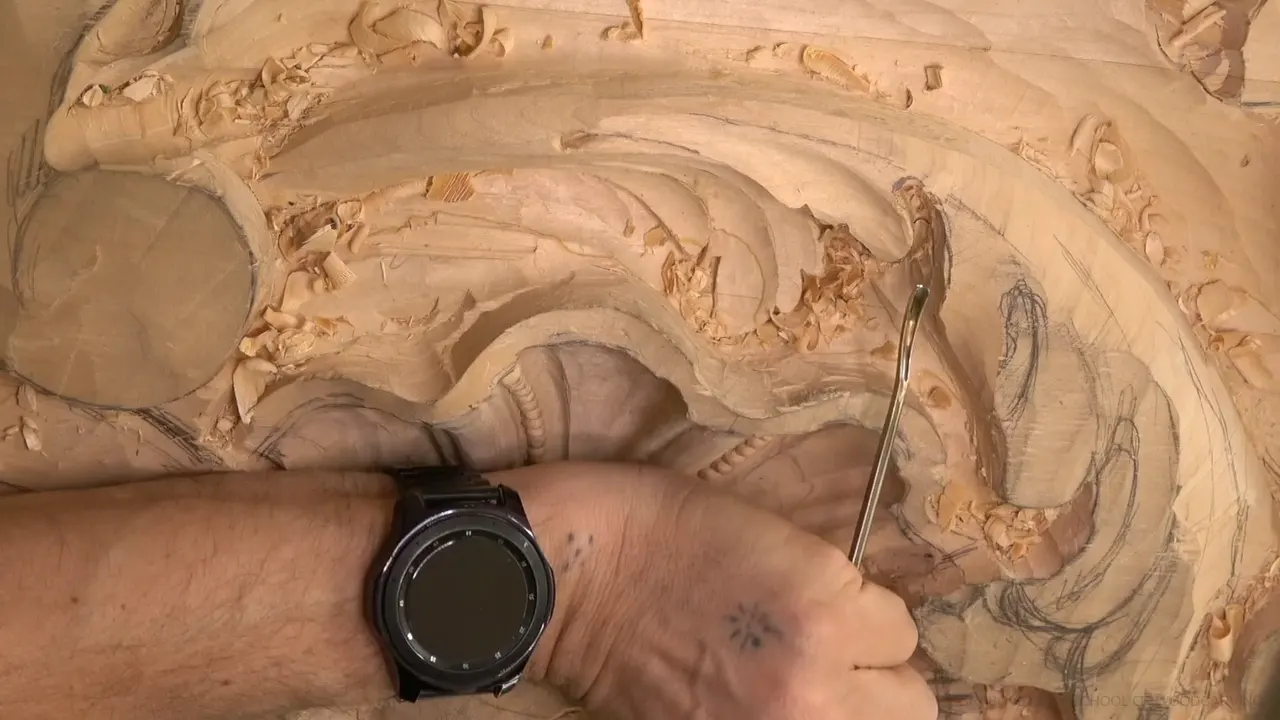

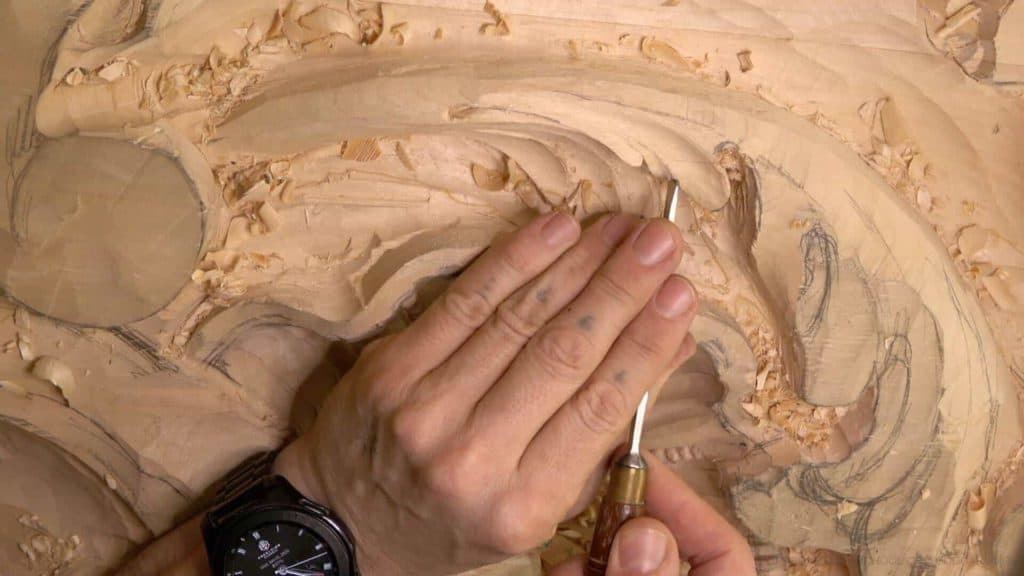
"See? I don't want to break it, and I almost broke it," I said in part 8 of Venice Room 8. Other lessons of mine hold the same words, and beside them I put glue, a smaller tool or another way around the part.
Ever stopped a gouge a hair before a thin part gave way? Below is what I said in part 8, what the two parts beside it add, and the lessons where I said it again.
What this page holds
- My words in part 8, in the order I said them.
- The two parts beside it, with the plans I stated there.
- Lessons from other courses where my words were the same, each with the fix I named.
- A table with one short note for each lesson here.
What did I say in part 8?
I started with a gouge called a back bend, for the undercut. "See? With the back bend, I can go really deep and nothing is in my way," I said. A warning to myself followed: "But I still have to keep it strong because I can go to the extreme and make this too weak, and that is not what I want to do."

My plan was to "attack that from both sides and connect those two cuts." Of what sat inside I said "it is waste, which is controllable now" and "It's not connected to the upper part, and not connected to this one." The tool was "number 11 and maybe five millimeters" (close to 0.2 in). "Let me try," I said. Afterward came "I can easily take care of it."
Then a smaller tool: "I still have to probably use a small number nine and maybe just create a couple of straight-down cuts." The line at the top of this page sits just after that plan. I said "That is not good" and added "Especially in this stage, it's not good."

What I said next was my plan for the spot: "I'll leave it like that because it's going to be a lot easier to attack once I get this done." I called it a mistake and named what I did: "That is a mistake what I've done. I just attacked too deep right away, but that's okay." Last in that stretch came "I guess it is not the first mistake I made."
Next came a concave, and a ridge to make. "I could just put a concave right here," I said, with "a ridge, which is going to create a micro pipe look." For both I used a number nine, "a quarter inch" (6.4 mm). On sharp points I said "I don't want to see sharp points, at least on this design." In the same stretch came "Make it more round" and "I still want to clean a little bit this direction."

Near the end of the video I talked about mistakes. "I've got to be careful," I said, and I named how it happens: "when you're doing all day long and spending too much time in one spot." Of the mistake itself: "It's not really a deal-breaking mistake." Then "Still no problem." Near its end I said "Clean a little bit with just a skew chisel" and "Maybe undercut."

What do parts 7 and 9 add?
The video before it, part 7, sits in the same lesson. "Well, actually, I need to separate this small notch," I said there, and a "good idea to do it right away" came with the plan to "separate and create preliminary notch." Another line there: "It doesn't look too clean right here." And "So let me clean it first." Further on I said "I need to switch to smaller tool and just continue excavating." About depth, I said it would be "much harder to clean" if I went too deep.

The next one, part 9, holds the same trouble in a new spot. "Let me clean right here a little bit, but I can't because I made it too weak," I said. Of a piece: "I need to glue it" and later "And I'll glue it back." Of the next movement I said "I'm not sure smaller or bigger."

Which fix did I name in the Roman Acanthus Leaf?
In Roman Acanthus 16, part 1, I had a number five in my hand, "5/8 of an inch or 16 millimeters" and I made a remark about the tool: "I could use just a knife also." Later my words were "Looks like I almost broke this part, which is not good."
Then I told you the fix. "And if you would ask me how to fix it, here you go." "That's the fix." "Just glue it back." "It's better not to break it," I said, and "Sometimes it happens." Soon after, I said "Let me refine this cut a little more" and "Make it look nicer." The pipes were next: "Those are eyes, and I need to exaggerate those pipes."

Later in the same video came another plan: "I'll take a small gouge, like number eight and eighth of an inch" (1/8 in is 3.2 mm). On the video I said "Nope. I completely broke it. Probably should take care of it right away." My idea for the fix this time was "good idea to use not just the glue, but maybe a small toothpick."
Which lily box videos hold the same words?
In Lily Box 11, part 7, I said earlier "if you feel a lot of resistance, just try to resharpen your tool." "That's not good that I touched," I said, and "So I got a little bit of glue right there." Another line was "hold your breath." Then "Okay, let me see what happened right here." What followed matched the part 8 video.

On the fix, I said "One of the ways I could fix it" and later "It just proved to me that it's holding good." I named a clear super glue, with "Just penetrate this area a little bit." Where it went did not matter much to me: "I'm okay with it going everywhere because I'm still going to work my final detail on it." Then, further in, "each cut, each chip makes it more and more fragile." Another idea: "Maybe I should use a magnifying lamp or magnifier to do that."
In Lily Box 5, part 5, I said "if it fights, if it's not removing, that's okay." Then "Oh, that's fragile." Then came the near miss, matching part 8, and a wall: "Now I need to remove this wall." And "That wall is on my way, and that's why it's fighting." Next came "number 11 at first" and "carefully."

A crack showed up inside. "Looks like I created a crack on inside. But it's okay," I said, and "I really like it." The crack: "It's not broke completely." My plan for the crack was shellac or whatever the finish, and "it's going to be glued back."
Later in that part I thought about a downhill cut. The tool I named was "the number three," to "give a nice edge." "Now it's just too rugged," I said. Next: "This part is fragile, almost broke." And the plan: "Maybe I just have to put some glue in it."

How did I describe the CA glue?
In Venice Room 77, part 8, the plan was this: "I need to remove this section, kind of blend that section." I added "I'm pretty sure I can just hold it and attack that from opposite side." The near miss came just after that line. It matched part 8, and I said "Little too aggressive, I guess, today."
About the glue: "Now, what I did, I actually fixed this part with the CA glue." I do not like it much. "I really don't really like the CA glue, but in this case, it was a good one I used." "that's a super fast, and really thin," I said of it. Of its look I said "It's just like water, almost."

"it penetrates all the way through," I said, and "So it actually stabilizes this area, and that's really solid pretty much." The wood is paint grade, so "I really don't worry about it." The other side: "it's not going to probably last too long" and my figure was "it's usually just about five years, 10 years at all." And "Depends on the brand."
Next, "I have to find a solution how to reinforce the backside." Another way was "I have to either glue that part to something else," or "reinforce it on the backside if I want to do the CA glue." About my cuts: "So don't have to be too aggressive with my cuts." And "It is not good idea." My next move was a clamp: "I can probably just clamp it and just attack this side." Any clamp will work, I said.

Which tool came next?
In Venice Room 119, part 1, I started with options: "just a knife pretty much, or I could just use any gouge, maybe like a #7." Then "#7 will work really good," I said, with "#7, 14 millimeters" (near 0.55 in). "First division pretty much done," I said. Then "If I'm going to force it, I'm going to break it." A near miss followed, matching part 8. "Now do the second one," I said, and later "It looks good in my opinion."

In Venetian Flowers Rosette 3, part 4, I said "a two millimeters number nine" and told you I would "go right inside of this hole." My caution was "I have to be careful because this is fragile." After the near miss, which matched part 8, came "Maybe I need to use even smaller one." The size was "1.5 millimeters" (roughly 0.06 in), to "excavate inside like this."

Which other words did I use for the same near miss?
In Furniture Panel 19, part 14, I apologized first for the light that changes in the video. "I'm using magnifier lamp right now," I told you, and "when I bring that lamp closer, it just automatically changes the color and exposure." My tool was "16th of an inch" (1.6 mm). The words were "I pushed too hard and I almost lost this part, so be careful when you're doing the micro details like that." My next plan was "about 64th of an inch deep right here" (0.4 mm).

The words "I almost lost a detail" sit in Furniture Panel 17, part 9. Earlier in that video I said "a 45 is going to give you a better result," about "45 degrees approximately versus the straight line." "So got to go around," I said, and "Wasn't careful." About the wall I said "don't dig in the wall itself, okay?" And "So it's better to clean later." "It's a tiny, small detail," I said.
In Roman Acanthus 13, part 2, my small tool was a number three, "only about eighth of an inch" (3.2 millimeters). "It's a really handy tool to have if you have a situation like that," I said of it. Around it, "I've got design on the right-hand side, on the left-hand side." "It looks like I've almost lost my pipe," I said.

The eye came in Roman Acanthus 4, part 4: "I almost lost my eye." Beside it I said "that would be much more safer if I cut from outside in."
The last of these is Furniture Panel 20, part 7: "See? I still kept the part. Almost lost it." "I saw the movement, but I kept it," I said. My own comment on it was "So that was not too wise to use the tool right away and remove the background."

Which lesson holds which words?
Every lesson below holds my words, with a note beside each one.
| Where I said it | Notes that sat beside my words there |
|---|---|
| This part, 8.8 | Number nine to try, the near miss, then a concave plus a ridge |
| Parts 8.7 and 8.9 | Notch to separate, a smaller tool as a need, a piece made too weak |
| Roman Acanthus 16 | Number five at 5/8 in (16 mm), glue, then a toothpick |
| Lily Box 11 | Little glue, a held breath, a clear super glue |
| Lily Box 5 | Wall in the way, a crack inside, shellac and glue to come |
| Venice Room 77 | CA glue, five to ten years, a clamp |
| Venice Room 119 | Number seven at 14 mm (near 0.55 in), then a second division |
| Venetian Flowers Rosette 3 | Two millimeter number nine, then 1.5 mm (roughly 0.06 in) |
| Furniture Panel 19 | A 1/16 in (1.6 mm) tool pushed too hard, and a magnifier lamp |
| Roman Acanthus 13 and 4 | Pipe and eye, number three at about 1/8 in (3.2 mm) |
| Furniture Panel 17 and 20 | Detail to guard, a path around it, a part I kept |
Where can you watch part 8?
Part 8 sits inside workshop 8 of the Venice Room course. Its neighbors sit beside it on the lesson page, with workshop 7 before it and workshop 9 after it. Everything on the site sits inside the tuition. Sizes here come in millimeters and inches, my own figure first.
Which thin part of your own wood carving needs a smaller tool? Pick one, and keep some glue close.
How it's done
- Leave the weak spot. "I'll leave it like that," I said.
- Pick a smaller tool. Part 7 holds "I need to switch to smaller tool."
- Add glue. A lily box lesson holds "Maybe I just have to put some glue in it."
- Use less force. "It is not good idea," I said about aggressive cuts.
- Go around the detail. "So got to go around," I said about a detail.
Frequently asked questions
Which words followed the near miss in part 8?
"Especially in this stage, it's not good." After that I left the spot for the moment and moved on to a concave and a ridge.
How did I react to the mistake in part 8?
I called it a mistake, and I said "that's okay" in the same breath.
Which fix came with the Roman Acanthus leaf?
The glue came first, and "a small toothpick" beside it came later in the same video. I also said "It's better not to break it."
How long did I say a CA glue holds?
What to carve next