
Alexander Grabovetskiy, woodcarver, School of Woodcarving · Published 2020
What does a wood carver mean by "I still think"?
Quick answer: In part 9 of workshop 8 the words "I still think" came while I named the next piece, and next I said I was not sure of its size. In other lessons the same words come before a bigger concave, a wider convex, slicing and a green paste.
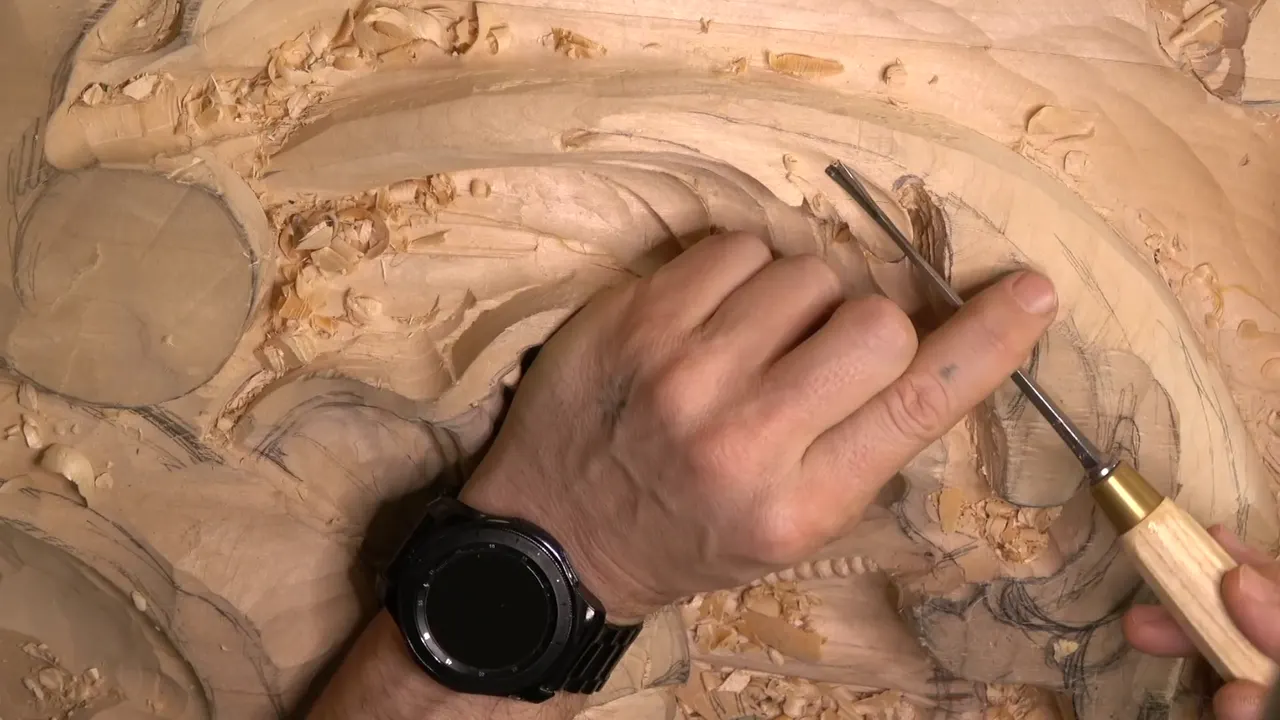

In Venice Room 8, part 9, I said "I still think" while naming the next movement. After that I said I was not sure it should be smaller or bigger. Those three words come out of my mouth in other lessons too, and this page walks through the ones I read, each with its place.
Have you ever heard a carver say that over a half-finished leaf and wondered what comes next? Part 9 comes first. After it come the lessons where I said the same three words, from a bigger concave to a green stropping paste.
Where does it sit in part 9?
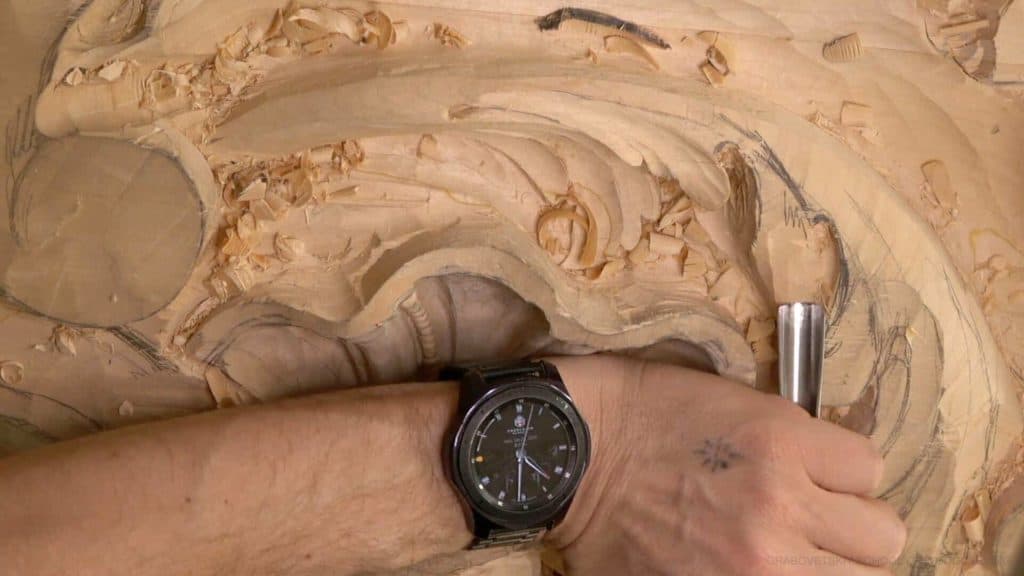
"Okay, let's move to the next movement." Then: "I still think I have to probably separate, which is going to be this one." The size came next: "But this one I want to make, I'm not sure smaller or bigger." "Let me think what I should do," came next. Then, "Maybe a little bigger than that one, okay?" I added that this was what I was going to do, and a second idea came with it.

One option was to "actually go underneath of that one," and to "bring that one on inside." The eye needed a place too: "somewhere right there." Next, a plan to start excavating and bring "this element down a little bit."
The plan for the tool was number nine, with "16 millimeters at first" (about 0.63 in).
What else did I plan for the leaf and the eye?
Further on, an offer: "like I said, I could bring this leaf a little bit underneath." And: "It's still not going to go all the way to the background." Then "what I could do, I could just develop a really beautiful movement." The eye: "let me create my eye."

Another option: "take this one down and make it, like I said, going underneath." Next: "So kind of blend." Here is my reason: "because I want to make a nice separation and I don't want to repeat myself everywhere."
Next, a concave cut: "preliminary, I'm going to create a concave cut." It was to sit "on the side of the future pipe," and I named "the same number nine and 16 millimeters" (about 0.63 in).
What was I doing before that?
The part opened with a need: "again, number 11." Then: "And clean a little bit underneath a little better." Then "And now it looks good," and a plan: "let me do second attempt of cleaning here."
"See, I need to glue it. I need to break it and glue it back," I said, "but let me work on that one, okay?" Then: "So let me leave it alone, for now, at least, okay? And I'll glue it back."
"I hope you can see some of the development," I said, and "it should look good." A slight concave was on offer: "Maybe just a slight concave on the side right here," to give "an extra shadow." Then: "Maybe not. Maybe it was not necessary."
And a thin spot: "let me clean right here a little bit, but I can't because I made it too weak."
What do the parts on either side say?
Part 8 opens with a thought about the room, which would be "most visible at night," and how the light affects its shadows.
Part 8 carries the word "still" as well: "But I still have to keep it strong because I can go to the extreme and make this too weak, and that is not what I want to do." Another: "And I still want to clean a little bit this direction, but I've got to be careful."
Part 8 also has a mistake of mine: "That is a mistake what I've done. I just attacked too deep right away." And: "I guess it is not the first mistake I made."
Part 10 opens with an edge I did not want to lower too much, "because I really still want to see the overall form unified." Later: "I still don't kind of like it." Then: "Overall, just doesn't feel like it's flowing. So I need to move this line little bit this direction." What I wanted: "the right type of acanthus," and "really authentic to that era."
There I was using number nine at a quarter inch (about 6 mm), "and the help of a mallet," and I said "At some point, I have to switch to a spoon."
Does the phrase come before a bigger cut elsewhere?
Workshop 14, part 12, is where I called my work "just giving the main shape." The words "I still think" came before "I should give a much bigger concave right here. I want to raise this edge even more." Before raising it: "let me actually hit that bit, that tool, and make it really nice and smooth," "Where it doesn't have any high spots." See workshop 14.

In workshop 31, part 9: "I need to see from all the positions," and "I don't want to overdo it." Right after, "I still think" led to "chop a little more right here." My skew was an option, to "give a little better shape," and I added "I'm not too happy about how far it is."

Over in workshop 102, part 1, I said "create a really good shadow spot in this section, create a really deep cut," and "I have plenty of material till this corner, this edge."
Then: "You know what?" "I still think" led to "do just a convex in this area a little wider." Next came "number 11, and I'll take 10 millimeters, three-eighths of an inch." I also said "I really want to exaggerate this area and create beautiful shadow," and "I have to keep an eye how it flows, this line."

And a spot I did not yet know how to attack?
Workshop 17, part 7: "That is not bad, except I still think a couple of ways I could attack this one." I followed it with "I don't know" and "Let me think," and then "let me use, again, quarter inch number nine" (a quarter inch is about 6 mm). Then "double think, and maybe just" a concave cut "on this side of my movement."

In lesson 20, part 2: "And I still really want to create a convex." And: "Nothing stops me because I still have material." "I still think" was followed by "I'm able to," and then "what should I do? How should I do it?"
Later in that part I asked "What tool should I use?" and answered "Maybe a number three or maybe number five." In the same part, an idea about the pipe: "maybe even, I can just do opposite direction pipe." Not a convex, I said, but "the concave pipe," so as to "create overall movement like that, which is also common technique even if it doesn't make any sense because usually you want to see that pipe as a convex."

Did I still want a detail I could skip?
In workshop 31, part 4, I said "I don't have to, by the way." Then: "I still think it's going to look better if I'm going to create some kind of details." The plan: "let me create a concave right here. Not really deep." For the tool: "Number 11, that's what I'm using."

Lesson 33, part 6 (workshop 33): "I could leave it actually like that, without extra separations and so on, but I will do extra separations." As to the look, "I still think" was followed by "it's going to look really nice." Tool and size: "Three millimeters is what I'm using right now, number 11" (about 0.12 in). "I can go as deep as I wish and create beautiful shadow," and "I'll make the decision how deep I'll go a little later."

Workshop 34, part 5: "Still not too happy with the position of this eye." Then: "So I could get by without the eye." Next: "I still think the eye will give me really beautiful movement." I wanted no dip: "it has to follow the overall movement very much."

In the Hashemi Flowers course, lesson 6, part 3, I said "you can see the cuts are kind of rough, and I really don't like how it looks." Then: "Let me get the number seven, 10 millimeters, but the spoon gouge, and attack that from the right position with the grain." The 10 millimeters are about 0.39 in.
Even if I would not see too much of the ridges, I said, "but I still think" the cut would look better.

Tools and wood, then?
Hashemi Flowers 15, part 3, is about slicing: "on almost all of my cuts, I do my slicing, like a carver's cut is how we call it." And: "Even if I feel like I could just push it and I can get really good results, I still think slicing will give you a much cleaner cut." "And I'm not forcing it, I'm just taking my time."

In Hashemi Flowers 19, part 3, my V-tool needed a strop: "It looks like I need to strop my V-tool." With "Just the leather and the green paste." About that paste: "I still think it's one of the best, although other pastes are also going to work."

The Maine Coast sharpening class, part 1-7: "you just take your ceramic stone and establish that micro bevel on inside." "It doesn't have to be big." About the wire edge: "I still think that the wire edge we're creating, it's better when it falls out on its own than you just force it back and forth and then it falls."
In Hazelnuts 3, part 3, I said "I am still thinking about the grain direction and so on." The reason, in my words: "I am working into the grain." "You can barely see any cuts I make," I said, and I did not want "to catch the grain and split the thing." And "tools, they must be sharp, especially if you're working into the grain."
In Furniture Panel 16, part 11, there was a big crack: "So it's a big crack. I can see it." "Before I started the design of it, I already knew about those cracks." Next: "I still think this wood is beautiful."

Then: "people who used to build furniture in 19th century, they were not as picky." "They didn't waste a lot of material as we're doing right now, especially with the walnut." "Nowadays, if there's a little sap, people cut this out and throw away, but it wasn't the case back then." "They would use it. Absolutely, they would use it."
And in Venice Room 64, part 4, the words were about live streams: "I just thought, and I still think live streams are really good, but I need to figure out what is going to be the best approach."
One row for each place I said it
| Lesson | What I was talking about | The tool I named, if any |
|---|---|---|
| 8.9 | The size of the next piece, and where the eye goes | Number 11, then number nine |
| Part 12 of lesson 14, in the Venice Room | An edge to raise even more | Just "that tool" |
| 17.7 in the Venice Room | A spot with a couple of ways to attack it | Number five, then number nine |
| 20.2 | A convex I still wanted, with material left, and a pipe turned around | A back bend with number five |
| 31.9 | A little more chopped, without overdoing it | A skew |
| 33.6 in the Venice Room | Extra separations I could have left out of it | Number five, then number 11 |
| 34.5 | An eye, and a dip | None named |
| Hashemi Flowers, lesson 6, part 3 | A cleaner cut, though the ridges will hardly show | A number seven spoon gouge |
| Hashemi 15.3 | Slicing, even when a push would give good results | The same tool, on its edge |
| Lesson 16, part 11, in the Furniture Panel course | A crack known from the beginning | None, it was about the board |
| Hazelnuts 3.3 | The grain direction, and sharp tools | None named |
| The Maine Coast sharpening class | A wire edge that falls off on its own | A ceramic stone |
Where can you watch these lessons yourself?
This part sits on the lesson page for workshop 8, inside the first Venice Room course. Other Venice Room lessons named above: 14, 17, 20, 31, 33, 34, 64 and 102.
The Hashemi lessons are 6, 15 and 19. The Furniture Panel one is lesson 16.
Would you like to watch me stop in the middle of a cut, say what I still think, and then carry on in the wood? Do you want to hear what I do about a spot I made too thin? The whole Venice Room is open on one tuition plan, and this leaf is waiting in it.
How it's done
- Say which movement is next. It was the one I still thought I had to probably separate.
- Say what you are not sure of. Not sure about the size, I said I would think about it.
- Pick a size. A little bigger than the first one, maybe, was my pick.
- Pick a tool. Number nine, in the size I named at first.
- Plan the next cut. A preliminary concave cut was my plan.
Frequently asked questions
Right after "I still think," what came next?
Unsure about the size, I told myself to think what I should do, and I settled on maybe bigger than that one.
Which tool did I name?
Number nine, with the size I named at first, and the same pair again for a preliminary concave. The part opens with number 11.
And the weak spot?
"I can't because I made it too weak," I said, about the spot I wanted to clean. Before that, I said I needed to glue it, and to leave it alone for now.
Did a bigger cut follow the phrase in other lessons?
What to carve next
- This part sits on the lesson page
- The first Venice Room course
- Workshop 14 and a bigger concave
- Workshop 17 and ways to attack a spot
- Workshop 20 and a convex
- Workshop 31 and chopping a little more
- Workshop 33 and extra separations
- Workshop 34 and the eye
- Workshop 64 and live streams
- Workshop 102 and a wider convex
- Hashemi Flowers 6
- Hashemi Flowers 15 and slicing
- Hashemi Flowers 19 and stropping
- Furniture Panel 16 and a cracked board
- The Maine Coast sharpening class
- Hazelnuts 3 and the grain