
Alexander Grabovetskiy, woodcarver, School of Woodcarving · Published 2020
What does a wood carver mean by "yesterday"?
Quick answer: In Venice Room 9, part 3, I said "I like it much better than what I saw yesterday." In other lessons the same word sits beside a concave that was not deep enough, a design detail I wanted to wipe out and a curl I wanted to expose more.
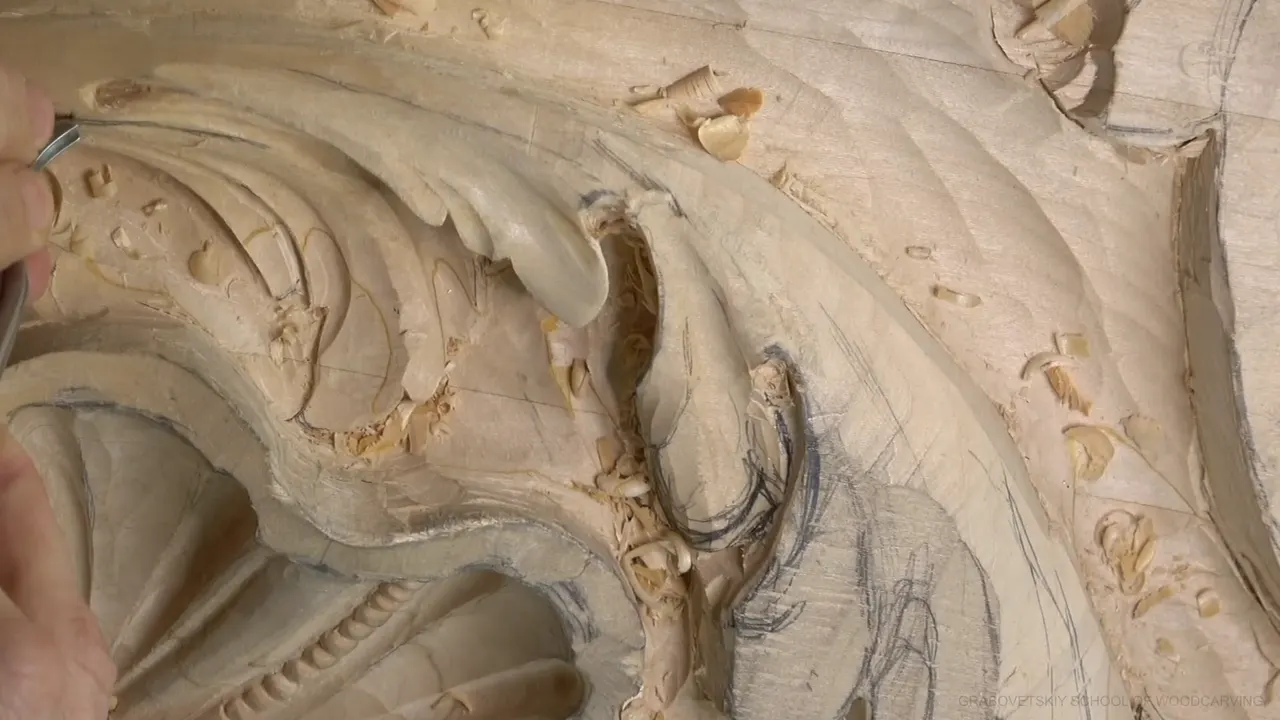

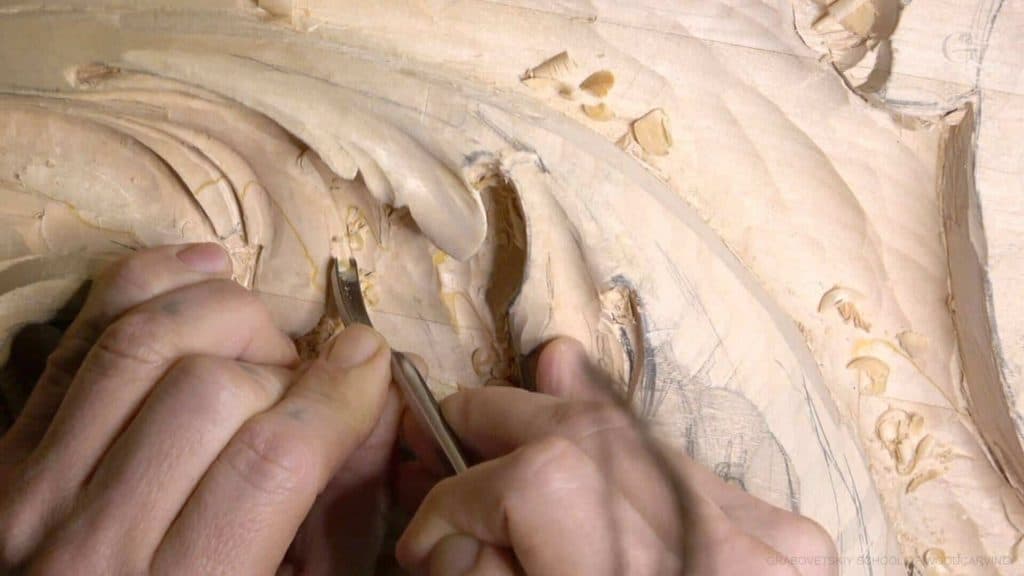
In Venice Room 9, part 3, I said "I like it much better than what I saw yesterday" after I mentioned the glue line between those two layers. The same word turns up in other lessons, each time beside a different piece of carving.
Ever looked at your carving the next day and liked it less, or more? Yesterday shows up in my wood carving videos. Here is the line in this part. After it come the places in other courses where I said it, with the course and the lesson named each time.
What was I carving when I said yesterday in part 3?
The part opens with a plan to round something: "And now I need to make it more roundish, so I have to break that edge." "And I'm going to use back bend again," I said, and then "Let me think which one is going to be the best option for this." Next came "maybe this one will do," and "Double check."
My goal was a better cut with the number 11 "right here beside this one." Then: "It just doesn't look right." I wanted to go "all the way to my future pipe," where the cut would sit "on the side of the pipe." The pipe was a plan for later. "But again, that is in future."

History came next. "It's Italian style," I said, and "Greek and Roman cultures, they really actually like smooth surfaces." They "used to work with marble and stone, and you never would see any rough marks."
Then a maybe about sanding: "I probably could use a sanding." It would be "even more authentic, I would say, to the original, if I'm going to use a little bit of sanding." "I don't have to, but I think I can create an even better look that way."

Back at the wood, a plan: "Let me attack from this side until I blend nicely." Next, "That is much, much better for me, except I still have to kind of create this shape right here." The shape was "still not the shape I want to see right here." A new idea followed. "Maybe I need to use a bigger back bend."
How close was I to the glue line when I said yesterday?
"I am right on the glue line between those two layers, which is okay." I needed to "create that shape, otherwise it's just not going to look nice," and "just because of the glue line, I can always probably create micro concave somewhere."

The line from the top of this page comes next: "Okay, much better. Okay. I like it." After that I said the part "falls right on the glue," so I "could probably just give a small, not big, but small concave cut."
For the small hollow I planned "number 11 again," to "excavate right beside like that. And gradually going to move out." About the light: "Just a small indication, which I really don't see with the light I have right now."
Then the mess: "Okay, that is all junk on my way, and I can't even see what is going on right there. Let me brush it."

A tool I had not used much came up: "maybe it's a good idea for me to try again to use my new addition, which I didn't use too much before." The aim was "smoother transition right here." Next: "Maybe it's a little too aggressive there," and "they're grabbing a lot." After "Okay, got a different one," I said "It's not that convenient. Can't even get it."

"Can't do that." Then "let me use just the back bent again, the old way." The part ends on a question: "Find the right one, and what should I do with that?"

How did the next video treat the micro concave?
Part 4 takes it up again. "I found when I researched, they created really small micro concaves on inside." They were "not distracting ones from the main form, I would say." My tool was "number five," at "3 millimeters, 1/8 of an inch," and they "break the light and create small shadow."
When did I say I did not do enough yesterday?
Venice Room 5 has it first, in part 10: "I don't think I did enough my number seven cuts when I was working on it yesterday." "I should create little deeper, but it's okay," and "I should be all right."

A challenge followed. "I don't want to destroy the chunk of wood for future acanthus, but I still need to somehow attack this area." My choice was "small one," then "Small number three." And then: "Maybe big again."
Later in part 10 the word comes back: "if you would ask me why I did my concave cuts in the middle yesterday, if I still have to go all the way." Without those cuts, "it would be much harder for me to get a really consistent look."

The next video, part 11, says it too: "I did not do enough concave yesterday. And it's okay. That's fine." After that, "So we can always dig deeper with no problem." "Clean it." "Just shave slightly."

Which tool or idea went with yesterday in the other courses?
Corinthian Acanthus Leaf, lesson 3, part 2: "Okay. I guess from yesterday, I need to touch it up a little bit." Then the main movement. "I see the center line somewhere from this point." It would be my "high point," I said, and then "go downhill this way."
Byzantine Acanthus, leaf 3, part 1: "So remember yesterday, I said everything's supposed to be connected." There was "an invisible center line, right in the middle somewhere." The points of the leaves had to be connected to "that central line."

Leaf 2 of the same course, part 1, gives the size of a tool: "take the biggest tool you have." Mine was "number nine, which is a half round, if you remember yesterday." I added "you could use even bigger," and said my number 11 is "30 millimeters" (1.18 in).
"Keep approximately three-eighths of an inch on the sides" (9.5 millimeters), I said, and "So about 10 millimeters" (0.39 in).
In leaf 4, part 2, I said "So what I told you yesterday, I told you yesterday about separations inside of those leaves." The plan was to "divide that in three." "Each of those, we're going to divide in three."
In Modern Acanthus, lesson 4, part 1, I said "So some of you miss the point yesterday," and "I mentioned that yesterday." And "let me repeat that one more time." For the tool, "you have to grab a spoon gouge," and "It would be 10 millimeters" (0.39 in) in your case, and "number 11" in mine.
The Tray of Blessing, Cabernet Sauvignon, lesson 3, part 2, had a curl on my mind: "I don't wanna forget about that curl." The next line was "I, with the same tool that I used yesterday." My plan was "number 11, three millimeters" (0.12 in), to "create my first initial cut."

In How to Sharpen Micro Tools, lesson 3, yesterday sat in a chip: "that is chip from my yesterday's carving, you wrap that sandpaper like this." The paper was "a 220 sandpaper," and it "creates that inner bevel." That bevel was "one millimeter" (0.04 in), "but you can do even half a millimeter" (0.02 in).
A tool got the word in Venice Room 52, part 2: "I used that a lot yesterday. It's cool." Next, "I can just use one tool and create whatever requires multiple tools."
Did I change my mind about anything I said yesterday?
Venice Room 22 brought a small curl backward, in part 12: "I just thought maybe I could curl it a little bit right here. Small detail." The line was "I know yesterday I said maybe it doesn't worth it." Also: "I think it's going to be nice detail."

In Carving Furniture Panel, lesson 17, part 1: "Oh, by the way, I looked yesterday at my design, and one of the areas I kind of doubt I like." I went on with "I don't need that detail. So let me wipe that out." And "Like I said, we're going to make some changes on the go."

Then: "Probably originally I wanted to get parallel to this diagonal, but that doesn't look organic." Next, "I think it's going to look much better, just a stopping point right there."
A late look came in lesson 6 of the tray course, part 1: "Another thing I was looking yesterday at the last curl we did." "When you look all day long at the piece, it makes sense," I said, and I did it "late, like 11 o'clock yesterday." And "It doesn't really show that curl well."

I planned to "expose that curl a little more." My plan was "number nine," with "you could use probably number 11 also," and "just the small chunks, just a small bites." A warning came with it: "don't use, uh, like number two, like most of the people try to do right away," because "you're gonna damage it."
Where else did I mention yesterday?
Lily Box, lesson 12, part 4: "Let me do opposite one, okay? Again, what I explained on the small one, when we worked yesterday on a smaller flower." What I explained was a hero and an antagonist, a plus and a minus, then opposition. With a convex in the middle, "logically, I have to create opposition." That would be a concave right in the middle.

In Lily Box, lesson 8, part 3, yesterday was a recording day: "I lost approximately half an hour of video when I recorded yesterday." "All I had is just the sound," I said of the part with no picture, and "I had to throw that away."
Right after that I went inside "with a spoon gouge number 11, and I used 4 millimeters and 5 millimeters and 2 millimeters" (0.16, 0.2 and 0.08 in) "and went really, really deep." I also said "I could actually excavate more," and "I still have some doubts." The doubt was olive wood, and whether it would "develop some cracks," with "a lot of cracks inside of the wood" already.

Yesterday was an editing day in Venice Room 6, part 9. "I looked myself yesterday in one of the segments, when I was editing, and it's almost impossible to see the real shape right now because my camera position." Then "you're just looking from the angle a little bit. That's why you don't see the real shapes."

A promise and a request came next: "later on, I'll make a overall picture, and I'll show to you how it looks." And "please forgive me, and again, don't judge too hard."
Where each video says yesterday, row by row
| My words | Where I said it, and what stood beside it |
|---|---|
| I saw yesterday | Beside a shape near a glue line that I called much better, in this part. |
| working on it yesterday | After a run of cuts and a concave in the middle, in workshop 5. |
| enough concave yesterday | Next to a concave that was not deep enough, with a note that digging deeper is always an option, in the next video of workshop 5. |
| from yesterday | About a touch up that was still needed, in a Corinthian lesson. |
| remember yesterday | Before every leaf ran to one invisible center line, in a Byzantine lesson. |
| if you remember yesterday | Alongside a number nine, a half round, in another Byzantine lesson. |
| the same tool | For a first cut with a number 11 at 3 millimeters (0.12 in), in a tray lesson. |
| maybe it doesn't worth it | About a small curl backward, in Venice Room 22. |
| looked yesterday at my design | On a detail in the drawing that I wanted to wipe out, in Furniture Panel 17. |
| 11 o'clock yesterday | Around a curl that did not show well, with a plan to expose it more, in a later tray lesson. |
| a smaller flower | Under a convex in the middle that needs a concave as its opposite, in Lily Box 12. |
| recorded yesterday | Following half an hour of lost video, with a spoon gouge going deep, in Lily Box 8. |
| I looked myself yesterday | Because of my camera position, the real shape is almost impossible to see, in Venice Room 6. |
Where can you watch these videos yourself?
You can watch part 3 on the lesson page, inside the first Venice Room course. The other videos live in the courses linked above: the Corinthian course, the Byzantine course, the tray course, the Furniture Panel and the Lily Box.
Would you like to hear how I judge a hollow I left the day before? Want to see the glue line and the back bend? This part is waiting inside the whole workshop, which is open on one tuition plan.
How it's done
- Break the edge. More roundish was the aim, so the edge had to break, and I named a back bend.
- Name the goal. My goal was a better cut beside the first one, with the number 11.
- Check the glue line. I was on the glue line. A micro concave was something I could probably create.
- Judge the shape. Much better, I said, and I liked it more than yesterday.
- Return to the old tool. A different one was not convenient, I said, so I planned to go back to the old way.
Frequently asked questions
How did I rate the shape I carved beside the glue line?
Much better, I called it, and I added that I liked it. Earlier in the part I had mentioned the glue line, and the comparison was with yesterday.
Was sanding part of my plan in part 3?
A sanding was a maybe: I "probably could use" one, and I did not have to. I tied it to "Greek and Roman cultures" and their "smooth surfaces."
Which words came before I went back to the old back bend in part 3?
"A little too aggressive there," and "they're grabbing a lot." Then "Can't do that," and after it, "the back bent again, the old way."
What to carve next