
Alexander Grabovetskiy, woodcarver, School of Woodcarving · Published 2021
What does a wood carver mean by "same sweep"?
Quick answer: It is my line from workshop 110, part 1, said over a number seven in a smaller size. In my other lessons the same words sit beside a bigger number 11, a back bend, a smaller nine and a warning about brands.
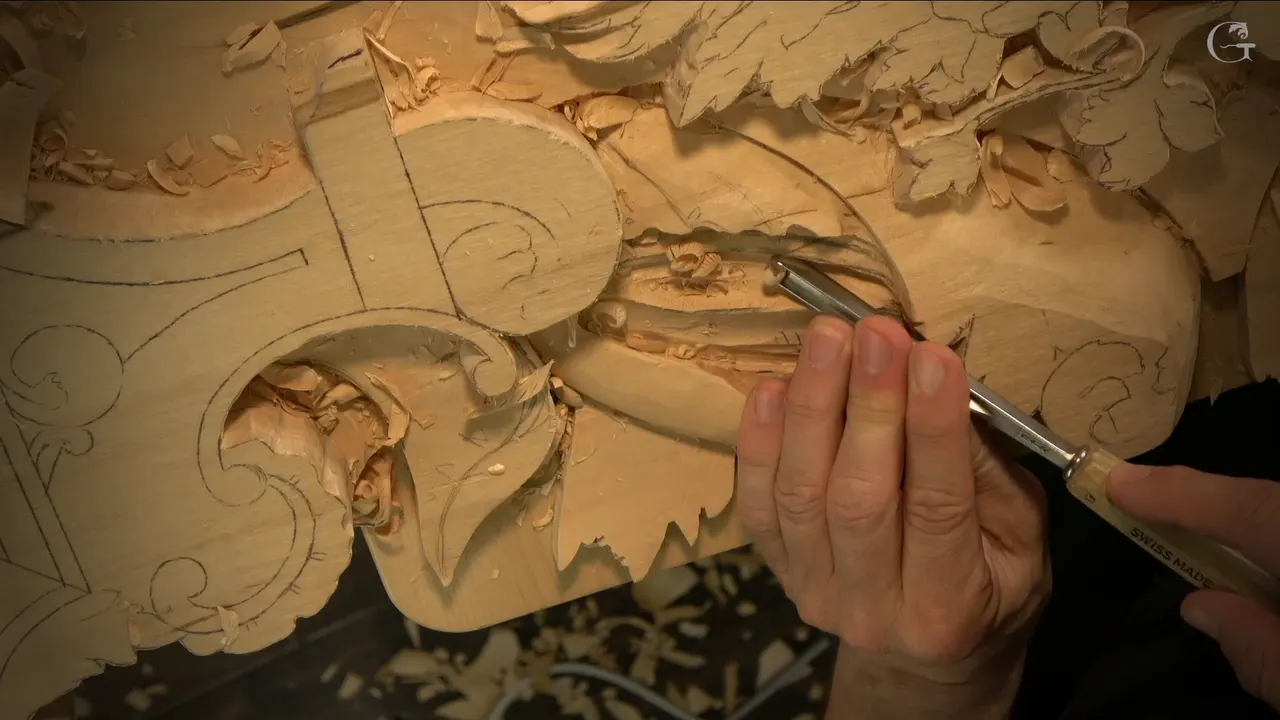

"Same sweep" is what I said in workshop 110, part 1, over a number seven in a smaller size. Other lessons of mine carry the same swap with a bigger number 11, a back bend or a smaller number nine, and others carry a warning that the number on the steel does not settle it.
Ever grabbed a gouge that was a hair too big for the spot, then wondered whether you had to buy a whole new curve? Ever stood at your rack with two number sevens? This video is a run of small cleaning passes with that swap in it, and after it come my words from other lessons, each one named and linked. Sizes are in millimeters and inches, my figure first.
How does the first video of workshop 110 go?
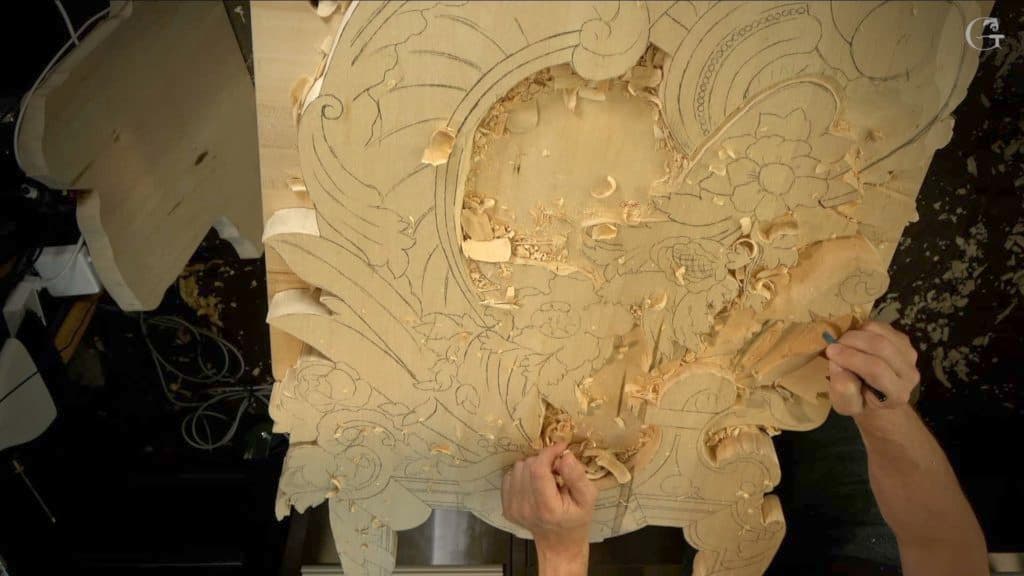
It opens on a plan: "There's going to be some kind of stem, just to give a little more detail." I named 7 millimeters (about 9/32 in), and then, "Number 11, of course." Next came a plan for the inside. "I can create the concave on inside," I said, and "it will give me a much, much better shadow spot."

"I think it would be the right tool," was my line about the number seven. Then: "Number seven, and let me think which one." Next, my plan: "I will take a big guy, about an inch and a spoon veiner with the big bevel." An inch is 25 mm. Of that tool I said it would "give me a wider cut."
I also said where the work would stop for now. The detail would come "a little later underneath of that acanthus movement" and for now, "start close to it, but I'm not going to do it all the way yet." What I'm after, I said, "is just to create a cleaner look on inside."

Then the result. "It looks like I need to undercut a little deeper in this section. But overall, it gave me a really nice beautiful smooth finish." And it came "just from the tool."
A little later I looked again and said, "Okay. Well, actually, you know what? I see there's a couple rough spots." Then: "Okay. Now it's beautiful and clean cut. Nothing even I need to clean after." I put it this way: "Just pretty much out of the tool, out of the chisel, how some people say it."

The undercut came next. A spoon veiner was in my plan, to "recreate the undercut. Not recreate undercut, but create a little cleaner undercut" with "just 1 millimeter, number 11." That is about 0.04 in. Cleaning came next: "I need to clean little bit to my undercut, and I'll take probably just number three. In this case would be a spoon number three." After that I said I would take 1 millimeter (about 1/25 in) again, number 11, "and get rid of that fuss I just created."

What did I say about a smaller number seven?
That swap came over a spot I did not like: "I don't like one of the spots right in this section. Let me get the same number seven, but it's going to be a little smaller. Not the same tool, but same sweep." After it I needed to "hit a little bit and clean this part."
Then, "Now I'm happy." I added, "I know maybe you don't see as much, but I think it looks awesome."

The last cut I named in the video belongs to a ray. "So the final part would be to create some kind of cut right here. And like I said, this part belongs to this ray. Okay, so that ray continues underneath." Next on my list was 4 millimeters (about 5/32 in). Another plan came with it: "Little later, I'm going to undercut underneath because I still have to develop that acanthus." The last tool I named was 2 millimeters (about 5/64 in): "Let me take 2 millimeters."

What did the other two videos of workshop 110 use?
Part 2 opens on another undercut: "I'm going to undercut slightly more on this side. And let me take 1 millimeter. 1 millimeter, and yes, it's still number 11." That is 0.04 in. Later came number three, "just a spoon," a small one of "5 millimeters, 3/16 of an inch." After that came "a different spoon," "probably number three" and "12 millimeters first." Of that one I said "Number three and 12 millimeters, about half an inch."

Part 3 changes sweep, with a reason. For some concaves I said "probably just the number seven" at 14 millimeters (about 9/16 in). Later: "I need to bring a flatter gouge, let's say, like number two, because I don't want to leave those ridges." That one was 12 millimeters, about 0.47 in. Near the end I said, "And I'll take number two again" and of the curl that followed, "I can probably do it the same tool with number two."

Where else did the number stay while the size changed?
Venice Room 8 has a clear case: "attack with the number six, with the same number six, maybe with the smaller one." In Venice Room 9 I went the other way: "a little bigger now. Same number 11, but little bigger because I want to see deep shadow." Workshop 34 has "same number 11, maybe a little bigger, actually, this time, because I think it has to be more gradual."

Two sevens were on my mind in Venice Room 41: "I can use same number seven, or I could use actually bigger number seven. But that's okay. That's going to work also." The next tool I named was 4 millimeters (0.16 in), number 11.
The furniture panel course has it too. In lesson 31 I said, "Let me get actually smaller number nine, same number nine, but it's gonna be only one eighth of an inch," which is about 3 mm. In the Acanthus over Moldings course, lesson 10 I said "I can't create the Big big cuts" and "maybe I could" go with "the bigger tool with the same number nine what I used before." I then named "number 9 and 3/8 of an inch," or about 10 mm. A size can also be wrong for the job, as Venice Room 38 shows. I said I would carry on using "the same tool, with the back bend" and then, "this is a little too big of a tool for those separations."

In Roman acanthus 5 I changed my mind mid-sentence. I started with "Although I'll take a smaller" and then, "Maybe not smaller, maybe the same number 8, what I have, five-eighths of an inch." Five-eighths of an inch is close to 16 mm. A warning for the grain came right after: "be careful, because you can see these, just because the grain goes a long way, it's easy to break it." And in Roman acanthus 16 I still had to "fix a little bit my smaller concave" and said, "I'll get the same number eight and an eighth of an inch," which is about 3 mm.
Where did the number stay while the bend changed?
A bend is a different change from a size, and Lily Box 4 shows it: "Let me find the number five. Same number five and a quarter inch, but back bend." A quarter inch is about 6 mm. I asked why back bend, and the answer came next: "Because this side is in my way, okay? And with back bend, I can get closer to the areas." Before that I had said, "If you don't have a back bend, it's okay, too. But I think it's a good idea to use a back bend."

I came back to it a little later: "Like I said, it's the same sweep, same size, six millimeters, quarter inch. It's just bends it backward. Okay, let me recreate the groove."
The Venice panel has it as well: in workshop 72 my plan was "a back bend, same number five. That's what I used before. Exactly the same thing." In Roman acanthus 12 I said, "It's almost impossible without a back bend, although to the certain degree, you're still able to." Of my number seven back bend: "You can see nothing is on my way, and I can create a really deep shadow." And: "I would suggest if you're really serious about wood carving to get those back bends, different sweeps."
Is a number five from one brand the same sweep as another?
I gave a warning in Lily Box 5: "Different brands, even if they mark sometimes like a same sweep, like number five, number two, number three, but if you compare tools from different brands, you will see a big difference in sweep. Okay, so don't just go by the sweep. Grab a tool, just to check if it's going to fit, and if it fits nicely, then use it."

The Greek acroterion course, lesson 4, has a warning of its own, and it comes from the charts. "They have a little different charts, European chart and English chart." I added: "there is a big difference actually between sweeps." One grounding tool was number three on the English chart: "It is number three, but still, it feels like it's less than three." Just before that, in the same lesson, I called one tool "number five, also sweep, but bigger. So it's about five-eighths," which is close to 16 mm. In Lily Box 2 I listed what I pay attention to in a tool, and one item was "availability of different profiles, different sweeps, it also matters."
Can one sweep do the job of many?
In the Dining Table Apron course I said I have a lot of different sweeps and tools, and "It just makes my work a lot quicker." A little later I explained it: "It doesn't have to be just a perfect fit. You're still able to, if you do what I'm doing right now, you're using just the edge of it, just the one part of the gouge, and follow along the profile, just little by little." I said you will still be able to do "different shapes with no problem, with lesser tools."

Later in that video I fixed my own word: "It's mostly just the number fives, just different sweeps. I mean, different diameters. Radiuses, if you wish."
Lily Box 3 has the same idea: "If you don't have a different sweeps of gouges. The same result can be done with different tools, with just a knife. But I really like perfect curvature it creates." In Hashemi Flowers 23, the knife did it: "Just because of that sharp point of the knife, I don't have to use the same sweep gouge. I can follow any line, pretty much any sweep." It is "a multi-use tool," I said, "So you can do a lot of work with just a cheap carving knife."

The Flower Rosette course has a buying rule: "If there is a same sweep, same how wide it is, but if it's available in straight and the fishtail, I would prefer to buy a fishtail." The corners of the fishtail "help me to get to really tiny spots when I'm carving."
Listing all my tools came up in workshop 21: "different sizes of the same sweep, let's say number 11," running from half a millimeter (about 0.02 in) to 30 millimeters (about 1 3/16 in).
When did I change the sweep instead?
The number had to change in Venice Room 7. It would be "much easier for me to use a different sweep." Then: "I thought number eight will be enough, but looks like it's not. Definitely, for me, it doesn't look enough. Okay? Let me turn to number nine."

Over in workshop 28 comes a plan, "I could use actually a different sweep" and a limit: "But I don't want to force it." I wondered aloud in workshop 64 whether "a different sweep, maybe number six or so" would do: "Let me try. Or even seven."
Hashemi Flowers 6 has "I probably should go with a different sweep. Maybe number seven, I would say" then "10 millimeters number seven, or three-eighths of an inch." Three-eighths of an inch is about 9.5 mm. The furniture panel, lesson 18 has "little different sweep, like flatter. Number seven" and Lily Box 4 has "a different sweep on the inside" with "number seven at first."
I chose not to in Roman acanthus 6: "I could use a different sweep. I could use a smaller and different locations. I didn't want to do that."

All the swaps from these lessons, lined up in one small table
| Lesson | What stayed and what changed |
|---|---|
| 110-1 | Number seven kept, a size smaller |
| Venice 9 | Eleven again, a little bigger |
| Venice 41 | Either seven, or a bigger seven |
| Furniture panel 31 | Number nine kept, a smaller size |
| Lily 4 | Number five, now with a back bend |
| Room 72 | Back bend, same five as before |
| Lily 5 | Brands that mark one number differently |
| Hashemi 23 | A knife instead of a matching gouge |
| Room 7 | Eight did not look like enough |
| Hashemi 6 | Another sweep, and a seven |
Is there a spot on your piece of wood where your gouge is a hair too big? Everything in these lessons sits inside one tuition plan. The Part 10 course page holds workshops 110 to 121, and the 110 lesson page has all three videos of this workshop. More wood carving waits there.
How it's done
- Pick the tool for the inside. For the inside I named a number 11, plus a big number seven. A wider pass was part of the plan.
- Look at the finish. My first pass left a smooth finish right from the tool, and I said I saw a couple of rough spots.
- Clean the undercut small. A spoon veiner came up for the undercut, then 1 mm (under 1/16 in) in number 11, then a spoon.
- Swap the size, keep the curve. For a spot I did not like, I asked for a smaller one of the same number and called it the same sweep.
- Name the next cut. The tool for the ray was 4 mm (0.16 in), and a plan for 2 mm (5/64 in) came after it.
Frequently asked questions
Which tools did I name at the start of workshop 110?
Seven millimeters (9/32 in), number 11, came first. Then a number seven, a big one of about an inch (25 mm), with a spoon veiner and "the big bevel." Then came 1 mm, and number three.
Which words came with the smaller seven?
I called it a different tool on the same sweep, and I said that I needed to hit a little bit and clean that part. The words after it were "Now I'm happy."
Did I keep one gouge through all three videos?
Part 2 had a 1 mm number 11 (1/25 in), then a 5 mm number three (3/16 in), and a second 12 mm number three (about half an inch). Part 3 added a number nine, a flatter number two and 4 mm (5/32 in) in number 11.
What to carve next