
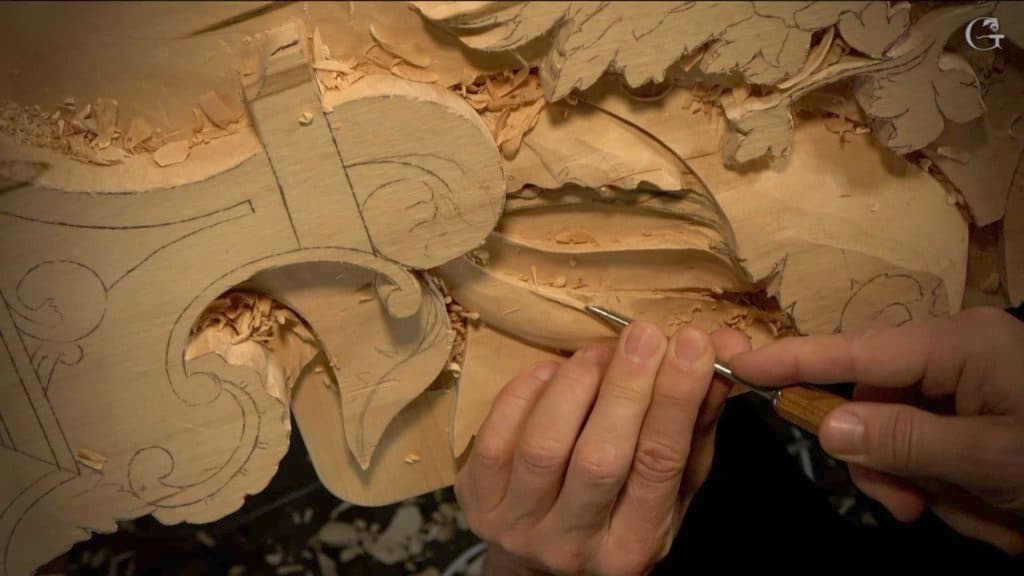
Alexander Grabovetskiy, woodcarver, School of Woodcarving · Published 2021
What does a wood carver mean by "lesser"?
Quick answer: It is a word I use in the third video of Venice Room workshop 110, about the small details that go around the big flowers. In other lessons I say it over sweeps, concaves, pipes, strokes, thicknesses and sheens, with the tool and the size close by.
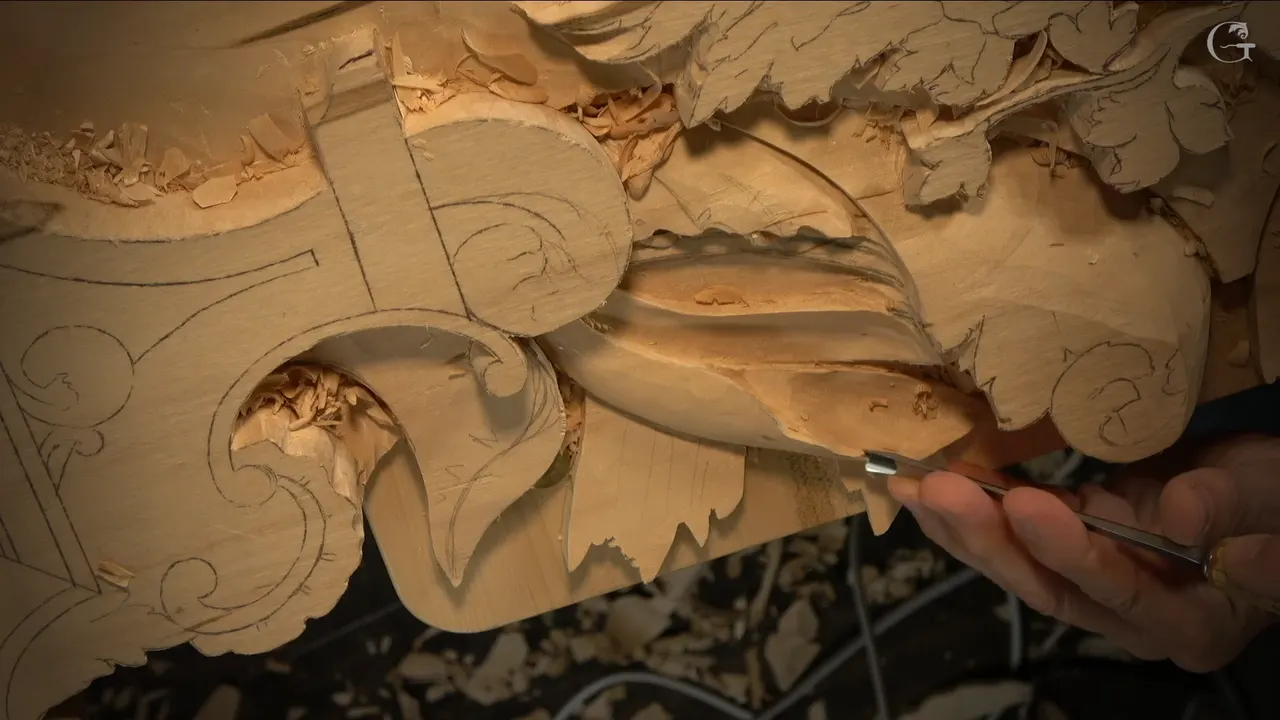

"Lesser" is the word I use in workshop 110, part 3, when I say the small details around the big flowers get "a lot lesser details than on the flowers." In my other lessons I say it over sweeps, concaves, pipes, strokes and thicknesses.
Ever stood at the bench with one gouge in your hand and wondered if the next one should be smaller or flatter? Ever put a small mark beside a big one and not known how far to take it? Below, my word follows each of those from this video into other lessons, every one named and linked. Sizes are in millimeters and inches, my figure first.
What did I say about lesser details in workshop 110, part 3?
The big idea has its place in this video. "I told you the main, the big idea is here, and those flowers are big, and I need to frame it somehow." The next line is the one this page is named for: "And to make a frame, so I need to place some smaller details, a lot lesser details than on the flowers."
Those details were going to "just work as a frame around." Right after that came "Let me take number nine," about half an inch (13 mm), and to "create cut like this," only "a little bit."

A flatter gouge was my next need, "like number two, because I don't want to leave those ridges." Blending came with it, "toward the curvature like this." The tool was a number two, "12 millimeters, about half an inch or so."
One curl needed more. I wanted to "exaggerate that curl" and my pick was number 11 at 4 millimeters (0.16 in), "little bigger than eighth of an inch." It would undercut that way and "create shadow cut." Next came a request to look: "See how nice that shadow I just created?"

Before any of that, the video opens on small concaves. Number seven at 14 millimeters (0.55 in) was my pick for them, and the line was "Not big concaves, but it's still going to be visible."

What did the first two parts of workshop 110 show on the small side?
Part 1 starts with "some kind of stem, just to give a little more detail" and a 7 millimeter number 11 (0.28 in). For a cleaner undercut I would take 1 millimeter, a number 11 again. Later I wanted "the same number seven," only "a little smaller": "Not the same tool, but same sweep."
Part 2 has its own list. One number 11 is 1 millimeter, then a spoon number three of 5 millimeters, 3/16 of an inch (0.2 in). Further on: "4 millimeters, and I can try to get with the little smaller one, try to get the 2 millimeters." Then: "1 millimeter pretty much right away." All three videos sit together on the workshop 110 page.

What does lesser sweep mean on a gouge?
Hashemi flowers lesson 11 starts me with a number seven of one inch (25 mm). I was "trying to get rid of extra ridges I just created." My next step was "I have to change my tool to lesser sweep, and maybe I can just use number three." That one was 12 millimeters (0.47 in), and I called the job a blend, "just to blend those two cuts together."

The lily box has it too. In first layer lesson 3 I had just made "nice ridge" and called it "Beautiful ridge." Then: "And now I need to get a lesser sweep, maybe like number five or number four. Number four will do, I think." That number four was about 6 millimeters, a quarter of an inch (0.24 in), for "a couple more ridges."

Lily flower lesson 11 had a rougher stretch. "It's probably the time to switch to more flatter gouge, lesser sweep," I said. My next words were "I'll switch to number seven," about 10 millimeters (0.39 in), a size I also gave as 3/8 inch. The slicing was plain: "I'm actually slicing with this."
A slip followed. "Oop, I made my hole even bigger. Shouldn't do that." Later I told you, "And that is fixable, by the way."

In lily flower lesson 12 the same word came as a need: "And now I need the lesser sweep gouge." Two ideas followed, "Maybe I should use even back bend" and then "just the number one." I meant to make a cut "right beside my first cut" and I said "that is almost invisible."
Lily box 8 lets you hear me swap the word in the middle of a sentence: "or I could use a number nine or number eight, or even smaller sweep. Or I should say lesser sweep."

Over in the Venice Room, workshop 18 had me on an S shape. "Not too happy how that S looks. Maybe I should use a lesser sweep, like number five." Softening was the aim: "Kind of soften a little bit this movement."

In 23 I began to say acanthus, then caught myself: "not acanthus, I'm sorry, shell." The line was "More or less like a flatter, lesser sweep right there." Extra material was still there to develop. Next I would try a number two and a mallet, and a little later I said "Always quicker with the bigger tool."

The dining table apron course, in workshop 8, widens it. "That's why I have a lot of different sweeps, a lot of different tools." The edge of one gouge can follow a profile "just little by little" and you can do "different shapes with no problem, with lesser tools." Number five "will do a really good job" there, I said, and then "I'm going to use a number six right here."
When does lesser just mean a smaller tool?
A number 11 of 5 millimeters (0.2 in) was in my hand in workshop 28, and I said I could "use actually lesser, smaller sweep, like four millimeters or even three millimeters." Better, I thought, and then I named two millimeters (0.08 in) to "get underneath."

Smaller still comes in workshop 35, where I said "Let me use 1.5 millimeters," a size I gave as a sixteenth of an inch (about 1.6 mm). A bit later: "I could go lesser, even 1 millimeter. One and maybe even half a millimeter because, in this case, I'm able actually to get my brush in with no problem." Half of one millimeter is about 0.02 in.

The deep shadow still mattered: "But I still want to see deep shadow." Earlier in that part I had talked about the later paint, which would "penetrate and make it harder."
In 88 it comes in one line: "closer I get to my future drop, lesser or smaller tools I should use."
In workshop 29 the aim was "just deep enough." The line was "Okay, number five, and just knock down that wall. And of course, probably that would be smarter to use number three, a little lesser sweep right there." A small number 11 of one and a half millimeters (0.06 in) was my next thought, "and excavate a little deeper." Going deep was not needed, I said, since "it's really high above."
Workshop 34 says why I use number 11 gouges "a lot": they work "like a gouge, but it also works as a U shape." Side on, it "just becomes a gouge, a lesser sweep" and the bottom works "like number nine." For an undercut it gives a U shape, and my verdict was "really nice universal tools."
How does lesser change a concave, a pipe or a punch?
Light picked the side in workshop 26. It would hit from that side, "so it's going to create extra shadow" and that was the reason for "a little deeper concave." Then: "I can excavate a little lesser concave on that side" with "a little number five or number six."
A pipe sits in workshop 25. The other side was to get "a little lesser a sweep" and I was "probably going to use just number nine," 14 millimeters (0.55 in). That pass would be "less pronounced." No need to excavate too deep, then, I said.

A big number 11 shows up in a part of workshop 29 that comes earlier. I said what I can do: "not just a straight concave," but "U concave going closer to that edge," raised "a little bit," a "lesser concave."
The tool I named was a big number 11, about 5/8 of an inch (16 mm), a size I also gave as 15 millimeters, used "just the side of it" plus a number three sweep "right here and number nine on inside." I said I can always turn it and use the bottom, which would "give me gradual transition between number three and all the way to number nine."

Pipes come up in workshop 163. After "5/8 of an inch" (16 mm), I said, "It is a lesser pipe, but still important one." My reason was "it's already raised part," so I would "just roll it like that" with "almost no concave."

A blend came next, using number two: ten millimeters (0.39 in) was "a little too big." Eight millimeters (0.31 in) got a try, and eight "is good."
A punch has the word too. In first layer lesson 3 again, I said the finish would penetrate "a lot more in those punched areas" and the plan was "a harder punch closer to the design and lesser on the outside." Everywhere was not needed: "you don't have to do everywhere, just some parts."
What about a lesser stroke, a thickness or a number?
The mallet got the word in furniture panel 19. My finger on the molding gives me control over "how deeply my tool going to penetrate inside of the fibers." Another way is "holding it much higher, but my cut is not as strong. So I hit with mallet with the lesser stroke."

Furniture panel 18 has thickness. The design was "a much thicker design right now" and the final will be "a lot thinner," so it is "lesser thickness." I had left some extra, and I did not want marks on my background.
A gap got the word too. In second layer lesson 4 of the lily box, the layer was "almost to the first layer." The final goal I named was "maybe 1/16 of an inch, maybe even lesser, maybe one millimeter between." That is 1.6 mm for the 1/16 inch, and 0.04 in for the 1 mm.
A number can be lesser. In the plate with butterflies I started from a diameter of approximately 10 inches (254 mm). "It's easy to calculate Fibonacci's sequence" and "three inches is going to be my lesser number." Three inches is 76 mm, and I added "inch and a half gonna give me a really good border," which is 38 mm. The Fibonacci sequence is on Wikipedia for the numbers.
A finish can be lesser. In lily box 13 I said I did not use a 25% sheen here, since "it would be a little too shiny." Then: "if you would use a lesser sheen, and I used 10, 15%, this one, what happens, it creates a really matte finish all around."
Where else do I say lesser, besides tools?
In workshop 32 I said "just about 3 millimeters all around" (0.12 in), and I was "just eyeballing." Then: "of course, a lot lesser right here." I took part of it back: "Maybe not. Maybe I can actually do still about one-eighth of an inch" (3 mm).
The principles of design course has it in a talk about the figures that "support those guys, the main guys." Of those I said "They're not the main idea, but they're still important" and "they have to be much lesser."
Two of my lines pair the word with "still important." The 163 line is "a lesser pipe, but still important one" and the design course has "much lesser" beside it. In 110-3 the flowers are big, and the frame around them gets lesser details. The Part 10 course page lists every workshop in the room from 110 to 121.
Lesson by lesson, the whole list at a glance
| Lesson | What I called lesser |
|---|---|
| Venice 110 | Lesser details to frame the big flowers |
| Hashemi 11 | Number three as the lesser sweep |
| Lily 3 | Number four chosen as lesser sweep |
| Lily 8 | Smaller sweep corrected in midsentence to lesser sweep |
| Box 11 | Flatter gouge first, then a number seven |
| Room 18 | Number five for a softer S |
| Room 23 | Flatter sweep on the shell sections |
| Venice 28 | Four or three millimeters instead of five |
| Workshop 35 | One millimeter, maybe half, instead of 1.5 |
| Lesson 26 | Lesser concave on the side, maybe number five |
| Lesson 163 | Lesser pipe that is still important |
| Furniture 19 | Hitting the mallet with a lesser stroke |
| Furniture 18 | Lesser thickness once the design gets thinner |
| Butterflies plate | Three inches as my lesser Fibonacci number |
| Box 13 | Lesser sheen, ten to fifteen percent |
Is there a spot on your own carving where the next tool should be lesser? Every lesson named here sits inside one tuition plan, and hand tools in many sizes appear in the videos. Pick one spot on your wood carving or other woodworking, take the smaller or flatter tool, and watch what it does to the shadow.
How it's done
- Name the big idea. In the third video of this workshop I pointed at the flowers as the big idea, and I said they were big.
- Plan smaller details. Surround the flowers with details smaller than theirs, which I said I needed to place.
- Make the first cut light. Take the number nine, about 13 mm, and cut a little bit, not a lot.
- Blend away the ridges. Bring a flatter gouge, a number two, and blend the ridges out.
- Curl it with an 11. For a stronger curl my plan was a 4 mm number 11, undercutting that way for shadow.
Frequently asked questions
Which tools came out in part 3 of workshop 110?
Four gouges came out. The seven was 14 mm (about 9/16 in) for small concaves, the nine was roughly 13 mm, the two was 12 mm for blending, and the 11 was 4 mm (5/32 in) for the curl and its shadow.
Why did the flowers get a frame of smaller marks?
The big idea was in the flowers, I told you, and the flowers were big. To frame them I needed smaller details, and I wanted fewer of them than the flowers carry.
How did I handle ridges left behind by a cut?
A flatter gouge, something like a number two, was my need, because I did not want the ridges left. I blended them into the curve with a blade of 12 mm (15/32 in).
What to carve next