
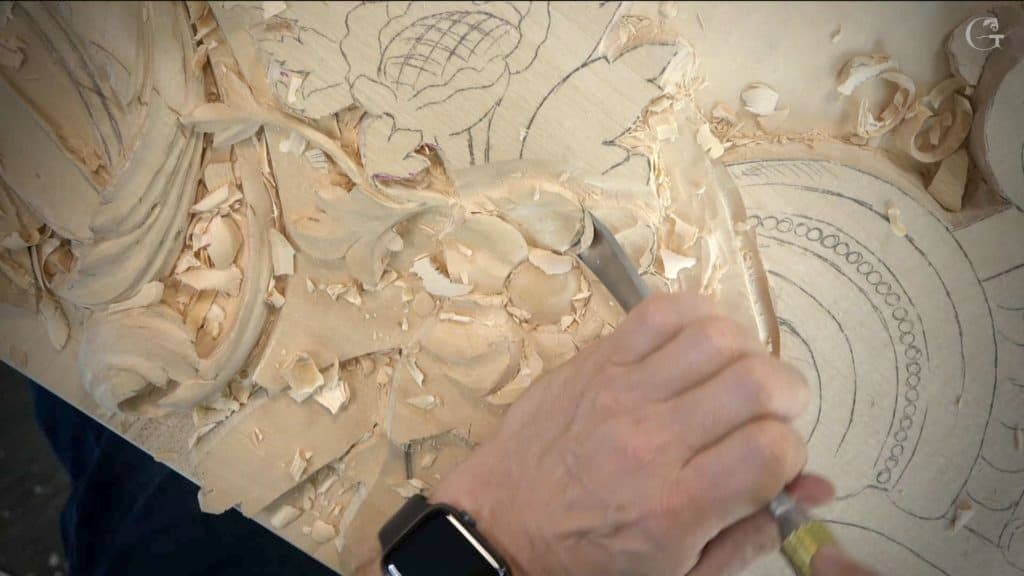
Alexander Grabovetskiy, woodcarver, School of Woodcarving · Published 2021
What does a wood carver mean by "a good movement"?
Quick answer: "A good movement" is what I said in the last seconds of the third video of workshop 114, after a top view: "I think it's a good movement." Next came "Let me give some shape to some of those." Elsewhere the words are followed by a chop, a cleaning pass or a note that the work is not final.
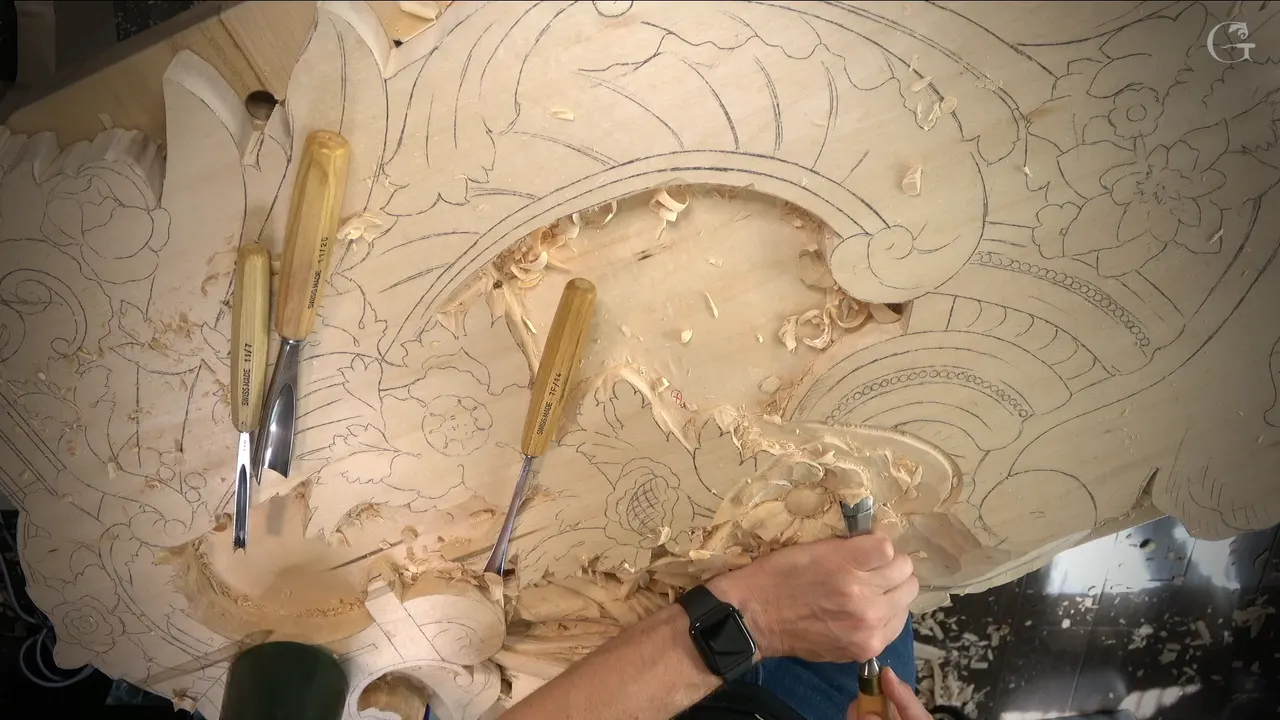

"A good movement" is what I said near the end of Venice Room 114-3, right after I showed the carving from above. The same two words sit in other lessons of mine, and what I do next changes with the lesson.
Ever carved a hollow and stepped back to ask whether the shape reads, or is just a hole? Do you check it from straight above, then from one edge? One short video of mine opens this page. After it, the same words take us through the Venice Room, the Lily Box, the Hashemi flowers, a grape onlay and a few more courses.
What did I mean by a good movement in Venice Room 114-3?
Near the end of that video I took a look from above, with a "let me" at the front of it. Then came my verdict, "I think it's a good movement." Right after it, "Let me give some shape to some of those." The first tool I named in that video was a number 11 at 20 millimeters (0.8 in), and the piece was the flower I had called simple in the second video.
The video does not start with a verdict. It starts with a want. "I want to create concaves and convexes," I said. About one spot I said it looked like a concave was coming, and next to it I could create a secondary concave, "directed this way." That plan ends on "beautiful movements."

A bigger plan follows. Yes, I said, I would do extreme concaves and convexes, and they would give almost like a life look. Then the tool: "that's what I'm using right now" and "Number 11, of course." The first concave got "Obviously, I need to make it nicer."
For the second one I planned a spot "somewhere right here" and then "just blend that." "Okay," I said, and "that is good." Then one word: "downhill." Edges would wait. We would develop them a little later, I said, but for now it was only the hollows and the humps.
How did I get to that verdict?
A thought came. Why not exaggerate that, I asked, and again, "right away"? "Good opportunity," I said, "to just to get one of the deep ones and kind of folding one." And: "Just go right underneath of this moment."

A raised part set up the next move. Since I had this part raised, the opposite side was supposed to go lower, I said. That way it would "look more appealing, I would say." Number seven was my pick for that, and an undercut was also on my list. A check was due, too: "I need to check this edge. Otherwise, it doesn't look so good."
Getting closer was a problem for the camera. Covering it was something I did not want, I said, and getting closer would do that. Later I said, "I'm sorry I just covered again" and then, "My apologies."
In the middle of another shape I planned a hollow. The big one again, 20 millimeters (0.8 in), number 11, was the tool I named, to give a huge, "almost down to my surface. From nothing, almost nothing, to that surface." Beside it I said I could just indicate movement toward the center.

A ridge came next. I planned to soften it a little bit, and it did not have to be sharp. Again: "Really doesn't have to be that sharp." For another area I said, maybe the upside-down number seven. And nothing wrong, I said, with a little downhill cut like that one.
The last stretch went underneath. The next one was also going underneath, I said. My number five, "what I used previously," would do the undercut. Later came "this one also the same thing" then "I'll do opposite direction right here." The look from above and my verdict came last, with a plan for shape right behind them.
Which cause did I name for good movement?
Elsewhere the words come with a cause. In Venice Room 13 I said another pipe was coming, a long one, because, I said, I want to see very good movement. Another concave could go right on its side. "The idea is the same," I said, and then I wanted to make this part more roundy.

A raised ridge made me happy in workshop 11. For me the movement was very good. Next I could start, probably, making subdivisions of the main detail. One would go underneath, a big one, and logically I had to subdivide that side as well.
Overall movement had me not really happy in workshop 8. Number five, and the big one, was next on my list, to see if it was a good solution. Then: "And yes, I think I like that." A chop straight down, I said, would make the movement really good.

Hashemi flowers 46 has a deeper hollow. "Yeah, deeper concave," I said, and the movement would be really good. A plan followed to establish the boundary, maybe with a number 11.

Lily Box 10 has a lower part, on a small flower held in a clamp. One side could take a much more extreme curl, I said, because that side would flip over the main design and I needed to leave some material there. Behind it I had said, "Give a nicer curl." And about this side: "But here, this part can go much lower." That would bring movement, a really good one, and then I could chop a lot more material right there.

In workshop 63 the side of my tool did the work. Good movement, my words for it, and the same would happen on another side of the pipe. I was "using just the side of my tool pretty much."

A slice that goes underneath turns up in lesson 2 of the grape leaves vase. With the 10 millimeters (0.39 in) I could slice it just like that, "just to create the feel like it's going underneath of here." The slice would bring good movement to that vase. That was not the final depth yet, I said, because we would still have to create the movements inside of those.

What happens right after I say it?
More carving comes next, and what it is changes with the lesson. Cleaning around that area came next in workshop 8, with the same number seven, "what I used before" then a little deeper and a little better clean.
Chopping was next there: "It's tough. Not easy." And then, "Don't want to risk it." My verdict in workshop 88 was a very good one, "in my opinion, of course" and cleaning with the No. 2 was next on my list, to create "a clean canvas."
Details come second in workshop 86. It was "actually a really good movement," I said. I added that I liked it, and that it was already revealing. Inside we would have more details, but first I had to establish the main movement, and then work on details.

The Grinling Gibbons class in Maine puts the shape first. "I'm after overall shape," I said, "and then I'll work my details." Then came the line that the movement was really good, and a bigger skew was possible, "like one inch" (25 mm), in Maine class lesson 10.
Wood I wanted to remove is the subject of workshop 44. Something on the side would be visible, and it would give me a chance to reduce the thickness of this chunk, because right now it was too thick. Actually a really good one, I called it. "Love it." Next: "I've got to another layer."

In the design part of the Furniture Panel course, lesson 10, a pen and paper were in front of me. "I like that movement" was my line, and I called it a very good one too. Then a question for myself: what can I develop here? One idea followed: maybe I can just get another acanthus return this way.

Can a good movement still be unfinished?
Chopping away what I did not want to chop away is in workshop 127. "I need to relieve it much better now and make it a little deeper." I was not going to worry about that. Good movement was still coming, and I would move it a little more inward. My next wish was to indicate my lines, where "those guys" would start the shell, and I wanted to make sure I could find them a little later. Those were approximate positions, I said, because I was still going to make it nicer.
In Grape Onlay 9 I talked about the big tools, and then called the movement very good, "even if it's not the final yet." A couple of cuts this way were possible, just to make it motion. The big tools must be super sharp, I said, in that same lesson.

Another one sits in workshop 48. Movement number one made me happy, and I called it very good. "Not detailed yet, but that is somewhat what I want to see." A little nicer division was the next plan.

The main outline took a couple of minutes in workshop 68. After "I think that's a good movement," the outline did not look too nice yet, I said, but it would. Depth was on my mind in workshop 96: I had to keep an eye how deep I was going, and not overdo it, but I still had to create a really good wall. A side angled slightly would give me some movement, really good, "but not as much."

Do I say it as a fact, or as a hope?
Hope shows in workshop 65. The middle point, I said, I should bring all the way this direction, because it would be visible from the side position, too. I thought it would be good, and then: "I hope, I should say, it's going to be good movement, which I have no doubt it's going to be."
We would chop out some of what I would not need there. It was a little too sharp a transition downhill, I said.

Doubt shows in workshop 14. "Not sure I like it or not, but maybe a little bit chop off this side." I thought the movement would be really good. Then: "And this one has to make sense." A relief cut first, probably, with the number nine, was how I planned to take out some of that. "Wherever I see those triangles, I always try to do the relief cuts."

One spot left me not too happy in Furniture Panel 22. "Actually really, really good movement," came the line, "although I'm not too happy how it looks right here." A light touch on the edge could make it look much nicer, I said. Then: "I'm happy about this detail."
A view from below is the subject of workshop 33. On the inside, I said, it gives me movement that is really good. Standing "just straight below it," you would not see it, but you would from other points of the room, "from a distance, I should say." Then: "I understand I just created for myself a lot more work to do. I could get by without doing it, but I really want to make it look beautiful, this project."
A small part has it in Lily Box 11. It is a small part, I said, but kind of complicated from a different point of view, and you can actually make a big mistake. I had my oval, and this piece goes up. "I can see that is a good movement." From this perspective, I said, I had "really nice curvature connecting to that piece."

Pointing my view is the reason in workshop 19. I wanted big excavation, and movement that is really good, right there, because it has a movement this way, and I wanted to point my view in this direction and also that direction. I added, "Hope it makes sense." It would be one of the separations, I said.
Where I said it, and what came with it, in one small table
| Lesson (all Venice Room unless named here) | What came with it |
|---|---|
| Video 114-3 | A top view, then some shape |
| Workshop 8 | A straight down chop, then cleaning |
| Lesson 13 | A planned long pipe, a concave beside it |
| Hashemi 46 | A deeper concave, then a boundary plan |
| Lily Box 10 | One part much lower, then chop more |
| Vase 2 | A slice that goes underneath |
| Room 44 | A chance to thin the chunk |
| Venice 48 | Not detailed yet, a nicer division planned |
| Workshop 86 | The main movement first, details after |
| Lesson 88 | A clean pass with the No. 2 planned |
| Room 127 | Still good, a move inward planned |
| Onlay 9 | Not final yet, a couple of cuts planned |
Is there a hollow on your board that already looks right from above, but not yet from the side? Everything in these lessons sits inside one tuition plan. The Part 10 course page holds workshops 110 to 121, and lesson 114 has all three videos of this flower. More wood carving waits there for a gouge, a mallet and a chisel.
How it's done
- Plan the hollows. At the start I said I wanted hollows and humps, and that I could add a secondary concave directed one way.
- Name the tool. The 20 millimeter (about 0.8 inch) number 11 was what I was using, I said, and after the first concave it needed to be nicer.
- Exaggerate one part. I asked why I should not exaggerate it right away, and said the opposite side of a raised part is supposed to go lower.
- Soften the ridge. The ridge did not need to be that sharp, and for another area an upside-down number seven was a maybe.
- Show the whole piece. A top view came last, with my verdict that it was a good movement, and more shaping came next.
Frequently asked questions
What did I say right after "a good movement" in workshop 114?
More shape was the next thing I named. That sentence closes the third video, right behind my verdict. The top view came just before the verdict, so the order in the video is look, verdict, shaping.
Does a good movement mean the shape is finished?
In Grape Onlay 9 I said the movement was very good, even though it was not final. In Venice 48 the shape was somewhat what I wanted to see, though details were still missing.
Which tools showed up in the third video of workshop 114?
A number 11 at 20 millimeters (about 0.8 inch) was the big one I named for a huge hollow in the middle of one shape. For the side across from a raised part I said I'd use number seven, and my number five was named for an undercut.
What to carve next