
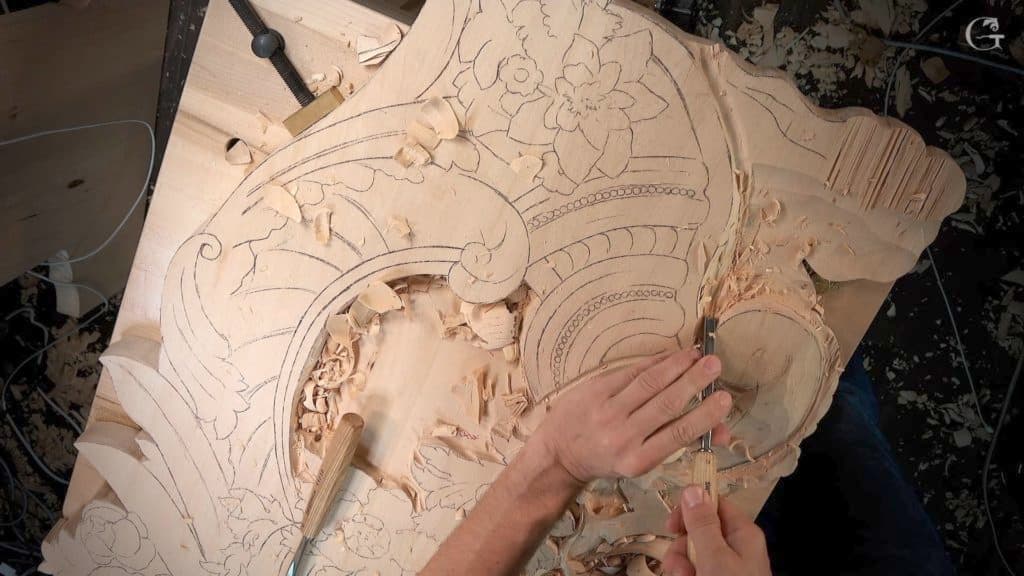
Alexander Grabovetskiy, woodcarver, School of Woodcarving · Published 2021
What does a wood carver mean by "I would say"?
Quick answer: "I would say" is what I said in Venice Room workshop 116, part 3, beside a number three, a smaller tool. In my other lessons the same words sit beside a number five at one inch, a number six at about 10 millimeters, and 3/32 of an inch.
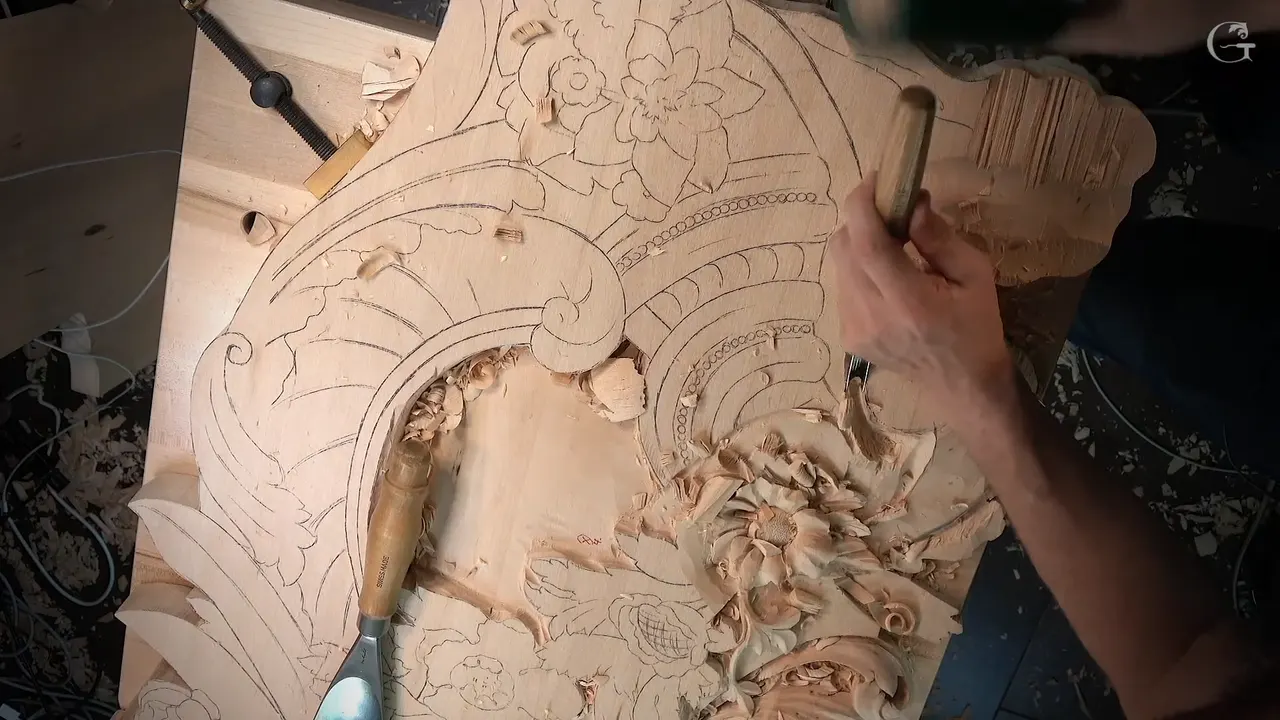

"I would say" is what I said in Venice Room workshop 116, part 3, when I switched tools: "just a number three, I would say, and maybe 20 millimeters or so." In inches that is about 0.8. The same words come next to other tools in my other lessons: a number five, a number six, a veiner, and a small cove.
Ever reached for a gouge and said its size out loud before you were sure? Does the carving in front of you ask for something smaller? This page starts with parts 1 to 3 of workshop 116. Then it follows my words through the Venice Room, Furniture Panel, Hashemi Flowers, Floral and Molding, Lily Box, three acanthus courses, a rosette course and the Grape Onlay.
Where did I say it in part 3 of workshop 116?
Right after my plan to take the big one again.
The big one came first in my words: "Let me take again the big one. Straight down cut." Then came the switch: "I'm going to switch to a smaller one, just a number three, I would say, and maybe 20 millimeters or so." The straight down cuts would go on "just like that with a smaller tool."

Earlier in the part I named another size, "probably number 11 and the 10 millimeters" (0.39 in), to get "a little closer and deeper." Because of the grain of the wood, my plan was to attack from both sides, and "it's easy to make mistake."
Then I told you, "Let me move my workbench so you would see it." After that: "Okay. I created a lots of mess. It looks really messy."

What was the plan around the line?
The plan had an order.
"I'm going to create my outline around this line," I said. It would be "a little lower than the future parts," but I would still do "outline first, straight down cut second, and then level it to the level I need."
For the tool I said "the same what I used previously, 20 millimeters, in this case, number 11," about 0.79 in. Then: "And let me just outline. Again, first cut going to be right on the line. Got to be careful."

Further on I said, "that is enough for now" and that I would take care of "this mess." The tool: "I'll take number seven and three inches, and remove some of that." Three inches is 76 millimeters. Then: "I need to make sure it's stable. I mean, my workbench."

Near the end I said, "So now I need to clean a little better inside. A little better inside." The tool would be "maybe just a small number 11." Then: "just make it look nicer and less chance to catch a sharp splinter."

Which sizes came up in parts 1 and 2?
Part 2 had a gap: I could "get much deeper cut and stay away about eighth of an inch or so," about 3 millimeters.
Later in part 2: "number 11, of course" at "seven millimeters" (0.28 in), for a "little nicer outline cut." One more line there: "I have to be mindful how deep I cut because I'm really close to my workbench. So it's easy to overdo it and remove too much." Part 2 ends on another plan: "big number seven," placed "straight down," to "chop straight 90 degrees down."

Part 1 has the words too. My number 11 "would be 7 millimeters, a little bigger than quarter of an inch." For the outside of some leaves: "probably take a smaller number 11, I would say, let's say 5 millimeters," about 0.2 in.

Which sizes came with the words in the Venice Room?
Two sizes and a distance sit in workshop 69. I told you, "I'm using 20 millimeters, but I could use actually 30 millimeters easily, I would say. It would give me even better result. And why don't I?" Then came "30 millimeters," "I'll do it" and "20 millimeters is fine also." Thirty millimeters is 1.18 in.

Later in that video: "Let me use just a smaller number 11 first, like 3 millimeters, I would say." That is 0.12 in. Another video of the lesson had a distance. "I want to do about 20 millimeters," I said, and "maybe, actually, I can do a little lower than 20." Then: "Right now, I've got about, I would say, about maybe an inch and a half or so to the point." The inch and a half is 38 millimeters.
Over in workshop 52 the plan was to "attack that with probably number five, I would say. One inch" (25 mm). And "pretty much right away, it gives me the shape I'm after."

In the same video I said I was not going to go too deep, because otherwise I would damage the surface, and then it would be hard to get rid of tool marks.
A ridge on the side was in my way in workshop 57, and I wanted to get rid of it. I needed "a continuous convex," I said, "otherwise it's not going to look as nice." My tool would be "probably number six, I would say." Then: "about 10 millimeters number six," about 0.4 in.
Cleaning came up in workshop 22: "To clean it, I probably should use number seven, I would say, let me use number seven and half an inch, or 14 millimeters approximately." In metric the half inch is 12.7 millimeters, and 14 millimeters works out to 0.55 in.

A veiner is in workshop 101: "I would say 2 millimeters number 11 veiner is sufficient, but I could go to extreme and use number 11 veiner and 1 millimeter and create even nicer shadow." Two millimeters comes to 0.08 in, and one to 0.04 in.
In workshop 37 I talked about how to take care of a middle part: "I could just use probably number seven, I would say, or actually, you know what, even just bigger, number 11." In another video of it: "Maybe number five, I would say one inch."
A cove sits in workshop 92, where I said, "I don't have a lot of space. The biggest cove I can make, it's only, I would say, no more than about one-eighth of an inch," or about 3 mm. Of a piece in that video I said "it is a corbel" and called it "kind of a little bit confusing, I would say."
A chisel turns up in workshop 76. "I'll just take any straight chisel, I would say, like number one." In the same video: "So really, I would say, I think it's a good setup."
How big were the Furniture Panel numbers?
A leftover turns up in Furniture Panel 17. "I'm leaving approximately 1/16 of an inch, a little more maybe, just slightly more than 1/16. Some spots, like 3/32, I would say." Those sizes come to 1.6 and 2.4 millimeters, and I added, "A couple of millimeters."

I also said, "I don't want to see a choppy line, okay" and "It's better to do the first cut as nice as possible."
In a different video of that lesson I said, "Try number 7 and see if it's going to match." Then: "Number 7, and this one is approximately, I would say, 10 millimeters, three-eighths of an inch, and I need to get something smaller. Maybe number 8 will fit" (Three eighths is 9.5 mm.) Then: "Number 8 and a 1/4 inch. Almost perfect, I should say" and a quarter inch is about 6 millimeters.

In Furniture Panel 33 I said, "What I used previously, that would be number seven." Then: "In this case it is about three eighths of an inch." And: "It's a closer to your number eight I would say." Three eighths is about 9.5 millimeters. Another line: "Watch out how I'm slicing through the fibers. I'm not pushing."

The angle in Furniture Panel 19 came with a size: "number three and eighth of an inch," about 3.2 millimeters. Then: "Carefully just make my cut straight down, just like that. More like on 45 degrees, I would say. Make a step carving. Step cut, I should say, because I'm stepping in."
Which flowers and acanthus leaves got the same words?
Hashemi Flowers 3 has the words after two tool numbers, a 3 or a 5. "Now, I will take probably just a smaller number 3 or number 5, about 3/8 of an inch. Or even smaller, like 1/4 inch, I would say." The first size is about 9.5 millimeters and the second is 6.4.

Hashemi Flowers 48 has a petal: "I would say, no more than 16th of an inch thick." That comes to 1.6 millimeters at most. Later there, I could "follow with the half a millimeter to create that vanishing line" and half a millimeter is 0.02 in.
In Floral and Molding 5 I said, "Number six, and in this case, it's about, I would say maybe 12 millimeters. That should work." It comes to 0.47 in. For a deeper cut: "So that would be about one-eighth of an inch, about 3 millimeters, I would say, just to create a shadow line."

In Lily Box 8 I said, "Let me get number six, I would say, or even number five and a quarter inch." A quarter inch is a little over 6 millimeters. Elsewhere in the lesson: "I had to move it about maybe 3/32, I would say, inside," or 2.4 millimeters.

Two number sevens sat side by side in Roman Acanthus 16. I said one was "number seven at six millimeters" and the other a seven too, at four millimeters, which is 0.24 in and 0.16 in. There was "almost no difference" and "I would say this one is about five millimeters." Also: "Either of them will do." One of them has a tail at the end, I said, and the other is straight.

Byzantine Acanthus 9 has a wall. "If you see the wall, so get as close as possible to the edge, but not too close. But I would say maybe about five millimeters, six millimeters, about quarter inch." Five millimeters is 0.2 in. I added, "Later on, we're going to refine it just in case if you made a mistake, so you're going to have some meat."

In Greek Acanthus 1 I said I would probably place my block on a piece of paper and trace it. "This time, acanthus leaf itself is going to be more deeper, I would say. Okay? So actually, this block, we're going to take maybe 5/8 down, 5/8 of an inch down, like halfway of what I have right here." About 16 millimeters.

Over in Chamomile and Bow Rosette 4: "I can get really to the point, because it is a fishtail, I would say." After that: "About one millimeter deep. Well, actually, one and a half millimeters deep, about a sixteenth of an inch."
Was it only ever a tool or a size?
Grape Onlay 2 has a skew. I called it "just a skew" and said "it's a good one." Then: "It's about an inch I would say, but what I like about it, you could quickly block the thing." An inch is 25 millimeters. "You could do that with just a normal gouge, you don't have to have like a skew for this operation. But personally I really like it."

Some lines in workshop 69 name no size. About the main form: "I was able to create the main form really quickly. Relatively quickly, I would say." About taking it to 3,600 and 6,000: "Again, that step, really unnecessary, I would say."
How do the sizes line up?
A short list, with the lesson on the left and what I named on the right.
| Lesson | What I named |
|---|---|
| Workshop 116 | Number three, 20 millimeters (0.79 in) |
| Venice 69 | Could use 30 millimeters easily (1.18 in) |
| Room 52 | Probably a number five, 25 millimeters (1 in) |
| Lesson 57 | Probably number six, 10 millimeters (0.39 in) |
| Panel 17 | Some spots 3/32 of an inch (2.4 mm) |
| Furniture 19 | Number three, about 3.2 millimeters (1/8 in) |
| Panel 33 | Number seven, about three eighths of an inch (9.5 mm) |
| Hashemi 3 | Or even smaller, like a quarter inch (6.4 mm) |
| Hashemi 48 | At most 16th of an inch thick (1.6 mm) |
| Molding 5 | Number six, maybe 12 millimeters (0.47 in) |
| Lily 8 | Number six, or even a number five |
| Roman 16 | Five millimeters, with almost no difference (about 3/16 in) |
| Byzantine 9 | Maybe five millimeters, six millimeters (about 3/16 in) |
| Greek 1 | More deeper, maybe 5/8 down (16 mm) |
| Venice 22 | Number seven, 14 millimeters (0.55 in) |
| Workshop 101 | A 2 millimeter veiner (0.08 in) |
| Room 37 | Maybe a number five, an inch (25.4 mm) |
| Lesson 92 | A cove, 1/8 inch at most (3.2 mm) |
| Onlay 2 | About an inch, a skew (25 mm) |
Is there a gouge on your bench you pick up before you decide how to carve? Everything in these lessons sits inside one tuition plan. The Part 10 course page holds workshops 110 to 121, and lesson 116 has all three videos of that workshop. More wood carving and relief work waits on the other pages above.
How it's done
- Name the tool. Part 3 had me name a smaller tool, a number three, around 20 millimeters (a bit under 0.8 in).
- Start with the outline. Part 3 gave the order: outline first, a straight cut down second, and then level it to the level I need.
- Keep the first cut on the line. Part 3 says the first cut would go right on the line, and I said I had to be careful.
- Mind the workbench. Part 3 has me say I needed to make sure the workbench was stable. Part 2 has me say I had to be mindful how deep I cut near it.
- Check the size beside the words. Venice Room 52 gives a number five, one inch (25.4 mm), and Venice Room 57 gives 10 millimeters, or 0.4 in.
Frequently asked questions
What tool came with those words in workshop 116?
A number three at around 20 millimeters (0.8 in) in part 3. I said I would switch to a smaller one and carry on with straight down cuts. Part 1 named a number 11 at, let's say, 5 millimeters.
Which size sat beside them in the Venice Room?
Thirty millimeters (about 1.2 in) in workshop 69, and a number five, 1 inch (about 25 mm) in workshop 52. Workshop 57 had a number six, and workshop 101 had a 2 millimeter veiner (about 1/12 in).
Did the words go with a gap too?
On the Furniture Panel I was leaving 1/16 of an inch (1.6 mm), and in some spots 3/32 in (2.4 mm). The molding panel lesson has about 3 mm.
What to carve next