
Alexander Grabovetskiy, woodcarver, School of Woodcarving · Published 2021
What does a wood carver mean when a carved detail looks "dull"?
Quick answer: In Venice Room 120, part 3, I called a detail dull before and much better after I outlined it with a number 11 of 7 mm (about 0.28 in) and weighed how deep to go. Other lessons used the word for a leaf with no frame, a petal, a lobe and a pipe.
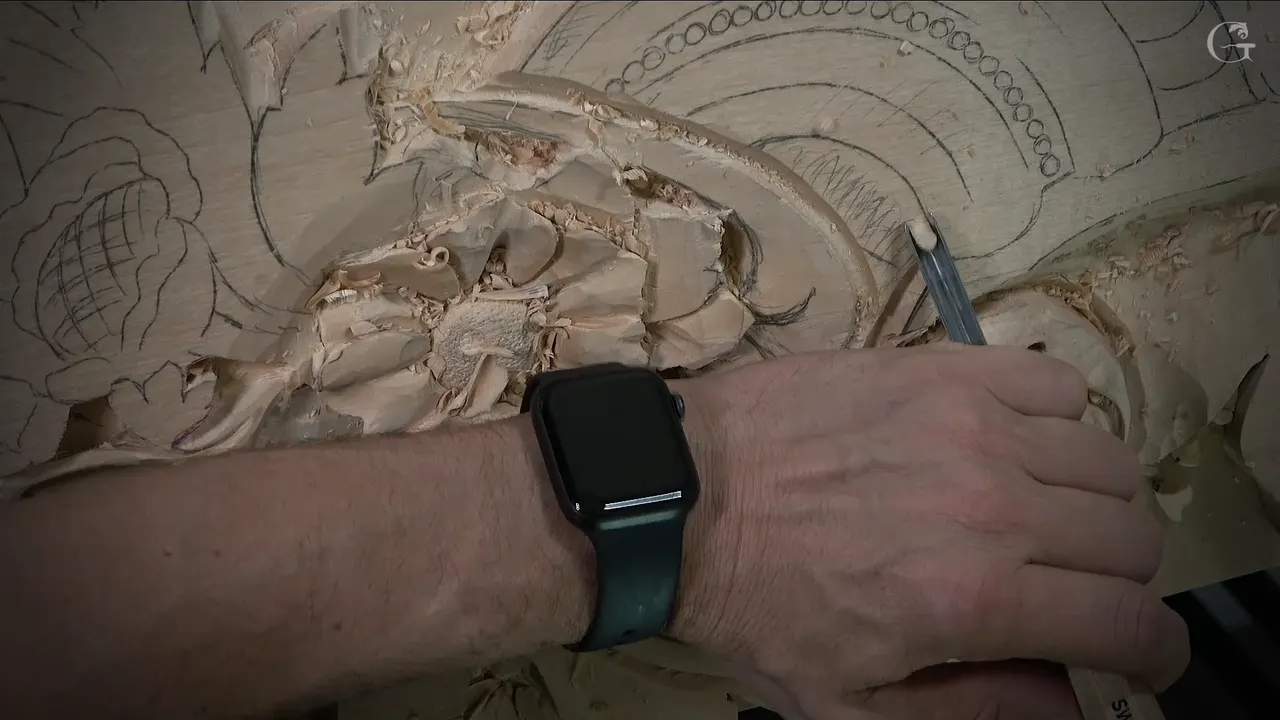

In Venice Room 120, part 3, I said of one detail, "It was dull before but looks much better now." This page follows that word through the work I did around it, and then through other lessons where I used it.
Have you ever carved a leaf, stepped back, and felt one place was not working? Did the place beside it look fine? Then you know exactly where my eye was in that workshop.
What was dull in the third part of workshop 120?
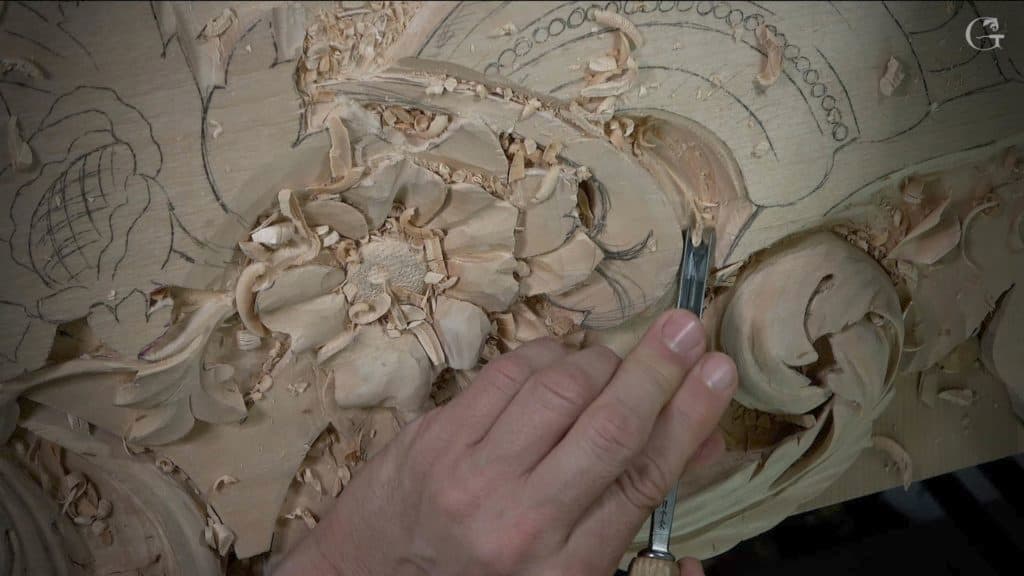
The detail sat on the panel, and I outlined it using a small gouge. "I'm going to use probably smaller tools for this operation," I said, and I would start with a number 11 of 7 millimeters (about 0.28 inch), "just 1 millimeter bigger than quarter of an inch." Outlining carefully was the plan, with "the first cut going to be right on the line."
One line has nothing to do with wood, "Let me take out my watch," followed by "I don't want to distract" and then I went on.

"So the second cut, I stay away approximately one-eighth of an inch from the edge, so you can see that ridge." That is about 3 mm, and with the smaller tool, I said, "it's more obvious."
How deep did I decide to go on that detail?
Depth came up next, and I said so: "Now I have to make the decision how deep I really want to go." I wanted three dimensions, "I want to make it 3D" and a movement that has to look 3D. A possible loss came in one line. "I really would like to see much deeper shadow, even if I have to lose some inner details on inside. I still want to see a shadow spot."

Another part of the carving was already deep. "If you look on this part, it's kind of deep," I said, and I thought I could "go almost as deep in this case right here." The payoff I named was "more outlining." Next came "You can already see it's already popping, this detail" and the sentence from the top of this page follows right there.
"And I think that is enough," I said.
What came after the detail looked better?
Then came a straight pass: "Now I can just create the straight-down cut, create that movement." For it I would take "number seven, the big number seven, three inches" (76 mm), and I thought it would produce "a really nice cut."

After that I named two numbers, and I would take "a number two, or number three will work. But I'll try number two first." My verdict was short: "And that is perfect. I think it's perfect" and the clean-up plan came after it.
Cleaning came next, with the same small tool. "Let me now clean with number 11, 7 millimeters, the same tool." One place needed care, and I said it: "Got to be careful right here."
One more line had to match. "Now, I need to match this line, which means I'll take number three or number two." For "just variation of tools," I said I would get a different number three, "a number three by Henry Taylor, and about three-quarters of an inch" (about 19 mm).

My last words in the video were about how it looked. "Don't pay attention. It doesn't look too appealing inside right here. Once we're going to roll everything, it's going to look really good." Part 2 of the same workshop had a similar line: a place that does not look appealing at the beginning would look "awesome" once it was cleaned and the extra material removed.

What did a dull place lack in lessons 64 and 65?
Venice Room 64 puts the word beside a deep shadow. I was about to dig: "I can actually excavate really deep hole in this section," which would give "a really good shadow, a really beautiful shadow." Looking at the wood as it stood, I said, "See, right now it's kind of dull. It's a chunk of wood." And: "if you look above what we've done, it's already kissing dark shadow."

Repeating the move was my plan, "exactly the same right here." I called it "the same operation, just the number nine" and number eight would work also, but "I kind of like number nine," a little bigger, "maybe about three-eighths of an inch" (about 9.5 mm).
Two movements sit side by side in Venice Room 65, and I asked you to look at one against the other: "See that movement, how it looks much better than this one? This one looks a little too dull because I don't have that shadow play." The plan was the same for "this section of the leaf, because it's beautiful and I should do it." Checking the wood came next: "looks like I do have plenty, so I can actually get deeper. So I can actually give it more shadow."

Another video of lesson 65 gave the word a reason. "This is kind of dull. Even the detail is beautiful, but it's dull because we don't have any frame around." One option was "a plug cut from this side and a plug cut from that side," to get "a frame." Every element, I said, is "supposed to be like a frame with the shadows." Otherwise, I said, it would not look nice.
I had to keep two main things in mind, "the light and the shadow." My tool for it would be a quarter-inch number nine (about 6 mm), "because it just rotates beautifully. It's a half-round true number nine." Closer to the wood, I said, "it's already giving me beautiful dark spot, beautiful shadow. So that is what I'm after."
Did I ever fix a dull place with movement?
A convex was on my mind in Venice Room 73, and I said it was logical to "start creating another convex." One part would be concave and the other convex, and I needed "something three-dimensional in this area." Of one piece I said it looked too dull. So: "I need to do something also more dimensional" and that way it would make sense.

Furniture Panel 23 begins with a slip in an undercut. I wanted to make sure I was "not going too deep" and called it "a mistake, what I just done." But "it's okay. It's not that bad and all." The undercut was too deep, "and I just created an extra movement, which is absolutely okay." Extra movements, I said, are "the next step, what I have to do with those flowers. Otherwise, it's just looking too dull."
"You could see already some of the result, but it's not the final look," I said. The work ahead, I said, was to "work my details" with "probably just the number eight" and to give "real nice concaves and convexes movements on inside of those petals."

Another video of that lesson uses the word again, with me "not too happy yet" and the spot looking too dull. That one needed "some kind of movements on the side going toward the center line like that." The tools I named were "maybe just the micro tools," to "create few concaves." The point, I said, was to "exaggerate little bit and create some interest."

Light came into it, too, and painters have a word for strong light and dark side by side, chiaroscuro. With the right light condition, I said, there would be "a lot of movement with the light and shadow. It already does. Even more." And: "So I am happy with what I see."

Two lobes overlap in The Tray of Blessing 3. I asked what I would like to see, and one lobe was dull: "It doesn't give me a really good motion." My idea was "to get this lobe kind of go right underneath of this lobe" with the number seven, chopping "slightly this way." The shape I was after was "like water drop shape."
The result showed on one of them: "it gives me really good shadow already." The other one "doesn't give me good shadow, but it will if I'm gonna drop that even more."
What about a dull place with no detail on it yet?
Lily Box 6 is about a volute: "I can develop an upper volute and then move to the lower volute" and then "what I mean by developing, because right now it's just too dull. No details." Next I said, "Let me use a smaller one, maybe about a millimeter and a half" (about 1/16 in), and that I would clean it a little bit.

Lily Box 12 had a thick spot in the wood, and I said I could "take advantage of this spot. Right now, this petal is looking a little dull, this spot." The answer I named was "extra concave movement" and the tool a number eight. Next: "I just created extra movement." I also said, "I actually go to extreme and slightly create cut on inside like this, okay?" And last: "Give that extra pop."

Grape Onlay 3 opens on a tool choice: "Little bigger tool, any tool will work. In this case I got number 11." My plan was to "create a shadow spot, otherwise it's not gonna look nice" and it would "look like, uh, dull." I added, "They don't have to be on the same level like in real life. So a couple, um, spots." And of my motion, "I got some variation in my motion. This is gonna give me better result."

The pipe in Floral and Molding for the Panel 11 got the same word. Of the pipe I said it was "going to be big convex" and "really important for me to have that convex feel, otherwise it's going to look too dull." Without it, I said, the pipe would not be "three-dimensional, if I can say it that way." Which means, I said, "I have to lower down that ridge even lower."
Did I say the before and the after out loud?
Tools changed first in Venice Room 66. "That is too big of a tool as of now, so I need to switch to smaller one, 20 millimeters" (about 0.8 in). On the movement I said, "It's a beautiful movement we're working on." And: "It was dull before. It wasn't too nice before, and now it becomes more and more nicer." A boundary came up too, "my boundary of this movement" and after that "I'm safe to chop around with no problem."

The April 2020 livestream has a spoken before and after as well. The working end of my number nine, I said, was "only about maybe 10 millimeters, no more than that," or "maybe about three-eighths of an inch." I asked the people watching if they could "see already that shadow" and if it was "already making difference." My reason was that before, "it was just a little too dull. It wasn't too good."
My plan came next, to "bring everything to the same cut." For that I would take a number 11 and "probably use a mallet," to "bring everything to that cut even deeper." Earlier in the same video I had said "I really need that shadow" and that I was "going with my shadows at least one inch, about 25 millimeters."
Does dull also mean a tool?
At my bench it does, and I use the word both ways. My four millimeters might be dull, I said in Venice Room 54, and "I need to spend time and sharpen it." In the same lesson, another video has this: "looks like my number nine is dull, and I need to sharpen it."
Venice Room 67 gives the other half. "It's already dull," I said. Then: "I just buffed a little bit, or honed, and it's much better now." In my own words the next step differs: a tool needed sharpening, buffing or honing, and for a detail I talked about depth, a plug cut, a frame or extra movement.
A short table of what looked dull and what I did
| Lesson | What looked dull | My next step or plan |
|---|---|---|
| Workshop 120 | A detail I had outlined with a small tool | Outline first, then a decision on depth |
| Room 64 | A chunk of wood in the section I was digging | Number nine, maybe about 3/8 in (9.5 mm) |
| Venice 65 | A leaf section, and a detail with no frame | Shadow play, with a frame as an option |
| Workshop 66 | A movement as it looked before | A boundary for it, then chopping around |
| Room 73 | A piece in need of more dimension | A convex first, then something more dimensional |
| Furniture 23 | Flowers after one deep undercut | Extra movement, then a number eight |
| Furniture 23, later | A side going toward the center line | A few concaves with micro tools |
| Tray 3 | A lobe with no really good motion | The lobe tucked under its neighbor, a number seven |
| Lily 6 | A volute with no details | A smaller tool, maybe about 1.5 mm (1/16 in) |
| Lily 12 | A petal beside a thick spot | Extra concave movement, using a number eight |
| Grape 3 | A section with no shadow spot | Shadow spots, using a number 11 |
| Floral 11 | A pipe with no convex feel | A big convex, and a lower ridge |
| Livestream, April 2020 | A shadow area as it was before | Plan: everything brought to the same cut |
Which place on your own carving would you carve deeper first? The workshops in Part 10 sit inside one tuition plan. The Part 10 course page holds workshops 110 to 121, and lesson 120 has all three videos. More wood carving and relief waits there, with lesson 121 next.
How it's done
- Outline with a small tool. A number 11 drew the outline, and my first cut was meant to go right on the line.
- Set the second cut back. The next pass stayed approximately one-eighth of an inch (about 3 mm) from the edge, so the ridge showed.
- Decide the depth. Depth was a decision to make, and I wanted a 3D movement with deeper dark.
- Look at a deep part. Another part was kind of deep, and I said I thought I could go nearly that deep.
- Stop at enough. After I said the detail was already popping, I said I thought that was enough.
Frequently asked questions
How did I get to a detail that looked better?
A small number 11 drew the outline, and my first cut was meant to go on the line. A second pass sat about 1/8 in (3 mm) back, so the ridge showed. Then I wanted three dimensions and a deeper dark spot, and I weighed how far to go.
Was the word always about shadow?
No. Lesson 65 tied it to a missing frame, and Furniture Panel 23 tied it to movement. Missing details in Lily Box 6 got the same word, and so did a pipe without a convex feel in Floral and Molding 11. Two other lessons used it for tools.
Which tools turned up in these places?
Lesson 120, Grape Onlay 3 and the livestream all named a number 11. Number nine came up in lessons 64 and 65 and the livestream. For the flowers and one petal I named a number eight, and a number seven came up for the tray lobe and the big first pass.
What to carve next