
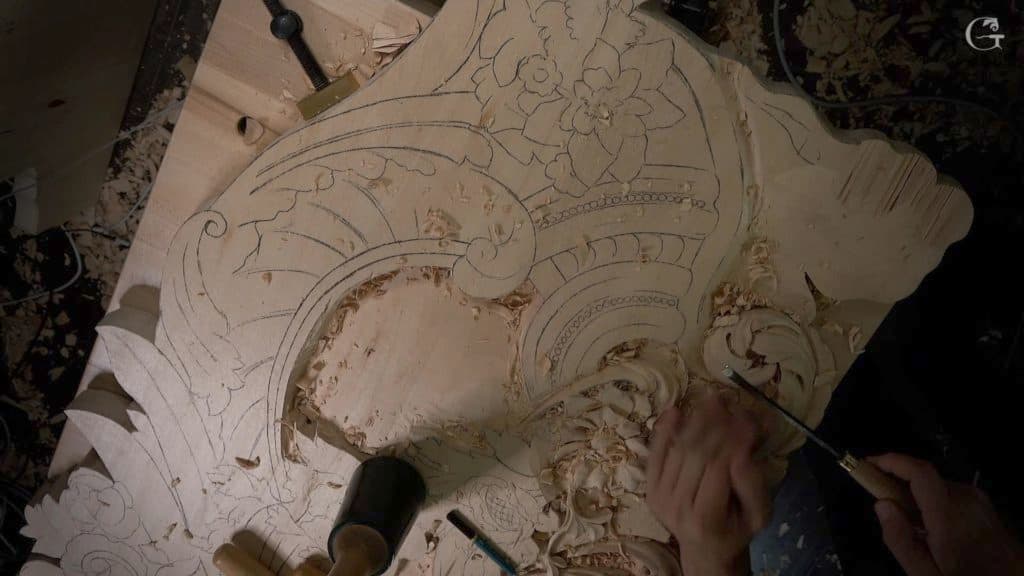
Alexander Grabovetskiy, woodcarver, School of Woodcarving · Published 2021
What does a wood carver mean by "the first step"?
Quick answer: Venice Room 122, video 2, has me say the first step for the upper side is an outline. In other lessons I use the same words before a relief cut, a number 11 at one millimeter, a measurement, a middle line and a shape.
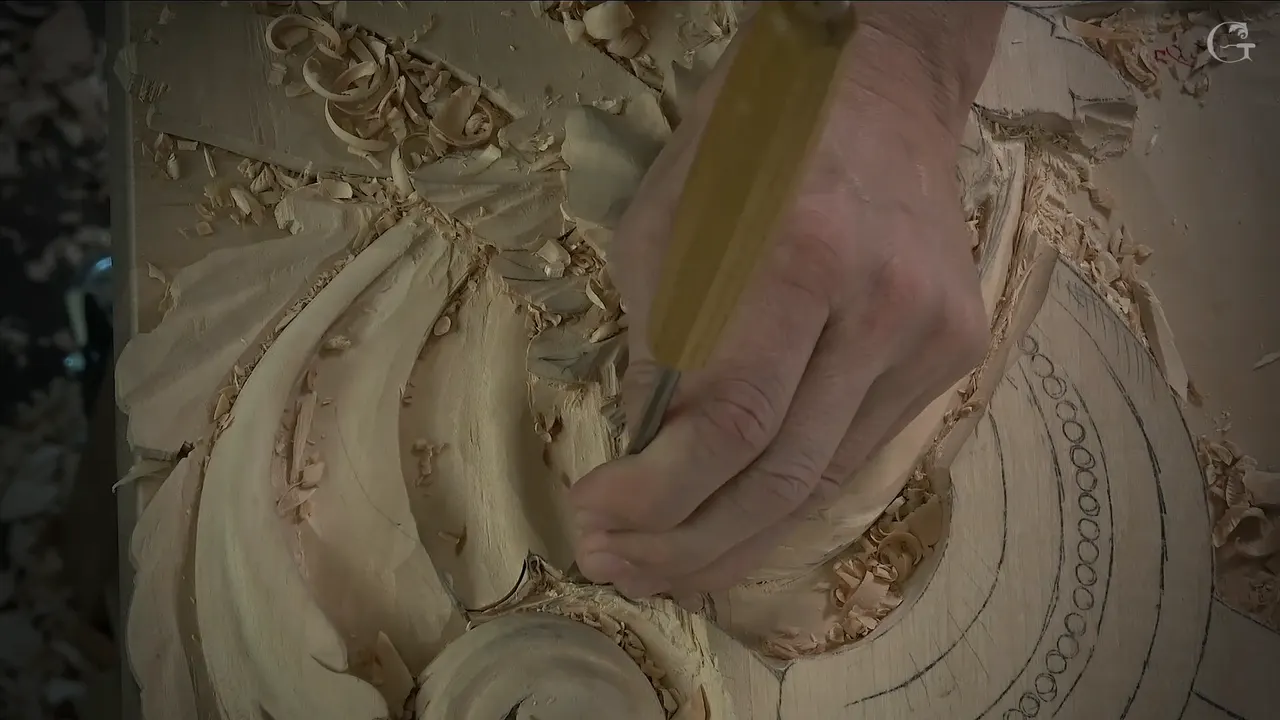

In Venice Room 122, video 2, I stop to think what the first step will be for the upper side, and I say it is to outline that part. This page begins with that line. From there it follows two plain words through my other lessons and names the lesson behind every line.
Ever stood over a board, gouge in hand, and wondered which pass should come first? Did a wrong first pass ever cost you a detail you wanted to keep? Then you know why I stop and think.
What did I say about the first step in workshop 122?
The video opens with "I'm going to wiggle." One side is moving, and I say "that's okay. I can live with that." "All I need is just the outline." That area will be lower, so I "don't worry about losing some of that stuff."
With number seven I'll strike "straight down like that," which is "just a straight down cut." Number nine is for "a couple plug cuts." I'll attack "straight down" in "those weak areas" and that will be "easier."
Going "all the way through" would be no big problem, I say, because the back side will also be plywood. Even so I "have to be somewhat careful in this area." And I am "really close to the opposite side, to the back." Then three words: "Carefully, carefully, carefully."

Then number three: "let me take number three" and "chop down, just like that." The chop is "also necessary now because that part goes like this."
About the slope I say "maybe I can right away take care of whatever that slope" and I ask "how am I going to show that to you?" "Let me think how I could show that to you." Then: "Right there. Okay. So it's much better."
On the slope I say "just start sloping nicely" and I will not do the final slope. It "has to be a really nice and gradual movement" and "I don't want to rush it. I do not want to rush it." With "number four spoon" I'll "attack from this side carefully, carefully, carefully. Until I'm happy with the slope." And I correct a word: "With the movement, I should say."

"Final line, I can do only after I lower down this side." While I slope, "this edge is also changing," so "it's easy to make mistake and miss that line." I correct my own word: "Miscalculate, I should probably say." After that, "That looks all right now" and "that is probably where I should stop messing with that."
"It is time for me to develop upper part." The details wait: "take care of it little later, right here, right there, and right there." My aim: "I want to concentrate on this side." And the words this page is named for: "So let me think what the first step going to be. And obviously, the first step, I need to outline that part. Okay? So that is going to be my first step."
The words end on a plan. The outline is what I say comes first on that side.
What do the other two videos of lesson 122 add?
In video 1 I say I "wasn't too careful and almost made a mistake." I plan to take a smaller number 11, "maybe two millimeters" (0.08 in), "and excavate even deeper shadow."

Video 3 opens with "number 11 and 20 millimeters" (0.79 in). My first cut will hit that line, I say, and I will not be as deep, "although, I probably could go much deeper." For a bigger tool I say "30 millimeters" (1.18 in) in number 11, to "remove a bunch of material at the same time much quicker."
Is the first step an outline?
A part that grows from underneath another one is the subject in Venice Room 41, video 1. The first step "would be for me to kind of outline this part," I say, and "I can do that with just a number 11." I could go deeper, I say, "because I'm going to have a twist."

Numbers show up in Venice Room 148, video 2. I have "six millimeters down" on one side and have to do "absolutely the same on the opposite side." First I outline "that line." The thickness is "about six millimeters" (0.24 in) "at the widest point" and "it becomes smaller."

Grape Onlay 10, video 1, starts with "one of my favorite tools," a number 11 of "two millimeters" (0.08 in). "I'm gonna just outline the first step, like always just outline." I "wanna keep an eye" on "how it goes" "from underneath" and "I wanna make sure it's connected." Of what I leave I say "I can always make it less about three millimeters" (0.12 in).

Butterflies 5, video 1, bends the words. Outline it, I say, and "that is the first step on this part" and then "it's not really the first step. Because we already done the first step." That "was my first cut right there." The next one is "really important step so I can mess up if I'm not gonna hit that line." The line is "scorched all around" and "my knife really really really has to be on that line."

Does the first step call for a small gouge?
A leaf outline in Lily Box 3, video 4, needs "this section" removed and "this notch" made. The gouge is "just a gouge, maybe a little bigger, about eighth of an inch, number eight" (about 3 mm), and I'll "cut straight down." Call it "just a relief cut." For "a straight-down cut" too, I need "a smaller gouge, maybe about 16th of an inch" (1.6 mm).

A small relief cut is named in Lily Box 5, video 9: "First step, of course, would be a small relief cut, and I'll take number nine. Number eight, I'm sorry." It goes "right in the place of division or subdivision." My reason: "wood is really crunchy, and if I'm not going to do that relief cut, I can lose that detail." Scale matters: "On a bigger carving, I wouldn't do so many subdivisions."
An eye waits in Furniture Panel 19, video 13. "My first step would be just to hit that with the 1 millimeter number 11, the eye area" (0.04 in). For the other side I say "let me do this side also exactly the same." My plan is to "switch to half a millimeter number 11" (0.02 in) and "continue my cut."

Undercuts get the same name. After "get underneath" in Lily Box 5, video 10, a number 11 of "one millimeter" (0.04 in) is the first step, I say. I need "to create that illusion that is flipping" and it "has to catch the shadow." "As of now, it still doesn't" and "that's why I need to undercut it." In Lily Box 3, video 2, it is "one millimeter first step" and "I'll just follow with a half a millimeter" (0.02 in).
Digging out a center is the job in Lily Box 10, video 1. "The same number nine and a quarter-inch" (about 6 mm) is what I'll take, and "carefully" I will "dig out my center." I call that "the first step." My goal: "dig out as much as possible the center part, and then I'll establish overall shape." Of the wood: "it's the heart of the wood, so it's not really easy to carve."

When is the first step a shape?
Furniture Panel 22, video 12, is plain that the form is "not the final form yet, okay?" We "still have to outline and undercut and make it absolutely beautiful." Then: "Just giving the shape. That is the first step."

Byzantine Acanthus 2, video 1, makes it a rule. "We're not going to do details yet at the first step." "So it's always, we establish overall shape, so the main movements" and details come after. The problem I see is "people working on details first" and then "it's too late."

A flower becomes "a donut" in Hashemi Flowers 29, video 1. Shaping it is "actually the first step to make that flower look like a donut." "Semi, okay, donut, not like real donut." Why: some spots will be higher and some lower, "but still it's preliminary." I use "number five and one inch" (25 mm).

Floral and Molding 10 turns to the left-hand side in its first video. "First step on this side" is "as usual" and it is to "establish the main 3D form, the main movement." The work is "without the details" with every shape, movement and curve "in three-dimensional world." After that comes "jump on flowers."
What about measuring first?
A volute on each side of Floral 8, video 1, calls for measuring first, and the calipers are "always, always the best tool, I would say." "I'll double-check on both sides." I read "little more than three-quarters of an inch," correct myself to "exactly three-quarters of an inch" and add "about 19 millimeters or so."
Reference points start Floral 1, video 2: "The first step for me would be probably just to get some reference points." The detail comes "multiple times" and it will be flipped, "a different direction." Of the pointing machine: "That tool is a lifesaver for me." And to you: "More you measure, more you put before you make a first cut, less mistakes you're going to make."
A reference at 90 degrees is the subject in Venice Room 85, video 11. "That's actually a really good idea to get this done at the first step than just figure it out later." "So I now know exactly" and I am "really square."

The golden ratio opens Furniture Panel 1, video 3: "the first step or the first rule, what I do, I find my golden ratio or principle of golden center." A simpler way is the rule of thirds, which "lots of photographers and cinematographers" use. "I could do that, but like I said, my goal is to create a beautiful piece of art."
A middle line starts Acanthus over Moldings 10, first video. It "doesn't have to be perfect, but you know try to be still accurate." My plan is "multiple chamfer cuts."

Flower Rosette 1, video 3, has the original beside the block: "the first step, what I have to do, it's actually to establish my edge." I'll place it "against my block of wood, eyeball it, and make a mark, which is about a quarter inch exactly, plus 1/32nd" (about 7 mm).
Greek Acroterion 1, video 1, begins with a plinth. To start, I "have to separate my plinth" "from the main design, from the two swirls and the palmetto part." For that I'll take "just a ordinary marking gauge" and plan to "start marking before I put any chisel."
How deep does the first step go?
Chamomile and Bow Rosette 4, video 3, is about undercuts. From the front the plan is to "take as much as possible" and then "take it out of the paper and then attack that from the backside." The number 11 is "small," "about maybe 4 millimeters or so" (0.16 in). I will not go all the way through, "because I still have to have some gluing parts." "All I need is just create a really, really good shadow."

In video 1 of Venice Room 140 a bigger tool is the plan. The first step is to "lower down section between those two elements" with "maybe even just the 30 millimeters" (1.18 in) in "number 11." The reason I give: "see how quickly I can get to the final depth." And a limit: "It's not always possible because, for example, right here, I've got that part on my way, and I can't do too much."
Video 3 of Venice Room 140 calls it a start only. "Preliminary convex. But that's only the first step." Another tool is the plan, to "just get rid of edges."
Venice Room 57, video 5, starts with excavation, and the first step there is "just excavation for me. Excavation of a concave." "I do not want to do too deep concave because it's going to create a lot more challenge to do my beads." My tool is "a number six," "a spoon gouge," "about, I would say 14 millimeters, about half an inch" (0.55 in).
Going underneath is named as the first step in Venice Room 41, video 6, and that pass stays less deep than a "much deeper excavation" I may make in one point "just to create extra shadow." The tool is "Number 11 in four millimeters" (0.16 in), "that's what I'm using."
In Venice Room 24, video 10, the first step is a skew, and the reason comes in the same breath: "I'll take a skew and fix little bit the movement. Because right now it doesn't look too good." I will not go "too extreme down in those sections": "I really don't need to." I "want to see it from the bottom."

A thin layer is left in Corinthian Acanthus 6, video 3: "about 1/16 of an inch before the final background line" (1.6 mm). You "pretty much take a number five gouge, and then after that" clean it "with number three." About the first step: "number five or number seven will work." "Just place your tool right on the line like I do, and make your move inside. Just against the grain."

What do these lines add up to?
In workshop 122 the words came before an outline. Elsewhere they came before a relief cut, a shape, a measurement or a pass that took wood out. The table below sorts the lessons by what followed.
The whole run, in five kinds
| Kind of start | Where I named it in my lessons |
|---|---|
| An outline | Venice 122, 41 and 148, Grape Onlay 10, Butterflies 5 |
| A relief cut | Lily 3 and 5, Furniture Panel 19 |
| A shape | Furniture Panel 22, Byzantine 2, Hashemi 29, Floral 10 |
| Measuring or marking | Floral 8 and 1, Venice 85, Furniture Panel 1, Moldings 10, Rosette 1, Acroterion 1 |
| A first pass | Lily 10, Chamomile 4, Venice 140, 57, 41 and 24, Corinthian 6 |
Which pass on your own board should come first? The full set of videos for this panel sits inside one tuition plan. The Part 11 course page holds workshops 122 to 131, and lesson 122 has all three videos of this workshop. More wood carving and relief waits there.
How it's done
- Number seven, one pass. A single straight down cut with number seven, as I put it.
- Number nine for plug cuts. A couple of them, in the weak areas.
- Slope without rushing. Number four spoon, from one side, carefully, for a gradual movement.
- Turn to the upper part. Details wait for a little later, and my attention goes to that side.
- Outline. I said the outline is the first thing I do on that side.
Frequently asked questions
Which words close this part of workshop 122?
A plan for the upper side. I said it was time for me to develop it, that I wanted to concentrate on that side, and that outlining came first. Other details, I said, would wait for a little later. Those are the last words in the video.
Why a 1 mm number 11 for the Lily Box undercut?
In lesson 5 of the Lily Box course I named one millimeter in number 11 (about 0.04 inch) for the first step, to get underneath. The leaf has to catch the shadow, and I said "That's why I need to undercut it."
How much wood comes off for the first step?
Lessons differ. Venice 140 has me taking a big tool to lower a section, "because see how quickly I can get to the final depth." Venice 41 went underneath instead, with a cut that was not as deep, and a deeper excavation in one point stayed a maybe.
What to carve next