
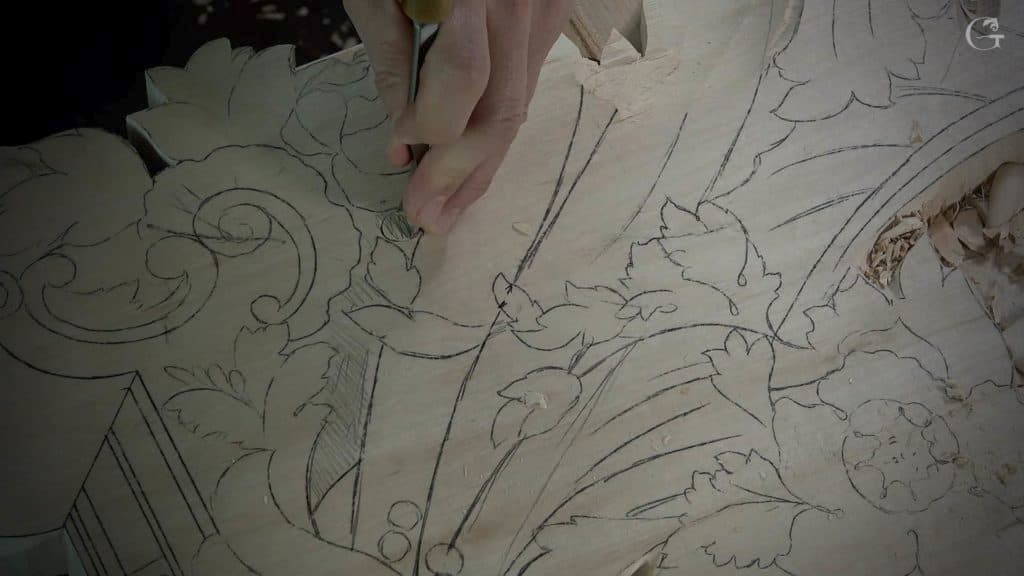
Alexander Grabovetskiy, woodcarver, School of Woodcarving · Published 2021
What does a wood carver mean by "a good area"?
Quick answer: Video 2 of lesson 125 has me jump into one section and call it a good area for a start. A clamp comes in my plan, then plug cuts that go deep. Elsewhere the same words go with shapes, leaves and shadow.
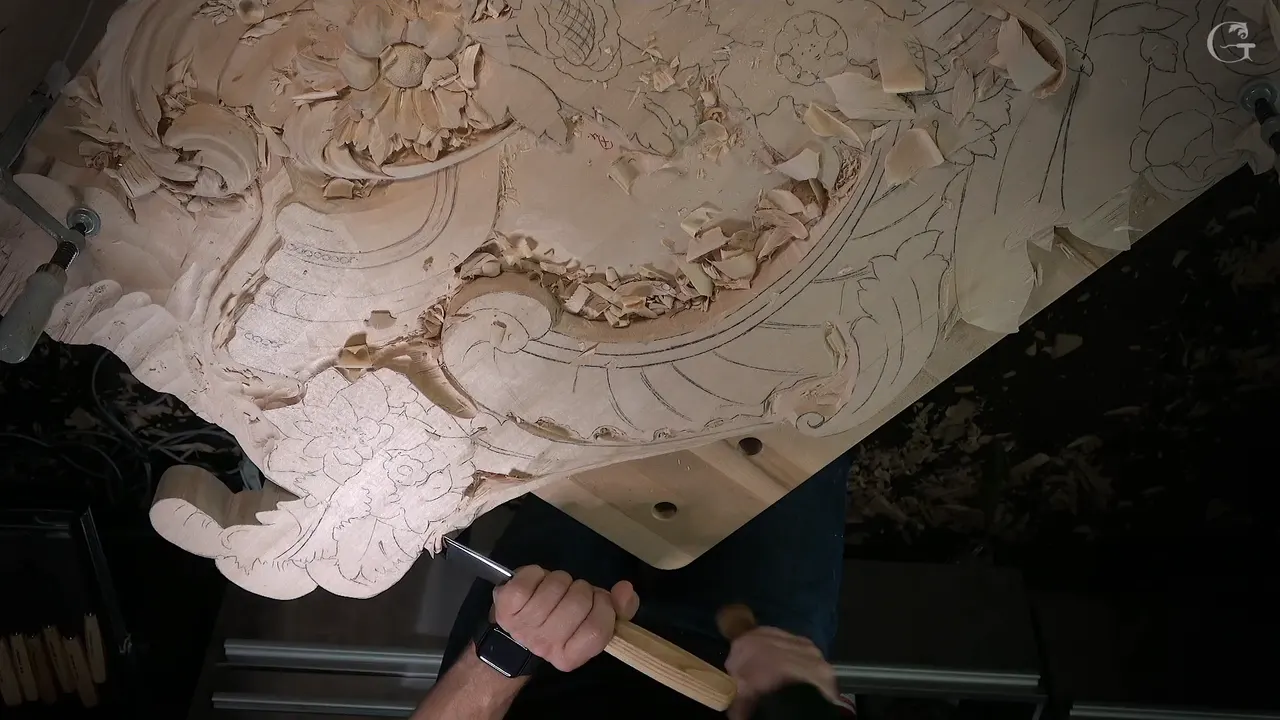

In Venice Room 125, video 2, I say I want to jump in one section of the panel and outline everything there. Then I say, "I think it's a good area to start." A reason follows right away. This page begins with that minute and follows the same words through my other lessons, with a cue behind every line.
Ever stood over a drawing and wondered where the first pass should land? Or picked a spot, then felt the wood fight you? You know the feeling. Here is how I picked one.
What does a wood carver mean by a good area?
The words in lesson 125 follow a long run of rolling and blending in this video. "I want to jump in this section," I say, and "outline everything." The reason is short. "At least I'm going to be able to see overall picture."
Next I say I could "use my clamp again." Then "And now it's solid." With the panel solid, I can "get this area closer to me" and "take out this clamp." "Don't need that anymore." And "It is not going to go anywhere."

What came before the words in lesson 125?
The video opens with "I'm safe to use number two this way." Next comes "clean up with the number 11." For the next tool I have in mind "that little smaller number two, maybe about 18 millimeters or so" (0.7 in), to "start developing even better shape." "Going to use that tool upside down," I add.

"Enough rolling," I say, "because I still have to develop those leaves and so on." "That rolls really good," I say, and "just blend it nicely." The look I want is "a really nice and smooth transition."

For a clean pass I plan "a little bigger number two, maybe even 50 millimeters or so" (about 2 in), "to get that cut clean." "Going to need the mallet," I add. A smaller tool follows, "like number three."

Some work can wait. "Little later," I say, I will "clean everything inside," so I "really don't have to worry about that too much right now." My verdict on the shape is "I like overall movement. It looks good." The next job is to "relieve right now that triangle of my future canvas."
One warning shows up, "Almost made a mistake" and then "I have to be careful how I do it." The area will be "all undercut." I still plan to use "number 11, of course." Once "we're going to establish those flowers," I plan to "give the concaves and convexes some more separations."
What came right after I said it?
Plug cuts. "I'm going to start with plug cuts in this section" is my line. That part "is going to be really deep," "about 30 millimeters down" (1 3/16 in). It will "create beautiful shadow," I think. And "give also lightness."

I will take "number nine" and "start excavating." I call the whole thing "same operation as always for the plug cuts." I correct myself with "I mean, plugging. Remove plugs." The last cue of the video is "Half an inch, that's what I'm using" (13 mm).

What do videos 1 and 3 of lesson 125 add?
Video 1 has "I want to see really good concave in this area." For the outline I plan "30 millimeters number 11" (1.2 in), and "I'm using only part of my tool."

In video 3 I plan to excavate that part and the opposite side, "much deeper." Still, "I don't need to dig a whole 30 millimeters right away" and "you can see in overall how it creates the shadow." It "just gives a beautiful look."

Do the words point at a place to show something?
Other lessons use them to point at a spot I want you to see. Venice Room 142 (video 1 of the Part 12 lesson) has "I don't have to" and then a "really good area to show you one more acanthus movement." That movement "used to be common," I add, "at least in the style I'm working in, so Venetian style." Next I plan a "smaller number 11," "maybe about seven millimeters" (0.28 in).

A "roll back" is the shape in Venice Room 54 (video 1). "I believe it's going to look really nice if I can create a roll back like this," I say. It is a "good area" when I want to show it, and I add "Maybe I can actually give you a better, closer picture of it."
The Curly Kitchen Cutting Board course (workshop 13, video 3) has a "good area" there for "a different approach." My own way is "I usually just go in one pass, but when you're just starting to carve, it's not always possible to do that, and you can struggle sometimes." The other way is to "just establish," work "from two sides" and "take that triangle out." "Same applies everywhere," I add.

Tray of Blessing 8 (video 2) wants depth. "To create the true depth" is the job for a "good area," I say. Before that I don't want to go "all the way" because "it becomes kind of weak in this spot." Later in that video the spot lets me see "that I left plenty of the material," because "I can always make it thinner going uphill."
That video also holds a warning. I show a way of placing my hand and say "That's too dangerous. Don't do that." Next, "Never place the hand at the front of the blade" and "you never know."

Which shapes did the words go with?
Look at Venice Room 82 (video 4), where I say "good area" and then "letter S curvature." It "has to be positioned properly," I add. My next words are "Let me get undercut" and then "Now get with the 1 millimeter" (0.04 in).
An eye shows in Venice Room 15 (video 2). "Because it moves inward," I say, it is a "good area" for that eye. A "big eye, huge eye" is what I want, and I tell you "I want to make sure I'm not going all the way through because I'm pretty close, really close."
In Venice Room 26 (video 9) I could do "a little deeper concave right here and bring this one up." The idea is "just same like what we did right here." The tool I plan is "number 11 and 12 millimeters" (0.47 in), to "carefully start excavating."

Next stop, Venice Room 102 (video 3), the other side of the same pair. "Good area" is my call for "my convex." The goal is to "blend that really nicely and smoothly." The surface is "just a little choppy," so I have "number three gouge" in mind to blend it "going that direction."
The curve is my reason in Venice Room 73 (video 8). "I can see the curvature right here, and I need to kind of taper anyway." So it is a "good area" and "a really good taper area."
A stop comes in Venice Room 60 (video 5). "I probably should leave it alone already because the more I do, the more damage I create." "I'll work on the pipe on inside of this movement," I say, which is a "good area" too. A number 11 at "4 millimeters" (0.16 in) is the start, and I think about "3 millimeters or even 2 millimeters." I settle on "Maybe just 2 millimeters" (0.08 in) "because I don't have too much space."

Where did I use the words for a division, a leaf or a small grape?
A division is the topic in Venice Room 143 (video 2). I start with "I could actually start making my divisions" and "really, really good" for that spot. A division on this side must be matched "on the opposite side as well," I say.
Hashemi Flowers 11 (video 8) says "let me also do subdivision right here." "I'll take probably just quarter inch" (about 6 mm), I say, and I do that "exactly with the same tool what I have in my hands." Then comes "patience, just a must."
The acanthus move is a "good area" in Hashemi Flowers 8 (video 1). Right here is "my high point," I say, and the movement goes "gradually going downhill." I have "a number eight" in mind, maybe "number nine" and "a big one, like one inch" (25 mm). "Really careful here because it's along the grain," I add.
A leaf is the topic in Hashemi Flowers 34 (video 1). One flower is "like a peony" and "I have to add some kind of leafage." I use "good area" here, "just to make one at least." The tool comes with "Maybe I'll just clean it with number four. And 10 millimeters, three-eighths of an inch." And "I am doing against the grain, but I don't worry about it for now."

I could use a tiny leaf in Hashemi Flowers 38 (video 1), "A really tiny, small one right here." Same words again, "good area." Then "Take a V tool again."

Look at Hashemi Flowers 44 (video 6), where a look comes first: "I can see it's beautiful moving downhill and then upward." A "good area" comes before "Let me take number nine. Remove chunk from middle." The grain matters. It is "against the grain," I say, but "probably knife" is "the best option."
Furniture Panel 6 (video 1) puts "the small acanthus" in a "good area" too. I add that I "can fill the whole space and make my move toward the major, the main point."
In Grape Onlay 1 (video 3) I see "gonna be a triangle" and "that's a good area," I say, since "I can probably divide that into two." I can get "one grape right here" plus "another grape right there." In Grape Onlay 2 (video 2) a small grape is the idea, "would just do probably a small one right in this section."
Where did I use the words for shadow?
Light comes first in Venice Room 97 (video 7). I expect "a really nice shadow, especially the light source is going to strike from this side, from above." "Careful how deep," I add. Then comes a "good area" where I work, I say.

I'll "take number 11 again and 5 millimeters, 3/16 of an inch." "I will start just outlining," I say, and "I don't want to go too deep." My reasons are "visible from bottom" and "hard for me." Then "you already see how deep shadow it casts. It's just perfect."
The words "good area" fit in Grape Onlay 3 (video 2) too. I have "maybe number nine in this case, and quarter inch" (6 mm), and I'm "gonna excavate right on the side," to "create the shadow, even if you don't see that."

Grinling Gibbons Maine class 14 (video 1) has an opening. I say "this area is darker that area is much darker" and "good area" goes with an opening in mind, "create some kind of opening." The goal there is a "dark spot."
For Venice Room 91 (video 3) the words go to a tool. I name a "good area" at that point "to use the rasps to create really nice and soft movements."
When is a spot no good?
Lily Box 1 (video 1) is a hunt for knots. I am "trying to locate my knots." "I want to miss this knot," I say, and "a nasty knot also." And "It's not a really good area."
Then there is Venice Room 59 (video 1), a choice. I ask "should I attack this part or should I concentrate on this volute?" "I think I probably should attack this section," I say. The reason I give is "I can see a movement going upward right here."
What do these lines add up to?
In lesson 125 the words came after rolling and blending, and I said a clamp could come off right after them. Elsewhere I pointed them at shapes, leaves, shadows and tools. Once I pointed them at a knot. The table below sorts the lessons by what the words pointed at.
Six kinds of spot the words went with
| The spot the words named | The lessons where I said them |
|---|---|
| A section to outline, then plug cuts after a clamp | Venice Room 125 |
| A spot to show you a movement or a different approach | Kitchen Board 13, Tray of Blessing 8, Venice 142 and 54 |
| S curves, eyes, concaves, convexes and tapers | Venice 82, 15, 26, 102, 73 and 60 |
| Divisions, leaves and small grapes | Hashemi 8, 11, 34, 38 and 44, then Venice 143, Furniture Panel 6 and Grape Onlay 1 and 2 |
| Shadow, an opening and soft movements | Maine class 14, Grape Onlay 3, Venice 97 and 91 |
| A spot that was no good, a nasty knot | Lily Box 1 |
Where will your first pass land? All the videos for this panel sit inside one tuition plan. Workshops 122 to 131 live on the Part 11 course page, and lesson 125 has all three videos of this workshop. More wood carving waits there. You will see acanthus leaves, a volute, shadow and grain, plus every gouge, chisel, mallet, rasps and clamp I name, in inch and millimeters.
How it's done
- Pick the section. I wanted to jump in one section and begin there, and I named it as my place to start.
- Name what you will see. I wanted to be able to see the overall picture.
- Check that the work holds. A clamp came back in my plan, and then the panel was solid, and I could take out a clamp.
- Plan the plug cuts. The next job was plug cuts in that section, deep ones, with a number nine.
- Expect the shadow. I thought the deep part would add shadow and lightness.
Frequently asked questions
Which line followed the words in video 2?
My next line was that I could use my clamp again, and then "And now it's solid." I said I could get the area closer and take out a clamp. Deep plug cuts were my next plan, in that same section.
Why did I want plug cuts that deep?
A look was my reason. I said I thought it would create beautiful shadow and give lightness too. The depth I named was 30 mm (1.2 in), and later I added that I didn't need to dig the whole 30 mm right away.
Is a good area only a place to start?
Lesson 125 used the words for a start. Elsewhere I gave them to letter S curves, eyes, tapers, leaves, small grapes and shadows. A nasty knot, on the other hand, was a spot to miss. A choice between two areas showed in in Venice Room 59.
What to carve next