
Alexander Grabovetskiy, woodcarver, School of Woodcarving · Published 2021
What does a wood carver mean by "absolutely okay"?
Quick answer: Video 3 of lesson 125 follows a big first pass with a number 11, then a smaller tool for the middle. And I say it is absolutely okay. Other lessons put the same words after messes, lost lines and slips, and some after a way you may choose.
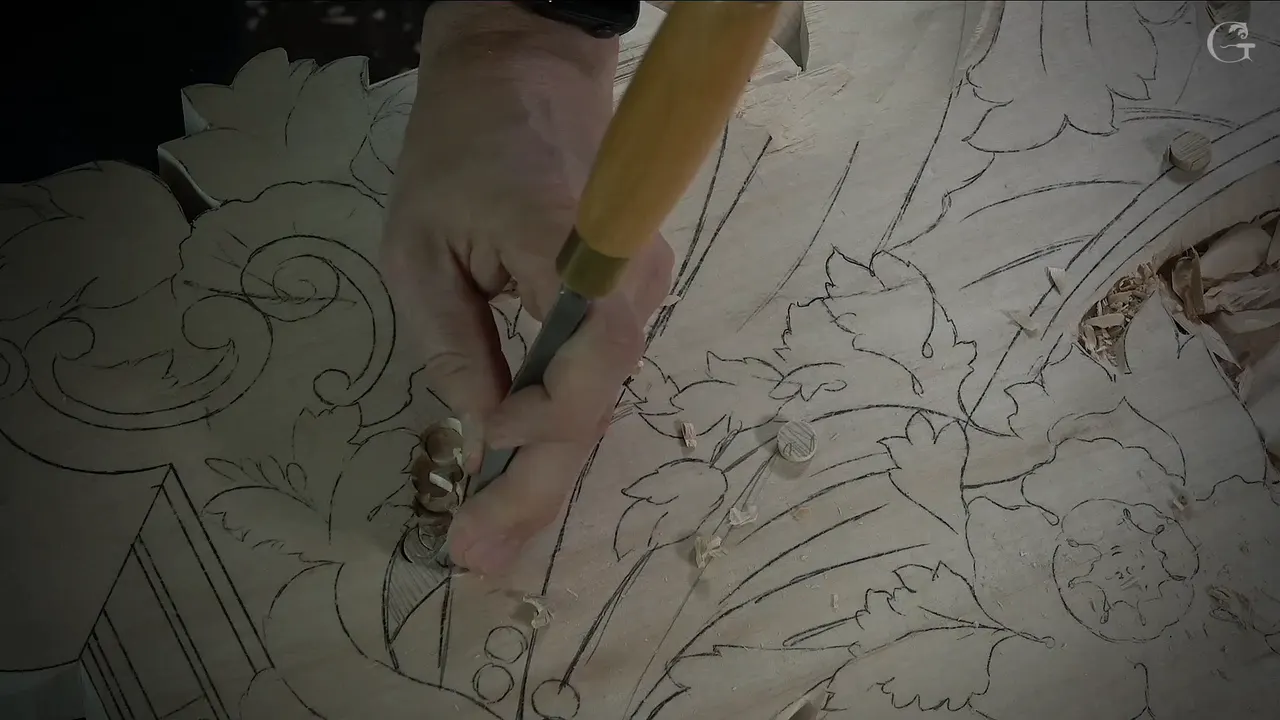

In Venice Room 125, video 3, I say I can follow a 10 mm (0.39 in) number 11 with a smaller one, "maybe seven millimeters" (0.28 in), "and just excavate the middle." Right after that I say, "I guess in this case, it is absolutely okay." This page starts with that minute of the lesson. Then it follows those two words through my other lessons, with a cue behind every line.
Ever carved a groove that came out wider in one spot than another? Or watched a gouge take more than you meant? You know the feeling. Both turn up in my videos, with the cue behind each line.
What did I call absolutely okay during lesson 125?
First comes a straight pass. "Just a straight down cut, but I work like this." My line about the wood comes next, "And that just removes a lot of material at once." A second way follows: "Obviously, there's a second approach. If I were just to take number 11 and 10 millimeters and remove some of it pretty much this way."

Next comes a smaller tool. "And I can follow with the smaller one, maybe seven millimeters, and just excavate the middle." Then my words: "I guess in this case, it is absolutely okay." My talk then turns to another tool.
My plan for the next pass: "And I'll take number three and create a straight down cut right on the line." I also say, "Make my opening a little wider." A line on the board gets its own words, "actually continuous right here on the opposite side. So it's more like a molding line, if you wish." Then, "Well, you don't have to wish. I know it is a molding line. I placed that anyway so I know what is going on and what is going to be."

What did I say while the piece was jumping?
A bit later: "I don't know why it's jumping so much. Maybe I should clamp it. Okay. Why don't I?" The clamp comes up: "Going to get the clamp, and maybe clamp that somewhere right here." Next a hope: "I hope it's going to be a little more stable, I should say."

Back to the pass. The number 11 returns, "and let me see if I should use 10 millimeters, I guess." I tell you, "But you've got an idea. So I'm going to excavate that part." I say it will be deep, and the opposite side gets "exactly the same matter" and I say it will be "much deeper" too.

Outlining is next. I plan to "just outline everything with the number 11, just like that, both sides, that side of the pattern and that side of the pattern." Later I plan to "lower down overall" and I say "yes, I need to outline my flower, too."
A side remark comes next. "By the way, I don't need to dig a whole 30 millimeters right away" (1.18 in). I go on, "but you can see in overall how it creates the shadow, and it just gives a beautiful look." Then, "So let me outline everything."

Is a mess I can clean absolutely okay?
Workshop 21 of the Venice Room begins its second video with a look at the work. "Now it looks good, except I've got a lot of mess going on inside right there." Of that mess I say, absolutely okay. "We can always clean it with the number 11." The size: two millimeters (0.08 in). A bigger tool would be quicker, and next, "let me use four millimeters" (0.16 in).

Workshop 64 has me damaging one side in video 1. About the damage I say "because I can clean that." It is absolutely okay. Then, "I have no problem with this side because I can clean it." A nine can do it, "Just super sharp number nine." A small section shows up later and I say it again, followed by "Okay, that is good."

Workshop 34, video 2: the edge of my tool "was digging in the fibers." Then comes "absolutely okay." Care follows: "Got to be careful how I'm doing it." Further on, "It's a really important movement, and I don't want to mess it up."

Over in workshop 72, video 12, I tell you "I need a little deeper excavation on this section because it looks like my back bent dug really deep." I put that as absolutely okay. Next up: "number five and half an inch" (13 mm), and "just a cut on those slopes and kind of refine the overall movement."

A crack in the wood earns the phrase in Furniture Panel 18, video 8. "I can see there is a crack inside of the wood, which is absolutely okay. I knew that from the beginning. On those pieces, I had those cracks. That's actually why I didn't use those pieces on an actual project. I just kept it for myself." Then, "But I really don't mind those cracks."

And Furniture Panel 23, video 4, puts a mistake in front of me. "See, that is a mistake, what I just done. But it's okay." I say next, "I've got too deep with the undercutting, and I just created an extra movement." The same two words come next, then "Because anyway, extra movements, it's the next step, what I have to do with those flowers."
A spot in the wood is the topic in workshop 83, video 10. About basswood, I say that if you see the dark spot, "the material is a little mushy, which is absolutely okay." The tool is named too: "one of my favorite tools," a skew in this case.
Cleanup by hand comes up in Furniture Panel 18, video 9. "So the rest of it, I have to clean just by hand with the gouges and veiners." Next, "absolutely fine, okay?" Then, "But I have to be careful. I don't want to make a mistake."
Is a lost line or a lost detail absolutely okay?
My condition sits in video 6 of workshop 17. "I still have to lower down the whole thing right there, but that is absolutely okay as long as I'm not going to lose the details I just created, which I should not." Video 11 of the same workshop has me losing details "because I already chopped from inside" and my words are the same. Next I think I should get a "little deeper concave," "maybe with number eight and a quarter inch" (about 6 mm).

Back in workshop 37, video 11, I talk about sides. "And no, I'm not afraid of losing the sides." The same two words follow, and I go on, "I can always dig deeper. But what I want to see, I want to see really good concave-- convex, I'm sorry. Convex."
A line down the middle is the topic in workshop 62, video 5. "Number 11 and seven millimeters, and let's start." My middle line will sit a little lower, I am not afraid of that: absolutely okay. Further on: "Even if I have to lower down my middle lines, that's okay, too." Also, "I can reestablish my middle line with no problem."

A plan about some sides sits in video 3 of workshop 61. I plan to dig inside a little bit of them, and it is absolutely okay again. I go on, "But I really need that half of a round shape."

A groove is next in workshop 24, video 2. "If you got your groove or if I got my groove uneven, somewhere wider, somewhere less wide," I call it absolutely okay. Plans follow. One is "the 2 millimeters now, number 11" (5/64 in), "and try to clean even nicer." The other is to use a magnifier lamp, "I should say," for "an even better cut."
Facets come up in workshop 73, video 2. "Although you can see those facets, but it's okay." Then absolutely okay, and "So now it looks much more appealing, I'd say."
Over in workshop 27, video 2, I lose a section. "And yes, I just chopped a section of this, which is okay. This section I just lost, that's absolutely okay. I can reestablish it, no problem." A piece breaks in Acanthus over Moldings 9, video 1, and it is absolutely okay: "It's just gonna be a little smaller."

Is it absolutely okay at every stage?
Hashemi Flowers 43, video 4, draws a line. I slip with the tool a little bit and cut through. At this stage it is absolutely okay, "but later on, it will be a big mistake. So that is absolutely no-no."
Workshop 27 goes on. "But honestly, I have to be more careful and not to rush anything. It is okay in this case, but in some spots, it would be a huge mistake."

A rough surface can belong to a stage, too. In Grape Onlay 1, video 1, my words are "absolutely fine because it's a roughing stage." And in Acanthus over Moldings 2, video 3: "Yeah, it does look somewhat rough. And I'm absolutely okay with that. Okay. So that is just the stage when I create overall shape. no details yet."
In video 1 of Moldings workshop 4, slight facets get a limit: "Slight lensing like that," absolutely fine, "but not to the extreme."
Damage can work for the shadow. Byzantine Acanthus 4 has this in video 1: "if you even need to dig a little deeper and create that damage, it's absolutely okay because we are after really good shadow effect."
And a wall gets the words too. In Greek Acanthus 15, video 4, I tell you, "for furniture, it would not be good idea if people are going to touch it all the time." It would be "too fragile." Then, "if you want to frame it and place it on the wall, it's absolutely fine."

Does absolutely okay also mean you may do it another way?
Some of my lines point at your way instead. Chamomile and Bow Rosette 4, video 1, is about moving a drawing onto the wood. "You could use carbon paper or graphite paper." I will probably do that: "absolutely okay to use it." One complaint follows: "The only problem that I have with that method is how much black dirt it just accumulates."

Floral and Molding 4 brings up the pointing machine in video 1. "You could use just a hand drill," I say, and it is absolutely fine. A bit size follows. "I usually just go with maybe about quarter-inch bit if it's possible," I say, and then "You could use 3/16 of an inch, like five millimeters." Again, absolutely okay. This job: "just quarter inch, six millimeters."
Greek Acanthus 3, video 4, sets a knife beside a number 7. "And it would be absolutely fine to use a knife." For anyone not comfortable with a knife, "in our case, we're using just a number 7, 14 millimeters" (0.55 in). For the cleanup, "You could clean it with the knife." Then, "It would be exactly the same result."
The sandpaper question gets its answer in that Moldings workshop 9, video 2. "Like I mentioned before it is absolutely okay to use a sandpaper if you feel like you have to. I have absolutely no problem with that matter." Then, "I used some of the Sandpaper just because like I said, it's gonna be covered with the paint." Then, "So don't get an idea that I'm using some paper all the time."
Lily Box 10, video 9, is about tools. I tell you "it's my experience, okay?" About a different experience with those tools, "that's absolutely fine."
Another case sits in Lily Box 12, video 7. "If money depends on the speed and so on, you have to make the decision. Well, already that's a stopping point because I really need to pay my bills and so on. And that's one thing which is justifiable." After that, the words I say are "absolutely okay."
Where do these lines leave us?
In lesson 125 my words came after a smaller tool and a middle to dig out. Elsewhere they followed messes, lost lines and slips, and sometimes a way that was yours to choose. The table below sorts what I said by the lesson it came from.
What the table shows
| What I called absolutely okay | Which lessons |
|---|---|
| A big first pass, then a smaller tool, in video 3 | Lesson 125 |
| A mess inside a hollow that a small tool can clean | Venice 21, 64, 34 and 72 |
| A lost line | Venice 17, 37, 62, 61, 24 and 27 |
| A slip that holds only at this stage, and no later | Hashemi 43, Venice 27, Moldings 2 |
| Another way for you | Chamomile 4, Floral 4, Greek 3, Moldings 9 |
Which of those would you say out loud at your own bench? Every video of this panel sits inside one tuition plan. Workshops 122 to 131 live on the Part 11 course page, and lesson 125 holds all three videos of this workshop. More wood carving waits there, with acanthus leaves, a mallet and a chisel, and every size I name in inch and millimeters.
How it's done
- Take the first pass. A straight down pass removed a lot of material at once, and I described a second approach with a number 11.
- Dig out the middle. Next, a smaller tool, maybe 7 mm, was my plan for the middle. The phrase absolutely okay came last.
- Set a number 3 on the line. A number 3 was my plan, a straight down pass right on the line, and then a little wider opening.
- Clamp the piece. The piece was jumping, so I planned to clamp it. I hoped it would be more stable.
- Outline both sides. The plan was a number 11 around both sides of the pattern and around my flower, and a deep dig that did not need all 30 mm right away.
Frequently asked questions
Which tools came before the words in lesson 125?
The second approach I described uses a number 11 of 10 mm (0.39 in). Maybe 7 mm (0.28 in) was the size of the smaller tool, to dig out the middle. Right after that came the words.
Did a mess ever count as absolutely okay elsewhere?
Workshop 21 had too much mess inside, and I said it was absolutely okay because a number 11 of 2 mm (0.08 in) could clean it. Workshop 64 had me damaging one side, and a number nine could clean that.
Was a lost detail absolutely okay too?
I said it about details in workshop 17, sides in workshop 37 and a middle line in workshop 62. For that line I added that I could reestablish it. In workshop 17 my condition was not losing the details I had just made.
What to carve next