
Alexander Grabovetskiy, woodcarver, School of Woodcarving · Published 2021
What does a wood carver mean by "how it feels"?
Quick answer: In part 3 of lesson 126 I say checking comes first, and a plan for the rasp follows. Other lessons carry the same check beside a finger on a bump, a whole movement and a tool in my hand, with a cue behind each one.

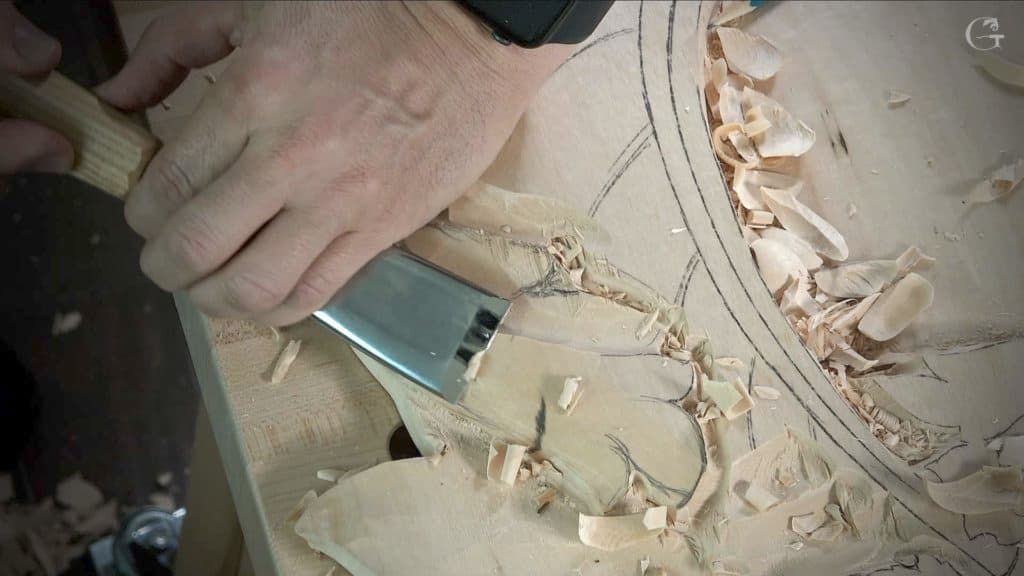
In part 3 of Venice Room workshop 126 I say I really need to check first, and a plan for the rasp comes next. This page starts with that part of the video. Then it follows the same check through my other lessons, with a cue behind every line.
Ever run a hand over a carved curve and found a bump your eye missed? Or liked a surface, and then not liked how it looked? Both turn up in my videos.
What did I say I needed to check first in lesson 126?
The part opens, "And now it's going to be a lot more careful movements or cuts, I should say." Then comes the line this page is named for, "So I really need to check first how it feels."

The rasp comes up next. "And maybe it's a good idea for me to hit with the rasp and get those high spots and make it really, really good and smooth." Then, "Don't really have to, but anyway."
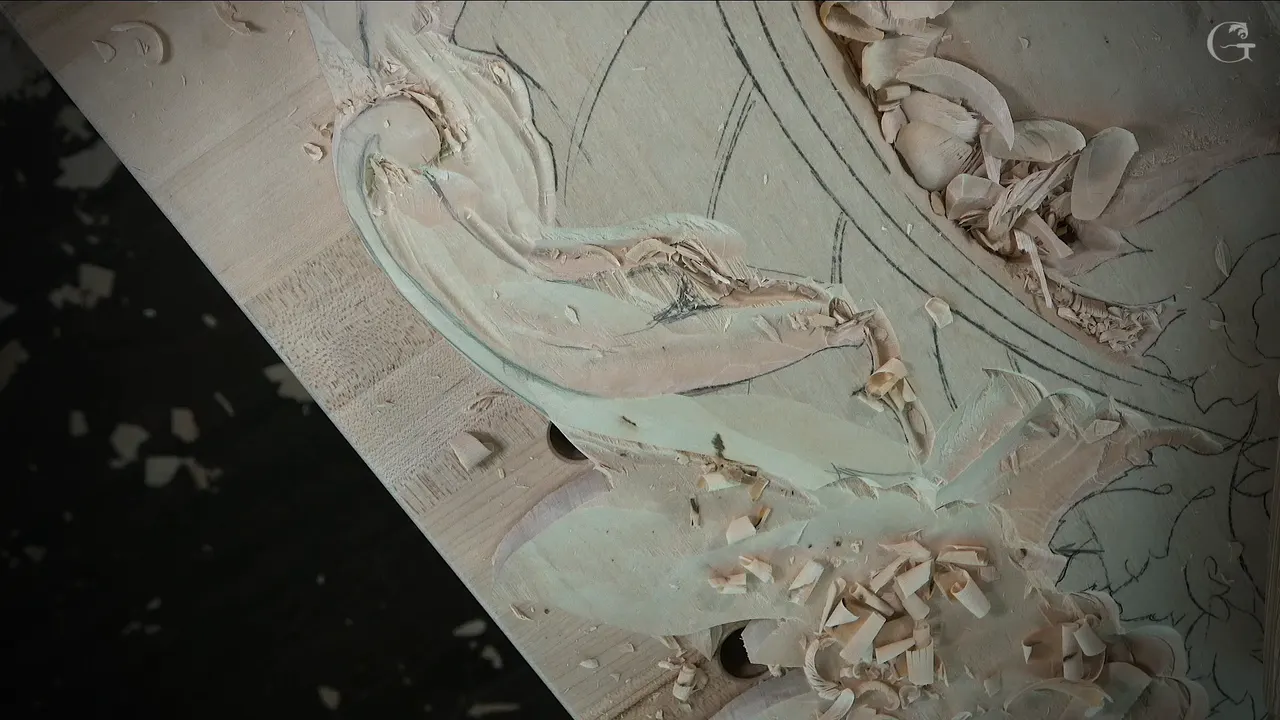
The result comes next, and I say it looks and feels "really, really good, although I damaged a little bit my workbench." My comment: "But it's okay." Then, "now it's good, but I don't like how it looks." An option: an upside-down tool. "I can always hit that with upside-down tool and shave it a little bit."

"That's not the end yet," I say. The next step is still ahead: "we need to establish concaves and convexes later, but still."
Where does the dig underneath leave the line?
"So let's dig underneath." A verdict follows: "So again, not too good. I'm rushing too much." I add, "And again, I can't be lower than that. Okay? So it's supposed to be just like on top although I could always lower this side. That's also a possibility."

What else could I do? Here is my thought, "I think I could just make change." The idea is to start "from this point" and I see that I would have to continue the line right there, "so it's not going to be good." So another idea comes: "let's move it somewhere right here, this line."
About the undercut I say, "I'm not going to undercut yet." That comes later on. For now the main surface comes first, and "I need to establish concaves and convexes on the main surface."

I want you to see what I'm doing. For that, "Maybe I have to turn my table. That's what I'm going to do." The camera is to be repositioned "where you would see those" shapes. My conclusion: "I think it's much better for you to see."

What did my iPad drawing show?
My check is the drawing on my iPad, and I "see if I'm not making mistake how I want to do it." I do make a mistake. "I already see I could make a mistake," I say. The spot is "the point right there" and "it has to just curl this way." Next, "Not a mistake, but it's a good idea to double-check." I close it with "I'm glad I did."

Next come my plans for tools: a number seven for "that S curvature, letter S curvature" and a smaller number 11, "like five millimeters number 11" (about 0.2 in), to "attack this triangle." Another letter S is to go "opposite direction this way."

One hump gets a frown, and I say, "I don't like this hump. That doesn't look too appealing." The check I name is "from different positions" and it is about the look. A number two comes next in my plan.

How does my finger check a surface?
The plainest line is in Lily Box lesson 7, video 9. The wood has "a lot of grain, and waviness" and I say it distracts overall movement. A finger is my answer: "I have to constantly just check by finger." "If I have any bumps, I need to take care." Next on my list: a nicer concave and a ridge. Afterward I see I hit my background, and my plan is a number seven, quarter inch (about 6 mm).

The Venice Room, workshop 11, video 4, has me "kind of happy with the overall feel." But I think I missed something. I plan to use a rasp, "to find the high spots," because I kind of don't like the feel right here. Two spots "kind of bugged" me, and "they're not flowing okay in my opinion." Next, "Now, it's better, but this..." On a tool in that video I say, "I didn't think I was going to like that tool at all. But the more I use it, I like it more."

Short, in workshop 10, video 9: the feel is still not one I like, right here. "So got to gradually..." Then, "Not all the way."

Furniture Panel 19, video 7, leaves me "not too happy" about one spot. I say I need to "chop slightly off." My verdict is plain: "Just not feeling right."

Video 8 of that panel workshop puts looks and feel together. The movements I like, but I don't like the look, and I add the feel, "I should say." "Let me just soften a little bit," I say next, and then "for me, it looks much better."

In workshop 82, video 7, I want the transition to "look nice." But the overall movement downhill is a feel I don't like, so "I have to take the high spots" and "I'm talking about 3D movement, okay?" I need to use "probably number seven from this point on."

Workshop 69, video 5, shows me "constantly checking from all the positions." The overall feel is what I check, and I say it "still does not feel like it's supposed to feel, which is okay." My next step is to go around a line and "remove some of that material." For that, a number 11 is the plan, "of course."

How does it read across a whole movement?
Designing Furniture Panel 11, video 5, holds a check at the preliminary stage. "I think that's good. I mean, overall." The details are coming up, "like I said." Next, "overall it looks good" and "maybe I'll just put some kind of movement like that right here."
In video 3 of Furniture Panel 29, a little more waviness waits: "I can do a little more waviness little later," I say, once I look at it and see the feel "in the overall movement." For now, "let me blend this part."

Workshop 70 has two lines. In video 1 comes a plan: "later on, I will fix overall movement." Right now I need "a really good pronounced convex" and I will do a micro cut on this side. And in video 12, "that is exactly" the feel right now, I say, "but I also need to make that going all the way this direction also." The tool is a number six, "20 millimeters, by the way" (0.79 in). I add "three-quarter of an inch" and "I think it works just really good."

Plain praise comes in workshop 34, video 4. I "really like" the overall feel, I say, and I think it looks "really nice." I want you to see "how it blends together."

Two checks sit in the Venice Room's workshop 37, video 5: "double-check from below how it looks" and a word about the overall feel, "I'm happy." Another thought: "I probably should chop with the bigger tool on inside."
A big veiner is in workshop 53, video 7: "You already should get the feel," I say, "and it feels really good already." And "I can actually get even deeper if I want to with this movement."

Over in video 4 of workshop 91, I want a spot to "feel like it's folding from underneath" and the overall feel is what I am changing. And I want "even deeper, probably, concave right here, because it doesn't look too natural yet." Number 11 is my plan.
Over in video 3 of workshop 102: "I actually really like the feel of it." The camera comes into it. "It's kind of hard to catch that on a camera, but it looks good."
Feel and look both please me already in workshop 115, video 3. I say, "I can see the ridge, the middle ridge" and that is "going to give me a shadow." "Obviously, it's not the end." Waviness for those leaves is something I will probably add "a little later."
Video 10 of workshop 62 ties the feel to design. I call it "all about" the overall design. "Sometimes I have to change mine and excavate deeper, but I'm not doing it from jump number one." Next, "I just look at it, and I see what is going to look better." A number five is the tool.

A warning arrives in workshop 42, video 1: I do not want to do "too close to the line," because once I undercut and round that, "I can face the danger of losing feel." Then, "Probably the best tool for it would be for me to use skew."
In workshop 44, video 5, I say "Wonderful." Next comes a doubt: "Except I'm not sure if I like how that feels. But I can probably work on that." After that, a plan: "give a shape to this one, more or less final shape."
Overlapping movements come up in workshop 74, video 7, where I say they are "lots of different movements" and "it looks simple, but I really love the idea behind it." The overall design is a feel I like, "if you wish." Next, "I think it's enough because I do not want to go too deep and create a problem for myself."
Does the grain come into it?
The eye has a right way in workshop 62, I say, in video 3. It comes from how the grain goes, and from the feel. Another line is in workshop 105, video 1: I plan to see the feel, and I need it "rounded this way."
When does it feel good in my hand?
The Tools Selection lesson has a handle that is "traditional English," a rounded one with "some kind of satin finish on it." The handle is one I like in my hand. Held "all day long," a rounded handle is more comfortable for me than an octagonal one. "Although I don't see the big difference," I add.

The gouge in Greek Acanthus 8, video 3, is "the brand I love the most." "Beautifully done," I say. Also, "I just love overall" the feel of it in your hand. Next plan: "why don't we do some undercutting right now under this piece?"

Lily Box lesson 2, video 6, has weight in the hand, "when you're carving it" and "even metal." Its weight is "not too heavy and it's not too light." Then, "it depends on the tool."

Micro tools come up in video 1 of workshop 69. They are "a really thin metal" and a micro tool "goes right through the fibers with no problem." "It doesn't have to be a micro tool. Any tool will work, even full size. I just love them." Working with them is something I like, and so is the feel.
Furniture Panel 15, video 5, shows a set of knives. "I like the size of it," I say, and the feel in the hand. Then, "They feel really comfortable."

A back bend is in workshop 140, video 3. I "kind of like" that brand, I say, and the feel "and so on." My plan: a "preliminary convex" and "that's only the first step."

And in the beginner course, Cutting Board 16, video 1, a first cut around the perimeter is "like a frame look." That cut is "going to give you a feel" in your hand, I say, "the gouge."
What the table shows
| What I checked by feel | Which lessons |
|---|---|
| Before a rasp on the high spots, in video 3 | Lesson 126 |
| A spot to check by finger or rasp | Lily Box 7, Venice 11 and 10, Furniture Panel 19 |
| The whole movement, overall | Venice 34, 37, 53, 62, 70, 82, 91, 102 and 115, Furniture Panel 11 and 29 |
| A tool in my hand | Tools Selection, Greek Acanthus 8, Lily Box 2, Venice 69 and 140, Furniture Panel 15, Cutting Board 16 |
| The grain | Venice 62 |
Which of those would you check at your own bench? Every video of this panel sits inside one tuition plan. Workshops 122 to 131 live on the Part 11 course page, and lesson 126 holds all three videos of this workshop, with lesson 125 before it and lesson 127 after it. More wood carving waits there, with acanthus leaves, a volute, a mallet, and every size I name in inch and millimeters.
How it's done
- Check first. I said checking comes first, after a plan for a lot more careful cuts.
- Plan the rasp. Maybe a good idea, I said, to hit the high spots with the rasp and make the surface smooth.
- Say what you see. How it looked did not please me, so I said an upside-down tool could shave it a little.
- Hold the undercut. No undercut yet, I said, because the main surface needed its shapes established first.
- Check the drawing. My iPad drawing was the check, and I said I was glad I did.
Frequently asked questions
Which tool did I plan after I said I needed to check first?
Maybe a rasp on the high spots, I said, to make the surface smooth, and I said I did not really have to.
How did I judge the surface in lesson 126?
I did not like the look. My option was an upside-down tool and a little shaving, and I said the surface was not at its end yet.
How did I check a spot in Lily Box 7?
By finger, constantly, for bumps. If I had any, I needed to take care. A nicer concave and a ridge were next on my list.
Did I check the whole movement too?
What to carve next