
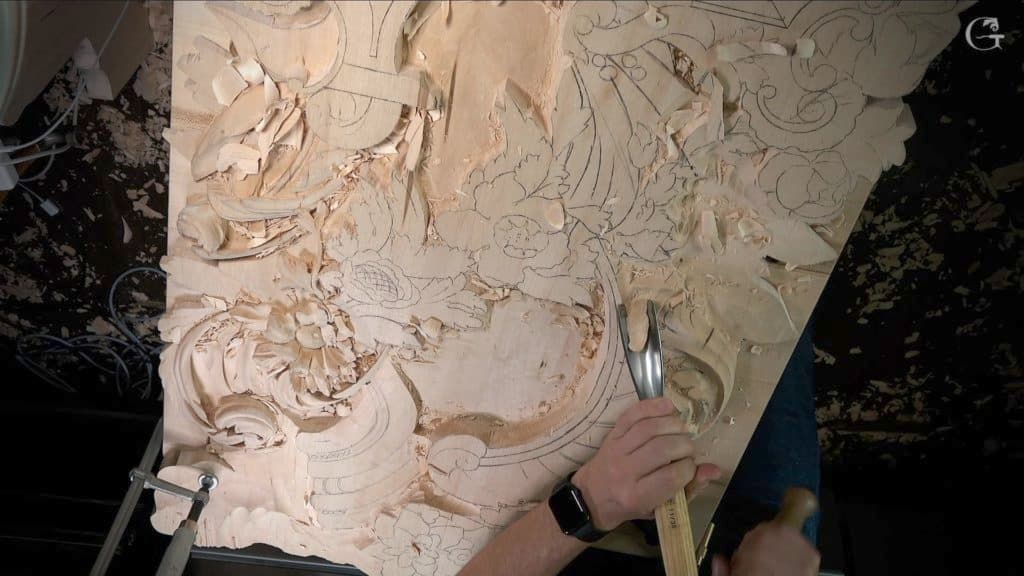
Alexander Grabovetskiy, woodcarver, School of Woodcarving · Published 2021
What does a wood carver mean by "I just did"?
Quick answer: In video 2 of Venice Room 127 I call one pass not good, say it is okay, and plan to relieve it better and go a little deeper. In other lessons the same words come beside a fix, a warning and a pass I want you to see.
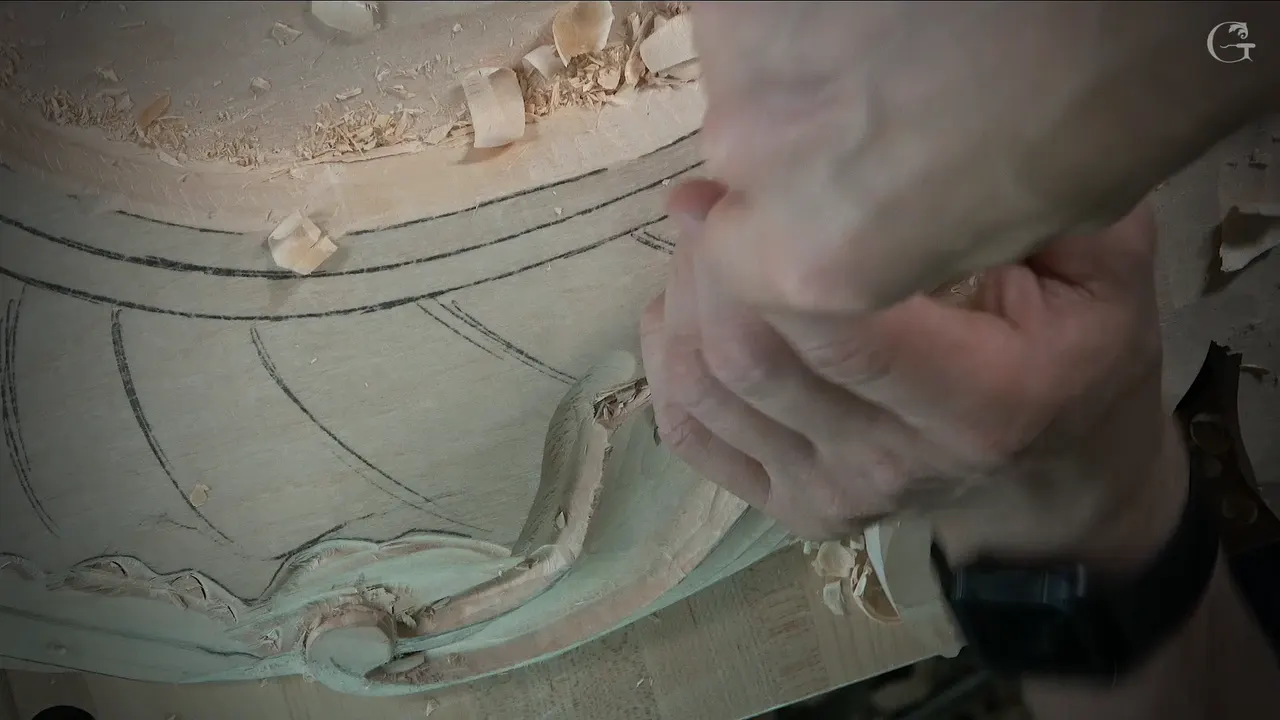

In video 2 of Venice Room 127 I stop at one pass and say, "And that is not good, what I just done, but it's okay." Right after it comes a plan: relieve the spot "much better now" and "make it a little deeper." This page follows the same kind of words through my other lessons, with a cue behind every line.
Ever pulled a gouge through a spot and felt it go the wrong way? Did you want to stop there and put the board down? You are not the only one. What I said next is below, line by line.
How does lesson 127 go before the slip?
The video starts with a plan to change sides: "let me walk on another side and attack it from that position." Next, "as you see, there is no details yet." More plans follow. "Now I can just establish the final edge" and "I will undercut that."

Lines of movement are on my list ("a movement this way," "a movement that way"), plus "another separation, and another separation, maybe one more separation." Then "some lightness, I should say, on this one."
Advice comes next: "always, always a good idea to relieve it and not to rush it with the number 11." It sits beside "relieving those triangles." Then "Let me get number seven" and "what did I do with my number seven?" The plan for that tool is to "establish my letter S curvatures, multiple spots."

A smaller tool is on the list as well: "a couple spots I need to relieve also with the smaller number 11, maybe 2 millimeters or so" (0.08 in). Then "one spot, and the second spot." Closer is next: "I can get a little closer right now, right here, too."

Where is the slip in lesson 127?
Look at the bold line at the top for the slip. Straight after it comes "See? It's just chopping away what I don't want to chop away." What has to happen is "I need to relieve it much better now and make it a little deeper."

Next I say "That's all right, I'm not going to worry about that, it's still going to be good movement." The plan for the spot is "I'll just move it a little more inward."

Marks are the next job. I want to "indicate my lines, where those guys going to start the shell," so that I can "find them easily." They are "approximate positions," because "I'm still going to make it nicer."
What came after the slip in this video?
One section has to go lower. "It does not look too good and it's too messy," I say. "That's going to go lower so I can safely take 30 millimeters" (about 1 3/16 in), and the section needs to go down "at least about half an inch or so" (13 mm), since "this part also going to go" just underneath those flowers.

A rule for the next pass follows: my first pass is planned "right on the line" and "Important for me not to lose that line." After that, "Oops." And "I just cut a little to the line. It's not good."

Does "it's okay" show up in the other videos of lesson 127?
Video 1 has the words too. I say I can blend those right here "although it's against the grain, but it's okay." Next I say I can "walk around and attack that from the opposite position." Then "Here you go, I'm happy with that."
Video 3 has a freed area. "I freed up my area," I say, "so now I can freely just clean it and establish the final look of my canvas." Then "I'll take number three, just to chip straight down for now. Later on, I will undercut."
Do I say the words right after a slip?
In several courses I do. Hashemi Flowers 6 (video 6) has "I'm just using number one chisel" then "I just did" and "I made a mistake." Right after that comes "It's okay."

A little later in that video I say "Really little by little. Like I said, can't force it in all." Another line: "a case like this, it would be much easier for me to reach from opposite side and make my other cut."
In Floral and Molding for the Panel 12 (video 3) I want to "get that cut really clean and right on the line." I call the pass "a mistake" with the "I just did" words in the same sentence. "See, I just chipped that, so not too careful," I say. And "Got to be more careful. Which is okay." I add "In this case, it's going to work with no problem."

Furniture Panel 23 (video 4) has "I want to make sure I'm not going too deep" and then "See, that is a mistake" with the same words after it. "It's not that bad and all." The deep undercut gave me an extra movement, "which is absolutely okay." My reason is "extra movements, it's the next step, what I have to do with those flowers." "Otherwise, it's just looking too dull."

A cause shows in Venice Room 4 (video 10), where I turn to you with a question on the pass I just made. "I broke underneath because I did not relieve it, the triangle." The break is "not really a mistake right now," I say, but "in general, that would be a big mistake when I would work on details." My own verdict is short. "So the mistake is that I rushed, and I didn't take care of the triangle." Plenty is left, I say: "I have plenty of material right here." I will leave it "like that in this area," because it "doesn't look too appealing to me right now."
Close to the edge is the trouble in Furniture Panel 22 (video 3). "I made too close to the edge and almost destroyed my ridge, which I shouldn't." Then "That's not the end of the world." My fix is a plan: "I can attack that again, a little bit with the sanding" and "recreate my lost ridge."
One more fix is due in Venice Room 20 (video 8): "I will still need to fix overall movement." After it I plan to check around and clean. "Let me check a little bit around," I say, and "Just a little bit cleaning."
One use has no carving in it. In Lily Box 13 (video 5) I blend "darker and darker" and the napkin cannot reach, so a brush takes over: "I'll just use the dry brush." Of the result I say "it's not really good" and then "because it is not the dye."

What did I do about the pass afterward?
Same lesson, different video: Venice Room 20 (video 1) has "I cut inside of the pipe" then "That's not good enough." A spoon is the plan. "That's why I probably should use a spoon." Maybe "even a bigger one, like number 11 and 10 millimeters" (about 0.4 in), "and create really nice and smooth cut." Also: "Although, I need to sharpen it."

The slip in Venice Room 40 (video 9) comes with "I broke it" and "I don't like" it, and I say "When I was working on inside, that's not good." Cleanup is easy. "It's really easy to clean," I say, and "Just give a small concave like this." I tell you "I don't really need the big deep concave." Then "Number three" and "Nice and long and good."

A repair opens Venice Room 19 (video 11): "I need to fix it somehow." It will most likely be "covered with the upper layer, but still." The next job is "Let me make the subdivision" and "I'm going to need to outline a little better right here."

Stress is the word in Venice Room 41 (video 7). "That's too much stress to the wood," I say, and I call it "stress against the grain." "At least I'm able to see what is going on."

Where do the words turn into a warning?
A few lessons use them that way, and the cause comes first. In Venice Room 19 (video 10), "it's better not to do that mistake what I just done." What went wrong: "I excavated too much closer to that edge, and essentially, I lost the material, which I should not." A smaller tool follows: "three millimeters, one-eighth of an inch. Number nine." The caution is that there is "a certain point" where a pass gets "too deep" then "too dangerous" and "I can break my tool, which I don't want to do."
A bigger warning sits in Venice Room 34 (video 9). While I set separations I say "don't do it" and name the move: "Never use your hand as mallet." I call it "a mistake" and "a big mistake." The safe way is "Use just a mallet" and there is a pad for it, "specialty pad for the carvers." More from me: "I almost never do that." My reason is "I'm carving every day" and I do not want to damage my nerves.
Furniture Panel 32 (video 3) tells you not to do what I did. I own it. "It was a big mistake on my part." Another line says "the only person who's gonna know it's just you" and the next one is "that is not a big deal, so I can always fix that."
Which lessons use the words to show a pass?
Several lessons do, and the tone changes. A name for the pass comes in Venice Room 55 (video 3): "Outlining Cut, or Setting In if you are in England." Then "really important for me to establish some shapes."

A blend comes first in Venice Room 53 (video 11): "I blended that in, and it just goes like the movement." It goes on with "that just creates beautiful movements overall" and the reason follows: "this part of a main movement overlaps that part."
Lily Box 10 (video 5) has "it just curls around, and it just creates a really nice movement overall" and then "I kind of don't like this edge." My fix: "I just kind of blended this side. Okay? Just slightly." An apology follows: "my apologies when I'm covering with my hands."

Gouge sizes come up in Lily Box 5 (video 5), in inches and as a number. "I'm using 3/32 of an inch gouge" (about 2.4 mm), I say. An option comes next: "I can turn to a flatter gouge, like number three again, and blend that to the cut."
Two millimeters is the size in Venice Room 44 (video 8): "even smaller, two millimeters" (0.08 in), and "cut that even deeper." My words are "I created for myself extra spot for the division." And "there is going to be division going downhill like that."

Look at Venice Room 29 (video 11), where I ask you to look at a pass I made a moment ago. My answer is "I still have a concave on the side of this ridge." Plus "it's not really deep but still detectable."
For Lily Box 3 (video 2) I say "Fix a little bit this side just slightly, not much." "I hope you can detect" it "on the camera," I say. Next come "So that is the middle ridge" and "now it just flows nicely."
A viewer question sits behind Lily Box 12 (video 6). Some of you, I say, would ask if four petals can look beautiful. "Yeah. Of course." A flip follows: "I kind of flipped it upward" and "now I need to create the convex."
Corinthian Acanthus Leaf 4 (video 1) is about clamps. I say you can "clamp it from any direction" and it will "hold really tight." The angle matters: "I need to attack this, and this gives me a really good angle."

The last stop is Lily Box 8 (video 1). "I know it's almost impossible to catch," I say. The thing to catch is "the concave on inside" and the light "going to cast also the shadow."

What do these lines have in common?
In lesson 127 my words came once a pass went wrong, and next to them I put a plan to relieve and deepen. In other lessons they sat beside a fix, a warning, or a wood carving pass I wanted you to see. The table sorts the places by what the words stood beside.
Six kinds of spot where the words showed up
| Beside | Seen in these lessons |
|---|---|
| A blend, grain noted | Lesson 127 (video 1) and also Venice Room 41 |
| A slip I named while I was still carving | Floral and Molding 12, Furniture Panel 22 and 23, Hashemi 6, Venice 4, 20 and 127 |
| Passes I did not like, then the fix that I named | Lessons 19, 20 and 40 of the Venice Room |
| A warning | Venice 19 and 34, plus Furniture Panel 32 |
| A pass I wanted you to see, with a name or a reason | Corinthian 4, Lily Box 3, 5, 8, 10 and 12, Venice 29, 44, 53 and 55 |
| A brush pass with color | Lily Box 13 |
Where did your last slip land? All the videos for this panel sit inside one tuition plan. Workshops 122 to 131 live on the Part 11 course page, and lesson 127 holds all three of its videos. You will see the gouge I name, in inches and millimeters.
How it's done
- Relieve before the big gouge. Always, always a good idea to relieve it, I said, and not to rush it with the number 11.
- Mark where the shell starts. I wanted to indicate my lines so I could find them easily, as approximate positions.
- Keep the line. The first pass was to sit on the line, and keeping that line mattered to me.
- Own the slip. Not good, then okay: I said both, and that I needed to relieve it much better and go a little deeper.
- Name the next move. A little more inward was my plan for the spot, and I did not worry about it.
Frequently asked questions
What was the plan right after the slip?
The spot needed relieving much better, and a little more depth. I called the spot good movement and did not worry about it. Slightly inward was the plan.
How much did I plan to lower the section?
The section would go lower, so I could safely take 30 mm (1 3/16 in). The whole section needed to be lowered at least about half an inch (13 mm) or so, because the part under those flowers would also go.
Is a mistake the only thing the words go with?
The words named a pass in Venice 55, Outlining Cut or Setting In. In Lily Box 10 they came with a gentle blend, and in Venice 44 with a spot I made for a division. A slip was only one of the uses.
What to carve next