
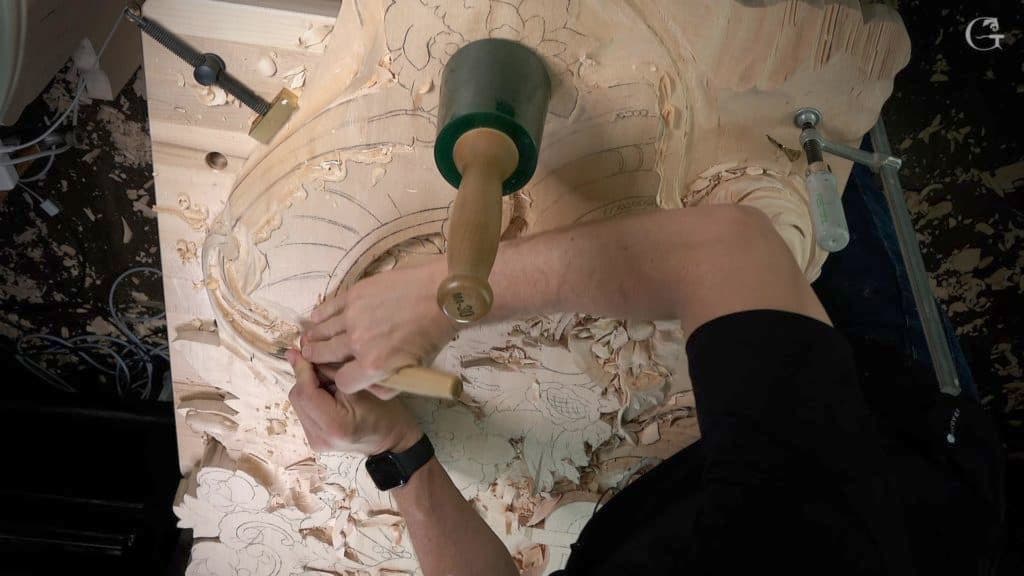
Alexander Grabovetskiy, woodcarver, School of Woodcarving · Published 2021
What does a wood carver mean by "design-wise"?
Quick answer: Video 3 of Venice Room 127 has me call a part too heavy and say "design-wise, okay?" Next I name 5 mm (0.2 in), 4 mm (0.16 in) and 2 mm (0.08 in) for a shadow. Other lessons use it beside a flower, a slope or a style.
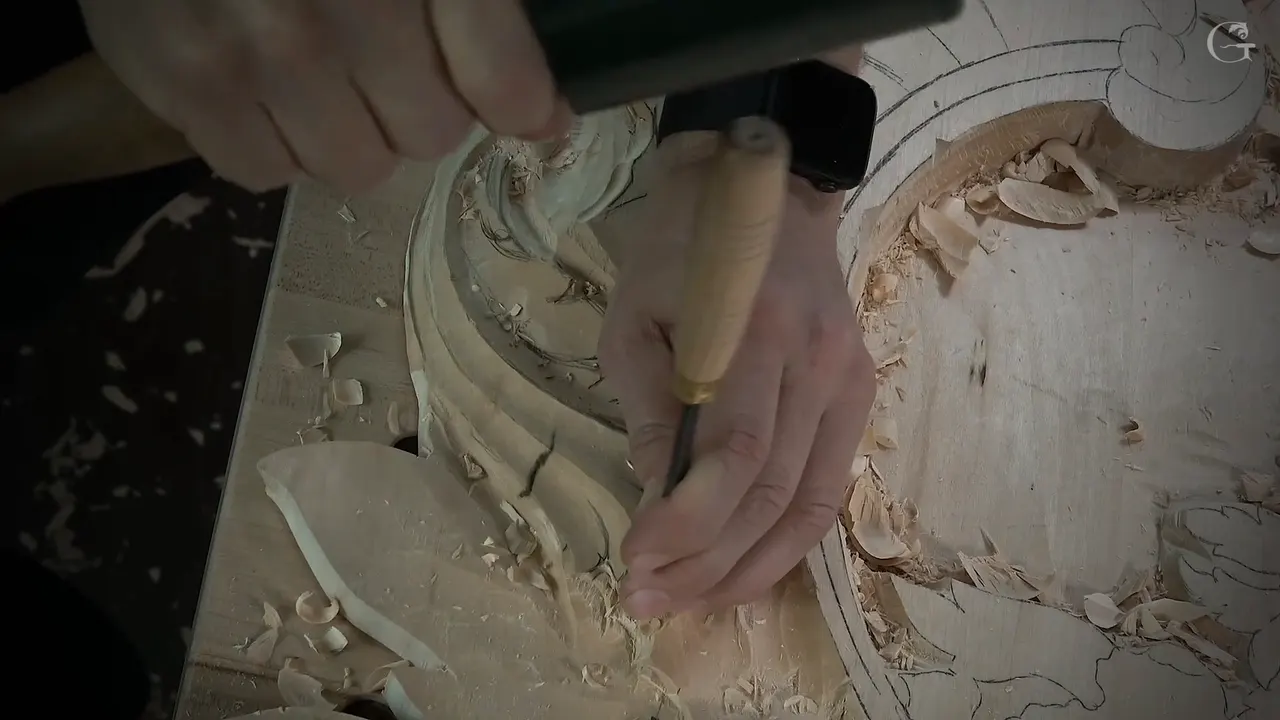

In video 3 of Venice Room 127 I say "It's too heavy" then "design-wise, okay?" Straight afterward I name three small sizes for a deep shadow. This page follows that word through other lessons of mine, with a cue behind every line.
Ever stood over a carved panel and felt that one part looked too big for the rest? Did you hold a gouge over it and wait? Then you know my spot. Below is what I said, and what I did with the gouge and the shadow.
What happens before the word in video 3?
The video starts with some stuff I want gone: "I also am going to remove some of that stuff right here" and then "Also needs to be gone." I also say "Not like it has to be gone, but still" and "It's a good idea to remove it right there."
The highest spot comes next, and I say I need to move gradually downhill. Doing it now is really not what I want, I guess.

Then the area is free. "Okay, so I freed up my area. So now I can freely just clean it and establish the final look of my canvas." "I'll take number three, just to chip straight down for now," I say, with a second job after it, "Later on, I will undercut." For now I want only straight down. "Here you go," I say, and then "a small area."
What am I unsure about just before the word?
Doubt shows first: "I'm still not sure if I want to keep it just like that or just give another division. I don't know." A plan follows: "let me do something else to make it look a little lighter."

The plan is to take "this part underneath of this line," a "little change" that I think will look much lighter. The start is planned for "all the way here."
What are the words around design-wise in video 3?
The stretch runs "I really don't want to see that" then "It's too heavy" then "I'm talking about design-wise, okay" and last "I don't want to see heavy design-wise."

Sizes come next, one after another. "Now we're going to use 5 millimeters" (0.2 in), I say, and "go like this." Then "I can use 4 millimeters" (0.16 in), and "I can use now, let's say, 2 millimeters" (0.08 in), "and create a deep shadow."
My reason comes out loud: I think it makes sense just to create a lighter look, I would say. More than one spot is in play, I say. Another spot is planned, and a blend. And I say I like it: "I do like it."

Which words in videos 1 and 2 of lesson 127 lead up to it?
Video 1 reminds me to look from different points of view. Looking that way, I say, you see how it flows in 3D, not just from above. My own line is "From above, it could look okay, but when you look from the side, sometimes it looks like you have to change something."
Video 2 holds "another separation, and another separation, maybe one more separation" and I say the work will give me some lightness, "I should say, on this one." You can watch all three videos inside lesson 127.
What comes after the word in video 3?
Undercutting is next, and I say I will do it "right away at this area, create really deep." The tool follows: I will take "number 11 and 7 millimeters first" (0.28 in), and I add "like I did before."

Then the grain gets my attention. "It looks like I am doing against the grain, and that is not the best idea, so I need to attack that from opposite direction." Of one area I say "I'm going to take care a little later" and that I will be more careful.

Position comes after that. "Somehow I need to turn different direction because it's not really convenient for me," I say, and then "Let me figure out what's going to be the best position for me." My guess is "it would be that way, and I can attack much better this way." "Much better this way," I say, and last, "Let me lock it."

How do I judge a flower design-wise?
Carving Flower Rosette 3 (video 2) uses the word about a flower: "This type of flower is actually simple, but still excellent design-wise, because you can use those flowers in any types of carving." That course is about a flower rosette. Earlier in that video I say "let me get a smaller gouge" and "I'll take just the number five, same what we used before, just the number five quarter inch" (about 6 mm), to clean that right to the center "without forcing it."
That video also tells how a gouge differs from a V tool. "The true gouge, you can always place the tool and make rotation, and that's going to give you the true circle." Of a V tool I say "you can't rotate and make the perfect circle." Gouges, I say, "go up to number nine, and number 10 and number 11, it's already a veiner," yet "I still call them gouge, just easy to remember."

After the word I say "Now, just take out the ridges." I am "happy what I do see" and "with the same tool, I'll just go around and make my cleaning cuts."
Venetian Flowers Rosette 3 (video 2) puts it this way: "right now it just looks really straight down, like a 90 degrees cut almost. But it's okay. I knew what I going to do." I plan to figure out the best way to attack that one. Then "you can see it's already showing really beautiful design-wise," I say, and add "Let me think how I can attack that. I probably going to attack that from this side."
What does design-wise do with a line or a slope?
A line comes up in video 5 of Venice Room 41: "I've got this element going this way, but I also do not want to lose, design-wise, this." "It has to go down underneath of that one," I say, and "really gradually." I call it a "really interesting transition" where "one leaf goes underneath of another one."
I tell you "that effect that's part of a same movement" and add that even if one grows upward and the other grows downhill, I still want that feel. A limit comes next. "That is deep enough, I think, because I can't go too deep, otherwise, I'm going to lose overall movement again."

Over in video 2 of Venice Room 39 the line sits high: I say this movement, this line, will be "higher than overall development underneath." I add that it "doesn't look right when you look from above" and name the design-wise I am talking about. I tell you it will "rise up" and that this part will be equal to that part.

Lily Box 6 (video 10) has the word beside a wall. The slope on one side is meant to be "as much as possible" and "almost all the way." Otherwise, I say, this wall is too big, so the design-wise would not look as nice if I leave it like that.
The plan is "I'll take a number seven and carefully slope it," but my next words are "No. Overall, it's actually a little too high" and "Maybe I'll just have to take care of all the region."

A volute I plan to make smaller is the subject in Furniture Panel 21 (video 5). The smaller volute is "actually going to help me," I say, and plan to create a secondary bevel. That way, design-wise, I say, it will be "more attractive" and "more appealing."

I want to make sure I save that slope and "work around," I say. "Let me refine that line," is next, and "later on, I have to a little bit take out from that line, just slightly, not much." About the whole I say "overall, how it looks, I'm pretty happy." Later in that video I say "there is a lot of different styles of carving for furniture," that this style is "more North European, more, I would say, French late 18th century style" and "I want to be authentic to what I designed."
Where do moves flow together?
Moves come up in video 4 of Venice Room 75: "all of them has to have a motion like returning backward like this." That way "I can just combine really nicely, the design wise" and they will "just flow together with the overall design."

The middle line is next: "I think the middle line needs to be shifted this way." I point to two spots, and say "60/40 rule, 60%, 40%. To be exact, that's a 38% and 62%, which is a golden ratio rule" and that will be my middle line.
It also has to slope: "I also need to slope it that direction." Care is part of the plan: I will approach this area carefully, because I do not want to lose the overall feel of it, and I plan "15 millimeters, number 11" (0.6 in) to "create that more perfect outline."
Can design-wise be apart from how hard the work is?
In Venice Room 3 (video 4) I say this will be "even more complicated." Then comes "I'm talking about the design-wise, okay? I'm not talking about how hard it's going to be. It's about the same. It's just the flowers."

Sizes fill the stretch around that line, before and after it. Earlier I say "I could go as deep as about an inch or even deeper, inch and a half, if I wish" (25 mm to 38 mm). It gives "a lot more dimension, especially this part going to go underneath, so I really need the depth." I plan the bigger one, "35 millimeters" (1 3/8 in), and then "let's switch back to 20 millimeters" (0.8 in).
Past the word I say I need the smaller gouge, the "5/8 of an inch, 16 millimeters" and plan to use 16 millimeters "right here at first." "What I'm doing, I'm just cutting from both sides and just removing blocks. You see?" I say. And "I use that technique a lot, actually, to go really, really deep if I need to."
Does design-wise have a place in color work?
The word turns up beside a color pass in Lily Box 13 (video 8). "I don't think I want to do anything in the middle of this flower because we already have some domes with those olives, and I think this middle part is actually really good connection design-wise, okay?" Then "what we can do, we can just put some color around and create beautiful effect."

A brush is next: "Okay, dry brush. It's all about blending together." "I want to still kind of go from dark to light," I say, and that it will give me "a glazing effect." A doubt follows: "I'm not sure if I applied enough color around here." And as it dries, "the effect is just really subtle."
Does design-wise point to a style and its rules?
In Carving Dining Table Apron, Workshop 5, I talk about shallow carving for furniture: "I love this style. You can create beautiful pieces of furniture, really nice chests, the drawer fronts, just with the shallow carving." Then "Beautiful style of wood carving. And it's fairly quick to do. It's not as complicated as a real three-dimensional carving. But design-wise, it's also unlimited. So you can design beautiful ornaments."

I add that the style of the ornaments "can be limitless."
In The Tray of Blessing 3 (video 3) someone asks about a non-classical approach to wood carving. My answer includes "The classical, let's say if you stick with those rules, right? There is a traditional approach. You still using traditional tools, but the design wise, you can just do whatever, you know, you don't follow those rules."

Over in The Tray of Blessing 8 (video 4) I say "as far as the design wise, you could, like I said, you could just do bunch of those grapes on this side and blend everything to that. Okay. Just to check, check and check."

Where did the word sit in each place?
In lesson 127 it came with a part that looked heavy, and next to it I named sizes for a shadow. In other lessons it came with a flower, a slope, a flow, a color blend or a style. The table sorts the places by what stood beside the word.
Seven kinds of spot where the word showed up
| Beside | Seen in these lessons |
|---|---|
| Too heavy | Venice Room lesson 127, video 3 |
| A flower that I like | Carving Flower Rosette 3 and Venetian Flowers Rosette 3 |
| A line or a slope to keep | Venice Room workshops 39 and 41, with Lily Box and Furniture Panel lessons |
| Moves that flow | Workshop 75 of the Venice Room, video 4 |
| Design, not effort | Lesson 3 of the Venice Room |
| A blend of color | The Lily Box, lesson 13, with a dry brush |
| A style and its rules | Dining Table Apron Workshop 5, plus the tray lessons |
Which part of your own panel looks too heavy to you right now? All the videos for this panel sit inside one tuition plan. Workshops 122 to 131 live on the Part 11 course page, and lesson 128 comes right after lesson 127. You will see the gouge sizes I name, in inches and millimeters, and a shadow go in.
How it's done
- Say what is too heavy. It is too heavy, I said, and I was talking design-wise.
- Name the lighter plan. I planned to take the part underneath the line, and I thought it would look much lighter.
- Pick the small sizes. I named a size, then a smaller one, and then one smaller again.
- Create the deep shadow. I wanted a lighter look, in more than one spot, and I said I do like it.
- Turn to the other side. Going against the grain is not the best idea, I said, so I needed to attack from the opposite direction.
Frequently asked questions
What did I say right before design-wise in lesson 127?
Just ahead of the word I was still not sure whether to keep the spot just like that or give another division. Next came "I don't know," and that I would do something else to make it look a little lighter. After that I called the part too heavy.
Which tool did I name for the undercut?
For the undercut I said I would take number 11 and 7 millimeters (0.28 in) first, like I did before. Of one area I said I would take care a little later, and to go with more care.
Is design-wise only about heavy parts?
Lily Box 13 has it for a middle part, called a really good connection. In the apron lesson, Workshop 5, I use it for a style that I call unlimited, and in Venice Room 3 I say it is not about how hard it will be.
What to carve next