
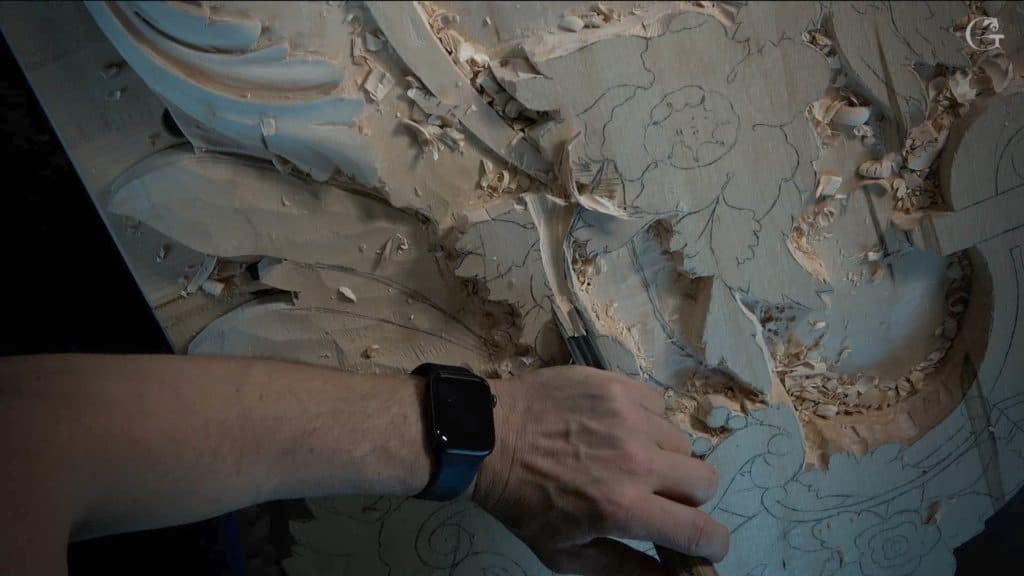
Alexander Grabovetskiy, woodcarver, School of Woodcarving · Published 2021
What does a wood carver mean by "should I or should not"?
Quick answer: In Venice Room 130, video 1, I ask it after saying I will outline first, and I answer myself with "Yeah, I guess I should." In other lessons the same question comes before a deeper hollow, a wider side or a flip, and some of my answers are "maybe not."
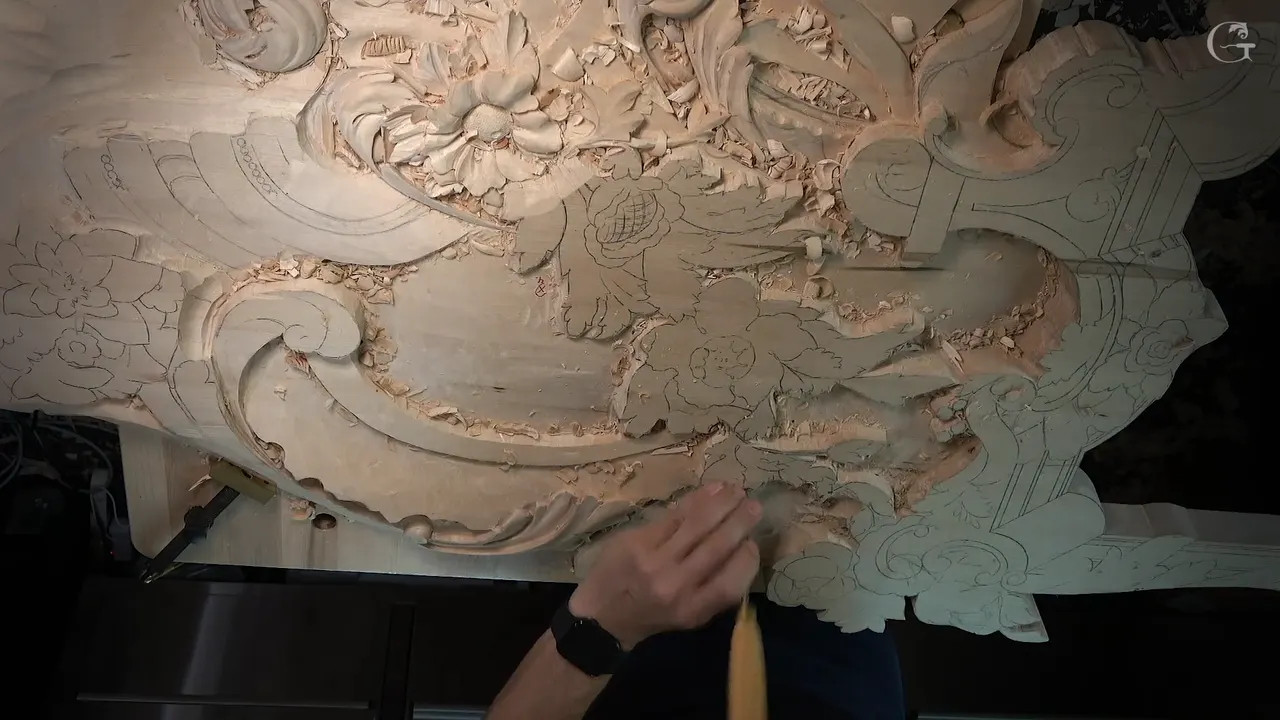

In video 1 of Venice Room 130 I say, "I don't know, should I or should not?" Below, that video goes in order, and then the same question travels through my other lessons, each line with a cue behind it.
Ever stood over a leaf edge you had just outlined, with a tool in your hand, and felt the hesitation before the next pass of the tool? A gouge is a type of chisel, as Wikipedia describes it. Here is how I answered myself on one panel, and how I answered in other lessons.
What happens in video 1 of lesson 130?
The video opens with a live stream, and I say I removed material right here during it, "but it's pretty much the same idea what I did previously." I plan to "level it approximately the same level" with the downhill movement coming "later on."
"So working details. So nothing special, just chop around those future leaves." Then three chops get named, "straight down cuts, and the plug cuts, and the edge cuts." For the edge cut I say, "just to get number nine and remove some of the material close to the edge. Straight down, 90 degrees." A bigger tool crosses my mind next, "maybe three-quarters of an inch" (about 19 mm), "a tool like number nine. And hit that little harder."
What do I draw before I carve more?
"I need to draw inside lines," I say. For that my iPad has to come out: "I have to pull my iPad and get the picture ready." A look at the screen comes next, with "let's take a look at what is going on right here" and then "that is my spot" and "I need to recreate that."

Before the pencil I name charcoal, in my own words, "I'll just get the charcoal, well, actually, no, I'll take a pencil." The lines come after that. "I do have a spot right here where I have a connecting point right there," I say, and the first line and the second both go to the same spot. One more part "will go right in the middle somewhere right there," I add, "I really don't have to be super accurate, but somewhat."

A snag follows. "Oops. That doesn't work on my piece. I mean, pinching. It just doesn't work on my piece." A question to myself follows, "what am I doing" and then "looks like here is the edge of that detail."
Which part goes lower first?
"I need to lower down that detail, but that part is going to be even lower," I say. The plan, in my words: "I'll lower first that part, all that, and then that's going to free up that detail, and those guys are going to go underneath of this leaf. Which means all that has to be much lower."

A look back at what I dug follows: "So pretty much here's my edge. So I don't know why I dug what I did right here. So that's supposed to go from underneath."
How do I answer myself in video 1?
"All right, so I'm going to outline first, and let's develop that detail. Okay? Let's develop it." Next comes the question, and my own answer to it, "Yeah, I guess I should." After that, "just to lower down the whole thing, and then I'll just redraw the whole thing also."
Marking my edge is the next plan, "I need to indicate my edge" and I will do it "little by little." Beside that sits "I don't need to, but I think it's going to help me."

It ends on a line about that cut: "because I have that cut, so now it's a lot easier for me to see, a straight down cut, what I'm talking about, okay? That is much easier for me to see."

Where do I say it and then hold back from the wood?
Beside an undercut, in Venice Room 7 (video 3), the question sits next to "I could kind of undercut this direction, too." Then "it doesn't really do anything to me, but it's still possible I could undercut this way and undercut that way." For now the plan is "I'm going to leave it like that."

A side is the candidate to lower in Venice Room 20 (video 6): "I also could actually knock down this side this way a little bit." After that comes the question, answered with "maybe not, maybe I just should not touch it, because deeper I go, more material I'm removing." Then, "maybe I shouldn't. Maybe just a little bit."

Over in Venice Room 37, it sits in video 4 and in video 3. Video 4 holds "I could leave this small section right there." Past the question, "maybe not, it's going to be too much, so let me excavate all that." In video 3 it sits beside depth, with "I could" and then the question. A different number 11 is the plan, a short bend, "maybe about seven millimeters" (0.28 in). Later in that video I say "yes, I could probably go a little deeper in this area and give an even better shadow."

The answer is spoken in Venice Room 42 (video 6), after "I could take it more if I wish." Past the question, "the answer is, I doubt I should." The reason, in my words: "because I can take one millimeter later on and excavate even deeper right here." One millimeter is 0.04 in. I plan to leave it that way "at least for now" and I say "that's probably enough."

A little detail is the subject in Venice Room 33 (video 11). "I'm probably not sure," I say. Then "I could add a little detail like that to make it tight." About another spot, "maybe I could get actually this one going little even more on inside, but if there is any reason for it. But I don't think there is any reason. I'm not going to do that." My next words are "let me use number 11 and get in those separations right there. That's 5 millimeters that I'm using," which is 0.2 in.

Where does my answer turn out yes?
A deeper hollow gets the question in Venice Room 19 (video 3), over "I could actually do even deeper" and a hollow "visible from below." My reason is an opening: "like cased opening, on this side, and the light going to hit this direction, and that would be really good to give extra shadow casing that way." For that hollow, "maybe even with the bigger number nine, like 5/16 of an inch" (about 8 mm). Later, "I think it is deep enough, except I need to knock down this side."

"I have to think," I say in Venice Room 23 (video 1), and the question comes with "I could give that concave continue go all the way right there, just as a one. But on another hand, I also losing the movement." Then comes "just that type of concave right here." A line to you follows: "now I'm just probably talking to myself pretty much, I'm making the decision what kind of concave I want to do."

A width is the subject in Venice Room 36 (video 10). "I'm not sure if I should make it bigger or wider, I should say, this way or not," I say, "because on another side, it is." Then "at least some spots, maybe I can just make it wider on this side. Okay. I think I should." Next come "I'll attack that from that side and go all the way" and "that's a really nice detail, actually."

Venice Room 66 (video 2) brings a motion as the idea after the question: "I could actually create the motion that this piece is just curling from underneath, okay, and expose the lower part that create the deep shadow." I name a catch, "I have a little challenge because I cannot go too low on this side." Then "I need to think, but let me do that" and later "why I'm thinking too much today? I don't know" and "I kind of like the idea of wrapping."
Trailing off, "what I could do, I could actually..." I come to the question, with "let me try" in Venice Room 112 (video 1). The idea after it: "bring that underneath of this ridge. That way, I don't need to create a long, long open cut." The tools: "now, I going to need 2 millimeters" (0.08 in), and later "I'll grab 1 millimeter, which is really unnecessary in this case, but still it takes a couple seconds."

A leaf will be "almost final shape" in Hashemi Flowers 34 (video 1), and "maybe I need to clean it little more," I say. After asking, "maybe I should, take a number four and take out this edge" and then "yes, I think I like it."

How does the question sit when I cannot tell?
Over roundness in Venice Room 12 (video 4) I say "I can exaggerate this one and give even better roundness." Then the question. My plan after it: "let me wait until a little later, and I'll see if I like it or not." The move is small, "maybe just a little cut like that. Just give that extra shadow."

Lesson 20 comes back in video 10, over a motion: "maybe I should get like a flipping motion even" and "I don't have to, but I think it could create even more interesting movement." Next, the question, with "let me double think. Let me think." Then "we can exaggerate that movement underneath" and "it just created really nice movement."
In lesson 19, video 8 comes after a line about interesting movement. The question comes once more, and then "if I don't like it, I can always remove it" with "that way, I can actually lower this one."

In Venice Room 82 (video 8) the lines are "only with the small, tiny tools" and then "let me also create a small concave." After asking myself, "I think I want to see a little more concave right here." Then "well, I don't know yet, so we'll see." And "don't want to overdo or overthink. And it's possible to overthink it and make stuff more complicated than it should be. And I really don't want to do it."

A division carries the question in Venice Room 152 (video 2). "A division right there" is my line, and then, asking myself, "maybe actually make division somewhere right here." Then "or I could actually just get a little nicer shape." And "I am having doubts."

Does the question change the spot or the tool?
Over in Lily Box lesson 8 (video 8) the answer moves the spot. "I should give a concave," I say, then "to this part." Another choice is the overall movement. This one would stay "a little higher" and number four, a small gouge, is my plan for the tool.

A smaller tool is the plan in Venice Room 29 (video 4). "I want to make it feel like this is flipping on top," I say. Asking myself comes next, with "not always you should do that, not every eye and not every pipe you should do that, but let me see if I'll be able or not." Then "maybe I can use a smaller number 11 and try to do that. One-eighth of an inch, that's what I'm using, okay?" About 3 mm.

Grape Onlay 9 (video 1) puts the question over a flip downhill, and I say "the light most likely going to hit from above." So: "I think it's gonna be better to create the flip going uphill to create the one deeper shadow." Number 11 at four millimeters (0.16 in) is the tool, and "I'm gonna just outline it."

Lily Box 12 (video 6) has a flower with four petals. "Let me also create something nice right here," I say, and after the question, "just make a flip upward a little bit." Then "but for that, I need to create a cut like this." A word to you follows: "sometimes, some of you probably would ask me, is it possible to make those just four petals look beautiful? Yeah. Of course." And in one breath, "see what I just did, I kind of flipped it upward."

Four ways my answers ran across these lessons
| How my answer ran | Lessons where it came up in my videos |
|---|---|
| I held back for now | Lessons 7, 20, 37 and 42 of the Venice Room |
| I leaned toward yes | Hashemi Flowers 34 and Venice Room lessons 19, 23, 36, 66, 112 and 130 |
| I could not tell yet | Videos from Venice Room 12, 82 and 152, ending in a wait or a doubt |
| I looked at another place or tool | Lily Box 8, Venice Room 29 and Grape Onlay 9 |
Which of these fits the spot in front of you right now, after what you just read? All the videos for this panel sit inside one tuition plan. Workshops 122 to 131 live on the Part 11 course page, lesson 130 holds all three of its videos, and lesson 129 and lesson 131 sit beside it. All of it is wood carving: a flower in Lily Box 12, a leaf in the Hashemi course and grapes in the Grape Onlay course.
How it's done
- Chop around the spot. "Nothing special, just chop around those future leaves," I said, and then I named three kinds of chop.
- Draw the inside lines. The inside lines come first, and a pencil is the tool I named after charcoal.
- Send both lines to one spot. A connecting point sits right there; both lines go to the same spot.
- Outline first. I said I would outline first.
- Ask the question. After "let's develop it," I asked myself and answered yes.
- Lower it, then redraw. I would lower the whole thing, then redraw all of it.
Frequently asked questions
What did I decide in the first video of lesson 130?
My answer to myself was yes, with a plan to lower the whole thing and redraw it. I would indicate my edge "little by little." I did not need to, I said, but I expected it to help me.
Which tools come up in video 1?
Number nine takes care of the edge cuts. A bigger one, maybe three-quarters of an inch (about 19 mm), is the next thought, and I would hit it a little harder. For the drawing, charcoal was my first word, and then I changed my mind and chose a pencil.
How did I plan the inside lines?
My iPad came out to get the picture ready, and after finding my spot I said I needed to recreate it. Lines were the job, and I did not have to be super accurate, but somewhat.
What to carve next