
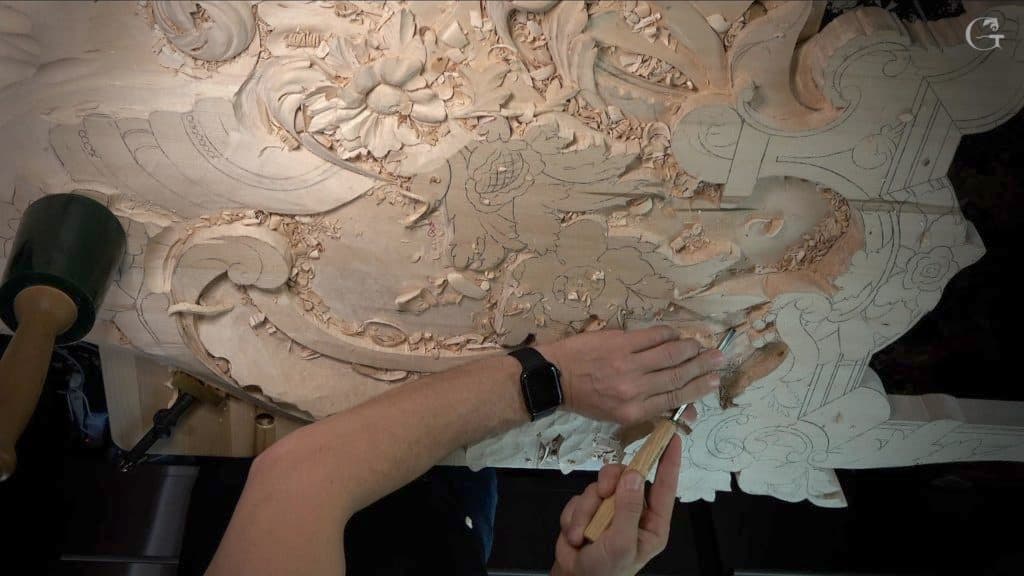
Alexander Grabovetskiy, woodcarver, School of Woodcarving · Published 2021
What does a wood carver mean by "first of all"?
Quick answer: In Venice Room 130, video 2, the words come before "I have to just do plug cuts," and next I say it will be much easier to identify the position later. In other lessons they come before a tool pick, before a cut, or before a reason that has a "secondly" behind it.
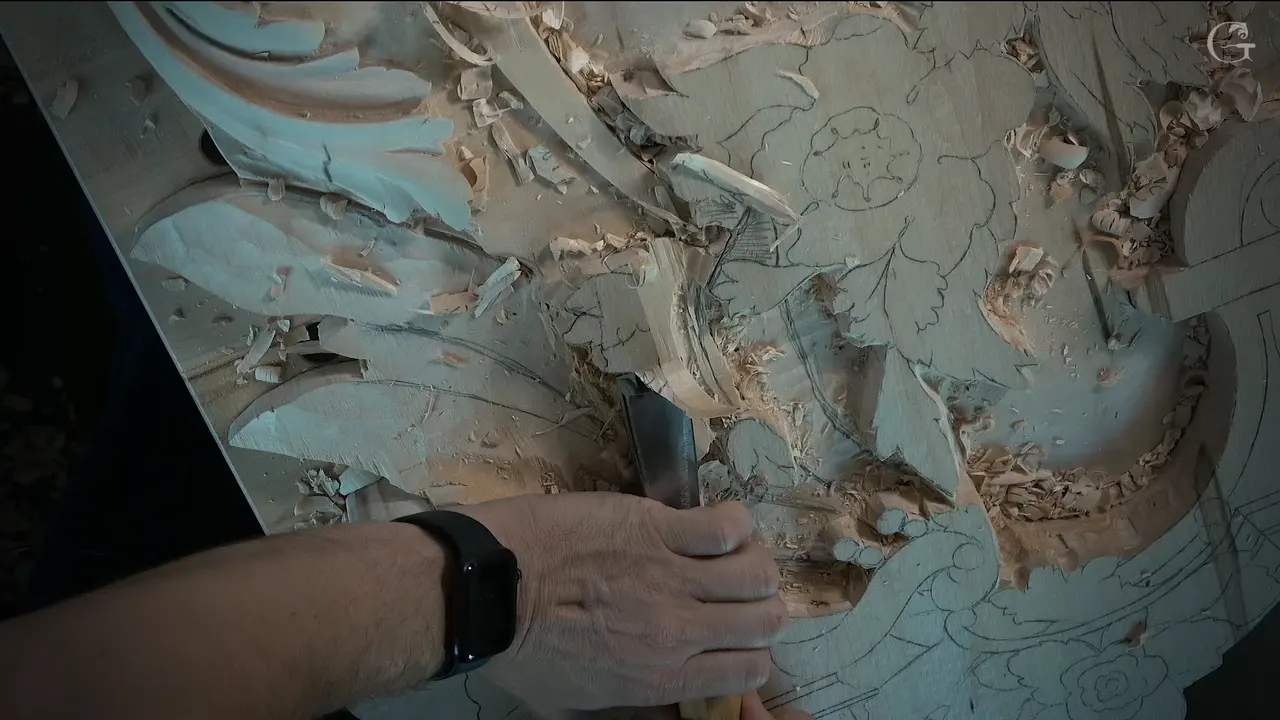

In Venice Room 130, video 2, I say "First of all, I have to just do plug cuts." Right behind it, "It's going to be a lot easier for me to identify little later the position of it." In other lessons they sit before a first tool or cut, or before a reason.
Ever stood over a leaf and not known which cut belongs first? Did you ever have two good reasons for one tool? Below are my words from lesson 130, then from more lessons of mine, each line with a cue behind it.
What do I say before the plug cuts in this video?
Blending opens the video. I won't lower that part too much right now, I say, because I really want to create some shadow, and "a little better should be okay." After that I plan to outline it "one more time" with number 11, "just right on that line."

"And yes, it has to be lower than the leaf." I say I don't really have to blend that really low. What I can do is lower one side only, with "almost like a concave going this way" on that side. The tip of this leaf "could be much higher going all the way above the flower."
What comes right after the words?
"That's what I'm going to do" and the words follow, ahead of the plug cuts. Then I say "smaller" and "I can probably do just like that."

"It's not the final, but what I need is just that edge." Later on, that edge will be easier for me to catch, I say, and this side of the leaf "has to go all the way to the same level as that side."
I'm not measuring it. "I'm eyeballing it," I say, because it's really easy to see pretty much, and "I'm really close." One side will sit higher, at the same level as that side, and the closer I get to this line, the lower it gets.

Then the edge. And yes, "like I said, this edge is going to roll up. So why don't I do that right away?" Then, I say it will be above the flower petal.
What goes inside that leaf?
A concave. I'll create one on the inside, I say, and for that I have to use "maybe number eight." Next, "Let me see." On depth I say "I guess it has to be somewhat deeper concave because I got some cuts right inside, right here."

Of the way I work there I say "that's not the best way to do that against the grain, but it's okay. It's just preliminary." To you, "So now you've got an idea. So the concave look." And "I hope you can catch that. So it's not bad at all."
My next job is "take care of this line" and that part will go underneath it. The tool in mind is "number 11 and 5 millimeters" (0.2 in), and then, "You know what? We could go even deeper right here and create beautiful shadow." Again, I say, that is just preliminary.

For another spot, "this one also going to go a little bit underneath of this line, I guess." The choice stays open. "I could do that or I could do something else. I would probably do like that."
Where else do the words start a job?
Below, you will see them ahead of an early tool, an early cut and a part to fix. Every link goes to a lesson page.
In Hashemi Flowers 10, video 6, they open a cleaning job. "Let me clean that," I say, and "Let me take a V tool first. And then I'll use number five." Just before, I say "number five" and "Also one inch" (25 mm). Of one more I say it "looks like I have to do it opposite direction. So I'll go that way."

Greek Acroterion 5, video 5, starts with them and a small gouge to "just remove that middle section." Next, "I'll take number five." Of that work, "I would do that closer to me" and "just removing those high ridges. Only in a place I can reach."

Video 2 of lesson 134 in the Venice Room lists "couple ways I could attack this edge." The first one, "I can clean it with the number 11" follows the words, then "straight down cut." For that cut I name "probably number three" and then "you know what, I can use number seven or number eight even." On number seven I say "it has some waviness" and "I want to keep that waviness." I don't want that flower to look just like a big round.

The next video of that lesson has them again. That spot will be really wavy, I say, and that part will be lower. I say I can just create "a plug cut pretty much with the number nine" and that I could use "the 20 millimeters, three-quarters of an inch." Soon I say I think I will be safe, and "I get really close to the design."

Venice Room 157, video 1, leads from the words into a flat spot. Right now it's "just kind of same level," I say, and I want it wavy. "It's not like what I did just a simple cut." To make the waviness I plan to use "20 millimeters number nine" (0.8 in), with a cut "toward the center" wherever I have the wider spot. One caution: "I have to be careful in this area because I can damage."
Outlining comes up in Venice Room 151, video 3, where the words open "There is an outline, so I need to outline it first." That spot will be the head of acanthus. I don't want to lose this line. For now I will keep that line, and "just stay away slightly."

In Carving Grape Onlay 4, video 1, the words open "of course I need to outline it." The tool is the same as before, number 11, and this time it is "four millimeters" (about 0.16 in).

Floral and Molding for the Panel 12, video 1, puts them before a volute. "Let's establish my volute," I say, and then "a part like that" follows. Soon after, "I need to just make sure the height is correct," for that part of the volute and for the other part. Then "Measure it. Let's measure it."

Back in the Part 2 course, Venice Room 19, video 1, brings "I need to make sure it has a logic behind." Next comes "I want to make it big and nice overall movement first." Then comes "overlapping little with this side" and "a little fatter" is the plan for another part.

Another choice sits in Venice Room 20, video 12. "A couple ways I could," I say. "I could do a point right here," though "I'm not sure if I should or not." Or "I could actually create something nicer." Then "Let me see" and the words, and "let me make it more round." Of that acanthus leaf I say I'm going to start creating "some of the movements, some separations." "Otherwise, it's losing the purpose."

Furniture Panel 19, video 1, has "There's no right or wrong way. Both of them are actually right." One way is "number 11 again, and 1 millimeter" (0.04 in), with the words before "just kind of outline, but not as deep." "Just try not to go deeper than 1/32 of an inch" (about 0.8 mm). Going "really, really deep" would be "big, big mistake."

Lily Box 4, video 7, has a part that sticks up. "I need to take care of this part," I say, and it has to go "downhill toward the main level." Otherwise it's "just sticking too high" and that's "a little distracting" from different points of view. My tool is "again, straight down cut."

What follows the words and "secondly"?
In some lessons the words open a reason, and "secondly" follows.
Lily Box 3, video 11, is about glue. "A word of caution," I say. My plan is glue "just in the middle sections" and not on "the other parts." Next to the words, "I don't want to see any squeeze outs, number one." Then "Secondly, part of it, partially," I will undercut. I want the gluing surface out of view, and it will be much harder to work.

Over in Hashemi 13, video 1, I say "Exactly the same idea what I did right here, so I'll just repeat on the inside." Then comes "I also have to keep an eye how I touch this section." Behind the words, "I can't pry" and I have to be really careful, I say. Secondly, "I want to keep it clean."

A V-tool shows up in Hashemi Flowers 21, video 3. "You can see I barely hit that, because" the words follow, and "it is with the grain." "Secondly, it's becoming weak," I say. Too much pressure is something to skip if you can, I add.

In Greek Acanthus Leaf 4, video 2, I say "probably I'll take number seven" at "14 millimeters" (0.55 in). "You would ask me why number seven," I say. Right behind them, "we already used this one." Next, "Secondly, I can see, for example, area like that, I'm pretty much at seven, and it fits perfectly in my pattern. So that can serve me double task."

In Furniture Panel 16, video 11, a knife is the tool, and "I'm not going deep," I say. I give reasons. Ahead of "obvious one" sit the words, and the harder wood is what I would rather not struggle with. "A walnut is a little harder than lime wood and basswood," I say. Pressing makes fibers "smush both ways" and later on the fibers come back up even if I clean it nicely.

Mallets come up in Hashemi 10, video 1. Mallets made of wood, I say, don't get much use from me, for "a couple of reasons." Behind the words, "just to protect my handle" and I don't want it looking like a mushroom. The other reason: "it's just too noisy sometimes." "That is why my preference is always a rubber one," I say, though I collect different styles of mallets, "just for collection."

Why I use 1 millimeter opens Venice Room 146, video 3. "A couple of reasons," I say, and the words lead into a check that a 1 millimeter cut is sufficient. "Secondly, I can get really close to the line and see much better the edge" and "I don't think 1 millimeter is enough." Then "I'll just follow with 2 millimeters" (1 millimeter is about 1/25 in, 2 millimeters is 0.08 in).

A decision sits in video 2 of Venice Room 148. I ask whether to keep it high or go much lower, and "most likely, I will have to go much lower." Next I say I have to go much, much lower, and the words follow "because." Another part will be "raised above" and "the head of acanthus" should be "also more 3D."
The numbers there are "about only half an inch" (12.7 mm) and "maybe 10 millimeters" (0.4 in) from that surface. The other part is "maybe about quarter inch higher" (6.35 mm).

In Furniture Panel design lesson 4, video 3, the job is a corner, and "Let me think how I can make my corner," I say. Then the words, and "again, rule of repetition." A movement "right here," I have to repeat "in this corner" and I call it "good place to repeat that movement."

Machines come up in Corinthian Acanthus Leaf 5, video 4. Of Grinling Gibbons wood carving style I say "there is absolutely no CNC on the planet Earth can do that." 3D printers "can probably print something close to it in future." The words come, then it won't be the same, and "Secondly" brings "it's not going to be the solid piece." And "the third, it's going to lack the most important part, human touch."

What do these places have in common?
In lesson 130 the words came before plug cuts. Elsewhere they came before cleaning, outlining, a rubber mallet and two reasons for a number seven. The table sorts those places, all of it wood carving.
Five kinds of spot where the words showed up
| The words come before | Where |
|---|---|
| A first tool or a first cut | This video, Venice Room 134, 151 and 157, Hashemi Flowers 10, Greek Acroterion 5 and Grape Onlay 4 |
| A shape to set before the rest | Venice Room 19, 20, 134 and 148, and Lily Box 4 |
| A small tool and a shallow cut, or a knife | Furniture Panel 16 and 19 |
| A reason with a secondly behind it | Hashemi 10, 13 and 21, Greek Acanthus 4, Lily Box 3, Venice Room 146 and Corinthian Acanthus 5 |
| A movement to repeat or a height to measure | Floral and Molding for the Panel 12 and Furniture Panel design lesson 4 |
Which cut would you name first on your next leaf? All the videos for this panel sit inside one tuition plan. Workshops 122 to 131 live on the Part 11 course page, and lesson 130 holds all three of its videos, with lesson 129 before it and lesson 131 after. You will see the tools I name, in inches and millimeters.
How it's done
- Outline on the line. I planned to outline the leaf one more time with number 11, just right on that line.
- Lower a single side. One side only could go lower, with almost a concave there, going this way.
- Do the plug cuts. Plug cuts were the job I named. Finding the position would be easier later.
- Roll the edge. I said this edge is going to roll up and asked why not do that right away.
- Hollow the inside. Inside I planned a concave, maybe with number eight, and I guessed it had to be somewhat deeper.
Frequently asked questions
Which lines come with the plug cuts in lesson 130?
Identifying the position a little later would be a lot easier, I said. After that came "It's not the final, but what I need is just that edge." Closer to the line, it gets lower, I said.
Which tool did I name for the inside of that leaf?
Maybe number eight, for a somewhat deeper concave, because I got some cuts right inside. Later I said I would take number 11 at 5 millimeters (0.2 in), with that part going underneath one line, and that we could go even deeper right there.
Why number seven in Greek Acanthus lesson 4?
Two reasons. We already used this one, and I could see an area where I'm pretty much at seven, and it fits my pattern. I called that a double task. The size I named was 14 millimeters (about 0.55 in).
What to carve next