
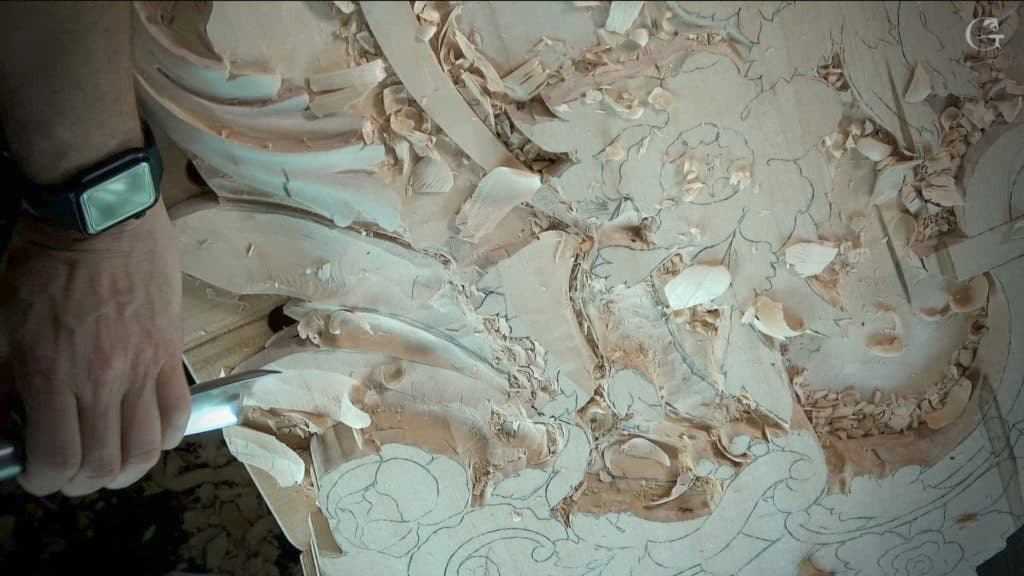
Alexander Grabovetskiy, woodcarver, School of Woodcarving · Published 2021
What does a wood carver mean by "a different sweep"?
Quick answer: In workshop 130 of the Venice Room, video 3, I say it at a hollow, then say an edge will go lower, after a big seven for the main concave. In other lessons the same words come beside a pipe or a back bend, a flatter cut, some ridges and two charts.
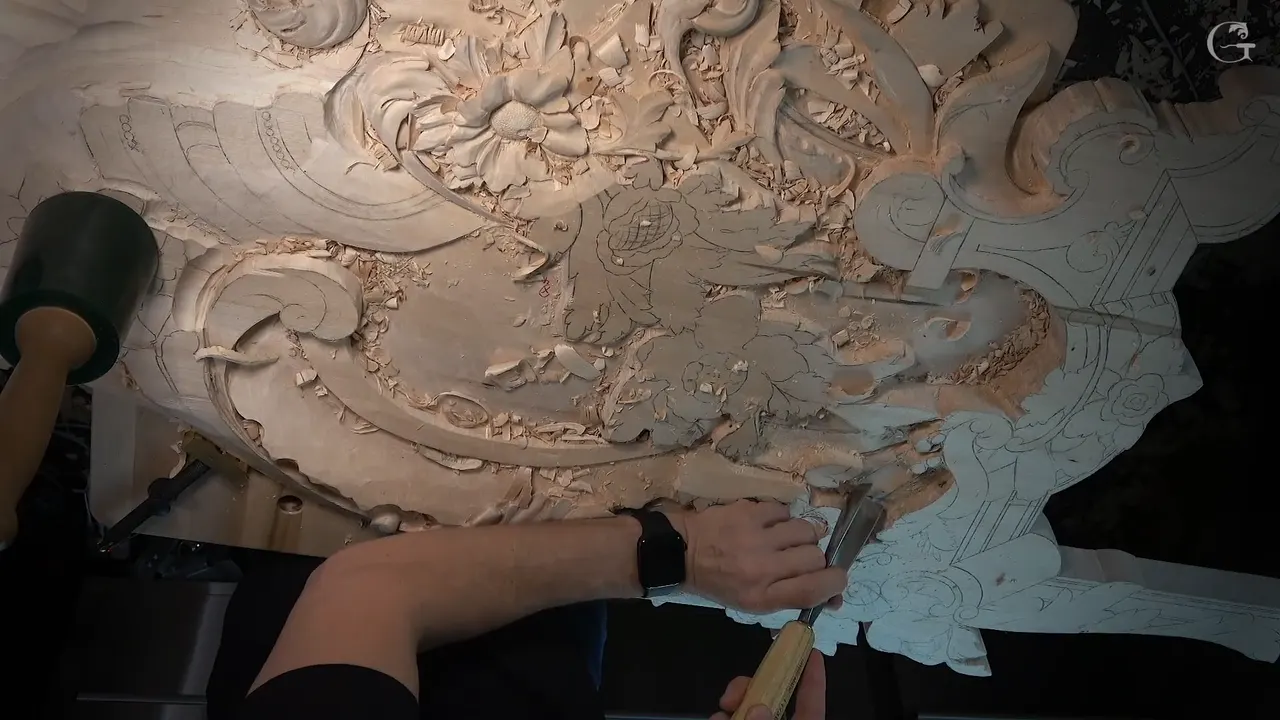

In video 3 of Venice Room 130 I say, "Maybe that is not even enough concave. I should do a different sweep." Below, those same words follow me through other lessons of mine, and every line has a cue behind it.
Ever looked into a hollow you just carved and wanted more shape in it? Maybe you reached for the same gouge again, or set it down and studied the wood. Here is what I said, and where else I said it.
What happens in this part of lesson 130?
The part opens with a tool that does not fit. "You know what? I'm just using too small of a tool. Let me use 30 millimeters for that." My plan is a size of 30 millimeters (about 1.2 in) for one spot, and a second spot gets the same: "This one also I could do with 30 millimeters." The aim is plain. "That is the goal for me, to make some concave look."

"You can already see it casts some shadow on inside," I say. "So that's why I exaggerate." That middle part will sit "lower than those two," I say, after "let me push it a little bit your way." I will take care of it right away, I say, and "attack from this side."
A pause to think comes next. "Now I have to make the decision, what am I going to do with those guys?" I need to think about "the best look for it." My first job is the main concave. "I need to lower down this edge because it is going to be almost laying on the background. So no more than a quarter inch," which is 6.35 mm.

Inside it, I say, there will be a secondary concave on one of the sides, "which going to give me beautiful shadow casting." My tool for the main one: "I'll take number seven, big one, and I could probably start attacking right from the edge."
What did I say about the sweep itself?
Here I turn to the hollow itself and say the line in full: "Maybe that is not even enough concave. I should do a different sweep." I do not name the new sweep in that sentence. The next line is about the edges. One will go lower too, I say, and I will do exactly the same right here.

Two figures follow. "This concave, I've got one of the edges higher, and this side is no more than a quarter inch, about six millimeters from our surface." And then, "That's what I've done."
A smaller tool is next, for the mess. "Of course, I need to get a smaller tool and take care of whatever the mess I've got right here." My words for it: "Maybe let me get number eight, or seven, I'm sorry. With number seven." The mallet is in the plan too: "I'll use a mallet to persuade."

A flower will go right there, and "I'm really happy how deep I freed up the material area." My plan for the cleanup is a number 11 of 30 millimeters (1.2 in), "to clean this area around." And, "Maybe some cleanup right here, too."
Later I go back to the hollow. "But anyway, I don't see enough concave yet, so I need to take maybe number seven and create that concave, the main one, okay?" My own words repeat: a main concave, with a secondary one on a side "to create the double shadow cast." Near the end I say, "Number seven, that is what I'm using" and "about 25 millimeters, about one inch."

Which tools do videos 1 and 2 of lesson 130 name?
Video 1 has me chopping around "those future leaves" and I give the kinds of chop their names. "Straight down cuts, and the plug cuts, and the edge cuts." For an edge cut I say the tool is number nine, removing some of the material near the edge, straight down at 90 degrees. A bigger size is possible, I say: "I could actually get even bigger, maybe three-quarters of an inch" (about 19 mm), "A tool like number nine. And hit that little harder."
Video 2 starts with blending, and I say I will outline it one more time with the number 11. A thought about one side follows: "I can lower down only one side of it" and "this side I'm going to create almost like a concave going this way." For that, "I have to use maybe number eight." Also, "I guess it has to be somewhat deeper concave because I got some cuts right inside, right here."

Of that I say, "that's not the best way to do that against the grain, but it's okay. It's just preliminary." Then, "So now you've got an idea. So the concave look." Later in that video comes "I'll take number 11 and 5 millimeters" (about 0.2 in), and "We could go even deeper right here and create beautiful shadow."

Where else do I say a different sweep?
The same words turn up in other lessons of mine, beside a hollow that does not read, a pipe, some flat cuts and a row of ridges. Every line below names its own video.
Do I reach for a deeper sweep when a hollow does not read?
My look in Venice Room 7, video 5, is an unhappy one. It is "not as distinguishable for me." Next, "Maybe I have to turn to an even deeper sweep, like number nine or maybe even to number 11. We'll see." And, "as of now, I'm not too happy."
A little further on I say, "let me remove at least some of it" and it will be "much easier for me to use a different sweep." After that, "I thought number eight will be enough, but looks like it's not." I name a bigger one, "Let me turn to number nine." Later, after "a little deeper excavation," "number nine gives me much nicer result."

Later in that same video I say, "I could attack a little bit closer to this end and get to my beads." A line later, "But I could do that with a different sweep just to get really close to the beads." Then, "I think it gives me a really, really good result."
Which sweeps do I name for a pipe and for a back bend?
Venice Room 64, video 5, is about a pipe. "Maybe I should use a different sweep, maybe number six or so." Then "Or even seven." The aim is the shape: "create that movement uphill." And, "that way, it's going to give me the right formation of the pipe." Maybe even "create some shadow underneath of the pipe," I say.

Next, in Venice Room 28, video 8, I say I am using a back bend: "that's number five, which is number five sweep and 10 millimeters" (0.4 in). Then, "Well, in this case, I could use actually a different sweep. I could use maybe number seven or number eight sweep back bend and just go that way." And, "But I don't want to force it."
I say I do not want to create too weak a spot. But still I want to undercut, because it is a deep excavation and you will be able to see underneath, and it is a good idea to take out some of the material.

What about a flatter sweep, or a smaller area?
Furniture Panel 18, video 3, has a short one: "Let me get little deeper cut around here." Then, "Just a little deeper." And, "maybe little different sweep, like flatter. Number seven."

In Hashemi Flowers 35, video 3, a smaller area comes first. "Make it a little smaller, this area." After that, "I need to make it a different sweep." Care follows: "I do have to be really careful when I'm touching the one I already done. So right now it's just kind of fragile." Further on, "I'm using number five, by the way. One inch" (25 mm).
I also take up why I subdivide the first ring in five parts. "You can subdivide as many parts as you wish" and I like to be "really close to nature." Of petals on flowers, "I'm not saying that's the absolute truth, but as far as I know, it's always close to the Fibonacci number."

What about a different sweep for eyes and ridges?
Roman Acanthus 6, video 3, names a different sweep as one choice. In the same stretch, "I don't want to make it too complicated." About the eyes I add that some could be smaller and some bigger: "I didn't do that, okay? But you could."
Further on I think my number nine of 10 millimeters (0.4 in) will be "a little too big for this" and "I need to take actually a smaller one." Then, "I'll take just 5/16 of an inch" (about 8 mm).

Roman Acanthus 8, video 4, is about ridges. "Right now, it's too many ridges. Of course, I'm going to just take some of them out by just using different sweep gouges, and make my moves long and nice." Before that I say the cuts are "not the final cuts yet" and there will be no sandpaper. Of sanding I say you are "just losing the point of wood carving, the chisel marks, the feel of the hand done." On the ridges themselves, "it's better to leave those ridges" and "It's going to be just more authentic."

Do two brands share one gouge number?
Greek Acroterion 4, video 5, has the plainest case. A number five of one brand differs a little in sweep from a number five of another, I say. "They have a little different charts, European chart and English chart." Another note: I may put the difference on the website, and "there is a big difference actually between sweeps." And, "Although it's not that critical."
In that same video: "There comes a moment when you really don't even check what sweep you're holding. You're just working in automatic mode and just grabbing the tool, just like a robot, which is laying on your workbench."
Later a grounding tool is "still number three in English measurement, English chart, British chart." Of it: "It's little different sweep." And, "It feels like it's a number two almost. Almost no sweep at all. And in the chart it shows number three."

Why do I keep so many sweeps?
The Dining Table Apron course, workshop 8, has me saying "It helps when you have the right sweep on a gouge. You just kind of rotate around the main radius, and it helps a lot. And that's why I have a lot of different sweeps, a lot of different tools. It just makes my work a lot quicker."
Then, "It doesn't have to be just a perfect fit." I am "using just the edge of it, just the one part of the gouge, and follow along the profile, just little by little." And, "different shapes with no problem, with lesser tools." The tools I name there are a number five and a number six.

In Lily Box 3, video 5, I talk about outlining a design by "placing your tool just like that, and you just outline it." Then, "you have a lot of tools to create that type of technique. Different profiles and different shapes, different sweeps and so on." And, "But also it leaves a mark."
Back in that lesson, video 7 returns to it. The method needs many profiles and sweeps of gouges, and "I know not all of you have that." Still, "I like that method myself." It gives "really sharp and nice line."
In Lily Box 2, video 6, the talk is about handles, and then "availability of different profiles, different sweeps, it also matters." About the most common brand in the United States, "not all sweeps and profiles available in the United States."

Which kinds of spot carry these words?
Back in lesson 130 the words came next to a hollow I said might not have enough concave, and a plan for number seven. Elsewhere they sit next to a pipe, a smaller area, some ridges and a chart. All of it is wood carving.
Five kinds of spot where the words showed up
| Beside | Where I said it |
|---|---|
| A hollow that did not read | Workshops 7 and 130 of the Venice Room, videos 5 and 3 |
| A pipe or a back bend | Workshops 64 and 28 of the Venice Room, videos 5 and 8 |
| A flatter or smaller area | Furniture Panel 18 and Hashemi Flowers 35, video 3 |
| A choice and some ridges | Videos 3 and 4, in Roman Acanthus 6 and 8 |
| Charts and a tool rack | The Greek, apron and Lily Box courses in my school |
Where did your last hollow stop reading? All the videos for this panel sit inside one tuition plan. On the Part 11 course page you will find workshops 122 to 131, and lesson 130 holds all three videos. Lesson 129 comes before it and lesson 131 after. Tool sizes in millimeters and inches stay as I said them.

How it's done
- Say what is missing. The hollow might need more concave, I said.
- Name another sweep. Another sweep was something I should do, I said.
- Lower the edges. An edge would go down as well, I said, and the same would happen at the next spot.
- Check the figure. One edge stood higher, and the other side sat a quarter inch (6.35 mm) off the surface at most.
- Take a smaller tool. A smaller tool was needed for the mess, I said, maybe number eight, or seven, with a mallet.
Frequently asked questions
What came right after the sweep line in lesson 130?
An edge would go lower too, I said, and I would do the same again right there. Two figures came next: one edge sat higher, and the other side stood a quarter inch (a little over 6 mm) off the surface at most. "That's what I've done," I said.
Which tools did I name in part 3 of lesson 130?
Number seven, the big one, for the main concave, and a 30 mm size (about 1 3/16 in) for the first spot. Number eight came up for the mess, corrected to seven, with a mallet to persuade. A number 11 came up for the cleanup.
What did I say about a deeper sweep in lesson 7?
Maybe I had to turn to an even deeper sweep, I said, number nine or maybe number 11. A few lines later I said I thought number eight would be enough, but it looked like it was not. Number nine then gave me a much nicer result.
What to carve next