
Alexander Grabovetskiy, woodcarver, School of Woodcarving · Published 2021
What does a wood carver mean by "although"?
Quick answer: Video 1 of lesson 131 has me liking one side, then saying "although" and naming an edge that still needs a fix, a job I set for a little later. Other lessons put the word beside a tool I might swap, the grain, a detail the eye may skip, and a doubt.
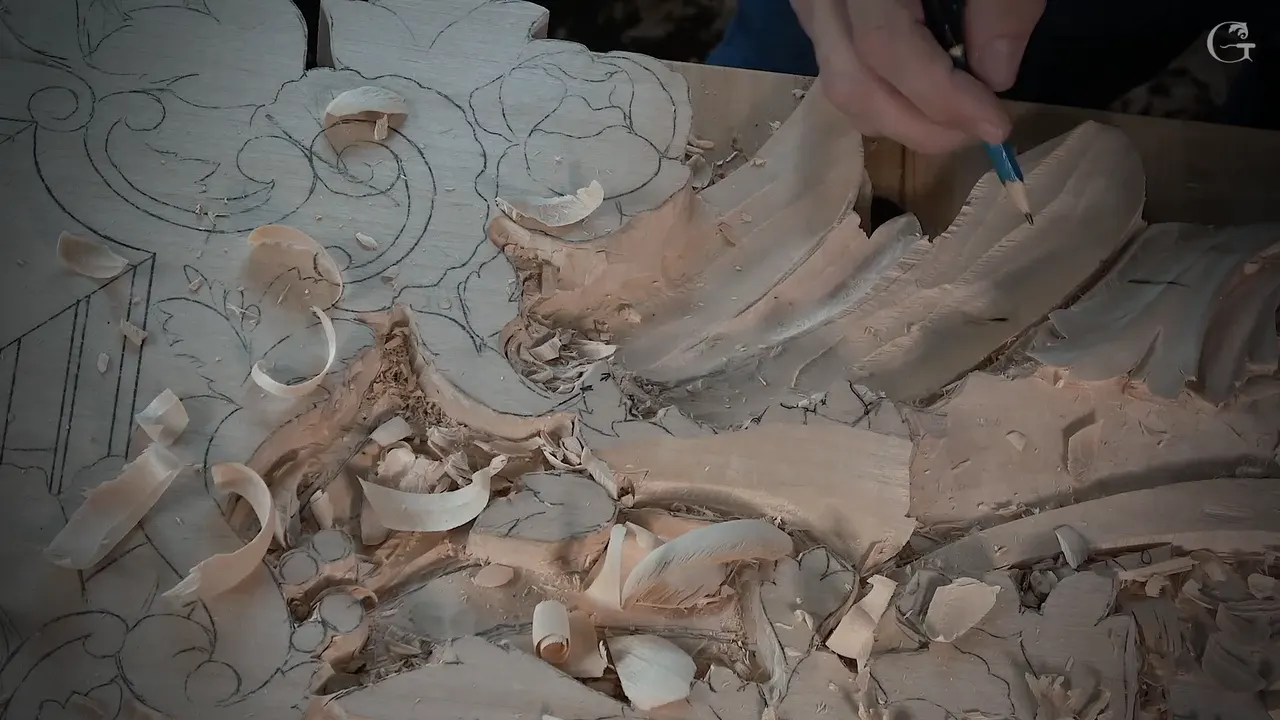

In Venice Room 131, video 1, I'm happy with that side, and the next word is "Although," followed by "I need to fix whatever the edge is going to be." Below, that video goes in order, and then the same word follows me through my other lessons, each line with a cue behind it.
Ever looked at a side you just carved and liked what you saw? And in the same moment, spotted one edge that still needed work? Here is what I said about that edge on one panel, and what I said in other lessons when a good result and a leftover job sat side by side. A gouge is a type of chisel, says Wikipedia.
What happens in video 1 of lesson 131?
My first words are "Okay" and the verdict on that side. Then comes "Although" and then the edge job. I add that it will be "taken care a little later."

Next I talk about taking one point, then another, and going across to a third. "I want to create, again, a golden ratio," I say, and I call it "about 60/40 rule, or 62% out of 100, 62/38." I plan to eyeball it, with the middle center line at "62 this side and 38 right there."
A question to myself comes next. "Am I accurate? I don't know," I say, and "Let's figure this out." Then calipers: "I can always use golden ratio calipers" and "I see I am right."

The center line gets a destination, "all the way to the point." Two ways forward follow in one breath. One reads "I have to fix a little bit this movement little later" with "Slightly later" added. The other reads "Or I can actually take care of it right now."
Which job comes before the secondary concave?
"I need to create the secondary concave, but before that, I need to take care of the line," I say, and "this little guy has to go underneath." I tell you "it's all about the shadows." It "just casts shadow, and that separates this leaf from the rest of the picture."

So before that concave I want "a really gradual movement right here, so without any waviness." The big number 2 is my tool for that. "I just ride like this, see? And I can hit the high spots," I say, so that "I know my movement is really gradual." Then, "Let me also hit from the opposite side" and "this side, I can actually lower down."

That stretch ends on a verdict of my own. "I need a really beautiful line," I say, and "that is what I'm after." One more line follows, "I guess I am right there."
Where does my tool go next in lesson 131?
"Now I am ready for the secondary concave," I say, "but I have to be really careful and attack from two sides." My plan reads "First, I'm going to go closer to the center line." Later comes "yes, this side also needs to be fixed a little bit."

For the ridge I say I have to attack it "from opposite side, from opposite direction." My reason is "Because of the grain, of course. Grain of the wood." The part ends on one more plan, "I'm going to hit again from this side."

Does the word come back in video 2?
It does, near the end. Earlier in that video I tell you "Don't pay attention to overall shape, it will be fixed." Close to the end I say "it's little too early to do it because I still have to work on the shapes." Maybe I will adjust my edges, I say, and make it look nicer, and "We'll see." The word follows. "Although it's nice already, but it could be always nicer. A little nicer."
How do I talk about a spot I like?
These lessons put a good line first and a leftover job after it. In Venice Room 120, video 2, I say "I think it looks somewhat good, although it doesn't look good yet, but it will." A plan follows, "So now I need to excavate inside right here and give some shape" with "number 11 and 7 millimeters" (0.28 in).

Lesson 69, video 12, holds two good spots in a row. I am happy with one and with the next, although another concave still has to go on that side. The reason I give for that concave: "I want to make sure this ridge is raised up."

The Greek acanthus course has a cleaning pass. Lesson 7, video 1: "Let me make a cleaning cut. And I'm happy with that, although I would still probably clean a little bit." About the next one I add that I could "just use a knife."

Hashemi Flowers 5, video 4, finds me happy with this, "although I'll take again number 16, 6-millimeter V tool and make my outline." Six millimeters is about 0.24 in. After it I say "I don't want to lose the overall picture."

In lesson 156, video 1, a cleanup comes first: "although it's pretty clean, but still, just remove some of it." Then "I've got two pipes."
Which tool do I name after the word?
Venice Room 151, video 1: I say I need number 2, "although I could probably take some kind of spoon, maybe number 6 or so, and excavate little more toward the volute." Six or seven, I say, "doesn't really matter." Then "It's still going to give me the same result."

Soon after, I say I will check whether number 7 can make a straight down cut. And my next words are "Although number 2 will work probably better."
Video 12 of lesson 63 has "That is better. Although maybe number six will work little better." Then come "Let me try number six" and "Maybe it's too much." My plan is to leave it alone, and "I could spend all day long in one area, but do I want to? No, I don't."

The hazelnut course has the word in lesson 5, video 2. "The same tool I'm using, number three and 12 millimeters gouge," I say. Twelve millimeters is 0.47 in. And then comes "although I think number seven would be better in this case, but it's okay."

Furniture Panel 23, video 7, has "let me actually excavate little deeper, although I need to change the tool." The new one is "a lot more flatter tool, maybe number two" and I name its size: "12 millimeters, like a half an inch." Twelve millimeters is 0.47 in. The plan after it is to chamfer it, "carefully just slicing it."

A word can also trade a line for a knife. In Chamomile and Bow Rosette 3, video 3, I tell you "Let me put those lines in" and then "Although I don't need to put those lines, I can actually use a knife." I follow with "there is more than one way of doing things."

Greek Acanthus 14, video 2, has a tool choice. "I could probably still use the same number one in my hand and carefully start undercutting," I say, and then "Although, probably the best, in this case, would be just the number 12 knife."

Venice Room 138, video 1, has me saying I could make a spot "feel like there's an eye" and then "Although I should use three millimeters, I think. It would be better." Three mm is 0.12 in.

Which way do I turn when the grain is against me?
Over in Venice Room 127, video 1, I can blend "although it's against the grain, but it's okay." Then I say I can walk around to the opposite position and attack there.

Workshop 142, video 1, says "Here I have to be careful because I'm working against the grain." The advice: "Although, always a good idea just to walk around."

Greek Acroterion 4 has the word in video 7, about a pass that is "not the best idea." The fix I name: "I have to just rotate my piece and cut from this side."

The beginner cutting board course brings up two sides as well. In workshop 13, video 4, I say "changes direction, so I have to approach from two sides now." A sharp knife can take you right to the edge, if you are careful enough, I say, though the result is not as clean as you may want.

Back in Venice Room 62, video 7, a ceiling gets in the way. There is "another side, although I need to attack that from opposite direction," I say. Then "ceiling is in my way."

Who is going to see that spot?
In lesson 152, video 2, my first move is a plan: "Maybe I should use a little bigger tool, maybe about three millimeters" (0.12 in). And the word: "Although it's not going to be too visible, but still, it should look really good."

Roman Acanthus 16, video 3, has a number 11 giving "that round look on inside, although it's not detectable by the eye, but for the light and the shadow, it makes sense." I call it "a more smoother transition."

What do I say about a worry or a wish?
Video 2 of Venice Room 113 holds a worry. I start with "Although" and go on with "I don't know if I want to do a deep undercut." Next, "Yes, I do need the shadow, but my question is, do I really need to do a super deep undercut?" I add "I think it's a good idea" about exaggerating a concave.

Workshop 134, video 1, puts the word after a close call. "Am I okay? Yes, I am okay," I say. "But pretty close. It was dangerous." After that comes "Although" and the reason I give for the extra material: some shape is still to come, "so I have plenty of material."

A brake shows in lesson 21, video 6. It is, I think, "going to give me a beautiful look." The brake itself: "Although I shouldn't push too much because I just created too deep of a cut, and I sliced a little bit inside."

Care for a live piece shows in Venice Room 154, video 2. "About quarter inch deep at the beginning," I say, which is about 6 mm. "Although, let me check." Then the molding: "going to go below, so I'm actually safe to bring the whole section down." I tell you "I'm working on a live project, and I can't redo that."

Grape Onlay 11, video 1, has "I think I made the right decision right there, although I don't like how this grape looks." My next plan: "let me remove a little deeper underneath of it."

Next, a wish, in video 2 of lesson 151. "I think it is going to look not bad and all," I say. After it I say "Although" and then "I don't like the position of this division." A razor comes next, "if I can find a razor." Then "I think I want to do my division below, right here."

The word opens a door in Venice Room 119, video 3, beside a backward curl that I do not have to do. "I really don't have to do a curling backward like this. Although it could look really good." My option follows, "I could actually do just a small leaf like this, just do the acanthus."

A taste of it sits in lesson 20, video 12. About a curly look, "that is exactly what I'm after in this project, by the way, not on all projects." Next comes "Although, I should admit, I really like curliness in wood carving."
A second route comes in lesson 43, video 9. "So let me reestablish the movements," I say, "although I could get this movement from down below upward like that."

Which words follow the word, side by side?
| What the word led to | Lessons where I said it in my videos |
|---|---|
| A job left to do | Lessons 131, 120, 69 and 156 in the Venice Room, Greek Acanthus 7 and Hashemi Flowers 5 |
| Another tool for the spot | Hazelnuts 5, Furniture Panel 23, Chamomile 3 and Venice Room 63, 138, 151 and Greek Acanthus 14 |
| The grain and the other side | Greek Acroterion 4, the cutting board course and Venice Room 62, 127 and 142 |
| A detail not seen | Roman Acanthus 16 and Venice Room 152 |
| A doubt or a wish | Lessons 20, 21, 43, 113, 119, 134, 151 and 154 of the Venice Room, and Grape Onlay 11 |
Which of these sits closest to the edge in front of you right now? All the videos for this panel sit inside one tuition plan. Workshops 122 to 131 live on the Part 11 course page, lesson 130 comes just before lesson 131, and lesson 129 sits beside them. All of it is wood carving, with a chamomile rosette in the mix.
How it's done
- Say what looks good. I started with a verdict on that side.
- Name the job left. Then the word came, and the edge job right behind it.
- Give it a later. I said that job was for a little later.
- Make the line gradual. I wanted a really gradual movement ahead of the secondary concave, and the big number 2 was my tool for it.
- Pick how to attack. I said I had to come at that concave from both sides, and at the ridge from the opposite direction, because of the grain.
- Look at the edges again. In video 2, after talking about my edges, I said it was nice already and could get a little nicer.
Frequently asked questions
What did I say right behind the word in lesson 131?
Right behind it came the edge, a job to carry out "a little later." The end of video 2 gave me one more line, after I talked about my edges: it was nice already, and it could still get a little nicer.
Which tools did I name beside the word?
Number 2 and a spoon, maybe number 6, came up in lesson 151. Maybe number six came up in lesson 63, and I think number seven in the hazelnut course. Maybe a flatter number two came up on the furniture panel, and probably the best was a number 12 knife in the Greek acanthus course.
Which side did I choose when the grain was against me?
On the blend in lesson 127 I said I could walk around to the opposite position. Lesson 142 called it a good idea to walk around, and in the Greek acroterion video I said I had to rotate my piece.
What to carve next