
Alexander Grabovetskiy, woodcarver, School of Woodcarving · Published 2021
What does a wood carver mean by "even now"?
Quick answer: In 132-2 I said "even now" about going two millimeters (0.08 inch) deeper, after a number 11 undercut and with some wall still standing. Other lessons put the same words beside a knife, a plug cut, a shadow and a look.
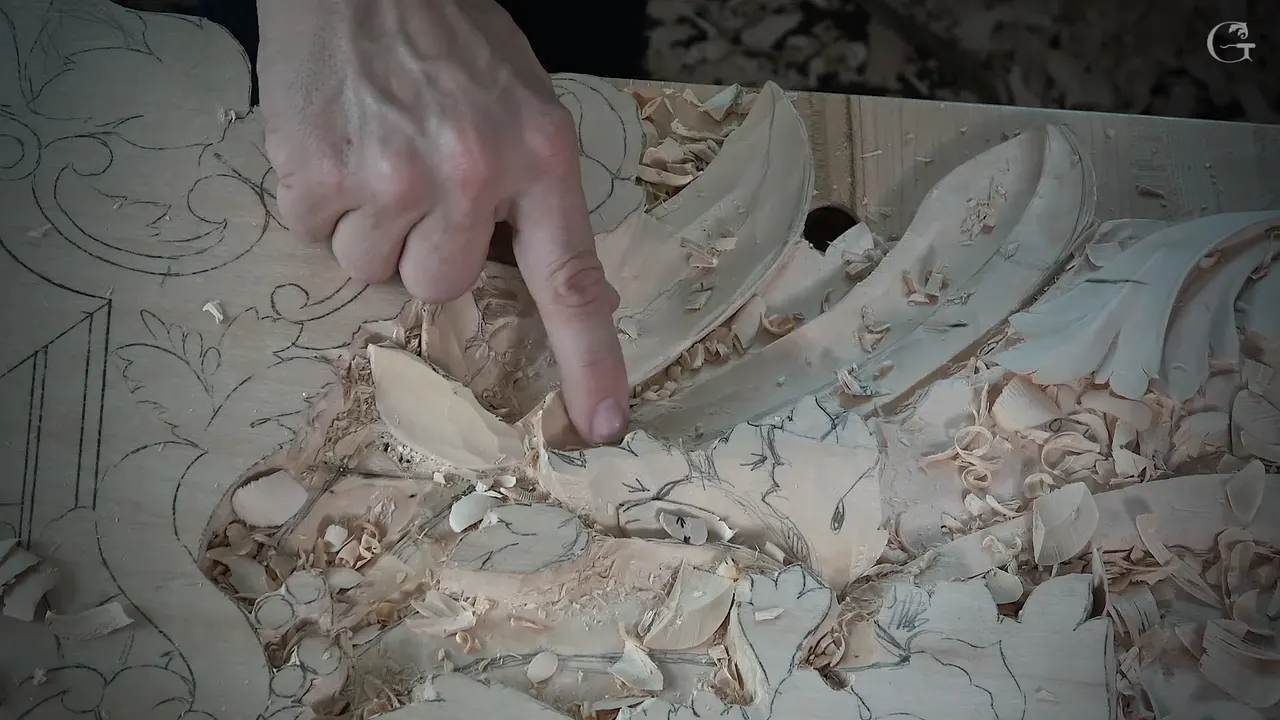

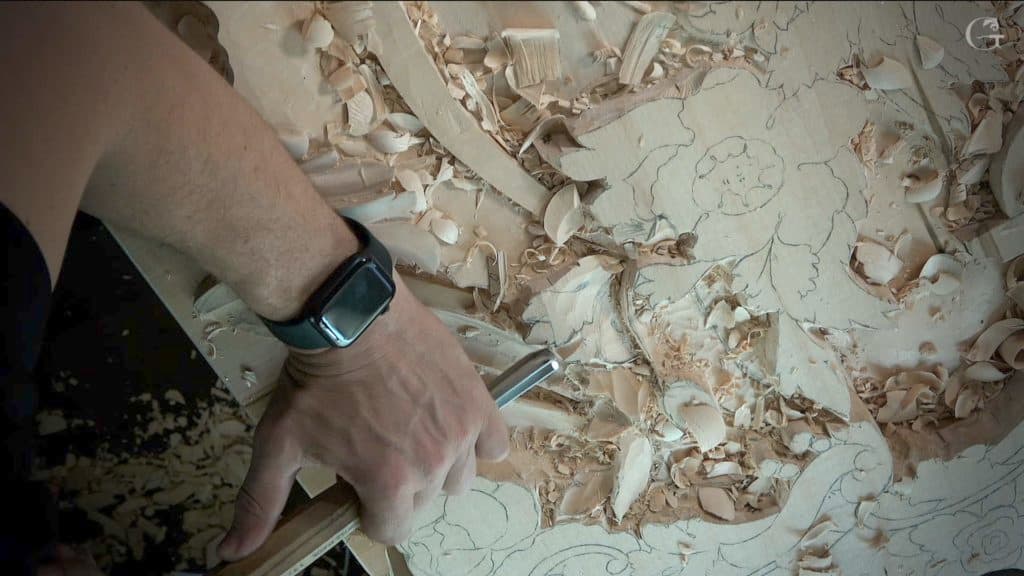
In video 2 of Venice Room 132 I say, "Later on, or even now, I can actually go a little deeper." Below, those words follow me through other lessons of mine, and every line has a cue behind it.
Maybe you have held a gouge over a leaf and wondered how much you can do right now, and how much has to wait. Here is what I said in 132, and where else I said it.
What happens in part 2 of lesson 132?
Number seven opens the video: "And yes, I'm using number seven." You do not see the final shape yet, and my goal is "to get this edge, this ridge, this part." For that I plan to "get the pencil for you to understand."
Then the distance. This part, I say, "is not going to be more than about one-eighth of an inch from above, from this line" (3.2 mm), and that line belongs to the long leaf. It is "only three millimeters" (0.12 in). My hope for what follows: "once I going to undercut, so you'll see it much more clearer."

Now the move. "I'm going to attack underneath of this leaf" and I plan a "preliminary undercut" there, so that "maybe you'll see what is going on." Number 11 is the tool: "I am using five millimeters" (about 0.2 inches).
After the cut comes "Just like that." Then come the words from the top of this page, and what they lead to: "I can go about two millimeters and get little deeper excavation underneath." Two millimeters is 0.08 in.

Something stays in place, though. "But I'm still leaving some wall right here, the thickness to the highest spot, because I still have to establish concaves and convexes. So those undercuts are preliminary. It's not like the final look what you're going to see."
Then a plan: "Let me also hit a little bit right on the line, the above leaf." After that, "I like it so far."

Next I have to lower this leaf underneath of that line. "Exactly the same operation," I say, and I plan number 11 again at "12 millimeters, about half an inch or so," which is 0.47 inches. The leaves, I say, will be "somewhat like a 3D" and "it's going to give me that real depth."
Two lines follow, one about a spot and one about a tool: I can "hit from this point." Then, "Let me get the mallet." A worry about my own work comes next: "I'm not doing mistake." I need to decide which side takes the concave, and my thought is "to create concave raising this part." That part will be "a little higher than the opposite side."

I name a seven for that job, "one inch" (25.4 mm), and I say I am going to "remove some of the excess material." Then I change my mind: "Maybe not even concave. I could do a convex on this side."
Another undercut comes up. "I'm not sure if you're going to be able to catch that or not" and the place is "all that mess." I plan to take "number 11 and 5 millimeters" (0.2 inch).

A remark about being too close follows. "I know when it's too close, you almost don't see what I'm doing, okay?" Then comes the line that it is "almost impossible sometimes to get an idea even what am I doing."
It is "a preliminary" and "I'm going to leave it like that." The final line is next, and my plan is to "lower down tremendously, I guess, this side. Maybe not tremendously, but somewhat."

After that, "Let me get number 11 and 12 millimeters again" (0.47 inch), and "now I'll switch to a smaller one. So maybe about five millimeters, number 11." Of what comes, I say there will be, "like I said, an eye." Next, "Even if it's not a canvas, I still want to get the same idea or close idea." Another eye is planned "right here" and then "I can, right away, very much excavate this way."
Which lines sit in the other two videos of lesson 132?
In video 1, concaves "make big difference as far as the shadow and light." I think about an undercut: "I could probably undercut right away underneath of this line" and it would "give me an idea." About one detail: "It's not the final height of that detail."
Video 3 carries the same promise as 132-2. Of an undercut planned with "11 and 5 millimeters," I say, "Later on, I'll use 2 millimeters and blend everything." I also plan to undercut "right away on this side." The shape is "preliminary movement" and it is going to "go downhill like that." With the lines redrawn, I can "make it look really light and nice" and "at least I can see exactly what is going on."

Which lines tie even now to work I can do?
Lesson 158 of the Venice Room holds it in video 2. My plan is a number nine, 1/8 inch (3.2 millimeters), to "start my excavation deeper and deeper and deeper." "Even now" then leads into "just create the plug cut from one of the sides." Then comes "And I am all the way through."

In lesson 143 I say "that already gave me that much lighter look." I name "12 millimeters or so" (0.47 in) for a smaller one, and then weigh it aloud: "Maybe yes, maybe no. Maybe even now with the 10 millimeters" (0.39 in) "and creating deeper shadow." Then: "that's enough, I guess."

In Floral and Molding for the Panel 13 I say I can clean up "a little bit all around," while "even now" opens a thought about a petal: "I can attack my neighbor or neighboring petal and make it really nice transition on inside." My tool is "4 millimeters number 11" (0.16 in), and the plan is "even nicer shape on all of the sides."

One fix has to wait in Floral and Molding 6. It depends on a decision about what goes underneath of that leaf. Meanwhile, "even now" brings "preliminary, I could take probably number seven and 14 millimeters" (0.55 in) "and make it nicer."
In the fourteenth video of Furniture Panel 19 I see a flaw: "I do see a mark on the previous cuts. I don't remember when I did it, but that's what I don't want to see." The words "even now" there lead into "I can slightly undercut, although there is not much space, but still, even with that, we're still able to. Little bit, not much, but little bit." My verdict: "for me, it looks actually really nice."
Lily Box 11 has a knife job, and the side of my tool goes in "carefully" with "almost absolutely no pressure whatsoever." At a connecting point: "I am happy with that. So I can take actual knife even now and clean that wall." Afterward, "I just created beautiful wall canvas to work with."

Lily Box 12, video 6, ties "even now" to a space that is "little too thick," so I can "take advantage of it and create a dome underneath." The dome is "just for the shadow's sake." And "shadow will be beautiful."
The dark woods get a word too: "Sometimes on darker woods, it's harder to detect those shadows. And more exaggerated shadows you do, more beautiful it's going to look."

What shows up when I say even now?
Back in Venice Room 30, video 2, a straight tool will not do, and the back bend "would be the best solution." Then, "But see, even now, you can see probably how deeper I got my shadow right there. And again, wood carving is all about the lights and the shadow." Then, "there's five levels of shadow, by the way" and shadow is "a complicated subject on its own."

A blade is the subject in Roman Acanthus 16. I say, "Any knife will work" and "any knife should work." "Of course, it has to be really sharp." The words that follow "even now" say you should "catch that edge looking more classical."
In Furniture Panel 38 a concave comes up: "you don't really see that shadow because I've got my lights above my work bench and I really have a super bright lights." Once the piece is in place, "you'll catch that shadow." Right after "even now" come the words "I mean, you could probably see" and "some shine right here and there's a shadow line. It's kind of outlined."
I do not like one flower in Grinling Gibbons Maine class 9. "It's too flat" and I want "full 3d." Looking in from the angle, "even now," shows the obvious pieces glued together, and "it does not look appealing." Also, "you obviously can detect those layers."

A long cut in Corinthian Acanthus 4 "gives a really nice movement to your piece." Then, "actually the results, what we have even now." Afterward, I wonder if I can turn "this light off" so that you see better, hopefully.
Hashemi Flowers 10 begins with "remember, I am working against the grain." Further on, "hopefully, you'll be able to see some of the results even now." Next, the idea "is to make it look like it's flipping" with "about five millimeters" (0.2 in).
In another video of Lily Box 12 I say, "Okay, now it's too small. Too small." The next words are "even now." A line about a finish follows: "all of those spirals will be visible. Right now, just kind of impossible to detect. Well, not impossible, but really hard to see."

Which cuts are not final?
Venetian Flowers Rosette 2 brings a cut, and "it's not even the final cut even now." That cut is "just preliminary." After it comes a decision about "how this petal going to look in an overall."

I stop short in Lily Box 13: "I shouldn't do that all the way yet. Still need some meat." I give a why. The backside needs work, and "they're fragile even now." If I take a lot more material, "they're going to become even more fragile. So that would be a big mistake."
The Curly Kitchen Cutting Board lessons sit in my beginner course. In lesson 13 a knife can do "much more than what we're doing even now," even "true three-dimensional carving."
The same two words sit in lesson 15, in a line about checking: "you could just check your carving, and if you catch something like that, and you usually catch it later." My explanation: "a lot of times you're catching stuff like that in a couple of days later because your eye is adjusting."

To explain it I use a broken mirror, a shattered one "just with a crack or so." You "really don't pay attention to that crack." For a carving, "sometimes it's a good idea to leave it alone for a couple of days, even longer sometimes, even for a week or so." The next step is to "work on something else, on different type of carving, and come back, and then you'll see all the mistakes you made."
Is a cut ever good enough, even now?
Venice Room 1 brings a plywood pattern first, then a router to make a cut "absolutely perfect." As it stands, "It is perfect even now." The router would make it "even nicer," but "it's good enough for me."
In Gibbons Maine 17 I look at a carving "even at this stage" and "even now it looks I think is good." The background is walnut, and "even in this stage. I think it looks great."

In Grape Onlay 4 I say, "actually it's not that bad even now." More waviness is not needed, I add, and I will "start excavating."

In the Q and A lesson on a dotted background, I would take "a v-tool, the really tiny v-tool" and clean it again. The line goes, "even now you can see just because we cleaned that, so it's really clean and you don't see any leftovers. You don't see any chips, and the carving is a really clean carving right now."
Four kinds of spot where I said even now
| Beside the words | Where I said them |
|---|---|
| Work I can do at this stage | Lessons 132, 143 and 158 (Venice Room), Floral 6 and 13, Furniture Panel 19, Lily 11 and 12, Cutting Board 15 |
| Results you can already see | Venice 30, Roman 16, Furniture Panel 38, Gibbons 9, Corinthian 4, Hashemi 10, Lily 12 |
| Cuts that are not final | Rosette 2, Lily Box 13, Cutting Board 13 |
| A look that is good enough | Venice 1, Gibbons 17, Grape Onlay 4, the dotted background |
You have probably stopped at a leaf and asked what a cut could do right now. Every video named here sits inside one tuition plan. On the Part 12 course page you will find workshops 132 to 143 of this wood carving room, and lesson 132 holds the three videos. Lesson 133 comes right after it. Sizes in millimeters and inches stay as I said them, and the shadow stays yours to judge.
How it's done
- Name the edge you are after. My goal in 132-2 is "to get this edge, this ridge, this part."
- Mark the distance with a pencil. I planned on the pencil, and I set the limit at about one-eighth of an inch (3.2 mm) from above.
- Undercut under the leaf. My words were a preliminary undercut underneath of the leaf, with the small eleven.
- Leave some wall. Some wall stays, "the thickness to the highest spot."
- Say what can go deeper. I said I can go about two millimeters more (0.08 in).
Frequently asked questions
Which words came after "even now" in lesson 132?
I named about 2 mm (0.08 inches) for a deeper excavation underneath. I also said some wall was still there, because concaves and convexes were still to be established.
Which tools came up in part 2?
I named a seven at the start, an eleven at 5 mm (0.2 inch) for an undercut, and an eleven at 12 mm, half an inch or so (0.47 in), for lowering a leaf. A seven of one inch (25.4 mm) came up for excess material, and then a smaller eleven of about 5 mm.
Which results show up in my lessons?
Deeper shadow in lesson 30. An edge looking more classical in Roman Acanthus 16. Pieces glued together in Gibbons Maine 9, which I said does not look appealing.
What to carve next