
Alexander Grabovetskiy, woodcarver, School of Woodcarving · Published 2021
What does a wood carver mean by a classical look?
Quick answer: Video 1 of Venice Room 133 has me saying not all classical rules apply, and a 100% acanthus leaf is not required. Other lessons put the word beside a small chamfer, an edge knocked down at an angle, a raised volute, and how deep old work was undercut.
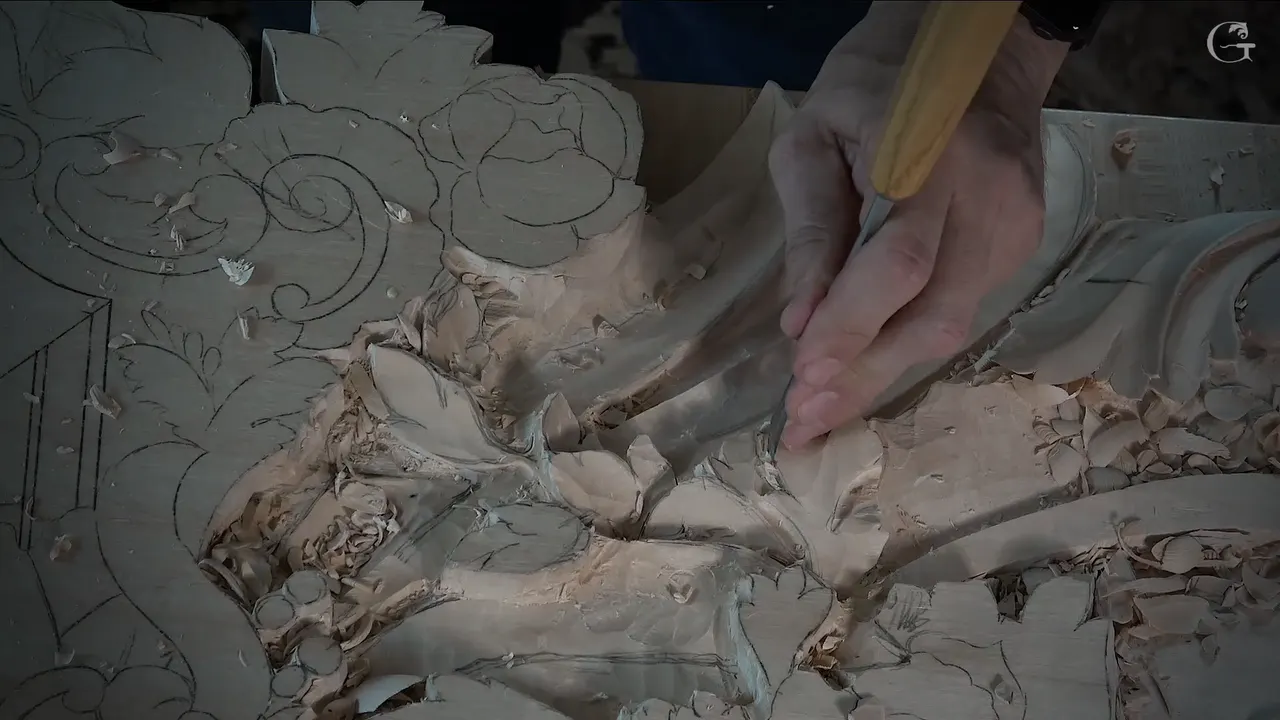

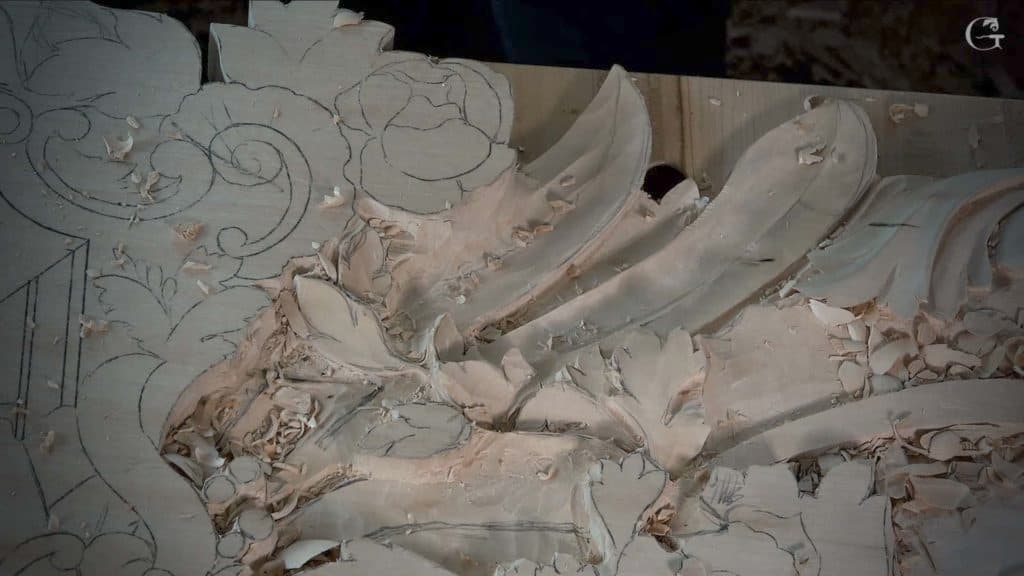
In Venice Room 133, video 1, I tell you that we can apply some classical rules but not all of them, and that a leaf need not be a full acanthus. Below, that video goes in order. After it, the same word follows me through my other courses, and every line has a cue behind it.
Ever carved a leaf and wondered how many rules from the old work you owe it? Ever studied a carved edge and seen a thin extra line on it? Here is what I said about both, lesson by lesson. Classical architecture, says Wikipedia, comes from the principles of Greek and Roman architecture.
What do I say about the classical rules in video 1 of lesson 133?
My video opens on this line: "I don't want to force it because it becomes fragile, and I can break it." Soon after, I tell you "you should be able to catch already some of the movements." They were "already showing up even before we undercut."

Then come the tools. "I'm going to take number five and 3 millimeters," I say, and that is 0.12 in. "I need also to establish letter S on this point." Another movement right here needs a micro tool or a detailing tool, and I name "two millimeters, number 11."
"So pretty much it's the same all around," I say. Next: "Just get on the edge and get whatever feels right gouge." And "it doesn't have to be exact in this case, because it's just a leafage."

Now the rule line. "But some of the classical rules we can apply. Not all. We don't have to do 100% acanthus leaf." Right behind it comes "But that's going to look better if we're going to apply some of those rules." "I hope it's going to look awesome," I add.
What else is on my list in that video?
This corner could go "a little lighter," I say, and for that spot I name "a small, eighth of an inch, number three" (about 3 mm) and "another separation here." A small spoon is next on my list. Its job is to "get to that separation."

One tool word gets a fix on the spot: I say micro tool, then correct it with "Detailing tool." A spoon comes up again, to clean that area up. "I hope you can see," I say, and "everywhere else, I'm pretty much going to do exactly the same operation."
Next I show you a leaf. "If you look from above, I want to make it like growing from the same bunch," I say, "going from underneath of this leaf and going on top of that long movement, which is a little challenging." My plan is "number two," although "probably number seven will be better." And "Have to attack from the right position."

The part ends on a raised side. My next move is to go "back down like this" and "raise one side" with the concave running "that way." In video 2 I ask about a side that could go right underneath. "Do I have to do it or not? I'm not sure."
What does a small chamfer do for a classical look?
Lily Box 4, video 9, has a ridge. "I want to create not the fillet, but chamfer on this ridge. Just a really small one, maybe one millimeter." One millimeter is about 0.04 in. Then: "It's going to give me a classical look." And "So I'm just creating a really good chamfer."

My tool is "number three and one-eighth of an inch," about 3 mm. "You can catch it visually," I say. "That is actually one of the techniques you can do to make it more classical look." Says Wikipedia, a chamfer is a beveled edge. My plan for showing it is "Let me try to switch to a different camera, and you can see that."
How does a knocked-down edge give a classical look?
Roman Acanthus 16 shows me drawing a leaf in video 3, and I explain. "We're going to clean all the edges, and that is going to make it look more classical, I would say." Seen in section, "inside of the leaf, there is a concave cut" and "right now, edge is kind of sharp." The goal is "to knock a little bit on an angle like this, maybe about 1/16 of an inch," which is about 1.6 mm. That edge will give me "a really, really more classical, I would say, look."
For the tool, I say "I'll use probably just the knife I showed you at first." Then comes a caution about the grain: "Check before you make a really deep cut what the grain does." I tell you "I'm actually just creating this classical effect, I would say" and some areas are "kind of fragile."

Sandpaper could do the same job, I say, "if you feel more comfortable with sanding. I don't." As for the knife: "I think it's much nicer to use just a knife." Down the line comes "But knife has to be absolutely sharp."
While I make this edge, "I can see if it's even or not" and "I can always refine my undercut." To work it, "Just attack that from all the sides." Of any knife I say it "should work," but "it has to be really sharp." Wherever a part has the edge, "we can always do that everywhere." Of this leaf I say "I consider this one as simple."

A caution about the rule list itself: "please do understand, that is only one of the ways to make it look more classical. So there's multiple ways." I add "I want to be more authentic, in this case, to history." The edge "just creates extra dimension, extra line, extra shadow, I should say."

By the end of that video, I say "In this case, we're working on a Roman classical look." Later on, I say, different acanthus leaves will come, and "We'll try to be authentic to different cultures, different periods of history."
Is a shaved ridge a classical look too?
A ridge gets shaved in video 5 of that course. "I'm doing only a 16th of an inch," I say, which is about 1.6 mm. "But it gives me that classical Roman, I would say, or Greek look."

The pass is "Just to create those extra ridges." Of the technique I say "They use that technique, actually" and "that's common in stone carving, architectural carving, I would say."
What do I raise for a classical look on the furniture panel?
Over in the furniture panel course, lesson 30 has a plan, what I call a "classical volute." "The upper part gonna be raised up slightly and then it's gonna go slow, slow, slow, going down, down, down." A volute is a spiral, scroll-like ornament, says Wikipedia. I remind you what I did before: "I outlined that with the number 11 and the two millimeters," which is 0.08 in.

In video 2 of that lesson I say I would really want to see "this part raised up."

Do I apply every classical rule?
No. My own line says "Not all." A spot in Venice Room 131, video 3, is "just some type of leafage, but still I'm going to add some kind of classical elements." Then: "Everything is going to be just like stacking on each other."

Lesson 135, video 3, shows a flower. "It's not like laying on top of each other. Something different, okay?" Then "not truly acanthus flower, but it still has a classical flair in it." And "Traditional flair." The tool comes next, "11 and three millimeters," about 0.118 in.

Lesson 137, video 1, gives the rule a limit: "the same classical rule, like letter S curvatures." Then comes "Not everywhere, but some spots."
Someone asks me about the classical approach in the Tray of Blessing course, and I answer that it has particular rules. "You have some certain rules like a rule of flow, so you exaggerate that flow." And "So everything just curves to the same motion." Leaf separations as they sit in nature "would look really dumb" in wood carving, I say, and "It's not connected."
How deep did the classical carvers undercut?
My courses give a few answers, and each one is only what I said. From Lily Box 8, video 8: "especially on a classical wood carving, if you go to some palaces, you don't see that deep undercutting sometimes." Then "And there is a reason."
The reason, in my words: "Not because it looks better. It's just much quicker." About the old work I say "For common people, it still would look nice." In the seventh video of Lily Box 12 I say "if you're doing it for a living, absolutely, sometimes you have to underdo." Then it "really applies to the classical carvers in the 19 and 18, 17th century." And "It's not because it was classical idea." And "They knew they needed bread." Of my own piece there I say "Right now, for example, I am doing actually extreme."

About extreme undercutting I say "Some people don't like it, actually" and "nothing wrong with if you don't like it." In its second video, Roman Acanthus 16 has "in the classical designs, you can see on the historical pieces" that people "didn't even worry about that deep undercut or extreme undercut." "It wasn't by design," I say. "So it was just to save time because everyone wants to get paid."
A debate comes up in Venice Room 47, video 12. "Some saying it's just a more classical look. I doubt. Just in my opinion." Then: "It still looks good, but it's much quicker not to go in and extremely undercut." And "in wood carving, when you're doing a extreme undercut, actually looks really good."

In Venice Room 52, video 10, I give two reasons. "Some people who is working in a classical design, they really don't like excavate deep." And "They saying that's too extreme." Reason one: "if you're doing this piece too thin, so it becomes fragile, so you can easily break it." Of my own work: "I've done really extreme undercut and I didn't break it."
Reason two is the place: "This piece is going to be installed close to the ceiling." And "the people not going to touch it so much."

Is the classical look only about the carving?
No. Flower Rosette 5, video 3: I name two brands I enjoy working with, "especially the planes." One look is classical. The other is "a more contemporary look, a more modern look, I would say."

In the first video of Furniture Panel 15 I show two brands of router plane. I like the first "more" for "the quality and the classical look," but "I am limited on the blades."

The place matters too. At the close of Grape Onlay 14, in video 3, I ask "where couldn't you use it?" I name "on a mantle," "on a kitchen hood, whatever" and "or even above the door, you know" and then I say "classical look."
Venetian Flowers Rosette 5 gives a picture frame in its video 3: "it's a picture frame for different art." Now the frame. "To make it classical, you really have to add some kind of movement." I drew the oval by eye. "The old ancient way," I say.

What if a design looks a little different from the classical one?
Cutting Board 8, video 2, has a design I call "somewhat flat." Then: "But that doesn't mean it's not carving." My next words are about the look: "It's still carving, and it still looks beautiful." Last, "It just looks a little different from a classical."

In Cutting Board 14, video 2, I talk about a skill. "We are developing the ancient skill," I say, and we are "taking that step by step progressively toward the modern approach of the wood carving." Then: "Although it's still classical, still traditional."
Which classical looks came from which lessons?
| The classical look | What I did or said about it | Where I said it |
|---|---|---|
| A small chamfer | On a ridge, using tool number 3 | Workshop, Lily Box course |
| A knocked-down edge | Planned with a knife, about 1/16 of an inch (1.59 mm) | Roman course, lesson 16 |
| A shaved ridge | Only 1/16 in (1.59 mm), I said | Roman course, video 5 |
| A raised volute | The upper part raised slightly, then slowly going down | Furniture Panel 30 |
| Letter S curves | In some spots, but not everywhere, I said | Workshop 137, Venice Room |
| A classical flair | On a flower, number 11 to start | Workshop 135, Venice Room |
| The look of a plane | I like one more, but I am limited on the blades | Furniture Panel 15 |
Which of these edges would you try on the leaf in front of you? Every lesson named on this page opens with full access to the school. Workshops 132 to 143 live on the Part 12 course page, and lesson 134 comes right after lesson 133. All of it is wood carving.
How it's done
- Pick the rules. Some rules apply, I said, and not all of them.
- Skip the exact. A leafage doesn't have to be exact, I said.
- Set the letter S. On the first video my plan was a letter S at one point, using a number five at 3 mm (0.12 in).
- Watch the thin part. I said I didn't want to force a part because it becomes fragile and I can break it.
- Try a small chamfer. Lily Box 4 has me saying a really small chamfer on a ridge was going to bring a classical look.
- Knock the edge. The Roman course has my goal as knocking the edge a little on an angle, maybe 1/16 in (1.6 millimeters).
Frequently asked questions
Must a leaf follow every classical rule?
Only some. In lesson 133 I said we apply some of them, not all. Lesson 137 put a limit on it: not everywhere, but some spots.
How big was the chamfer for a classical look?
Really small, I said in the Lily Box course, maybe one millimeter (0.04 in) on a ridge. The edge I planned in the Roman acanthus course was about a 16th of an inch (1.6 millimeters).
Did classical carvers undercut deep?
About the palaces I said you don't see that deep undercutting sometimes, and I said there was a reason. I gave it as quicker work, since they got paid only after the work was done. Over in Venice Room 47 I called it a debate and said I doubt it was only for a classical look.
What to carve next