
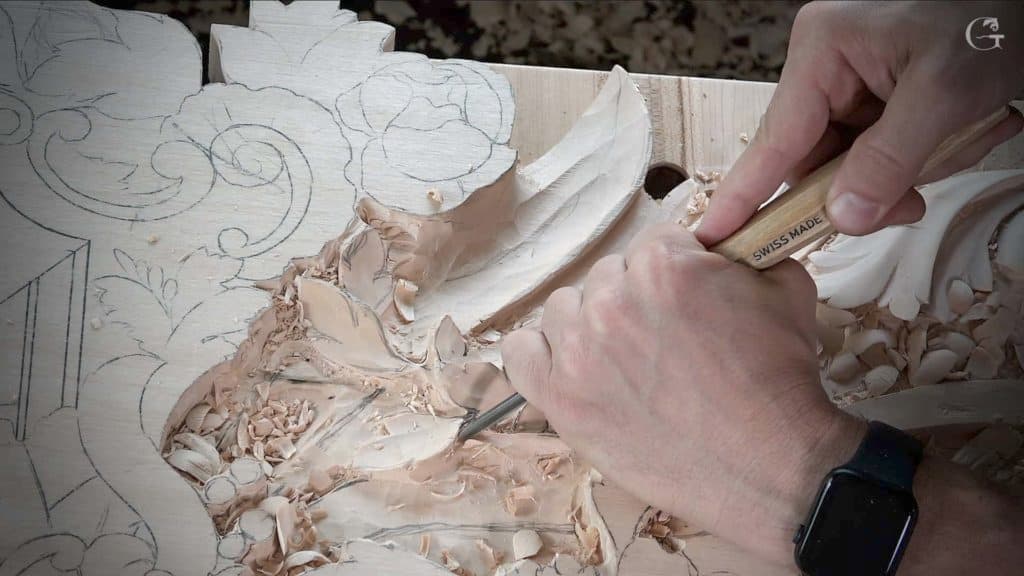
Alexander Grabovetskiy, woodcarver, School of Woodcarving · Published 2021
What does a wood carver mean by the high point of a leaf?
Quick answer: In video 2 of Venice Room 133 I call one raised part the high spot, or the high point, set right up top. In other courses I keep it untouched, take the wood down from it by 3 mm or so (about 1/8 in), and call a ridge a ridge.
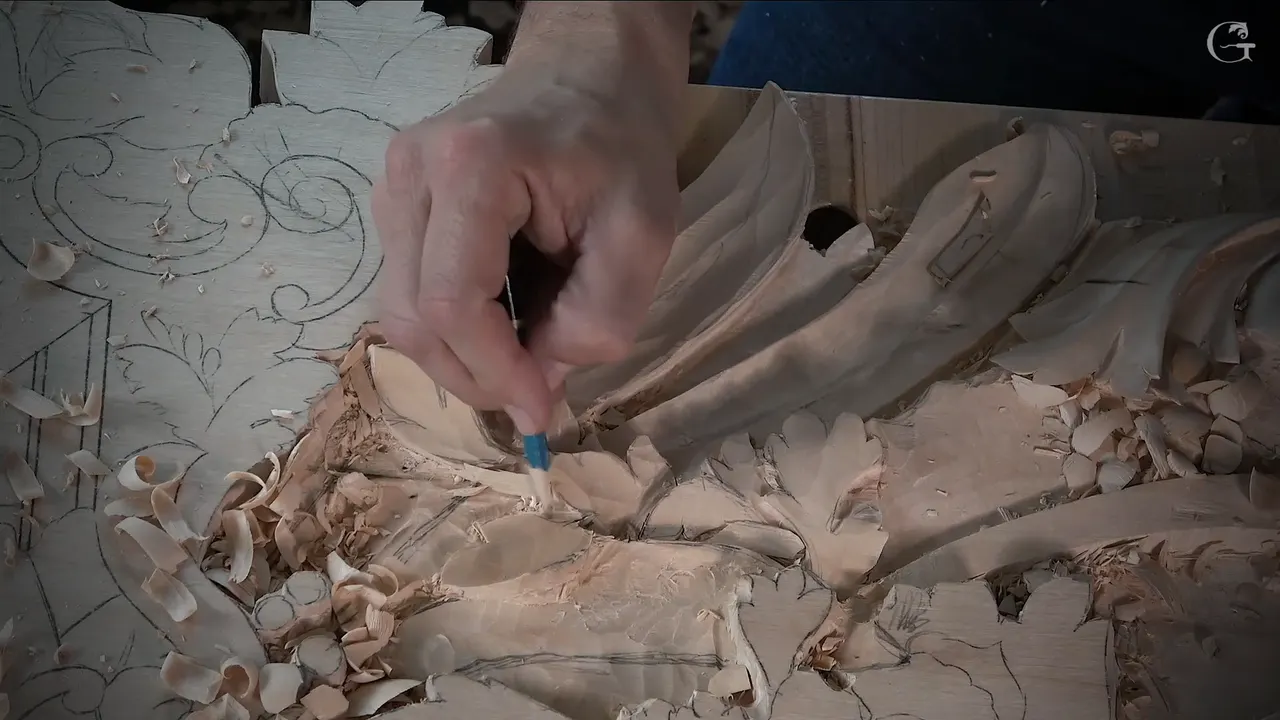

In Venice Room 133, video 2, I tell you "that is going to be the high spot" and then "the high point raised up, which is going to be right on top." That video goes below in order. After it, the same two words follow me through my other courses, and every line has a cue behind it.
Ever carved a leaf and wondered which part of it should stand tallest? Lowering the wood around one spot raises the question of how far to go, and how much to leave. Here is what I said about the part I call the high point, across my own lessons, one course after another.
What happens in lesson 133, video 2?
Next in that video I tell you "I need to redesign how I want to see this guy" and "I'm going to redesign it." A thought about the sides follows: "maybe I can actually do something interesting and get one of the sides to go right underneath."

Then a question: "Do I have to do it or not? I'm not sure." My answer is "Maybe not" and I wonder if it would be too much.
To "reestablish some separations" is the plan. Of the two sides, I say "this side has to go all the way down underneath of this leaf," while "that side is flipping above that long leaf."

How do I make room around the high point?
For the extra wood I say "let me get rid of some of the excess material with number 11." After it I name two more jobs, "relieve a little bit this area" and "excavate a little deeper around here." I tell you "I hope you can see. So now it's a part of this bunch." And "it makes sense now."

"I can start undercutting pretty much underneath of that leaf," I say, but "I need to get a little bigger tool, maybe 10 millimeters" (about 0.4 in), and that is what I plan to use. One warning follows: "Okay, I have to be careful not to touch the edge." And then "maybe I have to switch to a smaller one and attack that from the right position."
I add this about the look of the piece: "I know it does not look really good yet, but it will." I can probably outline it with a "straight-down cut" and number three is the tool I plan for that.

What about a thin part near the high point?
For one twist, a micro tool is the plan. Then a caution: "If I would just force it, I can break that area. I don't want to do that." Even if it ends up a little lower, I say "I'm safe."
"Inside right here, I need to create a transition," I say. "So the stem of this leaf going to go right underneath of this leaf, okay?" Then: "there is more separations." I tell you "you should get an idea what I've done."

"Now I need to lower down this side," I say. The plan is "three millimeters, of course, number 11" (0.12 in), and to "carefully attack underneath, even if it's from the wrong position." Then: "With the sharp tools, I should be safe." After that, "I need to connect this line with that side" and "take number three and preliminarily establish my border."

Where does the shadow come in?
"Number 11 and two millimeters to excavate this area carefully" (0.08 in), I say. I plan to "wiggle a little bit because it's kind of becoming weak." Next: "So it is a somewhat weak part. But I need that shadow. I really need that shadow."

"Yes, I can actually go a little deeper in this section and get that shadow much deeper." Then "Probably have to use even one millimeter" (0.04 in), and my last line in this part is "Number 11, of course. One millimeter and number 11. And get that shadow even deeper."

In Furniture Panel 21, video 3, I left "a little bit of paper," I say, and I really want that paper kept as the top. Then my plan: "Let me make an extra separation cut right here, like half a millimeter cut with number 11 to give that a little bit of shadow." Half a millimeter is about 0.02 in.
Which part is the high point?
In Lily Box 11, video 6, I plan to check my drawings: "Let me look at my drawings and see which one I decided to do on top." Yes, that one will be the high point, so "I need to create the cut from this side," I say.
Hashemi Flowers 15, video 5: I call "this paper" the high point. My next line is a plan: "take just the number seven, one inch" (25.4 mm), "and bring that to the edge."

On the furniture panel I kept paper as well. In lesson 20, video 11, I kept that paper to the end, so "I'm able to refine everything right now, all the movements" and the same height holds for the high spot. I fix my own word next: "I mean, high point of this movement."
One leaf can hold the spot in Hashemi Flowers 30, video 1, where I call one section the top of that leaf. I follow with "Usually, one leaf goes on top of another" and say "let's decide which is going to go where."
What happens to the high point when a leaf goes underneath?
Dining Table Apron, workshop 14, I say "this leaf, this one goes underneath of that one." I name the high point there. Then "So I need to take that one a little down."

In Hashemi Flowers 12, video 4, I call a spot the high point, planning to subdivide it into multiple parts. But before I can hit it, "I need to establish my main movements." Then: "that is actually the same detail, just it goes underneath. So which means I have to lower down this section and establish my main flow, and then I'll work on details."

Video 3 of Hashemi Flowers 19 has me call a spot the high point, "right here, but I don't like how it looks." For that I plan this: "I'll take again number seven, and I'll kind of lower this down slightly." After that it will look like "it's flipping completely like this."

What do I leave alone at the high point?
Video 2 of Hashemi Flowers 12 has "I can't go lower than this high point. I have to keep that high point untouched."

Greek Acroterion 3, video 5, gives a reason: "if I'm going to damage my high point or high spot, there is no way I can add that." Also "So for me, it's critical."
Lily Box 2, video 7: "I want to keep my high point, or I should say high ridge. I don't want to touch it yet. I want to make sure I'm not making any mistakes." In video 6 of the same lesson: "Just make sure you don't touch the edges, or you would break the high point, the high ridge, so it would not look good."

Workshop 12 of the cutting board course, video 2, has a line I call the high point. "I'm not touching it." Venice Room 65, video 9, has "let me get big gouge, like number seven." Next comes "I still want to keep that as a high point. Really important for me."
Venice Room 50, video 1: "I gave a little bit like a sloping movement this way." My wish is the high point at the same level. Lily Box 7, video 7, has "keep this as a high point, but I still have to give a little slope."

Corinthian Acanthus 3, video 2, has a leaf with two high points in my plan. Of what I mean by the word, I say it will be "somewhat at the same height of what we have this piece right now."

In the dining table apron course, workshop 11, I say "I need to keep my high points, which is the centers of that circle." Next: "I got to work little by little."
In Roman Acanthus 9, video 3, I say about the high point: "I'm able to fix it later, but it's better not to damage it."
How far down does the wood go below it?
Hashemi Flowers 26, video 1, gives numbers. Going downhill, I say the drop is "no more than 3/16 of an inch" (4.76 mm), "or maybe even less, maybe 3 millimeters, so it would be 1/8 of an inch" (3.2 mm). Then: "But anyway, between 3 millimeters to 5 millimeters, that's the highest spot, okay?" Five millimeters is about 0.2 in.

In Greek Acroterion 4, video 5, my goal is "to go from this high point down eighth of an inch and no deeper than that." That is 3.18 mm.

Byzantine Acanthus 7, video 2: my plan is to blend from the high point down, "just to leave approximately five millimeters or so, 3/16 of an inch on that side." Five millimeters is about 0.2 in, and 3/16 in is 4.76 mm.
In Roman Acanthus 6, video 4, a high point has gone "too long," I say, and that "should not be." It belongs "just at those spots, but rest of it has to flow downhill." And "Let me work just upside down with my chisel or gouge."

Lesson 14 of Hashemi Flowers, video 7, has a downhill line: "From high point, going downhill, then go upward."
Furniture Panel 21, video 6: "So it goes from high point, goes downhill, and then goes up again. Okay? So it's a small detail, but it creates a really nice movement." And "I use, by the way, number two. It doesn't have to be number two."

In Venice Room 79, video 8: "we need to establish that high point."

Does the grain change where I work from?
Video 1 of Hashemi Flowers 10 has me say "I have to keep an eye on my grain. So the grain is going this direction, and the high point is right here." Then: "So that means the first move I have to do this way, and then flip it and work this way. Not flip it, but rotate."
In Cutting Board 13, video 3, the grain goes "that direction," I say, and the high point is "somewhere right here." Then: "Let me take a marker." My stroke will run downhill "this direction" and the opposite side "that direction."
Video 1 of Hashemi Flowers 21 has "I found my high points on another side, and I brought my undercut from this side to those points."
Is a high point always a point?
Corinthian Acanthus 6, video 2: "Little by little, just reestablish my high ridge. I can't say it's a high point because it's not point, but it is a ridge." And "Important not to rush."
In Antique Style Rosette 5, I leave an edge and call it "high point, high spot." Then: "It was common, actually, practice" to leave a leaf edge standing high.

Where do I start a pass near a high point?
Cutting Board 4, video 4: "Also important, the understanding of the grain. If you can see, the grain goes like this. I'm always starting from the high point and cut toward myself, just kind of downhill with the knife." The pass will be "much, much, much cleaner."

Cutting Board 13, video 2: A pass that keeps going would break the high point, as I tell you. So I have to come back from the opposite side, "until those two grains meeting together, and I can easily remove them and blend it."

In Vase with Grape Leaves 2, video 3: "I've got two spots, the high points. This point high and that point is also high, and the grain runs toward that concave cut, okay?" Then "that's why I attack from both sides." And "So that gives me really clean and nice cut."

Which high points came from which lessons?
| The spot | What I said about that spot in the lesson | The lesson |
|---|---|---|
| On top | I call it the high point raised up, and I say it goes right on top | Lesson 133 |
| Mine to keep | Left untouched, with no carving below it | Hashemi 12 |
| Not to damage | Nothing could add it back, I said, if it were damaged | Acroterion 3 |
| Going downhill | Down 3/16 in (4.8 mm) at most, or maybe less | Hashemi 26 |
| An eighth down | My goal was an eighth of an inch (3.2 mm), and no more | Acroterion 4 |
| A ridge | I said I can't call it a point, because it is a ridge | Corinthian 6 |
| The leaf edge | I leave a leaf edge and call it high point, high spot | Rosette 5 |
| The start | I start high and take the knife downhill | Cutting 4 |
Which spot on the leaf at your bench would you keep untouched? Every lesson named on this page opens with full access to the school. All of it is wood carving. Workshops 132 to 143 live on the Part 12 course page, with lesson 132 just before lesson 133 and lesson 134 just after it.
How it's done
- Name the spot. Lesson 133 has me calling the raised part the high spot, or the high point, set on top of the leaf.
- Keep it untouched. Hashemi 12 leaves that spot as it is, with no carving lower than it.
- Take the wood down. Hashemi 26 gives 3/16 inch (about 5 mm) at most, with 3 mm (0.12 in) as the low end.
- Dig for the shadow. I wanted the shadow deeper in lesson 133, and one millimeter (0.04 in) might be needed for that.
- Start on top. Workshop 4 has the knife start high and go downhill.
Frequently asked questions
What did you call the top of a leaf in lesson 133?
I used two names for it, high spot and high point, and the leaf carries it on top. Furniture Panel 20 has me fixing my own word there, high spot first and then the other name.
Can you carve below the high point?
Hashemi 12 has me keeping it untouched, with nothing carved lower than it. Greek Acroterion 3 adds a worry: if I damage it, there is no way I can add that back.
How far below the high point does the wood go?
Hashemi 26 gives no more than 3/16 inch (about 5 mm), or maybe 3 millimeters (0.118 in). Acroterion 4 puts my goal at 1/8 in (about 3 mm), and nothing deeper.
What to carve next