
Alexander Grabovetskiy, woodcarver, School of Woodcarving · Published 2021
Why do you hear a child in the background of a wood carving video?
Quick answer: The child in the background is my granddaughter, and I say so in lesson 134, video 3: "She's visiting me today. Us, should say, not me." In other lessons I keep recording because I have work to do, and I say sorry.
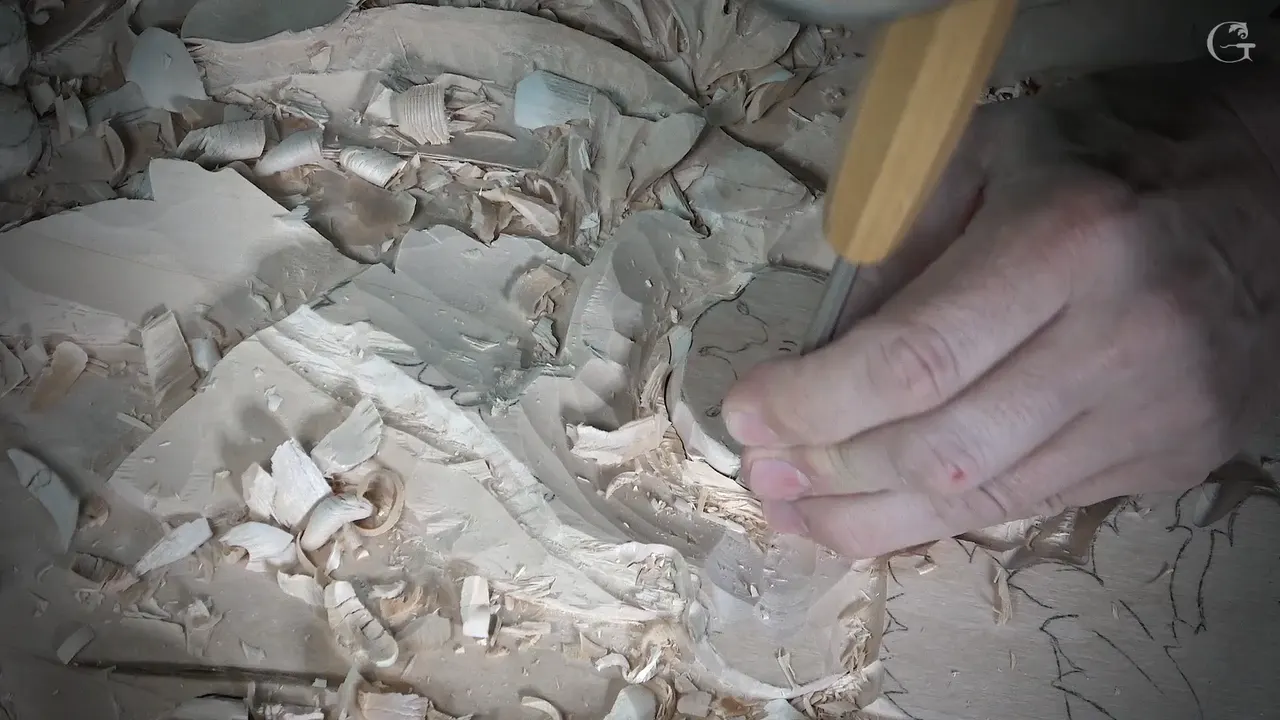

The voice behind me in video 3 of Venice Room 134 is my granddaughter. At 1 minute 41 seconds I say it: "So you hear my granddaughter on the background." Seven seconds later comes the rest: "She's visiting me today. Us, should say, not me."
Ever sat down to a wood carving lesson and heard a small voice somewhere in the room? Then you know the question. I answer it on camera, more than once, and the words change a little each time.
What sound is in video 3 of Venice Room 134?
Short, and fixed as I say it. I started with "me" and turned it into "us." Lesson 153 has the same fix in its first video: "Us, I should say."

Just before it I was talking about the depth of the flower. The tool was a number 7 at 14 millimeters (0.55 in), and with it I planned to clean it. Then came the figure: "about half an inch from the upper part down below" (12.7 mm). I call that good for this type of flower, and it "doesn't have to be bigger than that."
The line before hers is "Attack that from that other side." After hers the captions hold no words for 23 seconds. Back to the wood: "I will have to undercut around, otherwise it's not going to look nice."
What was I carving while she was in the room?
The video opens in the middle of a job. Going around some of the spots is the plan, and the shape need not be completely just symmetrical all around.

Waves come next. "I really like the idea of being wavy when I'm carving flowers, because you're never going to find any perfect shape in nature, in creation."
The tool is a number 7, and I say its size twice, with an "Oops, you should see that way" between the two.

Later in the video the undercut talk starts. "Some of the areas, I can actually already point inward," I say, "and I can create that undercut effect." My own words give the why: "I need to make it feel like it's growing from inside, from the middle, just like that. Okay? Just like the real flower."
A maybe follows. Probably I can do some of that undercutting right away, before I even work on the petals.

Waves come back, and so does the word perfect. Waviness is "only plus," I say, and nothing in nature is a perfect shape. A turn comes right after. "It depends what you mean by not being perfect," I say. Then: "By Fibonacci sequence, it's still going to be perfect."
A number comes next, and with it a sorry for what you cannot see. "I've got quite deep undercut. I think about five millimeters, I'd say" (0.2 in). "Apologize you don't see it," I say, and the next words are "five millimeters, that's what I've got inward."

Then a number 7 hits "just with the corner." It goes around, removing "excess material" and I ask you to look at the shadow it casts: "really, really deep and beautiful." One millimeter (0.04 in) could probably take the wood left over.

"It looks like I attached that piece separately, but it's not." Then: "It's still the same piece." And then: "But it's going to look beautiful once it's done."

The next part is a plan for the middle. I want to excavate. One area is meant to be really wavy, and that part is meant to be lower. For a plug cut I name a number 9 gouge: "in this case, I could use the 20 millimeters, three-quarters of an inch." Of the work itself I say, "I get really close to the design."

"There you go," I say. "And I've got my center. Right now, the center is approximately five millimeters or so" (0.2 in). A second figure follows: "I could go about six millimeters, about quarter inch. But five millimeters is also good. But it's not the end yet."

The edge comes last, and I plan to chop toward the center. Right after that plan: "It's going to be a lot easier for me later on."
Why don't I stop the camera?
This video gives no reason, but other lessons do. In the first video of 153 I had said I would blend with a number 2, "maybe 10 millimeters" (0.39 in), and round the piece from both sides. A question comes: "Do you hear my granddaughter in the background?" An apology for the distraction comes next, and my answer comes: "But I don't want to stop recording because I really need to do my work."

A little later in that video I say, "Yes, I could blend it a lot more, but preliminary it's okay." Taking a ridge out comes next.
Lesson 60, video 5, says it in fewer words. "I think it's pretty close," I say, though the tool is "a little too big." Please excuse "the screams on the background," I ask, and I will not stop filming, because I really have to work.

About half a minute later I look at a concave. "I kind of like it, but I don't," I say, followed by "I think this concave is just too much of a spooning."
Over in Venice Room 26, video 9, a number 11 at 12 millimeters (0.47 in) is ready to excavate, after I say I could do "a little deeper concave right here." "What you hear, it's my granddaughter on the background," I say. I call it "a back voice" and add, "My apology." I don't want to stop recording just because she is having fun, I say. I correct myself to "not having fun."

Work comes right back: "I am actually giving really good concave, really beautiful spoon effect going upward just like that."

Look at lesson 120, video 1: I talk about a future leaf and say I put no details in it. My plan is to point the tool one way and excavate underneath, "probably" from two sides. Then comes the sound, and a shrug: "But it is what it is." I keep recording. That day she is visiting us. Soon after: "And yes, I am all the way through."

My longest answer is in Lily Box 11, video 9, a lesson about the lily flower. Some of you are probably a little bit frustrated, I say. I apologize for the background noise. The answer follows: "that is no excuse for me not to record, because I have a lot of stuff to do, and it takes time, and I can't wait until everything is perfect."

Furniture Panel 16, video 7, adds a short one. After "See? Really nice and clean," I open with an apology for the sound. A lesson will not get skipped over the sounds, I say. I close with "Please accept my apologies." A little later: "I can see a light at the end of a tunnel. It actually looks like something now."
What do I say to you when you hear her?
Apologies come in different words each time. Video 9 of lesson 13 has "So my apologies if it's distracting a little bit." And lesson 78, video 5: "So my apologies if it's bugging you."

Back in lesson 13 I am deciding something while I say it. Before the sound: "Maybe yes, maybe no." Straight after, I say I want to think what the best move is, I'm not sure whether I should, and "I'm still debating about that detail."
Venice Room 77, video 7, goes the other way and asks you to take it. I say I picked smaller tools: "Sometimes I think it's safer to use smaller tools." Lighting comes up too: I ask for "a little better lighting." The sound will be there, "so please accept that as a reality" and it should not be very noisy, "but still, you're going to hear her once in a while." Smaller tools will probably take a little longer, I say, but on the other hand it could be much safer.
The Floral and Molding course, lesson 8, video 3, names a second child. "What you hear on the background is my second granddaughter," I say, and she was there that day. Next: "So please accept the noise in my shop." Before it I said I would attack something from one side, "carefully."
Back at Venice Room 10, video 11, I had said I keep an eye on all the lines and want to avoid making the piece too parallel. I also say this separation "will work really well in this case." After that comes: "I apologize for my granddaughter in the background. If you're catching up, you know the sound." Following that: "That is a good separation, but I need to create an eye."

She gets a number in lesson 78, video 5. I plan to finalize with some concaves, and they "don't have to be really deep." They are just for the shadow. Her age is in there: "She is almost two years old." The next lines: "She is visiting us today. Well, almost every day right now." The piece itself comes next: "See how it looks? And that's going downhill."
Two lessons give hardly more than a mention. In lesson 87, video 1, I am weighing a hole through the piece: "Maybe, I don't know yet. We'll see." A sentence breaks off: "That is my granddaughter." Next I name a number nine for a section. In lesson 90, video 4, I name her once more with a plain "And yes." About half a minute later I give a depth, "about six millimeters" (0.24 in), "so I should be safe."

Before that sound I said I had to be "really careful not to hit this line because it would be big mistake." Afterward I name "10 millimeters, number 11," for a little deeper excavation.
Over in Furniture Panel 19, video 11, I give it one plain line, "And yes, on the background" and then her name. Earlier I said it was maybe safer to outline with the help of a mallet, "Because mallet is always more control." Later: "you can see I'm barely hitting my mallet."
How does it sound to me?
It sounds different to me than it may to you, and I say that too. The panel lesson 16 gives "just like music for me." I understand it may bother some of you: "it could be a little distracting."

In Lily Box 9, video 4, I say: if you can hear her, please, she's visiting with me today. Then comes: "That makes me happy actually to hear her." Just before, I wonder about "even straight 1 millimeter" (0.04 in). A smaller spoon follows, a number 11 and half a millimeter, and "see how tough it is underneath." The spot is "a really, really tough area right now" and my answer is "What can you do?"
Video 6 of lesson 13 says you are hearing her, "which is a good thing." Next I plan to use a number five and chop a little. In video 9 comes a plainer line: "But she is my granddaughter and really important."
That lily box lesson gives the most. "For those of you who's grandfathers and the fathers, you know it's not a big deal at all." And a "real joy to have children around and grandchildren." And: "I guess I can say it's one of the biggest blessings in my life."
"I'm not that old, but I already have a grandchild," I say. "Beautiful grandchild, granddaughter." Then I stop myself: "And that's just off subject. Let's concentrate on carving."
Which lessons have her, and what was in my hand?
| Where you hear her | What was in my hand at the time |
|---|---|
| Venice Room 13, videos 6 and 9 | I named a number 5, planned a 3 millimeter number 11, and was still debating one detail |
| Workshop 26, video 9 | Number 11, 12 millimeters wide, about to excavate a deeper concave |
| Venice 77, video 7 | A 5 millimeter tool, picked because smaller tools can be safer |
| Lily Box 10, video 9 | Number 5 at a quarter inch, giving some roundness |
| Furniture Panel 19, video 11 | A mallet I was barely hitting, for the outline around one part |
Then Lily Box 10, video 9, has the same sound. You probably hear her on the background, I say, and "she was visiting with me again." Before it: "I'll use a number five and a quarter inch" (6.4 mm), and "Give some roundness." Afterward: "create little more space for myself to work."
Ever put off a job because the room was not quiet enough? In the lily box lesson I say I can't wait until everything is perfect. All the videos for these relief panels sit inside one tuition plan, and lesson 134 is where this page starts.
How it's done
- Say who it is. Lesson 134 names her as my granddaughter, then fixes "me" to "us."
- Say sorry in a few words. Lesson 13 has my sorry in one short line.
- Keep the camera on. Lesson 153 gives my reason: my work has to get done, so I keep recording.
- Go back to the wood. In Lily Box 11 I say, "Let's concentrate on carving."
Frequently asked questions
Who is the voice in the third video of lesson 134?
My granddaughter. I name her at 1 minute 41 seconds, and then I fix "me" to "us." Before that I said I used a number 7.
Do I stop recording when she makes noise?
Lessons 26, 60, 120 and 153 each say I keep going. Lesson 153 gives my reason as work that really needs doing, and the lily flower lesson says I have a lot of stuff to do.
What do I say to the people watching?
Lesson 77 tells you to take it as a reality, since you will hear her once in a while. Lesson 13 calls the sound a distraction and apologizes. Floral and Molding lesson 8 asks you to accept the noise in my shop.
What to carve next