
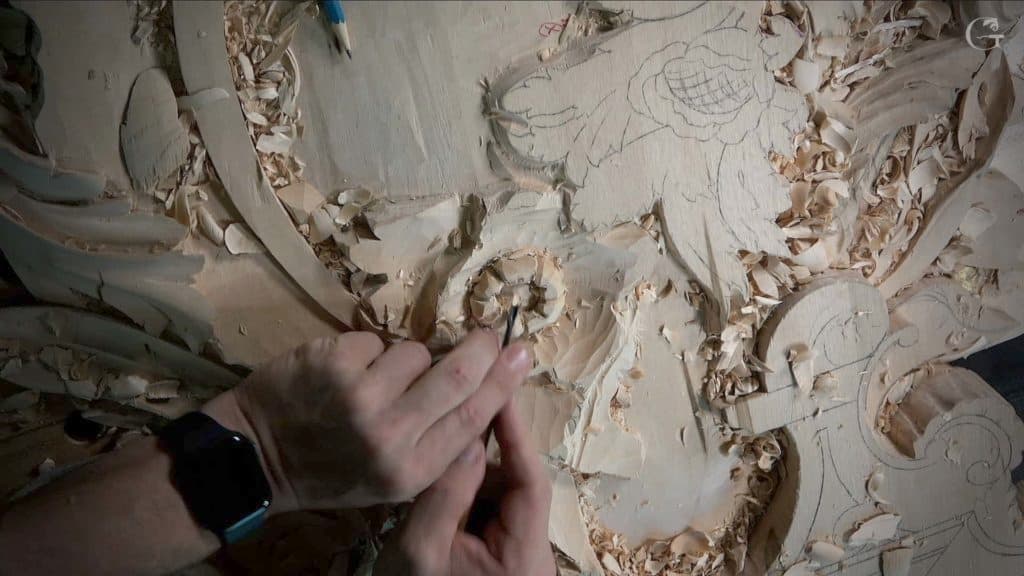
Alexander Grabovetskiy, woodcarver, School of Woodcarving · Published 2021
What does a wood carver mean by "step backward"?
Quick answer: In the second video of Venice Room 135 I say step backward right after an inward concave, and the next words are about a first concave. In other lessons I use backward for passes, rolls, twists and curls, and for a back bend gouge.
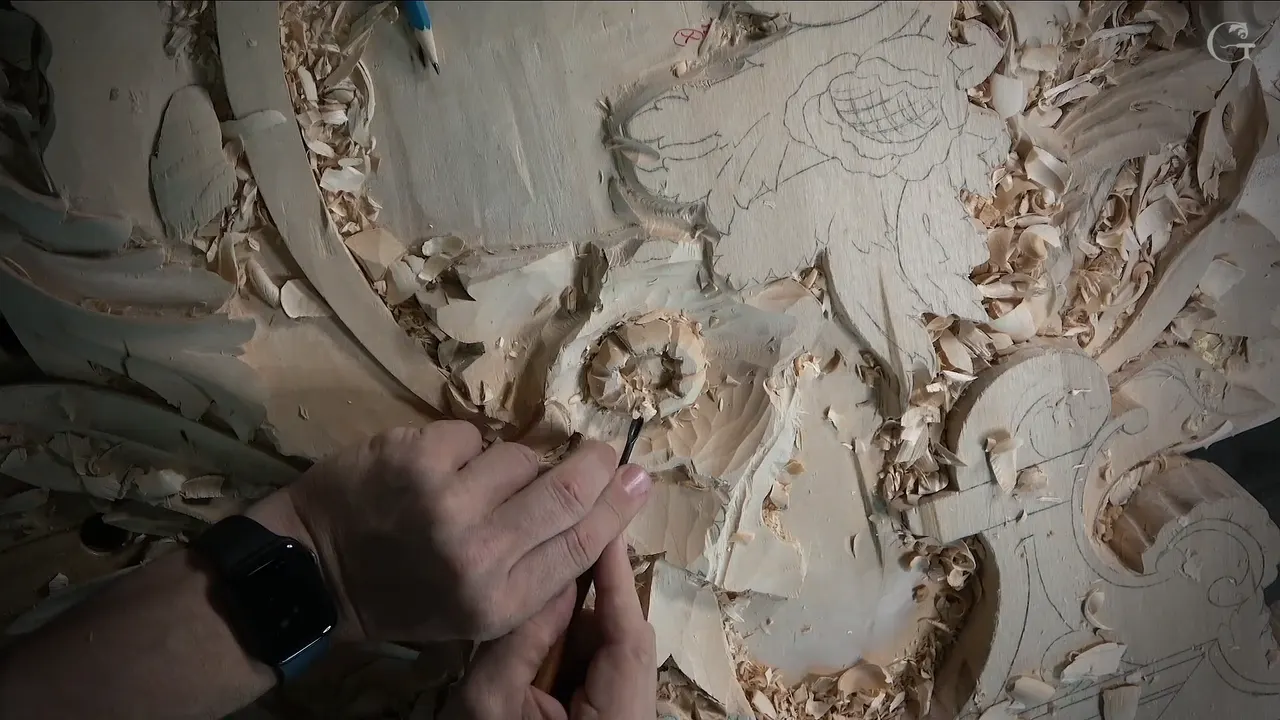

In video 2 of Venice Room 135 I tell you "I'm going to step backward and create opposite direction, toward myself" and the next thing I say is "that would be my first concave." That video goes below in my own order. After it, the word backward follows me through other courses, where it can mean a pass, a roll or even a gouge.
Ever finished one hollow on a carved flower and wondered whether the next one should run the other way? Do you want to follow my hands after the first pass has gone inward? Then watch the tool. Here is where I said backward, lesson by lesson, in this course and in my other ones.
What happens in the second video of lesson 135?
The video opens with "Okay, that is good." My plan comes next: "it does not have to be perfect, and I don't want to see it really perfect." Next: "I need to make my divisions now."
I count them off, "one, two, three, four, five" and settle on "five divisions." I don't want them on one level, I say, and "it's still going to be just some underneath of others." The plan for one side is "little bit pointing in" and "this side can go slightly underneath."

Then comes a line about the pattern. "And it doesn't have to repeat everywhere else," I say. "So this side could go underneath of that part also. So it doesn't have to be exactly the same pattern, otherwise it's just not going to look as natural."
I use "number seven" at "14 millimeters" (0.55 in). What I want from it is "really good shadow." A part can go "even lower to bring that shadow," I say, and then I fix my own word: "To create that shadow, not bring that shadow."

Of the result I say "it just gives more beautiful feel, I would say." I say "let me rotate" and then "underneath of this guy. And same right here."
Where does the first concave go?
"We don't have yet any concaves and convexes," I say, so "let's start on those." My choice of tool is a plan: "probably still number 11, I would say, maybe about five millimeters" (about 0.2 in).

"Let me start with the extreme one," I say. Then: "I can probably create concave right here." Two turns are planned: "also inward concave" and then "I'm going to step backward and create opposite direction, toward myself. Okay, so that would be my first concave."

Close to a little detail with some dip in it comes another concave. "I can also bring that all the way like this," I say, and again "I can go inward. Okay, that is good."

Another concave goes "right in the middle." I think it will "look much better" and it will be "somewhat deeper concave," again "going little bit inward." After that I plan to blend it out.
"And right away, I could create blending convexes. Blending convexes, so I can blend pretty much whatever needs to be blended." Then: "just blending."

How much time do I give the blending?
"And yes, of course, I can always get number seven and refine the movement, like overall movement and so nothing wrong just to spend time and create more beautiful shape. I just don't have that luxury of time."
For the finish, "just to indicate the main movements" is the plan, and "probably blend everything maybe off camera." Smoother is what I mean: "Make it smoother, I'm talking about, okay?"
I look back, too: "Especially I already spent a lot of time with the flowers on Hashemi flower project. So I did lots of detail work right there."

My last plan in this video is one more concave, and "let me try to get to it." And "I can go outward and blend it and maybe create little convex."
What do I say as video 3 opens?
"Even if I have next to it also going underneath." The next one gets a thought of its own: "So let's think the next one. I can also do somewhat big concave right in the middle, or bigger concave in the middle. I'll take number nine." Beside it, "I'll just do concave on the side. Maybe another one like this."
Next comes a look back: "So let me think how it looks. And in overall, it does look like what I wanted to see. I'm talking about the middle part." And "of course, it's far from perfection yet."

When do I move backward with a pass in other lessons?
Hashemi Flowers 10 has it in video 10: "Now I have to remove or gradually actually move backward, moving like this." I add "Let me actually excavate a little more" and then a warning: "That is across the grain. Not the smartest way to do that. But with the sharp tools, it's still possible."
One section has to "make a full twist on the inside, then go backward and just follow this movement," I say in video 1 of Hashemi Flowers 14.
The same lesson gives a tool and a size in video 2: "I'll take number eight. 10 millimeters" (0.39 in). Then "make a smooth transition going backwards. Later on, I will clean that from the backside, but for now, should look good."

Chamomile and Bow Rosette 2, video 1, has a twist I cannot show: "Doesn't matter what side I show, it still doesn't show what I'm doing. But anyway, so that is just a twisting backward."
A rosette lesson has it too. Chamomile and Bow Rosette 3, video 3: I say "I'm pretty sure they're going to be slightly off when they're going to just meet each other." My step, I say, is to "just go backward and go that direction." Then: "And that is a good spot to hide inconsistency."
Venice Room 53, video 8, gives such a pass a name: "You start usually right there and go all the way, but I'm actually starting at the end and moving backward. Like a lobster movement, backward. So we can call it lobster cut."
And then: "And after I created multiple small cuts like that backward, I can go back and create normal cut. Although I should probably use a smaller tool to do that."

Venetian Flowers Rosette 6, video 2, wants a smooth transition: "I have to also roll it backward to make it smooth transition."
A roll comes in video 6 of Venice Room 48: "Maybe I could actually roll it backward." Next: "That's still going to give me the full motion of the middle line."

Then Venice Room 41, video 9. I plan to "slightly rotate backward like this, okay, because I don't want to create too deep excavation at the escape point." Then: "Kind of blends into existing cut."

Byzantine Acanthus 8 has a small roll in the plan: "I want to roll it little bit backward, okay?" And "any flatter tool will work."
Modern Acanthus 4, video 1: "If you want to go a little farther, you can create the feel like it's rolling backward." For tools I say "number 7 and 14 millimeters" (0.55 in). Then comes my own roll, and how far it went: "no more than one millimeter on the camera." That is 0.04 in.
What does a leaf do when it goes backward?
A leap shows up in video 9 of Hashemi Flowers 47: "There is such a thing as a leap backward, and it looks like I am able to make a leap backward." Later: "You can call it curl backward."

A verdict comes in Hashemi Flowers 23: "And I do like what I see. So it looks like it's flipping backward."
One section of a leaf comes up in Hashemi Flowers 12, video 1. The section goes "from underneath, growing uphill, and then curl backward." Next: "I know it's kind of confusing right now, but hopefully, you'll catch what I'm trying to reach."
Ribbons are the subject of video 6 in Hashemi Flowers 13: "So the ribbon has to grow from underneath going upward, then make a flip on its side, and flip backward."
Furniture Panel 14 is next, video 2: "I think I can do some kind of acanthus flipping this way. So it's going to flip backward. All right. Hope it makes sense."
Floral and Molding 9, video 1, has me showing you a curl: "See that curl right here? It just curls backward."
Venetian Flowers Rosette 2, video 3, has a raised part and then a hollow, and I say "this concave is not just a straight concave." Later: "This one goes up and curls backward. Okay? And again, that gives me a somewhat realistic look."
Venice Room 75 has it in video 4: "So, the idea is it has a movement like returning backward like this. Okay? I hope it makes sense."
Byzantine Acanthus 1, video 1, is about a Byzantine swirl: "but it's still a leaf, just a normal leaf. It just twists. In this case, it's going to twist, go that direction, then go up, up, up, up, up, and go backwards."

Take a look at those acanthuses, I tell you in Byzantine Acanthus 6, video 3: "See what it does? It goes that way and goes backward. But there's a different approach how you're going to finish that point. You can go upward, you can go downhill, you can just do it to the side. It all depends how we're going to decide to twist it."
A convex can go the wrong way too. In Byzantine Acanthus 3, video 3, I say "it's no bueno because I've got convex. I would like to see convex going uphill but not going backward." That calls for "much deeper concave on that side."
Last in that run comes Modern Acanthus 5, video 3: "Doesn't make sense. It goes backward. And goes like this. I'm gonna excavate that section little more and roll it backwards slightly, okay?" Then I think it will give "more shadow."

Which parts of a flower go backward?
On layers, Hashemi Flowers 27, video 1: "Every flower has layers also, and the first layer usually goes backwards. So it's like a ring of the petals, which is falling downward, and then rest of them falling upward."
Furniture Panel 5, video 3, has me naming three layers of a cluster: "upper layer, second layer, and third layer going backward just like that."
A possibility comes up in Hashemi Flowers 33, video 3: "What I also could do, I could actually make a flip going upward, downhill, and backward again." Then: "Take number nine and let me create that movement."

Is a gouge ever called backward?
Back bends get the name in Venice Room 76, video 4: "The back bend allows me not to damage opposite side because it just rides above it." Then: "But I can create really deep excavations on inside of those eyes or any other undercutting parts, whatever I need to undercut. That's why I love those back bends or bended backward gouges."
Lesson 135 has the tool too, in video 1 (the lesson page). "At some point, I have to switch to spoon reamer because straight is not going to do anymore, but so far I'm okay." Later: "So now for me, it's time to take a back bend." The one I plan is 13 millimeters (0.51 in), and "it's a number five sweep."
"But I redone it, and I made it like skew." And what the skew gives me: "I can actually get with this corner really, really deep. See how deep I can go? Really deep."

Which lessons said backward, side by side?
| Where | What I said about going backward there | Lesson |
|---|---|---|
| A pass | Gradually move backward, across the grain, not the smartest way | Hashemi 10 |
| A meeting spot | A good spot to hide inconsistency, I said there | Chamomile 3 |
| Small cuts | Move backward in small cuts, and call it lobster cut | Venice 53 |
| A roll | Rolled slightly, no more than one millimeter (0.04 in) on the camera | Modern Acanthus 4 |
| A curl | See that curl right there, I said, it just curls backward | Floral 9 |
| A twist | Up, up, up, and then backwards | Byzantine 1 |
| A convex | Uphill is what I wanted there, and not backward | Byzantine 3 |
| The first layer | Usually goes backwards, like a ring of falling petals | Hashemi 27 |
| A back bend | A gouge I love for deep excavations inside the eyes | Venice 76 |
Which way does the next hollow on your board run? Every lesson named on this page opens with full access to the school. All of it is wood carving. Workshops 132 to 143 live on the Part 12 course page, with lesson 134 just before lesson 135 and lesson 136 just after it.
How it's done
- Mark five divisions. Lesson 135 has me counting one to five on the flower, with some divisions going underneath others.
- Pick the first spot. I said I would start with the extreme one, probably with a number 11 at about 5 mm (0.2 in).
- Turn the pass round. In video 2, an inward concave came first in the plan, and then the opposite direction.
- Blend the convexes. Blending was the plan for the convexes, and I said just blending.
- Indicate the main movements. I planned to indicate them and to blend everything smoother, maybe off camera.
Frequently asked questions
Where did you say step backward in lesson 135?
Video 2 has it, right after an inward concave on that middle part. The exact words sit in the first paragraph of this page, with the line that follows them. A back bend of my own comes in video 1.
Do you ever carve a pass backward?
In Hashemi 10 I said I have to gradually move backward. In Hashemi 14 the plan was a smooth transition going backwards, with the cleaning left for later. Another lesson names one such pass, lobster cut.
What is a lobster cut?
My name in Venice Room 53 for moving backward in small cuts. After those, I said, I can go back and create a normal cut, though I should probably use a smaller tool for it.
What to carve next
- Part 12 course page
- Venice Room 135
- Venice Room 134
- Venice Room 136
- Hashemi Flowers 10
- Hashemi Flowers 14
- Chamomile and Bow Rosette 3
- Venice Room 53
- Venice Room 48
- Venice Room 41
- Hashemi Flowers 47
- Venice Room 75
- Byzantine Acanthus 1
- Byzantine Acanthus 6
- Byzantine Acanthus 3
- Modern Acanthus 5
- Hashemi Flowers 27
- Furniture Panel 5