
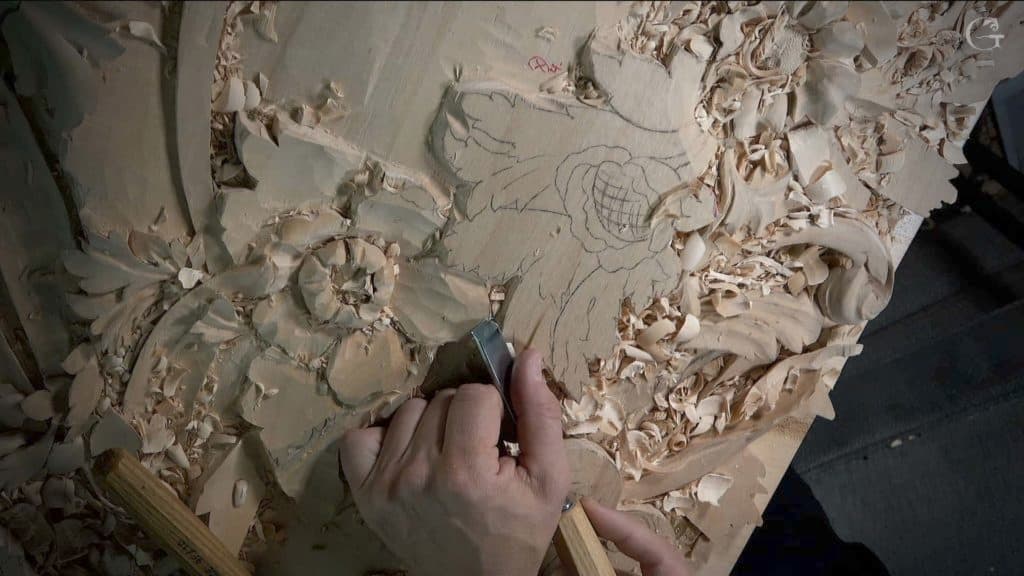
Alexander Grabovetskiy, woodcarver, School of Woodcarving · Published 2021
What does a wood carver mean by "extremely"?
Quick answer: In lesson 136, video 1, I said I could roll a part extremely, then that I thought I would, for a part close to the flower. The word comes back in Lily Box, Hashemi, Furniture Panel and Venice Room lessons beside undercuts, curls and small details.
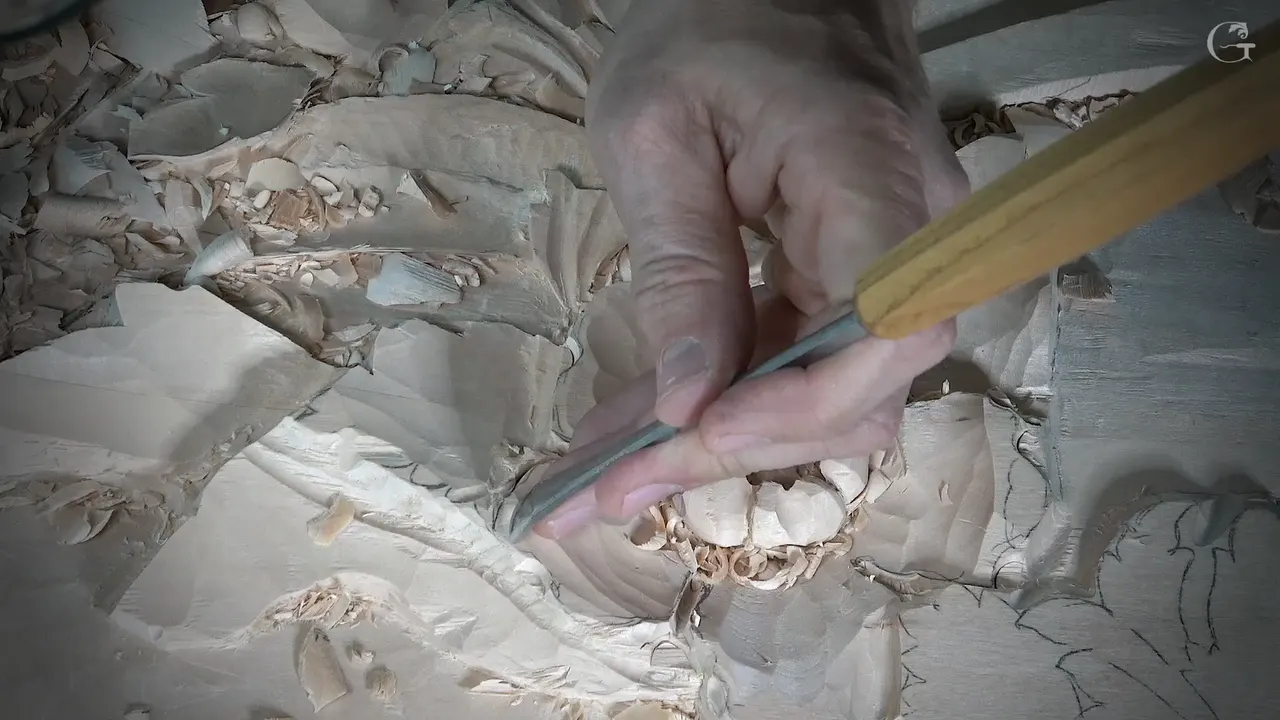

Venice Room 136, video 1, has me saying "I think I'm going to roll it extremely" and the word sits beside a part that is a short distance from the flower. It turns up again in my Lily Box, Furniture Panel, Hashemi and other Venice Room videos, so this video comes first below and each lesson follows.
Ever looked at a curl on a carving and wondered how far the gouge should go? Did you ask if the wood beside it could take that? Then you know the question, and below is what I said at the bench each time the word came out.
What did I say about rolling it extremely?
Two plans sit in video 1. The first goes "But in this case, I could roll it extremely from this point." My reason follows at once. "See how short distance from the flower it is?" I ask. Left alone, I say, "it's just a little off. It just doesn't look right."
Rolled, "it feels like if you're going to stretch those petals, so it's going to be the right shape." My verdict is "Okay. And that's good."

Earlier in that video I name what I want, which is to "slope it different directions." The movement it gives me, in my words, is "a lot nicer movement." A number two will do, and a number three would work too. The size I give is "maybe about 5/8 of an inch or so, or 3/4 of an inch" (16 or 19 mm), held upside down for "some kind of sloping movement."
How far is somewhat extreme on a concave?
Looking at one spot, I tell you "Here looks like I can create a beautiful concave." Next I say "Maybe I could do somewhat extreme one and go downhill like this." The pass ends with "Yep. It looks good." Another concave is next: "Let me get another concave right here."

Later I stop and think. "Let me think first, okay" is how it starts. A moment on, I tell you "I made the decision what I'm going to do." The roll goes "this way" and "I will need to clean everything, of course." For the roll I say "let me get number 11." All the wood around it will be lower too, and that part I can do "slightly later."

Video 2 has the word without the "ly." My line is "let me use number 11 and 10 millimeters, and I'll just go extreme this way" (0.39 in). The tool lies "almost laying flat on that surface." Laid that way, the tool makes it "a lot easier to create the true rolling feel." And "I can always undercut from this point."
A warning sits in the same lesson. "I have to be careful not to overdo it," I say. Extreme and careful share the lesson, and that pair comes back below.

What did I mean by going extremely underneath?
Lily Box 3 (video 3) is the plainest case. My pick is a tiny number three: "with the smaller tools, like a tiny number three, you can go extremely underneath just like that." After it, number 11 can "remove the waste I just created underneath." What I made, I tell you, is "really deep shadow casting, and I really like it."

Furniture Panel 20 (video 11) has a number 11 at half a millimeter (0.02 in), and I "continue my undercutting even deeper." A mallet is in my hand right now. Here I say "I can go really extremely underneath." A caution follows straight after: "But still, got to be careful, even if I'm doing extremely deep." Of the shadow I say "that just creates beautiful shadow." I do not want those two cuts to meet: "That would be a big mistake."

In Furniture Panel 21 (video 1) a 1 mm tool (0.04 in) gives "extra depth" and I say "I can get extremely underneath and start undercutting right away pretty much." One limit comes with it: "But not all the way yet because we still have to establish overall movement right here."
Over in Carving Hashemi Flowers 7 (video 2), I call it probably "one of the biggest secrets, how I undercut really extremely and working from the backside of it." The next line reads "Work upside down against the grain."

Venetian Flowers Rosette 4 (video 3) puts numbers on it. "I was using about half an inch" (13 mm), I say, and smaller works too: "maybe about 10 millimeters, three-eighths of an inch, and go extremely underneath." Smaller yet, "maybe a quarter inch" (6 mm), goes "even more on inside." The payoff is "a really, really beautiful shadow."
Short and plain is Chamomile and Bow Rosette 2 (video 3). "You can excavate really extremely if you wish," I say. The line after it is "If you do have small tools, then that's going to look nice."

Why undercut extremely when the part is only 1/16 inch deep?
I put that question for you in Hashemi 7 (video 1). "You would ask me why would I undercut extremely," I say, over a flat part "no more than maybe 16th of an inch deep" (1.6 mm). I add "I think I could actually go even more extreme right here."
The answer is "easy." It reads "It's all about lights and the shadows, okay? That's the simplified version of my answer. Just the lights and the shadows." Light that travels behind will "create a shadow," I say.
When did I say not to go extremely?
Plainly said in Venice Room 22 (video 8): "I don't want to excavate too extremely." Some jobs call for it, I tell you, such as "a really complicated flower composition" with people looking really close. This job does not. "I don't really need to do that in this case."

Next, Furniture Panel 22 (video 3). I want "as deep as possible shadow" and I add "But not extremely, okay?" A "weak point, just to cast a shadow" is what I will not create.
Beside "one 16th of an inch overall" (1.6 mm), The Tray of Blessing 7 (video 3) has "you just kind of undercut, but not extremely" and "otherwise it's gonna pop out." For a V cut in Carving Hashemi Flowers 40 (video 1), I tell you I can "right away pretty much undercut, semi-undercut, not extremely, but undercut."
Close to a line, "see what the grain does," I say in Furniture Panel 17 (video 5). "You really don't have to do extremely, just little by little." Next come the words "you can get really close to the background pretty much, much quicker."
One edge in Lily Box 12 (video 6) gets "Extremely to the edge." After it I say I do not want it paper thin, though I love paper thin if it is "just on the wall." The reason for the edge reads "I still have to have some thickness at the edge."

Is it still extremely when the details are tiny?
"We're talking extremely small details, by the way," I say in Lily Box 3 (video 4), and the future thorn is "barely bigger than one eighth of an inch, really small" (3 mm). Later, in video 6 of that lesson, "We're talking extremely small areas" and I say I will use "a half a millimeter to create the channel" (0.02 in).

Smaller still is Lily Box 11 (video 6). "You can take this to extreme if you would use a microscope," I say, of the micro tools. I add "that would look really nice, actually."

Rough starts get the word too, and Venice Room 20 (video 1) shows it: "I know it's just looking extremely dangerous, that I'm cutting a lot out." Then "But see, it gave me a really nice starting point, just like a true half round."
What does extremely do to a curl or a low spot?
A part in Lily Box 10 (video 6) "has to curl really extremely downhill." It needs "a really nice curl," I say, and "that's my concave already pre-established."

A rough patch comes first in Furniture Panel 21 (video 7): "It does look like it's a little choppy right here. But that's okay. We can always fix it." My plan is to "move it extremely and match my slope right here." The result "starts from almost nothing." It also "carefully blends in to the sloping motion."

I say I will use a number nine at a quarter inch, about 6 mm, in Furniture Panel 19 (video 3). I have "right beside that deep spot, which is also one-eighth of an inch" (3 mm), "so it's easy for me to see the depth, so I can eyeball it. I can actually go extremely low."

Carving Roman Acanthus 16 (video 2) hands the choice to you. "It's up to you how extremely you want to go, how clean you want to see this one," I say. "So there is no limit, actually."

Who says to undercut that extremely?
The use of the piece decides, and I say it both ways. On this, Venice Room 49 (video 10) has "It also depends how this piece is going to be used." Then comes "hit every day by people, absolutely you don't want to undercut that extremely because it's becoming too fragile." And "But on another hand, when you do an extreme undercut, it looks much better."

Lily Box 6 (video 9) takes a piece of art on the wall. It will not be touched all the time, so "you can undercut as extremely as you wish." A lacquer or shellac finish comes up. For shellac, "dilute a shellac as much as possible by using spirit and penetrate multiple times" and it will "bind all those fibers on inside" and "hold really long."
Two lessons talk about time. In Venice Room 52 (video 10) I put it this way: "If you don't undercut extremely like I do, it's a lot easier to cut straight, just a little angle it like that." And "it's still going to look beautiful." Next: "it's much faster process if you don't undercut extremely, quicker production, but you still get the same money."
Roman Acanthus 16 returns to it from the other side. On historical pieces, I say, "People actually didn't even worry about that deep undercut or extreme undercut" and "it's just a lot quicker not to undercut extremely." After that comes "It wasn't by design." Another line, from Venice Room 47 (video 12), says "in wood carving, when you're doing a extreme undercut, actually looks really good." stone carving is "different story" there, and "you can't undercut too much with the stone carving."

An option is open in Hashemi 48 (video 6): "I could extremely undercut this way and actually connect two sides." My doubt is "I'm not sure if it's a wise idea or not, but that's going to give me more shadow again." Hashemi 46 (video 3) gives "I really like this petal because I can actually really extremely undercut." My next tool, I say, needs to be "bigger, 3/16 of an inch, five millimeters" (0.2 in). Video 2 of that lesson holds the other side: "I'm not sure how extremely I should go on inside" and "Not every petal is supposed to be curling that crazy."
Do I use the word when I sharpen?
Sharpening in Maine (video 2) has it for a bevel. A question about a micro bevel comes up, and my answer is that some of my tools are "so extremely low bevel" and the point would be weak. "On all of my tools, I put micro bevel."
In video 4 I give a measure: "a really good rule, if you just get about three-eighths of an inch, about 10 millimeters, you will be safe." The edge and the heel come next. And "Some of my tools, I'm taking really extremely, even up to 20 millimeters, about three-quarters of an inch" (0.79 in).
Where did each of those sit?
| Lesson | What sat beside the word | Tool |
|---|---|---|
| This lesson | A roll made with the tool laid down along the wood | Number 11, from video 2 |
| Lily lesson 3 | Deep shadow casting from underneath, in video 3 | The smallest tool named |
| Flowers panel 20 | An undercut under the mallet, with a warning in video 11 | My number 11 again |
| Acanthus panel 21 | Extra depth, with the undercut left for later in video 1 | A 1 mm tool |
| Rosette 4 | A curl, for a beautiful shadow, in video 3 | Smaller and smaller |
| Lily lesson 12 | An edge that still needs some thickness, from video 6 | Not named |
| Background panel 19 | A deep spot beside it, to eyeball the depth in video 3 | Number nine, beside it |
| Maine class | The edge and the heel, from video 4 of sharpening | Some tools |
Which spot on your own relief could use the word? Every lesson named here opens with access to the school, paid monthly or yearly and renewed automatically until you stop it. Lesson 136 lives on the Part 12 course page, with lesson 135 before it and lesson 137 after. The Hashemi, Lily Box and furniture lessons are all wood carving, and so is the Venice panel.
How it's done
- Look at the part beside the flower. Video 1 has me calling it a little off until I had rolled it.
- Slope with a number two. I said I wanted to slope it in different directions, and named a number two, held upside down.
- Pick the roll. I chose to roll it and named a number 11 for the job.
- Lay the number 11 flat. In video 2 the tool lay almost flat, for the rolling feel.
- Leave the undercut for later. I said I can always undercut from that point.
- Watch the high area. I told you I can't be too low because a really high area sits right there.
Frequently asked questions
Why did I want to roll the part near the flower?
Left alone, it looked a little off to me and just didn't look right. Rolled, I said, it feels like stretching those petals, which gives the right shape. That was my whole reason, with the flower close by.
Which tool took the extreme roll in video 2?
A number 11 at 10 millimeters (about 0.4 in), laid almost flat against the surface. Done that way, I said, the rolling feel comes a lot easier, and I can still undercut afterward.
Can you undercut a carving extremely?
For art on a wall, I said in Lily Box 6 that you can undercut as extremely as you wish. For a piece people hit every day, Venice Room 49 has me saying absolutely not that extremely, since it becomes too fragile.
What to carve next