
Alexander Grabovetskiy, woodcarver, School of Woodcarving · Published 2021
What does a wood carver mean by "to the edge"?
Quick answer: In lesson 136 of the Venice Room, video 2, I turned down a boat technique and said the hollow goes to the edge. The words come back in Hashemi, Roman acanthus, Greek acanthus, furniture panel and Venice Room lessons, sometimes with a reason to hold back.
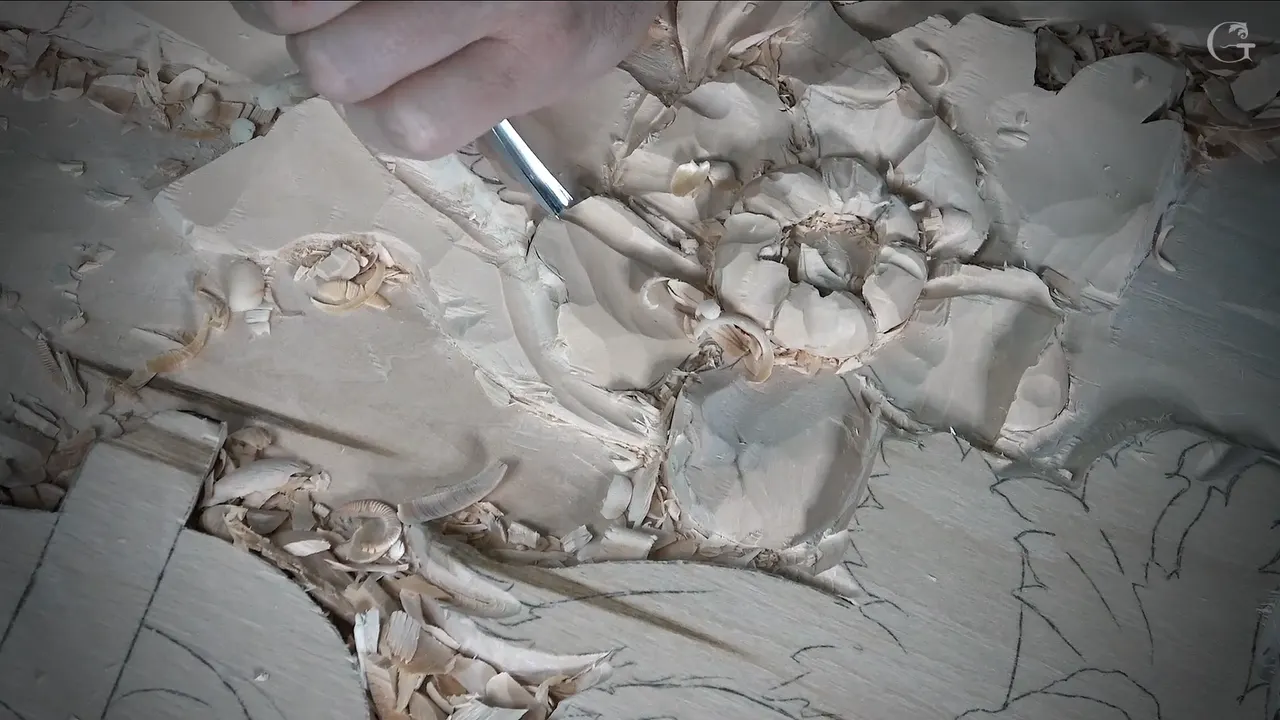

In Venice Room 136, video 2, I pass on a boat technique and say the hollow on a flower has to go to the edge. Other lessons carry the same idea. In several of them I say to hold back.
Ever drawn a hollow across a petal and stopped to ask where it should end? Is the edge rough, or too close to the line? Then you know the spot. Below is each place I said it, and what was in my hand.
What was I doing when I said it in lesson 136?
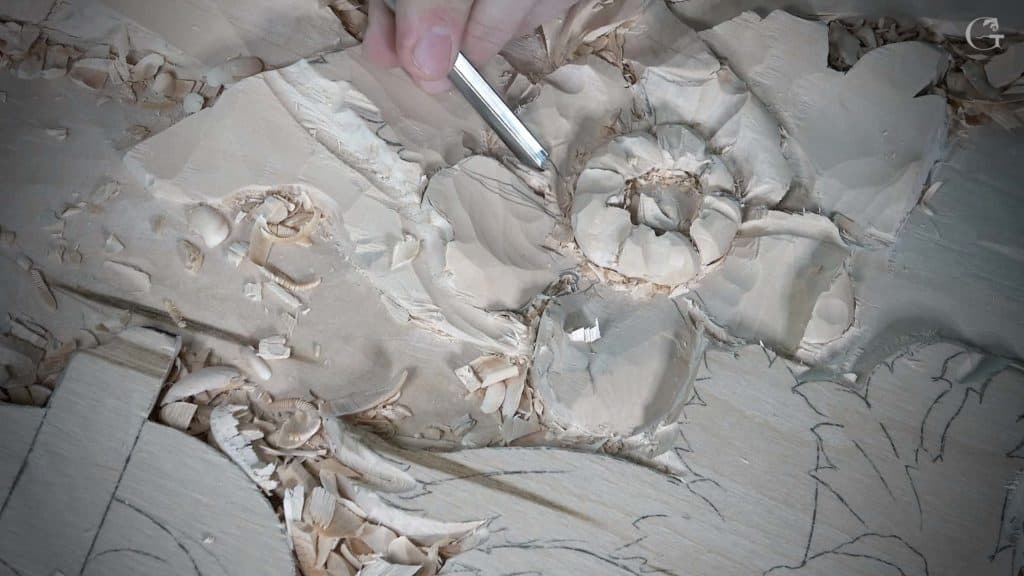
Working a flower on the Venice panel. In this video I said I wanted to roll one part upward, and my plan was a number seven upside down for "that rolling effect." The part "doesn't have to be plain," I said, and without some concave "it's not going to look nice."
Soon after that I named a number 11 of 10 millimeters (0.39 in): "I'll just go extreme this way. Almost laying flat on that surface." My reason is in the next line. "That way, it's going to be a lot easier to create the true rolling feel." And one more, "I can always undercut from this point."

What came before the edge in that video?
The eyes did. To get the plug cut inside them, my plan was a number 8, "a small tool." Then came "This one is a little too big." So I said "let me grab maybe two millimeters if I can fit that two millimeters right there. Or maybe even three millimeters." The verdict was "Yep, three millimeters will do" (0.12 in). Whenever I see my eyes, I said, "that's just for the sake of the shadows." A line about convexes follows: "Whenever I see an eye, I have to create some kind of convexes." Concaves came up too, since "I can create some concaves." The size I named for those was "maybe five millimeters" (0.2 in) in a number 11. Then "Maybe that is little too small," I said, and "I'll take probably number eight."

Which technique did I turn down?
Just one. "And yes, I'll go from the edge," I said. Here is the technique I turned down: "I don't want to use what we call a boat technique or spoon technique, when you just start from the edge and dig this out, so it's not going to look as organic."
And then the words this page is built on: "So it has to go all the way to the edge."

How does the next video of lesson 136 put it?
Video 3 has a softer line. I look at the piece and say "By the way, I can see that I could use another concave on this one." The spot is "Maybe somewhere right here." Then "It doesn't have to go all the way, but somewhat." My plan is to turn the tool over, "let me use upside down this side," to "Create the convex and blend that."
Is every hollow taken to the edge?
Hashemi flowers 1, video 4, shows me holding back. "This is number nine and about an inch and one-eighth" (about 29 mm), I say, and soon the edge "is still kind of rough." My plan is to leave "about maybe eighth of an inch for now" (3 mm). I add "I'm talking about the edge and my cut." Further on comes a note on the grain: "Keep an eye what the grain does, and if you have to change the direction, just do it."

A worry sits ahead of the same choice on the Venice panel, in Venice Room 79, video 10. "Something just bugs me," I say, and "It feels like I'm doing some kind of mistake." After "so that's why," I am not taking it to the edge. Deep in one spot, not too deep in another, is the plan.

A pass in Venice Room 100, video 1, is "initial undercut," I say, so it does not have to reach the edge yet. Later it will. Then a turn: "In some of the spots I'm actually able to do it."

Beads come into Venice Room 57, video 10. I plan to stay a little short of the edge, a gap of 1/8 in (3 millimeters), and "everywhere else, about three millimeters away." That line will be my boundary.
How much wood did I leave in the Roman acanthus lesson?
A small strip. In Roman acanthus 11 I am leaving "from the top of my pipe to my cut right here, about 3/32nds" in video 2 (2.4 mm). A reason follows a moment later: "later on, I'm going to show you a really nice, unique movement that they used back then." Next I tell you to stay short of the edge. "This is the edge right here," I say. Then "Just leave some material between your cut and the top of the pipe." And "It's really important, actually."

Video 3 gives a number. I left "about eighth of an inch between the edge and the concave cut" (3 mm), I say, after a number 9 of a quarter inch (6 mm) and before a number 5 for the blend. My own explanation: "my undercut is going to be extreme" and the edge will be "really sharp like this."

When did I say I could bring it to the edge?
A number 7 of 14 millimeters (0.55 in) opens Venice Room 77, video 6, and the shape is supposed to come from the same stem. From the backside, I can excavate, I say, and then "There you go." Next is "almost to the edge." After it I add that I could do it to the edge, no problem.

Later in that video I look over what I made. "We can do better than that." I need to "move opposite direction" and then comes "take it with the number 7" to the edge. A few shapes could follow, I say: "create some convex and concave on inside," "like two, three."

In Venice Room 13, video 6, I say I need "the 3 millimeters first, number 11" and "just like that from almost nothing." I can bring it to the edge, I say, and "I'm talking about this edge." About that: "It's going to give me a really nice shadow." A 1 millimeter could then continue the carving even deeper underneath, I say.
The wood helps in Venice Room 23, video 1. "The grain right now works in my favor," I say, and "I am actually able to bring my concave right to the separation line." Bringing it to the edge like that is possible, I say. A look ahead follows. After I undercut and get rid of this wall, it will look really good, I say.
A bevel comes up in Venice Room 30, video 3. "Number one, but I do have a much longer bevel on this one," I say. Taking it to the edge is possible too, I say, "and still maintain a really strong wall." "You don't really see what I'm doing, but it's just little undercut and a cleaning," I say of the work there. Next, "I'm going to take it on an angle."
A smaller version sits in Venice Room 17, video 3. Two distances look "a little too close," I say, and "it's not the way it's supposed to look." Then "Let me use also a little concave right here." Reaching the edge is possible if I need to. For the junk I see there, the number two could clean it.

And in Venice Room 22, video 9, my concave is going to fall "right in the middle between those." It ends at the edge, and "This edge is going to stay high." A number 9 of 10 millimeters (about 0.4 in) is my plan, with a doubt: "Maybe it's little too big. We'll see."

What do the Hashemi flowers add?
Hashemi flowers 7, video 2, brings a line about my own work. A little earlier I say "for the light and the shadow." Then "I'm always going" to the edge, I say, and the next line repeats it, ending "to the edge, always." I am working against the grain, and "let me leave it for now."
Then comes the knife. "I could use just a small knife," I say. "Any carving knife will work." Next: "I am using just a micro knife." One last note finishes the thought, "It's still not the final edge, like I said, but still."
The Hashemi flowers 44 lesson, video 3, has a cleaning job. What collected inside has to come out, I say. Then "from opposite side" and "I'll take it" out to the edge. A look from above follows: "let's see how it looks from above" and "I do like it, actually."

Which tool went with the edge?
The sizes change from lesson to lesson, so watch the numbers. Over in Venice Room 9, video 5, I say "Let me get a bit bigger number nine" and "Maybe about 10 millimeters right here" (just over three-eighths of an inch). I really want it at the edge, but not deeper. A spoon gouge comes to mind, with a "maybe."

The Greek acanthus lesson 9, video 1, has a number nine of "10 millimeters" and I add the United States figure, three-eighths of an inch. Going right up to the edge is my plan. Ahead of that I mention a hidden center line that the concave has to reach.

On a furniture panel, in Furniture Panel 20, video 7, I will use a number 6, "a quarter inch" (about 6 mm), "what I used before." My concave runs "to the edge of that slope" and what I get is "a beautiful ridge." Not final yet, I say.

Furniture Panel 23, video 4, puts the concave inside the petals. "I want to give real nice concaves and convexes movements on inside of those petals," I say, with "the different number eights and number 11s." A rule for the middle: "everything's supposed to go to the center point, okay?" Otherwise, I say, it will not look too nice. Next comes the edge line.
Why take a hollow to the edge at all?
Each lesson gives its own line, and I will not make one up for them.
In Chamomile and bow rosette 4, I plan a double concave on a bigger petal of the rosette, in video 2 of that lesson. I will just do it to the edge "because I really tired of that black line" and "Don't want to see it anymore." For the blend, "you're going to need the number 11 and maybe slightly bigger," about 1/8 in (3 mm).

On the vase, in Carving Vase with grape leaves 2, video 7, I describe a run on the surface. "A high point, high reach right here," I say. Then a shape "almost like a convex to the edge." After it come "concave right in the middle, then convex again, then concave again."

A beginner course on a cutting board shows the same care. In Curly Kitchen Cutting Board 8, video 1, I am "just doing straight down cuts just to follow the design." Then I tell the viewer, "Just be careful that your edge not hitting too deep that part." The line about the edge follows.

Can the design itself go almost to the edge?
In Roman acanthus 2, video 1, I say the acanthus design goes nearly to the edge, so I have to work carefully. "It's kind of dangerous what I'm doing, but I have to work from inside out." Of the splitting: "you can see sometimes it just splits the wood." The wood is "an inch and 7/8" thick (about 48 mm), and I am "not that concerned about this."
Where did I say it, and with which tool?
Here are the same lines side by side, with the tool beside each one.
| Lesson | What I said of the edge | Tool named |
|---|---|---|
| Venice 136 | The hollow goes to the edge | Probably a number 8 after an 11 |
| Hashemi 1 | The edge was still rough, so I held back | Number 9, with 3 mm (0.12 in) to leave |
| Roman 11 | Leave some material next to the pipe | About 3/32 in, a bit over 2 mm |
| Venice 22 | The concave runs out to the edge, which stays high | A nine, 10 mm (0.39 in) |
| Hashemi 7 | I am always going to the edge | A micro knife |
| Panel 20 | A concave to the edge of that slope | A six, a quarter inch (about 6 mm) |
| Greek 9 | I will just take it to the edge | A nine, 10 mm (about 0.4 in) |
What does the edge of your own relief look like right now, rough, thin, or ready? Every lesson named here opens with access to the school, paid monthly or yearly and renewed automatically until you stop it. Lesson 136 sits on the Part 12 course page, with lesson 135 before it and lesson 137 after. The other courses live in the Hashemi flowers course, the Roman acanthus course and the Furniture Panel course. All of it is wood carving.
How it's done
- Lay the number 11 low. I named a number 11, almost laying flat on the surface, to get the rolling feel.
- Set the eyes. Inside the eyes, I reached for a smaller tool after one that was too big.
- Name what you do not want. I named the technique I would not use, and gave my reason in the same breath.
- Say where the hollow ends. In my words, the hollow runs to the edge.
- Leave material when the edge is rough. In Hashemi flowers 1 I planned to leave a little for now.
Frequently asked questions
Why did I turn down the boat technique in lesson 136?
I said it would not look as organic. The technique I named was a boat technique or spoon technique, and right after it I said the hollow has to reach the edge.
What size tool did I name for the plug cut in the eyes?
Three millimeters (0.12 inch). I planned a small number 8 for it, and the tool I tried was too big. Two millimeters came up as a maybe before I settled.
How much wood did I leave next to the pipe in Roman acanthus 11?
About 3/32 in (2.4 mm), from the top of my pipe to my cut, in video 2, and I said we are still going to need that material later on. I also called it really important, actually.
What to carve next