
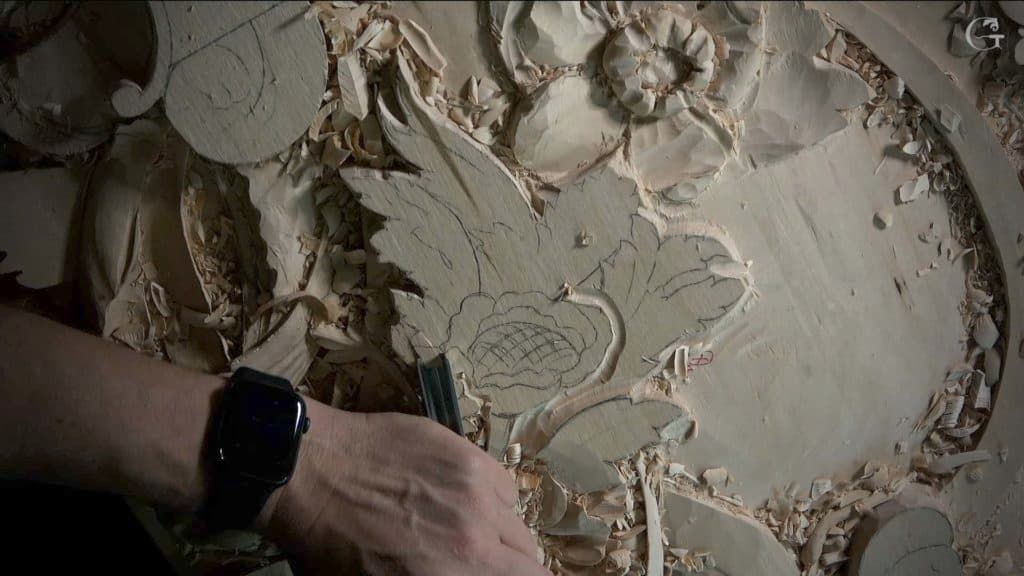
Alexander Grabovetskiy, woodcarver, School of Woodcarving · Published 2021
What does a wood carver mean by "be safe"?
Quick answer: Lesson 136 has me start the outline of a small leaf in video 3, using a number 11 at five millimeters (under 1/4 in), and I said I wanted to be safe. That idea comes back in Venice Room, Greek Acanthus, Moldings, Lily Box and Byzantine lessons, beside a line, a depth, which tool to pick, and wood left in place.
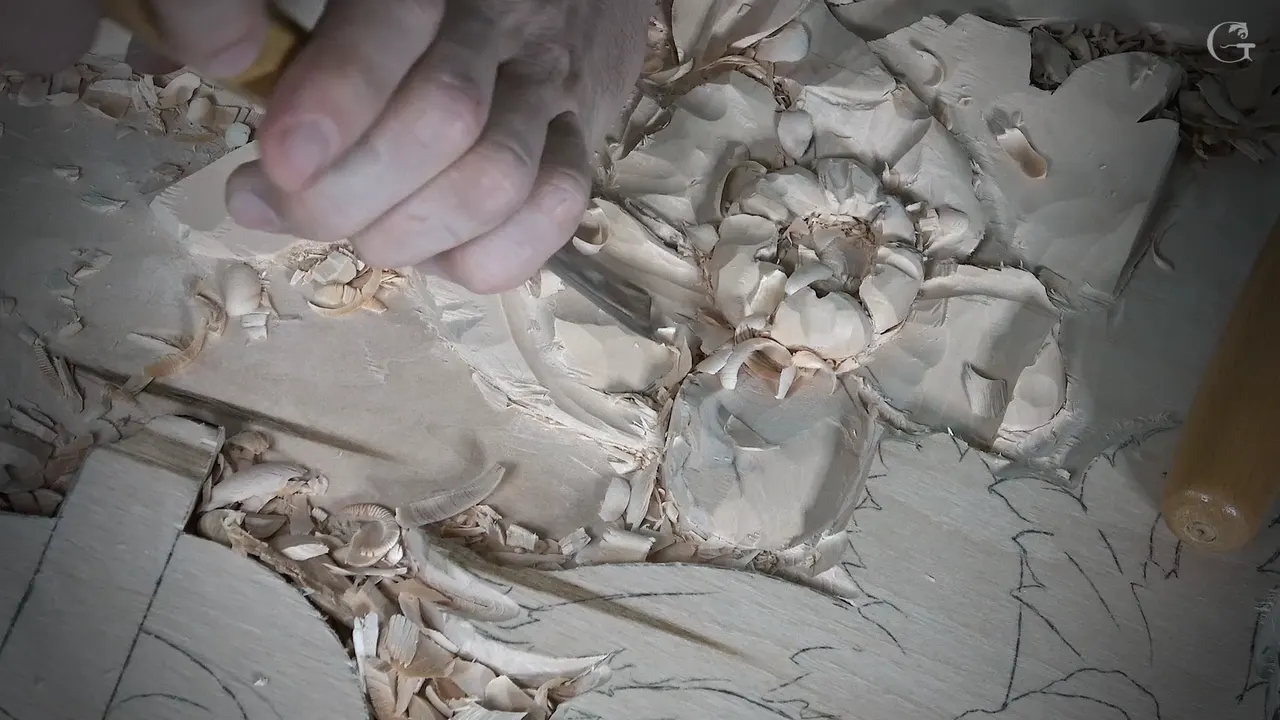

In Venice Room 136, video 3, I outline a little leaf with a number 11 at five millimeters (3/16 in), and I say "But I want to be safe." Other lessons carry this idea, over a Greek leaf, moldings, a small box and a panel. This video comes first, then each lesson in turn.
Ever drawn a line on a board and wondered how near the gouge should go? Did you ask what the wood beside it could take? Then you know this spot. Below is what I said in each lesson when I wanted the safer move.
What did I do in video 3 before the little leaf?
The video opens on a concave. "By the way, I can see that I could use another concave on this one," I say, and then "Maybe somewhere right here." It "doesn't have to go all the way, but somewhat." A convex is part of the plan, too: "let me use upside down this side. Create the convex and blend that."
"Okay. This one is good," I say. After that I plan to attack "this side" with the "same idea, just to pop that pipe." The pipe "doesn't have to be really, really pronounced, but somewhat pronounced." After that comes a plan to go around and clean it.

I show the flower from above. "It doesn't look too bad," I say, and "I've got one more flower to go." The cleanup of this one I plan to do "off-camera." Right after that comes "Let me jump right away on this guy, okay?" The cleanup, in my words, is "pretty much just to clean."
What about the second flower?
An outline is the plan: "looks like I do have that part." One part is "somewhat like an acanthus-y leaf, which is not really acanthus, but still." It sits "above" and "I do have a stem."

About the flower itself I say "I have no idea what kind of flower I drew, but I've got the idea of this flower from a 15th century building in Venice." The client comes up too. "We talked with the client, and yes, sure thing," I say. "They want to do that." A little leaf goes "right on top of this flower."
What did I say about the tool for the outline of that little leaf?
The leaf on top gets its own tool. "I need to make sure I'm outlining it with a smaller tool," I say. Then "let me start with number 11, and let me think, maybe about five millimeters or so" (0.2 in). I name the job, too, which is "outlining that little guy, which is supposed to lay on top."

Of the outline I say "Just indication of it." And "that part's going to be much lower anyway, so shouldn't be a problem." My next line is "But I want to be safe. Okay?"
A bigger tool waits for the waste. "That section, I can remove with a much bigger tool, with maybe 12 millimeters," I say (about 0.5 in). I add "I'll go around the flower." A limit follows: "I cannot be too deep in this section because you've got the high spot."

A thought about glue sits here, and the lesson 136 page tells it in full. The short version is that I wanted to glue a block right on top of this flower and pop it a little higher, and I'm "not sure if I should do that or not." My verdict is "I think I'm going to be okay without it."

The low side is next. "That side, I can be as low as I wish," I say, adding "not too low. But much lower." "I'll take 30 millimeters" (1.18 in), and "yes, that part can go much lower."

One more spot gets its depth from a neighbor: "I could probably go somewhat low right here, too, since I do have approximately half an inch on the opposite side. Why don't I?" Then "I'll just go almost half an inch" and "Maybe about 12 millimeters or so" (0.47 in).

My last words in video 3 give a reason. "So that's probably the lowest I can go." I ask "Why am I doing it" and answer that this side of the flower will be "much lower" and "we're going to reveal the middle part." They end on "And I need the depth."

Where else do I say it?
The idea sits in my Venice Room panel, a Greek acanthus, moldings, a small box and more. Here it is by what stands beside it, starting with a distance from a line.
How far from the line do I stay?
Early on, Venice Room 5 (video 7) has me checking "I'm not pressing too far." The distance is "approximately eighth of an inch, about 3 millimeters." After it I say I wanted to be safe, and of one side I say "this is a weak side, and it just breaks away."

Further on, Venice Room 151 (video 3) has me saying I will not go too close to my acanthus movement. "In some spots I could probably go closer," I say, and I'd like to be safe there. My line is the "one-inch line" and I stay above it by "about maybe three millimeters" (1/8 in). I also say "I want to make sure I'm not digging in."

Acanthus over Moldings 1 (video 3) uses smaller numbers. I stay away from my volute by "maybe about the 16th of an inch, one mil and a half to be safe." Above the line it is the same, "slightly, maybe about one mil" (0.04 in).

Further along, I go right to that side because the shell part is lower than that molding, "so I'm safe there." Then I change position to attack from the opposite side, and "I do have a marking on that side, on the opposite side, and I see exactly where I'm supposed to go."
Straight down is the cut in Venice Room 159 (video 2), and "I'm staying slightly above." Above what? "My final line." My reason is "I need to be safe" and I add "That's what I'm trying to say."

How deep do I go?
Number seven "gave me extra shadow" in Venice Room 8 (video 4). If you ask why I did not use it from the beginning, I say "I have no idea, okay? Just trying to be safe." The worry is "too deep of a cut" and the number seven gave me "absolutely beautiful movement." Then "maybe number seven right here, too."
A depth by eye turns up in Floral and Molding for the Panel 2 (video 1). Measuring is an option, "I could just measure the piece" and "I can probably just eyeball it" and how low it goes looks "no more than quarter of an inch" (about 6 mm). I can probably mark it about 10 millimeters, "about three-eighths of an inch" and I'm "pretty sure" I'm safe. "I'm not afraid of losing this line," I say, and "I can reestablish." Across the grain, I add, "it's always safer."
A tool and a depth pair up in Venice Room 134 (video 3). A plug cut can be made "pretty much with the number nine" and the size could be "20 millimeters, three-quarters of an inch." After the cut "the center is approximately five millimeters" (0.20 in), I say, "right now."
Deeper still, Venice Room 105 (video 3) takes 30 millimeters (about 1.2 in). Up above sits "some kind of acanthus head" and "people are going to look from the floor up, so they're going to see that side." Next, "I think it's safe to go deeper," I say.
Before the first bead, in lesson 159 (video 3), "all that has to be gone to about the same level as that point." I'll be safe, I say, if I go all the way right now to that surface, and that I probably should do it right away. A correction of mine follows, from "two millimeters" (0.08 in) to "about six millimeters deeper from that point" (1/4 in). Then comes "But now I'm safe to chop all that."
Which tool do I pick?
Moldings 5 (video 1) has me asking for care before a spoon veiner, when I say "I don't want to make mistake." A backbend comes later in that video. Which tool matters, I say: "When I'm doing a certain operation in this case backbend would be probably the best."

Around the backbend I say "I will blend all of those facets" and "Try to feel what the grain of the wood does."
A router plane comes up in that same Moldings lesson (video 2). "I am using one of the sides as a pivoting point, and I'm not pushing it," I say. "I'm actually just slightly using the corner of the tool" and that way I know I will be safe. I plan a different tool, "probably a good idea for me to use number 11 veiner." But in this case it is a spoon gouge, I say, laid "right on the side" to clean.
I wiggle the gouge in Carving Greek Acanthus Leaf 2 (video 3). A couple of points go "really close to the edge" and I'd like to be safe. Control comes from my hand, I say, and it works "especially in a case like this when I'm working against the grain." I'm "rotating" and I'm "not forcing it." After the wiggles I "come back and just make a clean cut."

My tool is a number eight. It is "about 5/8 of an inch" (16 mm). A smaller tool could do it too, I say, "even maybe" safer in some areas.

Holding the piece is the choice in Byzantine Acanthus 5 (video 3). "You can hold it and carve like that, or maybe good idea to clamp it," I say. I ask "Why don't we use a clamp just to be safe?" The next tool, I say, is a number nine. In one area I would "just take no more than maybe three millimeters" (0.12 in).
Lily Box 11 (video 2) brings a tool pick and an admission, "I know it's a multi-step for me" and next comes the line about safe and sorry from the triangles passage below. My plan after that is a number seven at "a quarter inch" (6.35 mm) to "blend that nicely with this one."

Modern Acanthus 7 (video 2) has a flipping motion. Make sure, I say, you "don't get too close to that spot" and it ends with that same line too.
What do I leave in the wood?
One volute stays unfinished in Venice Room 150 (video 2), and I go "same 5 millimeters" (0.197 in) and "I'll cut around carefully." Why not finish it? "I still have to establish the final look from above." So "I can always have extra material left."

A preliminary cut sits in Venice Room 56 (video 11), "just preliminary get the idea" of an eye. A cut like this, I'm "pretty sure," is safe. A mistake? "I'll fix it." And "I still have some material."
Not every call is a cut. Acanthus over Moldings 6 (video 1) holds a plan for a later cut that separates one movement from my molding. But for now, I say, "for me it's better to be safe." Then "that is enough."

In Lily Box 2 (video 1) I say "I'll just draw some triangles just in case." Then "Again, that could be overkill, but for me, it's better to be safe than sorry."
A light mallet tap shows up in Lily Box 4 (video 9). "I barely hit my mallet," I say, and next I check whether it is safe or not. The tip sits "maybe about three millimeters, three and a half millimeters away as of now" (about 0.12 in). Next comes a bigger tool: "number nine and a quarter inch" (6 mm), for "a down cut, just straight down 90 degrees."
Where did each of those sit?
| Lesson | What sat beside the words | Tool |
|---|---|---|
| This lesson | Outline of a leaf, then a bigger tool for the waste | Number 11, 5 millimeters (3/16 in) |
| Lesson 5 | A distance from the line, beside a weak side of the grain | 1/8 in (3 mm) |
| Room 105 | Going deeper, with people looking up from the floor | Down to 30 millimeters (1.18 in) |
| Panel lesson 134 | A plug cut that gets close to the design | Twenty millimeters (3/4 in), number nine |
| Room 150 | A volute left unfinished so extra wood stays | Same 5 millimeters (0.197 in) |
| Lesson 159 | A straight down cut above my final line | Straight down |
| Greek Acanthus 2 | Wiggles close to an edge, against the grain | Number eight, 5/8 inch (16 mm) |
| Floral Molding 2 | A depth I could mark by eye before the wood came out | Ten millimeters (3/8 in), number nine |
| Lily Box 4 | A light mallet tap, then a tip three millimeters away | Quarter inch (about 6 mm), number nine |
| Acanthus Moldings 1 | Staying away from a volute and a drawn line | About 1.5 millimeters (1/16 in) |
Which spot on your own relief could use the same care? Every lesson named here opens with access to the school, paid monthly or yearly and renewed automatically until you stop it. You will find lesson 136 on the Part 12 course page, with lesson 135 before it and lesson 137 after. The Moldings, Lily Box and Greek lessons are wood carving too, and so is the Venice panel.
How it's done
- Choose the smaller tool. The outline took a number 11, with a bigger tool planned for the waste.
- Keep the first mark light. Just indication of it, I said, with that part going much lower anyway.
- Plan the bigger tool. For that section a much bigger tool was my plan, maybe 12 millimeters (about 0.5 in).
- Watch the high spot. Around the flower, a high spot limited the depth, and I could not be too deep in that section.
- Take the low side lower. That side could go as low as I wished, though not too low.
- Check the lowest point. Near the end I called one depth probably the lowest I can go, and I said I need the depth.
Frequently asked questions
Why did I outline the little leaf with a number 11?
The little leaf lay on top of the flower, so I said I needed to make sure I was outlining it with a smaller tool. The pick was a number 11, about five millimeters (roughly 0.2 in). Soon after, I spoke about being safe.
How low did the flower's low side go?
It could go much lower, I said, and I named 30 millimeters (about 1.2 in). One more spot, I said, could go about 12 millimeters (0.47 in), since the opposite side had about the same.
How far from a drawn line do I stay?
An eighth of an inch (3 millimeters) was the distance in Venice Room 5. Venice Room 151 had about three millimeters (nearly 0.1 in) above my one-inch line, and Moldings 1 had 1/16 of an inch, one mil and a half.
What to carve next