
Alexander Grabovetskiy, woodcarver, School of Woodcarving · Published 2021
What does a wood carver mean by "I know I'm not lost"?
Quick answer: In video 1 of Venice Room 137 I talked through an outline and a slope with a number seven, then said the area was there and the rest was cleaning. In other lessons "get lost" sits beside crowded benches, thick marker lines and small details.
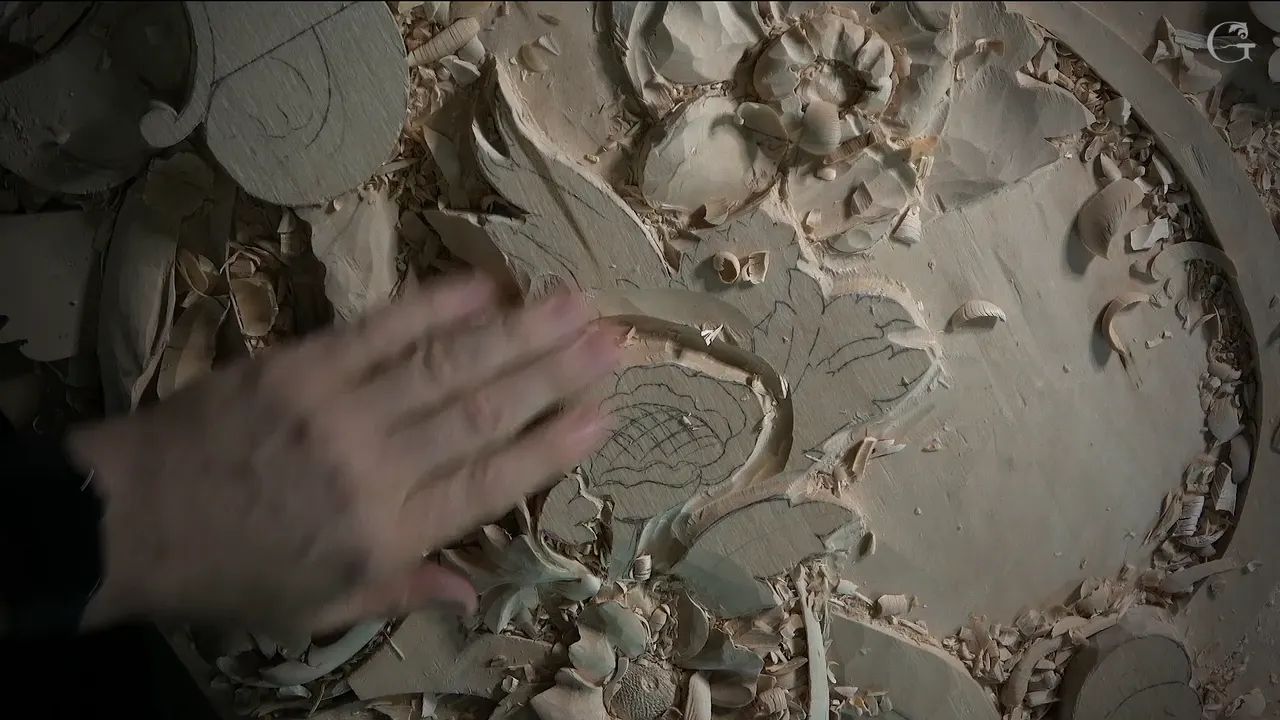

In Venice Room 137, video 1, I tell you I do have an area and know I am not lost, right after I talk through an outline and a slope. The word comes back in my Hashemi, Grape Onlay, Floral and Molding and other Venice Room videos, so this video comes first below and each lesson follows.
Ever started a wood carving piece with so many lines, tools and cuts in play that you wondered where you stood? Did you ask what I do to keep my place? Then you know the question, and below is what I said at the bench each time the word came out.
What came before that line in video 1?
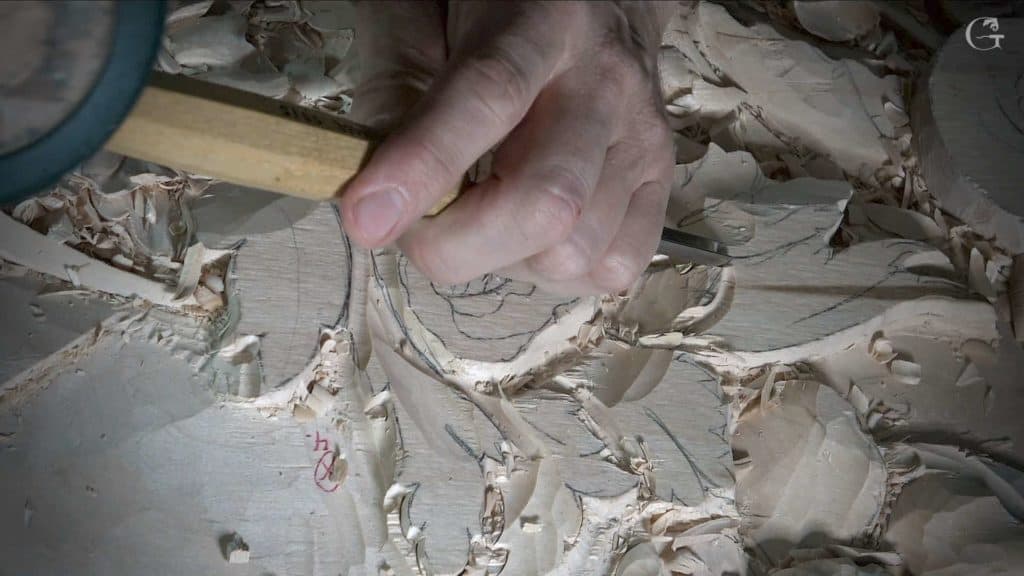
Video 1 opens on depth. "I need that depth," I say. I'll take a number seven "and remove some of the surrounding material." On lines: "I'm going to keep some of the lines" with "Right there is one of the lines." Of one spot my words are "I should probably leave it like that for now."
Then I stop to think. My question is "What should I start" and my answer is "I'm probably going to start with the surrounding and then going to jump on the flower." I will pull my iPad and redraw everything, I say. Then comes "I've got some movements back, and I can probably start developing pretty much."

"It is not acanthus, those movements, but still the same flair," I say, and so "we're going to have some small areas with the eyes and pipes and so on." One part is "a part we don't need" and it "is going to go all the way to the surface." I plan to start with this movement first, with two millimeters now (0.08 in). Some spots need relief, "like triangles" and I say "let me hit right here."
How did I protect the edge in video 1?
"I don't want to lose the edge of it," I say. My guess here is "number seven and 14 millimeters" (about 9/16 in), to "hit straight down, whatever the movements I don't want to lose." For some spots I plan "the same classical rule, like letter S curvatures," though "Not everywhere, but some spots." Of the borderline I say "I would just not lose, like I said, the borderline."

A slope comes next. "Even if I'm going to lower down right now this part, and it's going to slope this way," I say, and then "I'm not sure if you're going to catch that." Plainly: "So that is high, that is low" and with the number seven I will "carefully establish that slope." I add that I need to relief some areas right here.

And what followed it in video 1?
"For me, it's just a matter of cleaning, but I know the outline is there," I say, straight after it. Five millimeters (0.2 in) come next, with a plan to continue on this side. A caution follows: "Have to be careful. But actually, I'm safe. This area is a little lower, so I should be okay."

The words "outline that side" come first, then "I could outline right away this little guy." About separations, "Even if we're going to have some separations right there, I still going to outline the main form first." Then "Okay. And that is good, except I can now outline this side." The video ends on "looks like I am safely able to slope this guy underneath of that part."

Do videos 2 and 3 say "lost" too?
They do not; video 1 is the one with the word. Video 2 has "it's going to create a beautiful shadow underneath" and "all that can go much lower." A little bigger tool follows: "I'll take just the number two and clean this area." From above, "it looks like mess, but it's okay. So you get an idea."
Before that view, my plan is to take one side "underneath of this little guy" and "create some variations." Another part, I say, "can be blended underneath of that piece." Of the other side I say it can be blended under that movement.

In video 3 I name "number 11 and 2 millimeters" (0.08 in) and want to "create that shadow right here." Blending waits, as I say it: a little later I will blend everything, but for now it stays like that. Seen from above in that video: "I've got a kind of mess again all over. And I don't like that. So let me move on the next one."
How does a crowded bench come into it, and what do I do about it?
Carving Hashemi Flowers 21 (video 1) puts it plainly. "If you have a thousand tools, you can't lay them all on a workbench," I say. Then "You can get lost really quickly."

My answer is "I use a different system. I use a shelf system, so all my tools are on the shelves, and I know all the numbers and everything, and the position." I add "I know exactly where I'm working, what I'm grabbing, what I'm using, and I'm placing it back." For "couple tools, three tools," I say, "that's a good idea to use something like that, like a bench."
Acanthus over Moldings 4 (video 1) also speaks of a crowded bench. "I accumulate tools on my workbench, I get lost," I say. After it comes "it's a good idea not to keep more than a few tools. I mean three, five, seven. That's okay."


In lesson 7 of that course (video 3), "I need to clean up my bench. I just got too many tools out." Then "otherwise I'm gonna get lost really quickly. And that's not good." My number is "maybe keep only about, I would say, like three tools."
Carving Floral and Molding for the Panel 11 (video 3) has me saying I will put my tools back. "I really don't like to keep my tools on the workbench because, I don't know, when I get too many tools out, I get lost." Then "Sometimes you're looking for the tool." Now I know "the position of my tools" and "in every drawer, I do have the tool, and I know where to go."


Work Bench Organization gives a rule for the front of the bench, and a count. "I have like half a thousand," I say. Put all of them on one bench and, in my words, I will get lost. Mine are "two, three, five the most," on the bench, or "close to myself, and put it back."
In Carving Modern Acanthus 6, third video, I say I will take again the same tool I used before, "which in my case, I have to find it first." With a table or workbench holding a lot of tools, "you get lost."

Where do thick lines, a 3D model and small details come into it?
Venice Room 34 (video 6) is about a marker. "That is a disadvantage of using markers," I say. "You got too many thick lines and sometimes you're getting lost" and the cause is "if you're not taking care right away of that line you just placed."

The Tray of Blessing 3, third video, speaks of a pencil. "Don't worry about how it looks as of now," I say, "but if you feel like you got lost, don't put too many marks" and then "with the pencil, because you know, see how that becomes dirty." Then "indicate where the point gonna be in this case."
The lines in Venice Room 1 (video 11) come from a 3D model, and my plan is to use my knife on the details. "I kind of lost myself, where I'm at," I say. Then "there is a lot of lines, which is somewhat confusing for me, even for me." A wireframe view would be ideal for me, I add, "because wireframe mode gives me perfect line."

In Venice Room 55 (video 7) the word comes with blending. "So now I will need to blend everything," I say. "Otherwise, even I can get lost."
Carving Roman Acanthus 16 puts a warning on detail. "Please don't overdo it," I say, and small details are the place to get lost, where "you can spend a long time," though "you really don't need to." The knife follows: "Let me get the knife again" and "I should make a clean cut."

Furniture Panel 28 (video 2) puts the word beside depth and a shadow. "I'm gonna need to do it much deeper, otherwise there is not gonna be any effect," I say. Next: "you're not gonna be able to see what is going on." The word "lost" sits just before it. I name "half a millimeter number 11" (about 0.02 in), and my aim is "shadow from almost nothing."

Venice Room 24 (video 10) has the plain version: "But somewhere I'm lost." Earlier in that part, "I'm losing something. This, that." Also, I say, "I need to check the distance, which supposed to be approximately the same everywhere or as close as possible."

Carving Hazelnuts, lesson 7 (video 1), has a close word. "I can get confused if I'm not going to excavate this part," I say, with "about maybe 15 millimeters, about five-eighths of an inch" from one point to the other. "This is going to be my reference point."
Do I ask whether you are lost?
In Carving Grape Onlay 2 (video 2) I try to turn around, and "maybe you'll be able to see much better." The next words: "I just wanna make sure you do understand and you're not lost."

In Grinling Gibbons in Maine, class 3, third video, I ask the room "Does it make sense so far? Okay. Anybody got lost?" The next words are "No, all good." And "feel free people. You can always come and take a picture. Okay, if you got lost, nothing wrong with that, just to come and take a picture."

Carving Grape Onlay 4 (video 2) is about my own place. "I'll use some number nine and quarter of an inch, about six millimeters or so," I say, and I plan to create my initial one right there. And "That way I'm not gonna get lost and know exactly where I'm at." For you, I say, "it's gonna make more sense."
That Tray lesson, in its video 2, asks you a question first. "So now do you remember what I said about the center or middle part of the lobe itself? It also has to bulge out, like up." Which means, in my words, "I have to create another on this side." And then comes "I hope you're not lost yet."

Does lost always mean the carving?
No. In Venice Room 23 (video 5) it is my emails. "Don't email me, because sometimes my emails get lost," I say. I am "getting so many emails a day" and "not sometimes able to actually even see them." What I ask for is "please comment." The reason is "When you comment, I'm definitely going to see it."
And video 2 of lesson 7 says "you can do extreme movements, by the way. It's gonna look awesome." Of flowers I say "I mean you can just get lost" and "there's no limit pretty much." Next I'll use "that number nine again, a quarter inch, to clean that stuff" (about 6 mm).
Where did each of those lines sit in its lesson?
| Lesson | What sat beside the word | What I named |
|---|---|---|
| Video 1 of this lesson, Part 12 | A slope to establish, with the area and the outline both there | 5 mm, a bit under 1/4 in |
| Hashemi Flowers 21, first video | A thousand tools cannot all lie on a workbench | A shelf |
| Acanthus over Moldings 4 and 7, lesson videos 1 and 3 | A bench that fills up with the tools I have pulled | Three, five, seven |
| Work Bench Organization | Five hundred tools, all on one bench | Five at the most |
| Workshop 34 of the Venice Room, video 6 | A marker line placed and not yet taken care of | The line I just placed |
| Part 5 course of the Venice Room, workshop 55, video 7 | Everything still to be blended | Blending |
| Furniture Panel 28, video 2 | A cut that must go much deeper, or there is no effect | Half a millimeter, number 11 (about 0.02 in) |
| Grape Onlay 4, video 2 | My initial one, so I do not get lost | Number nine, 1/4 in (about 6 mm) |
| Tray lesson 3 | In videos 2 and 3, a bulge that needs another on this side, then pencil marks | A question to you |
| Maine class 3, video 3 | A room of people, with a photo to take | "Anybody got lost?" |
| Hazelnuts, lesson 7, first video | A part I can get confused about if I do not excavate it | Number 11, 7 mm (0.28 in) |
| Part 2 course, workshop 23, video 5 | Emails that get lost, with so many arriving each day | Please comment |
Which part of your own relief could use a check that you are not lost? Every lesson named here opens with access to the school, paid monthly or yearly and renewed automatically until you stop it. Lesson 137 lives on the Part 12 course page, with lesson 136 before it and lesson 138 after. The Hashemi, Grape Onlay and Tray lessons are all wood carving, and so is the Venice panel.
How it's done
- Number seven for depth. I needed that depth, and my plan was a number seven to remove the surrounding material.
- Keep some lines. Some lines are to be kept, and one spot may stay as it is for now.
- Redraw on the iPad. A plan for the iPad: pull it and redraw everything, to start developing.
- Outline the movement. This movement first, at two millimeters (about 5/64 in), with a need to relief some spots like triangles.
- Protect the edge. A number seven, as a guess, for the edge.
- See the outline. Then came "I know the outline is there," with cleaning left for me.
Frequently asked questions
What was the next thing I said about the outline?
I named five millimeters (0.2 in) next, with a plan to continue on this side, and a caution that I have to be careful. The cleaning line came just before that.
What was my plan for the edge in video 1?
A number seven at 14 millimeters (about 0.55 in) was my guess for the movements I wanted to keep. That was a guess, not a rule.
Why do I keep few tools on the bench?
In the bench lesson I said I have like half a thousand tools, and if I place them all on one bench, I will get lost. Mine are two, three, five the most on the bench or close to myself.
What to carve next
- Part 12 course page
- Venice Room 136
- Venice Room 137
- Venice Room 138
- Carving Hashemi Flowers 21
- Moldings course, lesson 4
- Moldings course, lesson 7
- Floral and Molding for the Panel 11
- Work Bench Organization
- Carving Modern Acanthus 6
- Venice Room 34
- Venice Room 55
- Carving Roman Acanthus 16
- Furniture Panel 28
- Carving Grape Onlay 2
- Carving Grape Onlay 4
- Tray lesson 3