
Alexander Grabovetskiy, woodcarver, School of Woodcarving · Published 2021
What does a wood carver mean by "it's time"?
Quick answer: From above, I gave the carving in the second part of lesson 137 my verdict, then named the next job: cleaning everything, then the final shape. The same words come back in Lily Box, Greek Acanthus, Floral, Byzantine and other Venice Room lessons beside a smaller tool, a stop or a break.
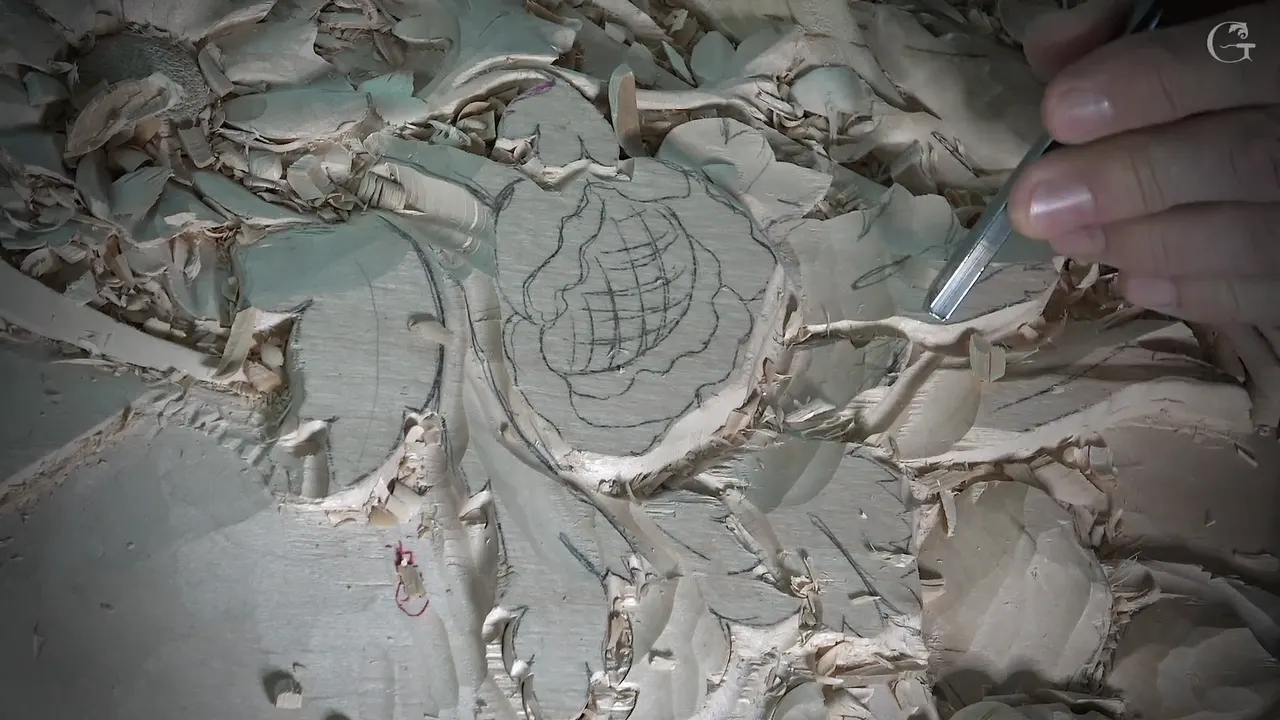

In lesson 137, part 2, I look at the carving from above. I call it a mess and say it's okay. Then comes "So now it's time to clean everything and just give the final shape and separations, concaves, convexes." I say it's time again in my Lily Box, Greek Acanthus, Floral, Grape Onlay, Byzantine and other Venice Room lessons. A different job follows each time. Part 2 of 137 comes first below; the others follow, grouped by the job.
Ever stopped mid-carving? Chips everywhere, rough marks on every face, and no idea if one more pass is the right move. That is the moment. Below is what I said at the bench when I got there.
What did I see when I looked at the mess from above?
The part starts at a shadow. "And yes, it's going to create a beautiful shadow underneath" and "all that can go much lower." I also mention "a little bigger tool for taking out of this material" and say I'll take "just the number two" to "clean this area."

Two lines about blending follow: "that part can be blended underneath of that piece" and later on "this side can be blended underneath of that movement." Next I stop. "Okay, so I've got a preliminary shape" and I tell you I will show how it looks "from above."

The verdict is "It looks like mess, but it's okay. So you get an idea." Right after the line above, I add "although it's not going to be too many concaves and convexes." Then: "So let me start."
Which tool came next, and why that one?
A warning comes first: "Again, I have to be careful how close am I getting to the surface because it is pretty much laying right on top of the surface" and "I cannot do choppy work." So the plan is to "take another tool, flatter tool," "probably just a skew," a "number three skew," "and give a cleanup cut." A skew is one kind of chisel, and it is the flatter tool here.

Then a second thought: "Well, you know what? I could take number 11 and 2 millimeters" (0.08 in) "and go right away pretty much and somewhat undercut." It stays a thought. Depth is held back too. "I don't want to get deeper undercut yet because I still have to create some convexes and concaves, okay?" What the thought would still give me, I say, is "the boundary," since I "still want to make it feel like it is laying right on top of the main body of the work."
The concaves are next: "a couple concaves, same like on acanthus leaf." Then "Concaves, big one, and I'll use 30 millimeters" (1.2 in), "number 11." After that: "I'm going to slice it like that" and "another one on the other side." By then I have this: "That is the main shape" and "that's going to give me beautiful shadow casting."

The part ends on a mix-up, and it starts with "Maybe I need to sharpen it." After that: "Okay, I just confused you." Then, plainly: "I don't need the sharp middle line, okay? But I need a sharp tool, okay?"
And what do parts 1 and 3 of lesson 137 say about it?
Part 1 has two lines worth knowing. About the leaves: "It is not acanthus, those movements, but still the same flair" with "some small areas with the eyes and pipes and so on." About the work: "So now I do have an area, and I know I'm not lost. For me, it's just a matter of cleaning, but I know the outline is there."
In part 3 the cleaning waits. "A little later" is when the blending comes, and "It's just a little later operation, I would say" is what I call undercutting all around with the same tool. A rasp gets a mention, "maybe even use a rasp" and a small concave there is "Just some movement. And I think that is enough."

Part 3 has a look from above too: "I've got a kind of mess again all over. And I don't like that." Next comes "move on the next one." The two looks lead to a next step each, and the steps differ.
Is cleaning everything the same job in other lessons?

In Lily Box 2.5 I have just warned myself about going too deep over the middle of the board. "Okay. Now it's time to clean everything" and the tool is "again number 11." It is "Same number 11 what I used before. That's a 3 millimeters number 11" (0.12 in), "and I'll just clean." Then how far to go: "I don't really worry about the final form yet of those leaves." And "I'm trying to get as close as possible to the final form, but not to the really final form." The grain gets a warning too: "with that type of wood, it's easy to make a split."

Lily Box 7.2 gives a reason in the same sentence: "And it's time probably for me" to clean up, "because right now it just looks messy, and that's not too appealing." I pick "number 3 and 6 millimeters" (0.24 in). "I want to recreate clean canvas, how I say that." The payoff is "I can see better, because I've got too many chips going on" and then "I can actually jump and develop a little more in that section."

Greek Acanthus 15.1 starts one step back: "So what we did, we undercut everywhere." Some of the design goes "all the way through" and "I've done it on purpose." What it gives is "really nice shadow lines." The list for the day is "clean the edges, lower down the background, and so on." Edges get a plain warning. "Doesn't matter how sharp tools you have or doesn't matter how good you carver, you still going to have some kind of rough edges." My preferred way is "just the same knife, what I used before, number 12," run "along the edge" to "remove what I think it's actually not supposed to be." Another way: "it depends on the grain. You can kind of scrub it just like that" and "it also cleans all the fuss out." And "you don't have to be perfect actually when you're cleaning."
In Venice Room 22.8 the cleaning stays small: "attack the edge and clean a little better. Not the final cleaning, but clean little better."
And when a tool stopped fitting?

Further back, Venice Room 59.4 has a stop: "That is enough" and without it the marks would be "hard to get rid of." At that point I say "So it's time" and the job follows: "switch to smaller tools" and "continue my development." Further on I name "using number 11" then "12 millimeters, half an inch" (0.47 in).

A limit comes first in Floral and Molding 4.2: "closer to my future volute" and "I don't want to damage the side of it." Then the switch: "And looks like it is time to switch the tool. Just doesn't fit any longer." Next comes a smaller one, an antique, "about one-eighth of an inch" (3.2 mm), and "it fits perfectly." The volute is the spot I do not want to harm.

Grape Onlay 8.3 puts it as a question with a maybe: "Maybe it's time for me to switch to a smaller tool Because My big tool is little too big now." Which one? "I could use just the number 11, whatever the tool gonna fit, okay?" And of the other gouges: "They all gonna work."
Did the word ever send me to stop, move or rest?

Lily Box 10.1 is a stop. The slab is "5/8, no more than that. So about 16 millimeters" (0.63 in), and I am down "half an inch, about maybe 13, 14 millimeters deep" (0.51 to 0.55 in). "I think it's time," I say, and the word after it is "stop." Next: "I still going to need a couple millimeters of thickness in this spot if everything is going to go how I planned."

In Venice Room 36.2 I move on. "Let me use number 11 and 5 millimeters" (0.2 in). "And that is probably the most what I want to do at this point to this region, because I still have to develop this movement right here." I say "I think for me it's time" before the move: "to move to another place." Also: "I do that once in a while." What follows is why: "Before I finish one area, I jump to another because if I concentrate too much on one of the areas, for some reason, I'm wasting much more time."

Floral and Molding 5.1 is a rest, and the sign sits on my bench: "sometimes when you get tired" and "If I look at my bench and there's more than two or three tools, that means I am tired. Okay? Right now, I'm okay to keep those two guys while I'm working, but when I start accumulating tools, it's time" and what follows is "to take a break." "At least that applies to me, okay?" Then: "Walk away for a few minutes and you should be fine."
Does the word ever point at the next shape?

Venice Room 64.4 says it this way: "And now I can start working on my divisions and make it more beautiful, more logical if you wish. Okay, so it is time." Next: "So let me excavate the eye." My tool is "a small 16th of an inch number 11," which I give as "1.5 millimeters." Of the eye I say "of course, there's multiple ways to do the eye" and "I can actually excavate, like shovel it out, okay? Start in, then move it slightly that way."

Venetian Flowers Rosette 2.1 uses the word for a loss: "Now I need to establish a three-dimensional form, and it's time when I'm going to lose most of the pictures." Right away: "I mean, most of the picture, I should say. But I'm not afraid of it, okay?" The answer comes at once: "Since I do have a printout, so I can always draw that right on a board." My goal is "a sloping all those flowers all the way" with "a huge number one." After it: "just because I sloped that, it became more roundy than it used to be. It used to be like an oval, but now it's much, much better."
When is it not time yet?

Byzantine Acanthus 1.3 makes the word a finger test, before the paper goes on the back of the piece I work on: "Wait a minute. Again, just to check with the fingers. If the finger is not sticking, then it's time. If it's sticking or it's too wet, it's not the time yet, okay? And then glue it, just like that."

The question in Greek Acroterion 5.6 is "how do I know it's time" for a tool, and the rest is "to buff that little bit or hone it a little bit?" My checks: "I'm always checking with the finger if there is any burr going on at the end of it." And: "if it leaves some marks on the surface, that means there is a burr, micro burr, and you have to take it out." The fix I name is "just the buffing wheel, and buff it a little bit." I add "You could just strop it with the leather also."
Where did each one sit?
| Where | What sat just before it, in my words | What came next |
|---|---|---|
| 137-2 | A look from above at a mess, and a leaf lying pretty much on the surface | Cleaning first |
| 2.5, Lily Box | Careful work over the middle of a board, with a warning about going too deep | A 3 mm (0.12 in) number 11 |
| 7.2, Lily Box | A messy look with too many chips, which was not too appealing | A 6 mm (0.24 in) number 3 |
| 15.1, Greek Acanthus | An undercut everywhere, with some of the design running right through | Edges, then the background |
| 59.4, Venice Room | Marks that would be hard to get rid of otherwise | Smaller tools |
| 10.1, Lily Box | About 13 or 14 mm (0.51 to 0.55 in) deep in a slab of about 16 mm (0.63 in) | A stop |
| 36.2, Venice Room | A region I still had to develop, with one movement left to do | Another place |
| 5.1, Floral | More than two or three tools on my bench, the sign that I am tired | A break |
| 64.4, Venice Room | Divisions I wanted to make more beautiful, more logical | The eye |
| 1.3, Byzantine Acanthus | A finger check on the sprayed surfaces, not sticking or sticking and too wet | Glue, or not yet |
Which step on your own relief is waiting for its time? Every lesson named here opens with access to the school, paid monthly or yearly and renewed automatically until you stop it. Lesson 137 lives on the Part 12 course page, with lesson 136 before it and lesson 138 after. The Lily Box, Byzantine, Grape and Venice lessons are all wood carving, and so is the Venice panel, with its acanthus leaves and its gouge and burr checks.
How it's done
- Step back. I told you I would show how the preliminary shape looks from above.
- Give your verdict. Mine was mess, and also okay.
- Name the next job. The job I named was cleaning everything, with separations to follow.
- Mind the surface. I said I had to watch how close I got to the surface.
- Pick a flatter tool. My plan was probably a skew, number three, to clean.
- Hold the deeper undercut back. I did not want one yet, since some convexes and concaves were still ahead of me.
Frequently asked questions
What was my verdict after that look?
Mess was my word, and I added that it was okay, so you get an idea. The separations were still ahead of me, and I said the concaves and convexes would be few.
Why was choppy work out for that leaf?
The leaf sat pretty much at the surface, and I had to watch how close I came to it. I said I would reach for a flatter tool, probably a number three skew, for a cleanup cut.
What size was the first concave?
For the big concave I named 30 millimeters (1.2 in), a number 11. I would make one, and then another on the other side.
How deep was the slab when I stopped?
What to carve next