
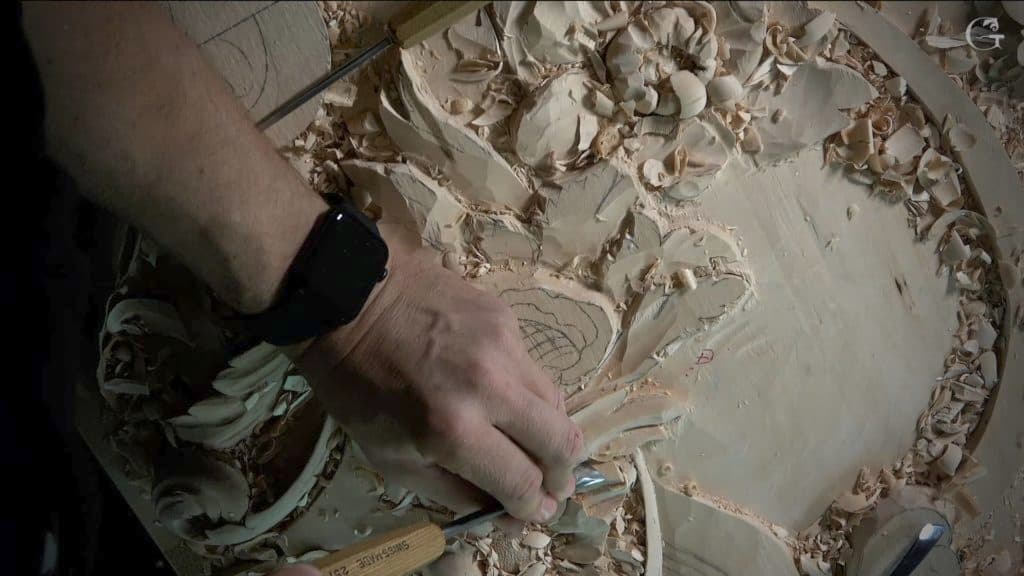
Alexander Grabovetskiy, woodcarver, School of Woodcarving · Published 2021
What does a wood carver mean by "it's not always the case"?
Quick answer: In video 3 of Venice Room 137 I hoped a rasp would speed up my work, then said sometimes it creates a lot more problem. Other lessons carry a line like it beside a convex middle part, a groove, flying chips, an undercut, a sphere and a drawing.
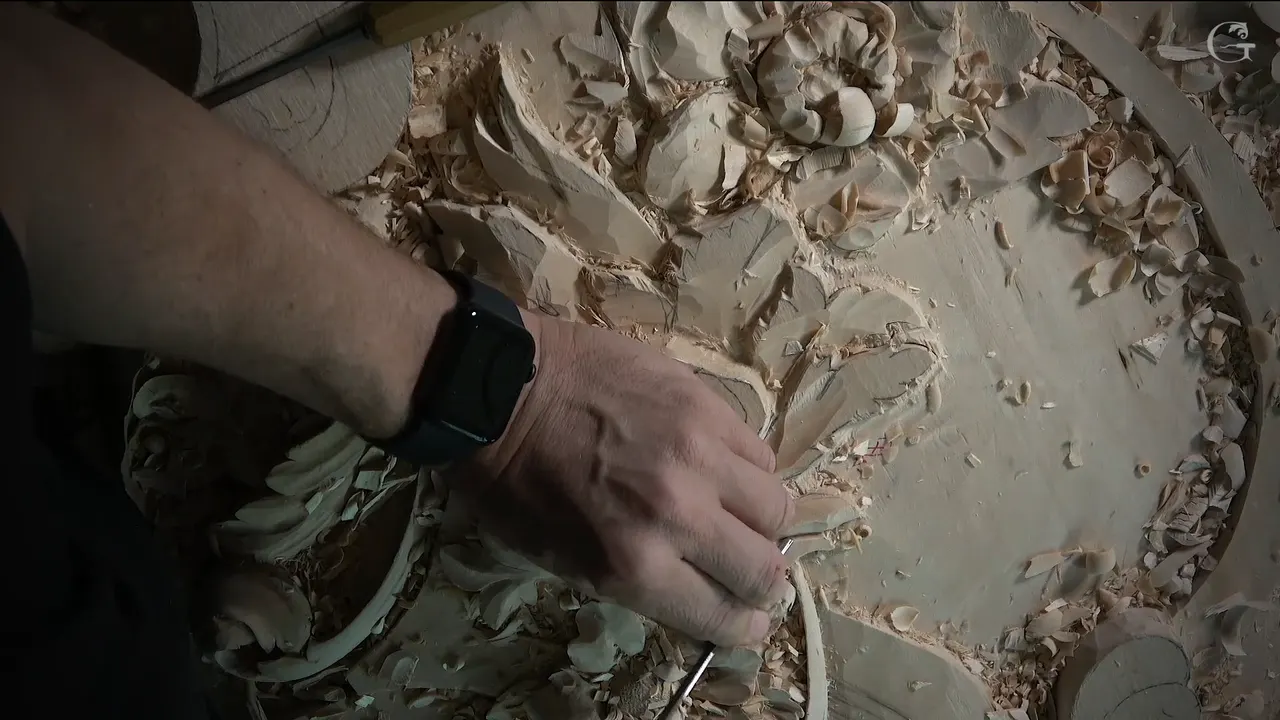

In Venice Room 137, video 3, I said "It's not always the case, though," right after I hoped a rasp would speed up my work. Other lessons of mine carry a line like it, beside a middle part, a groove, flying chips, an undercut, a sphere and a drawing. Every quote below has a cue behind it, and each lesson is linked.
A rasp is, says Wikipedia, a coarse form of file used for shaping wood, metal, or other material. A chisel, by the same source, is a hand tool with a wedge-shaped edge at the end of its blade. The Venice Room lessons are wood carving in the Venetian style.
What was I doing in video 3 when I said it?
The video opens with separations. I said I could work on my separations and create more movements. My first tool was a number 11 at 2 mm (0.08 in), and my plan was a shadow, then blending: "I'm going to create that shadow right here. And I'm going to blend."
A note about the blend came next. "Well, yes, I will blend," I said, "but I need, again, just attack it from the right position." Then two words: "This side."

More work with 2 mm (5/64 in) was in my plan too. I would "also create the cut with 2 millimeters right here." About the inside I said "all that inside, that's going to be clean" and "the same level as that." Then: "Pretty much right away. Get little undercut underneath of the next detail."
The edge was next, and my words were "clean the edge." After that came the option to undercut one side: "Right away, I could undercut pretty much underneath of this side."

I named my tool: "With number 11 and 2 millimeters, that's what I'm using." After it came a smaller size, offered as an option: "I could use 1 millimeter now" (0.04 in). Then, hedged: "That's probably what I should use, 1 millimeter."
Some work waited. Blending everything was for "a little later" and for now I would "leave it like that." Going all around with the same tool to undercut waited too. I called it "just a little later operation."

For 1 mm (0.04 in) I planned to "prolong those cuts" and I added "let me also do 2 millimeter cut right here."
Then the size changed again, and this time it went up: "And you know what? I could actually use 3 millimeter. I think 3 millimeters will work also." That is about 0.12 in, and what it would make was "a little bigger shadow or deeper shadow." I thought it would "look good" and then said "just blend."

A small concave came up as an option. "And what I could do, I could give a small concave." The tool I named was "12 millimeters, number 11" (0.47 in), "Going to create some kind of concave." Of that concave I said "Not much, but a little bit," "just some movement" and "I think that is enough."
A second concave was an option too. "I can actually get another concave right on this side. Just get, again, some kind of movement, just some feel of some lines and so on."

Then I showed the carving from above. "I've got a kind of mess again all over. And I don't like that. So let me move on the next one." The cleanup was a plan, and it came with a tool. Later on, I said, I would "clean everything and maybe even use a rasp."
What did I say about the rasp in that video?
What I said next: "and that's going to probably expedite my work. I hope it's going to expedite my work." Then came the limit, and what it said about the rasp was that sometimes it creates "a lot more problem."

Where I stand came next. "I still don't use it a lot, by the way, even a year later. I bought them about a year ago, but I still kind of have doubts." I fixed the word: "Not really doubts, but I think I am able to just do with my normal tools, sometimes better job than rasp."
Lesson 65 also talks about rasps, in its sixth video. "Yes, I tried those rifflers, those rasps, and I still kind of like my traditional way." About using them: "It's okay, I guess, to use. Might be I'll use it again, but I still didn't get grip of them."

Is the middle of an acanthus leaf always convex?
Video 8 of Venice Room 84 had me at the concaves. "I need to change tool," I said, and the size I named was "7 millimeters to continue this concave" (0.28 in), with a note right after it: "deeper concave here." A "second concave" was on the list too.
Then the middle part: "So because I need to make that middle part of acanthus convex." After that came "But please understand" and I said the middle is not that way every time.

I went on: "It's just particular Venetian style." Then: "There's also Byzantine style" and "It's exactly the same thing, actually. It's more convex inside of the middle part." Byzantine art, according to Wikipedia, is the body of artistic products of the Byzantine Empire and the states that inherited from it. According to the same source, the acanthus is one of the most common plant forms used for foliage ornament.
The Acanthus over Moldings course, lesson 8, video 3, has a similar moment. "Inside of those leaves, I still want to create the same idea. It's gonna be concave convex, concave," I said, and my middle part would be raised up. "You have to understand," I said, and the raised middle did not hold everywhere, just "applicable to that style."

Over in Venice Room 65, video 3, a pipe was the subject, and the half round would go "all the way to this point." I was bringing my concave "all the way there" with the words "not always, but in this case" in the middle of that sentence. My reason came next: "Because there's different types of acanthus." Then: "Not every acanthus is the same."
I checked how much material I had and said I could actually get deeper, to give it more shadow. For the ridge I named a tool: "just a straight tool in this case. Number three. And this number three and 12 millimeters, about half an inch." A shadow is, says Wikipedia, a dark area on a surface where light from a source is blocked.

Video 6 of that lesson puts the limit another way. "In this case, okay, so please understand, that is not always. It's just in this particular case, Venetian-style wood carving, they had those really exaggerated pipes."
Venice Room 10, video 11, sends you to the old work. "I do have an extra ridge, and I kind of like how it looks, but I'm not sure" about keeping it. "Because logically, it should not be there." Then: "when you look at the original work, the pipe not always convex." And: "I'm not joking. You can check yourself."

Of those pipes I said "Sometimes those pipes, they don't make sense, but for some reason, they look really good when they do that way." And last: "There's not always logic."
In Venice Room 62, video 7, I had just said "I got to be a little more careful" and picked a number 11 at "seven millimeters" (0.28 inch). I put the same limit in: not every time, I said, "actually." "Sometimes they had that groove on inside." I followed it with "But I'm still able to establish it, by the way." And "Everything's supposed to go to the center line."

Which of my tools and habits do not always work?
Back in Venice Room 6, video 12, I asked you to look at the clean result. "See? I can make even cleaner cut if I need to." Then: "Get really, really closer." Next the chips: "And of course, it would help if those chips would fly out right away." I added that they do not always do that, and went on: "But anyway, see? It just gives me really clean cut."

Carving Grape Onlay 1, video 2, has a sphere. The plan was to "establish my triangles" then "go from outside inward" and do "the true sphere shape again." About carving that sphere I said: "If you able to carve that ... that would be probably the best." The limit followed: "not always possible."
Right after that I told you to look at what I was doing. "But see what I'm doing again" and "really take a look how clean the result is." The angle of the tool came next. "I always place my tool on an angle, okay?" A number came with two hedges: "maybe a 45" degrees, "or so." Placing it at 90 degrees, I said, "that's a mistake" and of the people who do it: "a lot of people just pushing in. It's a big wedge." A wedge is, according to Wikipedia, a triangular shaped tool and a portable inclined plane.

The Carving with the Grain Q and A used a bowl, with a warning first: "Of course, I exaggerate." Then: "But when you start carving, the grain changes direction, and you really have to attack from the opposite direction." About a marriage line: "If you're going to continue carving, you're going to split." And: "So you have to attack from both sides." Then: "You still feel it." I added that it still does not hold every time, and the next lines were about a complicated carving.
I went on: "in a complicated carving, you have to really sometimes work against the grain no matter what." Then: "There's no way you can attack from the upper side. And the only way you can do that, sharp tools. Sharp tools." The grain, per Wikipedia, is the longitudinal arrangement of wood fibers. And sharpening, per the same page, is the process of creating or refining a sharp edge.
When did I say it about one spot only?
Venice Room 44, video 8, had an eye in the carving. "Because there's an eye, I need to create a movement downhill a little bit also because it has to feel like this is growing from underneath." Then my limit: "It doesn't have to be." And the reason I gave for this spot: "I think it's just going to give me really nice movement."

Seven millimeters (0.28 in) was the plan, "and see if I'll be able to get a little deeper in." Then "Maybe about five millimeters" (0.20 in). Then, smaller: "two millimeters" (0.08 in), "and cut that even deeper this way." And I told you what I had made: "So what I just did, I created for myself extra spot for the division."
Lily Box 5, video 3, has an undercut. A limit comes with it. "I still have to develop those notches which we have right here. But it doesn't stop me from undercutting right away, pretty much." Then: "Well, in this case." The limit sits in the next line, and last: "But in this case, it's actually, like I said, nothing stops me."

The notches came next. "Let me see if I can use actually number one, a small number one. This is a number one and a double bevel" and "it's only 1/16 of an inch" (1.6 mm). Of the concave: "slight concave, but still concave." It "creates a ridge, which is actually like a pipe, micro pipes."
On the depth of the design I said "it's no more than eighth of an inch" (3.2 mm). "It's actually less, about 3/32 of an inch right here" (2.4 mm). I also said "Let me use a half a millimeter now" (0.02 in), and "give that shadow even better."
How close is close enough?
In Venetian Flowers Rosette 5, video 3, I measured: "let me approximately measure. So what I've got, I've got about an inch and a quarter between those two spots" (about 32 mm). I checked my original drawing. "It does look like I'm pretty close." Then a small note: I said it does not always come out that way, "but close enough."

My next step, I said, would be to "establish where" I would "end up with my down cut." I said the space was "about five millimeters" (0.20 in), "3/16 of an inch" (4.8 mm), "maybe little less than it, like four and a half." "Doesn't really matter. But it's a good spot for me." A millimeter is, says Wikipedia, one thousandth of a meter.

Which lessons said it, and what did I add?
| Lesson and topic | The plan or the rule I had just given in that video | My added line |
|---|---|---|
| Rasp, lesson 137 | Maybe a rasp, and hope it saves me time | More problem, sometimes |
| Middle part, 84 | I need to make the middle of the acanthus convex | It's just particular Venetian style |
| Raised middle, Moldings 8 | Inside the leaves, concave convex concave, with the middle part raised up | Applicable to that style, I said |
| Pipe wrap, 65 | I bring my concave in, and the pipe wraps as a half round | Different types of acanthus |
| Groove, 62 | I have to be a little more careful, and I use seven millimeters | Sometimes they had that groove on inside |
| Eye, 44 | Because there is an eye, I need a movement downhill a little bit | Really nice movement, in this case |
| Chips, 6 | It would help if those chips would fly out right away | Really clean anyway |
| Undercut, Lily Box 5 | Notches still to develop, yet an undercut right away, pretty much | Nothing stops me, in this case |
| Sphere, Grape Onlay 1 | If you are able to carve that, that would probably be the best | Not always possible |
| Drawing, Rosette 5 | I check my original drawing, and I am pretty close | But close enough |
| Grain, Q and A | The grain changes direction and you attack from both sides | Sometimes against the grain, no matter what |
Which one would you like to see closer?
Every lesson named here opens with full access to the school. The page for lesson 137 is here. It sits after lesson 136 and before lesson 138, and the Venice Room workshops 132 to 143 live on the Part 12 course page. All of it is relief carving.
How it's done
- Pick a tool for the shadow. My tool for the shadow in video 3 was a number 11 with 2 mm, and blending came after.
- Mind the position for blending. The blend needed the right position of attack, on one side, I said.
- Plan a smaller size. I named 1 mm for now, and later 3 mm for a deeper shadow.
- Add a small concave. A small concave with a 12 mm number 11 was an option, not much, just some movement.
- Look from above. From above I called it a kind of mess and said I would move on to the next one.
- Keep the cleanup for later. Cleaning was for later, with a rasp as a maybe.
Frequently asked questions
Was a rasp part of my plan in lesson 137?
Cleaning everything came later, and a rasp was a maybe. I hoped it would help. Then I said that is not always so, and that a rasp can bring more problems.
Do I use rasps a lot?
My rasps are about a year old, and even a year later I still don't use them a lot. I fixed my word about doubts. My normal tools, I think, can sometimes do a better job than a rasp.
Is the middle part of an acanthus leaf always convex?
In workshop 84 I needed a convex middle, and I asked you to understand that this is not so each time. I tied it to Venetian style, and said Byzantine style is exactly the same thing.
What to carve next