
Alexander Grabovetskiy, woodcarver, School of Woodcarving · Published 2021
What does a wood carver mean by "think first"?
Quick answer: In lesson 138 of the Venice Room, video 2, I paused to think first before an undercut and weighed 2 millimeters against 1 millimeter. I went with the 2. I said the same words in Venice Room, Hashemi flowers, furniture panel and grape leaves vase lessons, each ahead of a different choice.
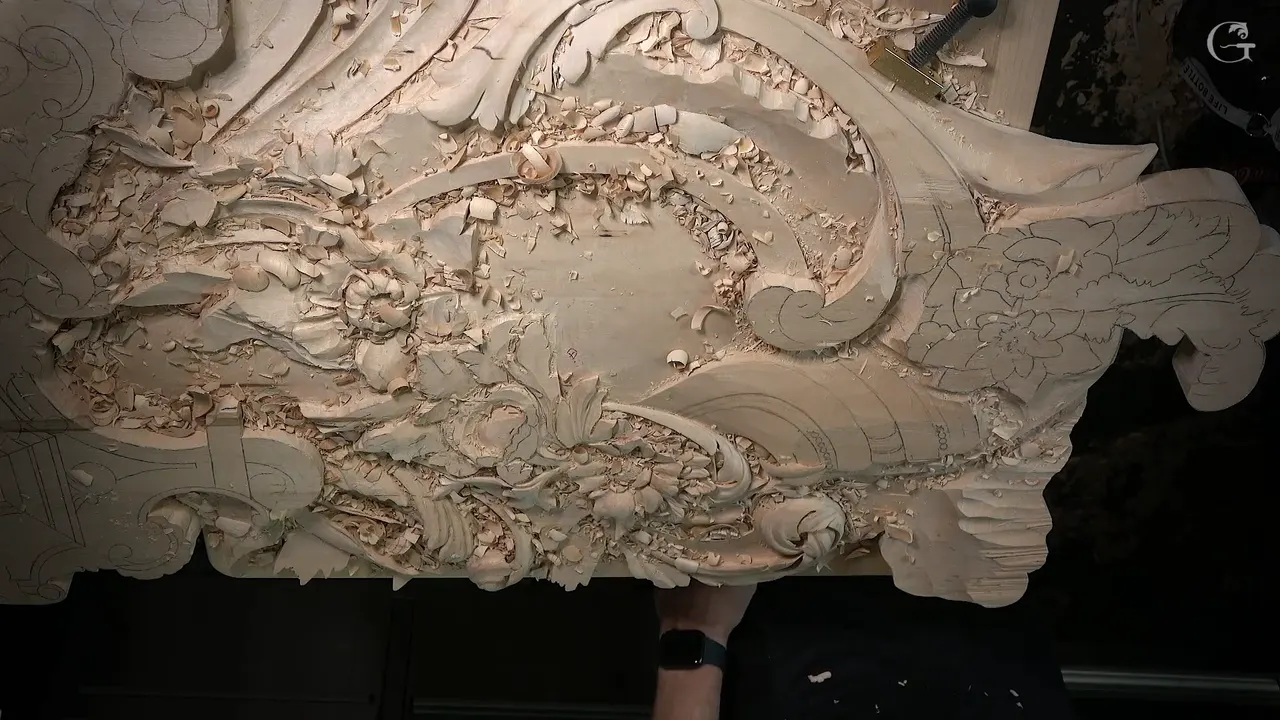

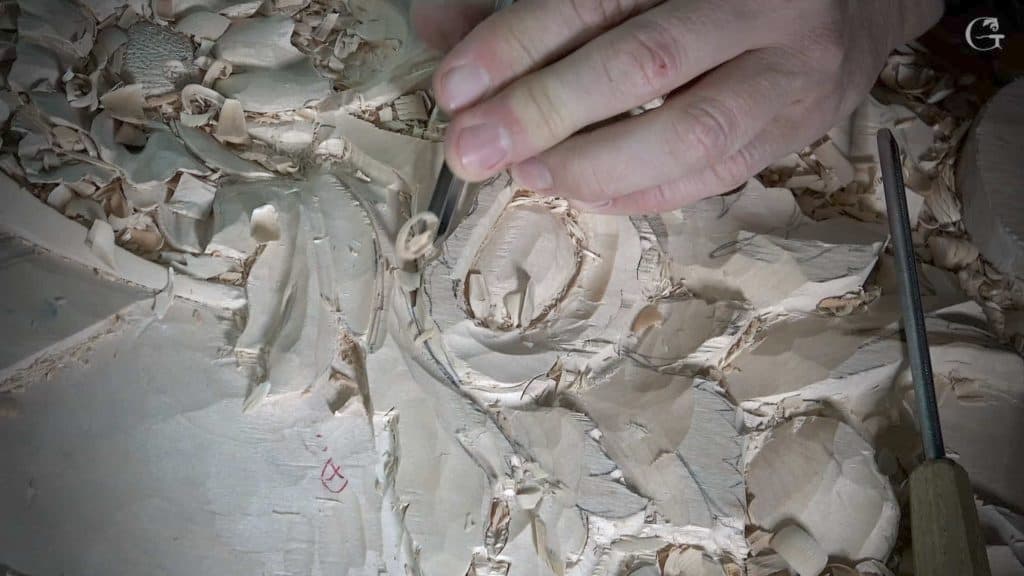
In Venice Room 138, video 2, I stopped to think first ahead of an undercut, and I weighed 2 millimeters (0.08 in) against 1 millimeter (0.04 in). I used the same words in other lessons, each one ahead of a different choice.
Ever stood over a line with a gouge in your hand and not known which size to pick? Did you grab the first tool on the bench? Then you know the spot. Below is what I said around those words, and what I did next.
What did I weigh in the second video of lesson 138?
The video starts with a plan. "I need to attack that from another position," I said. That part had to feel like it was really round. It "doesn't have to be perfect, by the way," since some details were coming on the inside, but giving it some roundness, or the feel of roundness, was still a good idea. For cleaning it my plan was a 3 millimeter (0.12 in) number 11.
The undercut came next. "What I also need to do, I need to undercut underneath of this line," I said; "really need to undercut that." I put the size at probably 2 millimeters, "no more than that." My next words were "Let me think first." Next I weighed the sizes: "2 millimeters or even 1 millimeter." The choice came right after, and it was the first one: "I'll use 2 millimeters."
Number 11, "of course" and "light on the left side." That undercut would go "all the way like this" and it was "really important for me to create that round feel, roundness." My tool went "this direction also" then "around" and then "one more time."

Which size came after the 2 millimeters?
A 1 millimeter. "I could use 1 millimeter now right underneath of here," I said. I guessed I could blend everything nicely, and I named "1 millimeter to take out whatever I just created underneath of this cut." The roll was still ahead of me: "I will have to roll it somehow. It's not really a pronounced roll, but still have to roll it this way." It still had to feel like it was rolling from underneath. "And it does indeed."

How did the same video turn to relief?
To "just outline this side" I planned a 3 millimeter (just over 0.1 in) number 11. That side would "lower down completely," but "I need to make sure I'm not losing the picture." So I would "hit that straight down with the straighter tool." "Maybe number 3 will work. Yes." After it come the stem and petals of the flower: "Here's my stem and my petals" and "this flower is more like relief carving." It is relief carving, "very much it is," but "not truly 3D."

All of it needed to be lowered down. "Just a big number 11," I said, at 5 millimeters (0.2 in), and then "I create a shadow." Next: "Even lower. You know what? Straight tool not going to fly in this case. I need to get some kind of spoon."

Did the other videos of lesson 138 weigh a size too?
They did, with a different tool each time. In video 1 I looked at a space and said I could make it feel like there is an eye: "Although I should use three millimeters, I think. It would be better." For a straight down pass I named a number 2, and I said it just happens to be on my workbench, a piece laying around. Number three or "whatever fits" would do as well.
Video 3 has a number 7 for the next roll, though "it doesn't really have to be number seven" and I could "still use number three and just take little by little." Near the end comes a limit: "I cannot be too deep." Some material was still left, so "I'm okay. I should be safe."
That is all in lesson 138. The same pause shows up in other lessons, so here is what I did around it in each.
How much did I plan to take off in Venice Room 74?
A spot on my leaf is "really high" in Venice Room 74, video 4. I did not know whether I wanted to see it, but I wanted to "probably knock down a little bit that spot." How much I should take out was my first thought. "I still kind of want it a little higher, but it's not as gradual as I want to." So maybe I would "just knock down quite a bit."
The tool was a number nine, "pretty much 20 millimeters" (0.79 in), which I also called about 3/4 of an inch. A mallet came to mind: "I could use some force." Working across the grain "is always safer" and "gives me a lot more control." By hand I could slip and damage whatever the carving already done. "So that not the best idea."

Which number did I try first in Venice Room 76?
A rolling motion opens Venice Room 76, video 5. "I'll use number seven," I said. "Number seven or number six will work." A stop to think first, then a try: number seven, "we'll see." The hedge: "Maybe it's not going to work. Number five will do." The mallet came up too: I "could help myself with the mallet." I counted "three movements" and I wanted them to look "really good." A decision about the look was still open, and I "really want to break that part" under the line and "create some kind of shadow."

Which section stayed in Venice Room 73?
One section would stay, and I would "excavate around" it, I said in Venice Room 73, video 9. "I'm going to take it out," I said. I wanted to think first, "before making too quick decisions," about how much to take out and so how much to keep. "Maybe I'll just keep a little bigger section."
A number 11 veiner of "probably seven millimeters or so" (0.28 in) was next, "a little bigger than a quarter inch." Start "little by little," I said; stay "really mindful."

Where did the pause come next, in Venice Room 68 and 72?
A deeper hollow came up in Venice Room 68, video 11, "a deeper excavation inside on both sides" with the smaller tool, "maybe just 3 millimeters, like eighth of an inch," a number 11 (about 1/8 in). "But let me think first," I said. The lines after were "It's okay" and "I think I can do, I'm safe." "Actually deeper" was possible, "on this side also."

A ruler and a golden ratio are in Venice Room 72, video 1. "I am not after perfection," I said. Whether I am really on a golden ratio was something I would not estimate with the ruler. That "would be little too much," so I would think first. The plan after it was 5 millimeters (0.2 in), a number 11, "to create that concave."

A pipe is the subject of video 9 in the same lesson. Next came a pause to think about what I wanted to do. A "much deeper excavation" was my thought. That pipe was "just not dimensional enough for me, so I need to exaggerate as much as I can." It was a good thing I had not undercut underneath, and "I do have enough thickness on inside," so "I'm safe to do that concave with no problem." Still to decide: "what kind of concave" and "how deep I want to go."

Which holes did I look at first?
Holes come first in Hashemi flowers 7, video 1, and "Take my drill," I said. "I'll use the same holes." The middle part would be solid, so "all those holes, they're going to be hidden." I would think first which ones we can take out. A black marker would "just identify which one I can easily take out right now."

A flow line needed fixing in Hashemi flowers 18, video 4: "I kind of have to fix my flow line." I took a moment to think about what I could do right there. One idea was to "make a subdivision" and have "this leaf go right above that part." "Probably just a V tool," I said, and "this one is three millimeters" (about 1/8 in). The same V tool later made a notch "more distinguishable."

Does a furniture panel get the same pause?
It does. Furniture Panel 13, video 4, begins with "I'm not sure what I should do." The shape bothered me: "I kind of don't like this being square, and I want to soften it somehow." I stopped to think first: "What can I do?" Maybe I could "leave this outside border without even touching," since "I think it looks good just like it is." Still, I "would like to make a small movement right here." Later: "that looks much better."

A movement to outline came up in Carving Vase with grape leaves 1, video 10, a vase lesson: "don't want to lose it." I paused to think first, and then "I got a leaf below, but how do I want to do it?" Another leaf would sit underneath, and "I need to outline that small one first."

Why did I stop before touching an eye?
Eyes are the subject of Venice Room 97, video 9: "Let me do some of the eyes" and I thought it through first: what I wanted to do. The spot I was about to carve would be visible from one position, so I had to be "really, really smart" about it. A mistake is something I "really don't want to" make. My plan: the left side underneath of the right one, "not much, but little bit."

How a spot will look is the question in Venice Room 92, video 5: "I have to make the decision how it's going to look." I thought it through: "I want to be authentic to the original Venetian styles." An excavation "little deeper" came next. Maybe I would "just do my preliminary deep cut," "going to be like a double-step molding" with a number 11.

Is there a time I had nothing to think about?
There is. Venice Room 29, video 4, has one section I did not need at all, "because from the bottom, it does not make any sense when you look from this side." It was extra material, "take out, I should say." I started to think first, and then said "Well, no, actually, nothing to think about. Just take it out." The next line: "It just creates beautiful movement overall. I like it."

Which concaves went with the number seven?
The number seven in Venice Room 110, video 3, was 14 millimeters (0.55 in). "Let me do those concaves," I said. Which ones I was going to do called for some thought first. They were "not much" and I did not plan to carry them all the way: "I don't really need it."

A concave that continues a side was my wish in Venice Room 103, video 3: "I want to try creating a concave." Doubt came next: "I'm not quite sure if I want to do that or not." I thought first, and said "I guess that's probably the only way." The result was "exactly the same what I see on the other side of my drop" and "I'm really happy." Cleaning would take "a little more time."

Which side of the line did I stay on?
Video 3 of Venice Room 140 brings in a smaller tool: "I think 2 millimeters would be a more appropriate tool for this" and "yes, I am eyeballing." A moment to think came first. The distance on both sides was supposed to be equal, but one side looked a little wider, "so we're going to stay a little bit on the side of the line." The plan was "my first cut" with a 2 millimeter number 11 (about 5/64 in).

Where did I use it, and with which tool?
Here are seven of those lines side by side, each with the size beside it.
| Lesson | What I weighed before the pass | Size named |
|---|---|---|
| Venice 138, video 2 | An undercut under the line, 2 mm or even 1 mm | Number 11, 2 mm (about 5/64 in) |
| Workshop 74, video 4 | The amount of that high spot to knock down | A nine, 20 mm (0.79 in) |
| Room 76, video 5 | Which number to try first for the rolling motion | Seven first, five as a hedge |
| Lesson 73, video 9 | The part of the section to keep for now | Veiner 11, 7 mm (0.28 in) |
| Venice 68, video 11 | A deeper hollow on both sides, inside the carving | An 11, 3 mm (0.12 in) |
| Hashemi 18, video 4 | What to do about the flow line there | V tool, 3 mm (just over 0.1 in) |
| Workshop 140, video 3 | Whether to stay a little bit beside the line | Eleven, 2 mm (0.08 in) |
What does your next relief carving need before the first pass, a smaller tool or a bigger one? Every lesson on this page opens with access to the school, paid monthly or yearly and renewed automatically until you stop it. Lesson 138 sits on the Part 12 course page, with lesson 137 before it and lesson 139 after. Two other courses on this page are the Hashemi flowers course and the Furniture Panel course. All of it is wood carving.
How it's done
- Name the pass you need. The pass in lesson 138 was an undercut beneath a line.
- Weigh two sizes. Two sizes went on the table, 2 millimeters and 1 millimeter, and the larger one won.
- Keep the round feel. I ran the undercut around, and a round feel mattered to me.
- Name a smaller size for underneath. After the 2, I said a 1 millimeter could go right underneath.
- Switch tools when one will not fly. A straight tool did not suit the last stretch, and I said I needed a spoon.
Frequently asked questions
Which size did I pick for the undercut in lesson 138?
Two millimeters (0.08 inch), on a number 11. I had put 1 millimeter up as the other choice and then picked the 2, adding that I think it would be better. My plan for that pass was to undercut beneath that line.
Did I call the flower in lesson 138 full 3D?
No. In the second video I called it relief carving and said "very much it is." A round feel still mattered to me, and the roll still had to read as rolling from underneath.
What size did I name for the big number 11?
Five millimeters (just under 0.2 inch). A line about a shadow came with it, then "even lower," and a straight tool that would not fly. A spoon was the tool I said I needed to get.
What to carve next