
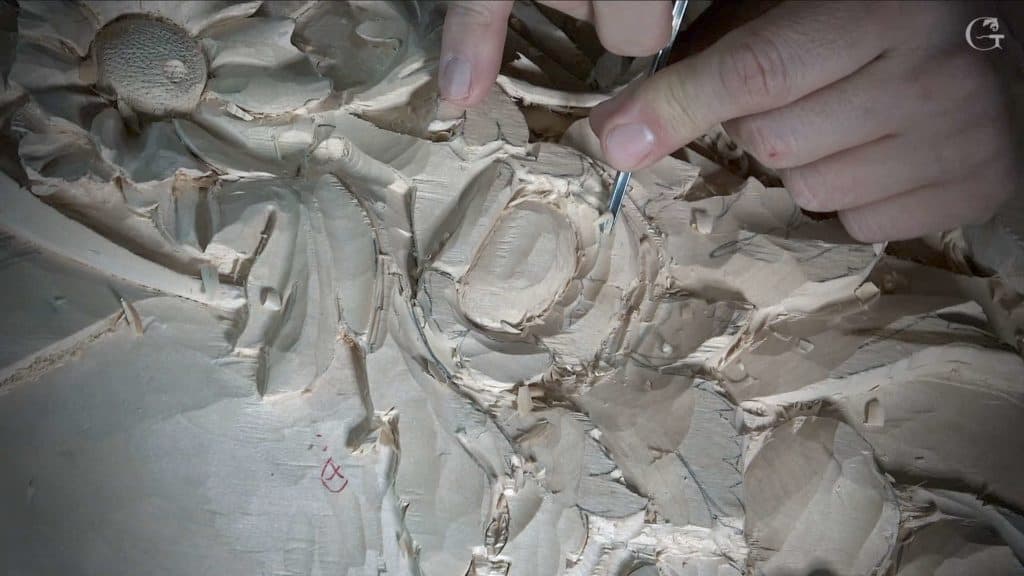
Alexander Grabovetskiy, woodcarver, School of Woodcarving · Published 2021
What does a wood carver mean by "lay it"?
Quick answer: In the first video of Venice Room 138 I plan a slope with the big number seven, laid nearly on top of the surface. In other lessons I name the same move with a number 11, a veiner, a V tool or a knife, on its side, flat or really low.
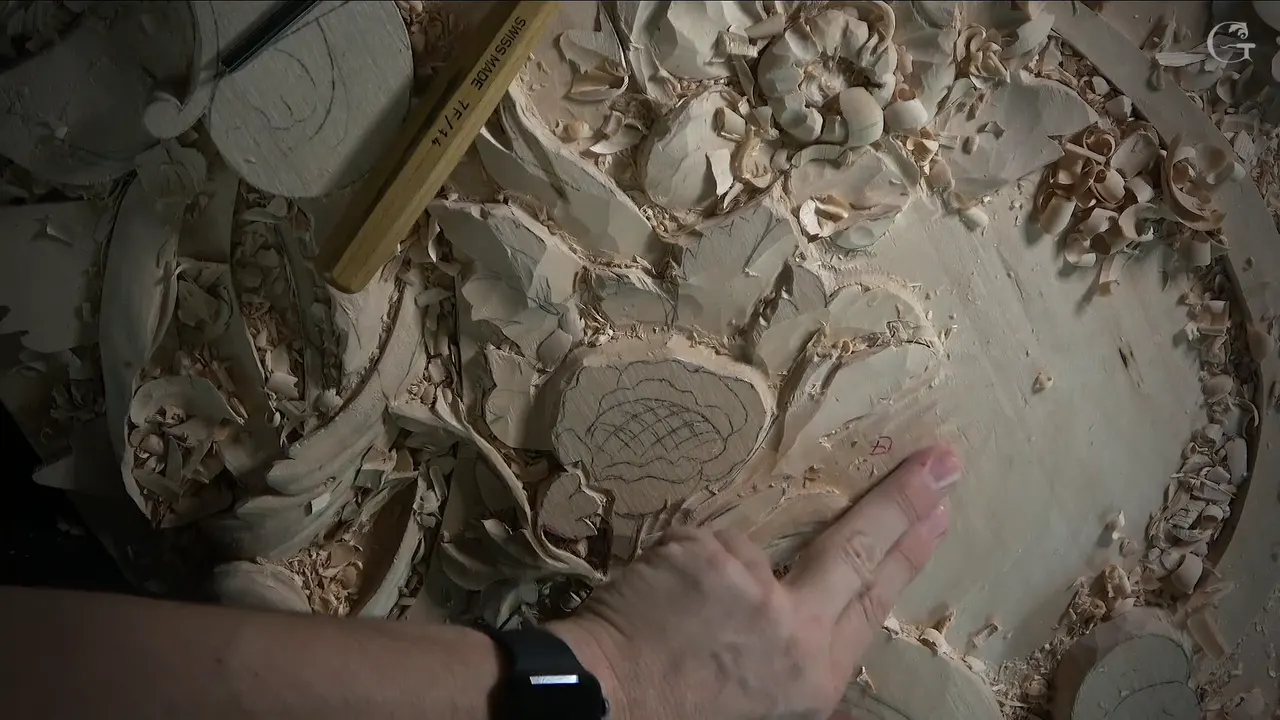

In Venice Room 138, video 1, I say "I want to slope completely like this" then "I'll take number seven, the big one. Three inches" (76 mm), "and I'm going to lay it almost right on top of that surface." That line is what I mean by "lay it." The words come back in my Venice Room, Hashemi, Roman, Greek and Hazelnuts videos, beside a tool set down on its side, flat or really low. Lesson 138 comes first below, and the other lessons follow, grouped by the tool.
Ever held a gouge so flat against the wood that its edge barely bites? Did you wonder how a tool lying down could shape anything? Then you know the odd feel of a tool that rests instead of standing up, and below is what I said at the bench when a tool lay down.
What did I plan to lay on that surface in video 1?
A slope came first. "So in this case, for example, I want to slope completely like this. That movement." I add that the slope need not be flat. After it, the tool: the big number seven, three inches. Then: "So that is the idea."

The flower was next. "So now, let me attack that flower, I guess." My plan was to "walk around first with number seven and chop straight down whatever the boundaries I have." In video 2 I say "this flower is more like relief carving" and then "It is relief carving. Very much it is."
What came back in video 3 of lesson 138?
The number 7 returns at the start of video 3, with a roll: "And I'm also going to need to roll this side opposite direction also." The pick is "the number seven." It does not really have to be that one, I say. I could still use number three and take it a bit at a time.

What am I after? "That feel it goes from inside, go up and then rolls back." Underneath is a plan too. "And yes, underneath, of course, it's going to be undercut. And I can probably hit that with the one millimeter right away" (about 1/25 in).
The petals come next: "So now, it's time to work on the petals." I offer a look from above, and I am "not sure if you're able to see it or not." So I clean up and vacuum. After that: "I vacuumed that, and now you can see much better picture." I also "recreated some line drawings pretty much for you to understand what is going to happen next."

The work goes on with the same tool. Number seven is the pick, and the aim is "that motion of rolling from inside." The roll is done "by just rolling little by little underneath." I also need to chop out "parts I don't really need." My separations start next, and one of them, I say, "can go right underneath."

The cleanup around it takes a smaller tool. "I need to clean a little better surrounding area. And let me take smaller number 11, three millimeters" (just under 1/8 in), "and take care of it." A check on how far I can go follows: "I cannot be too deep, but I still have some of the material left, so I'm okay. I should be safe."

The petals roll the other way. I want to roll those petals "opposite direction, just like that" with number seven again. That will give me even more dimension, I say. A slip follows: "Not dementia, dimension."

The video ends with "secondary petals growing from inside." If you asked me what type of flower it is, I say, "I have no idea. Some kind of flower." Then I "clean little bit that surface" and the tool for the petals is "two millimeters" (5/64 in), a number 11 that will "go around."

Did a tool lay on its side in other Venice Room lessons?
Yes, and I said so in Venice Room 82. In video 10 I say "Yet again, three millimeters. Now I'm going to lay it on the side, on the left wing." A better cleanup waits for later, I say, until I establish the final form of the movements. "But for now, it will do." I am also "not sure if I'm happy or not" about the whole, and I "have to probably roll it."

Video 11 of that lesson gives a laid tool another job. I need "to make sure that is actually flat with that surface" and I name "number one" as "the best double bevel." With it, "I can lay it right on a surface and create a rotating cut." I exaggerate it in slow motion, and the aim is "really at the same level, I should say."

The bevel comes up again. A double bevel works, I say, but "a single bevel like this would help even better," because it sits on a flat part and "that's not going to move anywhere from the surface." A trick of the trade, I call it.
A veiner does the same in Venice Room 66, video 3. "Number 11, of course," I say, and "a veiner, 30 millimeters" (1 3/16 in). Then: "See what my point is with the veiner, I can actually lay it on one of the sides" and the depth is "much shallower on this side and much deeper on that side."

A flaw gets no cover. "Don't pay attention, that is a little rough on this side. That's okay." I explain: "One side is clean and another side is not too clean."
How does a laid number 11 behave around a pipe?
Video 7 of Venice Room 44 starts with a size. Just before it I note "another division on inside," which is "really not bad at all." Then: "Let me use number 11," I say, and "maybe half an inch" (about 13 mm). I want a little more out of that pipe. Laid on one of its sides, it will give the middle almost no concave and the end a deeper one. About the whole shape I say: "I'm not losing overall shape. It still goes upward."

Venice Room 57, video 3, makes a claim about one tool. "I can almost lay it just on the side of it and create number three sweep, or number three sweep, I should say." A few lines on: "And I can go how deep I wanted to. Okay? That's wonderful." A little later I give the size: "I'm using still 12 millimeters" (a little under 1/2 in).

For a slight concave beside a pipe, Venice Room 30, video 11, plans "the same trick with the number 11," the tool on its side, and then "that more pronounced cut closer to the pipe and less pronounced to that ridge."

A laid tool is only a maybe in Venice Room 58, video 7. "Let me use 2 millimeters," I say, since "for some reason, my 3-millimeter tool is not there." The maybe is short: "lay it down really low." After it comes a test, "let me see if I'll be able to do exactly the same from opposite direction." And then "Yes, I am, actually."

What did a spoon veiner rest on?
Venice Room 110, video 2, brings a bent tool to the same job. "I'll take just number 11 and 4 millimeters" (5/32 in), "but in this case, I'll take a spoon veiner." It goes "right on the side." My next thought is a smaller one, "the 2 millimeters."

A plan sits in Venice Room 113, video 1: I say "Let me relief this area." Then comes a plan to undercut with a number 11 laid on its side, and I hold it back. "I'll take care with that a little later, not now, okay?" The inside has more details to come. "I don't want to jump too early to that stage."

Does a V tool lie flat too?
In Hashemi Flowers 26, video 3, it does, and the shadow is the reason I give. "The same idea," I say, "even if it's a backside." My plan: "a V tool, lay it flat, and make a small, not too big, but small undercut."

Hashemi Flowers 12, video 4, tilts it. "A V tool again" comes first, for a "little deeper separation cut." Not afraid to set it on an angle for a little undercut, I say. A warning rides with it: "don't do too much because we have different detail on this side."
The Roman course says the tool size is not fixed. In Roman Acanthus 9, video 3, I say "6 millimeters, 45 degrees V tool." Neither the 45 degrees nor the number 16 is fixed: "Any V tool will work." I plan to start from the middle of my leaf, go "that direction" then do "exactly the same" from the middle again. Then the laying: "One side of the V tool will stay flat." "Take a mallet," I say, then "Yeah, I don't need the mallet."

In Greek Acroterion 5, video 4, I spend a while on how to hold a blade, with a finger on the handle, before the laying comes. Then comes a change, and the plan is to lay it at a "really low angle" and "create my channel." Then I add "Just slicing carefully."

Can a knife rest low as well?
In Carving Hazelnuts, lesson 8, video 2, I say "Let me tell you about this special knife. See how thin the handle is." I add that some of you probably had a question about it. My answer: "Because I can lay it really low when nothing is going to be on my way. So that is why in this case I actually made that handle really really thin."

In Chamomile and Bow Rosette 4, video 3, I say "Just laying on the side and attack and get rid of some of the mess." My aim there: "All I need is just create a really, really good shadow."
Furniture Panel 37, in its third video, has me say "That's why I said number 11 and half a millimeter" (about 1/50 in), a tool among the "best friends of the furniture makers." On the tool's position: "In my case, it's gonna be on the left hand side." Then: "you gonna start undercutting. Not much, not much, but even small undercut." And: "Unfortunately you don't see, but it's already cast some shadow."

Where did each tool lie?
The table keeps one row for each video, listing the tool I named and the way I said it lay.
| Lesson and video | Tool I named, and its size if I gave one | How it lay |
|---|---|---|
| Venice 138, video 1 | The big number 7, three inches (76 mm) | Almost on top |
| Venice 82, video 10 | Yet again, three millimeters (a bit under 1/8 in), tool not named | On the left wing |
| Venice 82, video 11 | Number 1, which I called the best double bevel | Right on a surface |
| Venice 66, video 3 | Veiner, 30 millimeters (1 3/16 in), also a number 11 | On one of the sides |
| Venice 44, video 7 | Half an inch (about 13 mm), maybe, on a number 11 | On a side |
| Venice 57, video 3 | This tool, 12 millimeters, making a number 3 sweep | Almost on its side |
| Venice 58, video 7 | Two millimeters (5/64 in), as the 3 was missing | Down really low, maybe |
| Venice 30, video 11 | A plan: same trick, using the number 11 | Just on the side |
| Venice 110, video 2 | Spoon veiner, 4 millimeters (5/32 in), in place of a plain number 11 | Right on the side |
| Venice 113, video 1 | To undercut later, I named a number 11 for a plan | Planned, on a side |
| Hashemi 12, video 4 | Again a V tool, for a deeper separation cut | On an angle |
| Hashemi 26, video 3 | V tool, for a small undercut and a shadow | Lay it flat |
| Roman 9, video 3 | V tool, 6 millimeters (a bit under 1/4 in), 45 degrees | Flat, one side staying flat |
| Acroterion 5, video 4 | An unnamed tool, after a talk about holding a blade | Really low angle |
| Hazelnuts 8, video 2 | A special knife with a really thin handle | Really low |
| Furniture 37, video 3 | Half a millimeter (about 1/50 in), and a number 11 | Left-hand side |
Which tool on your own bench could lie down for a pass: knife, V tool or veiner? Every lesson named here opens with access to the school, paid monthly or yearly and renewed automatically until you stop it. Lesson 138 lives on the Part 12 course page, with lesson 137 before it and lesson 139 after. The Venice panel, the hazelnut course, the furniture panel, the acroterion course and the chamomile rosette are all wood carving.
How it's done
- Plan the slope. In the first video I wanted a slope, and I said it need not be flat.
- Name the big tool. Number seven, the big one, was my plan.
- Set it nearly on the surface. The plan was to lay it "almost right on top," and I called that the idea.
- Roll the side the other way. The third video has me needing to roll the side the other way, with the seven or maybe a three.
- Plan the undercut underneath. The underside will be undercut, I said, probably by the 1 mm tool (about 1/25 in).
- Show the carving from above. Clean up a little and vacuum, I said, so you will see much better.
Frequently asked questions
Which tool did I plan to lay almost on top of the surface in lesson 138?
The big number 7. A slope was the aim, one that did not have to be flat, and I said the tool would sit nearly on the surface.
Which tools came back in the third video of lesson 138?
Number 7 came back for the rolls, plus a number 3 as a maybe. A 3 mm number 11 (about 0.12 in) was for the area around the flower, and a 2 mm number 11 (about 0.08 in) was for going around the secondary petals.
Where did the one millimeter go in the third video?
Underneath, a plan: the underside will be undercut, and the one millimeter can probably take it right away. One millimeter is about 0.04 in.
What to carve next