
Alexander Grabovetskiy, woodcarver, School of Woodcarving · Published 2021
What does a wood carver mean by "in nature"?
Quick answer: The words show up in Venice Room 139, video 3, about an arch. In other lessons I used them for flowers that look perfect and are not, for straight lines, for a berry that is not a true round, and for the way a petal grows.

In Venice Room 139, video 3, I said my arch for cut number two would be "more like you would see in nature." The same two words turn up in my Hashemi flowers, Furniture Panel, Modern Acanthus and Lily Box lessons, each time about different work.
Should every carved petal be round? Must a line be straight? Here is what my hands were doing when I said it in lesson 139, and where else I said it.
What did I do on the arch in lesson 139?
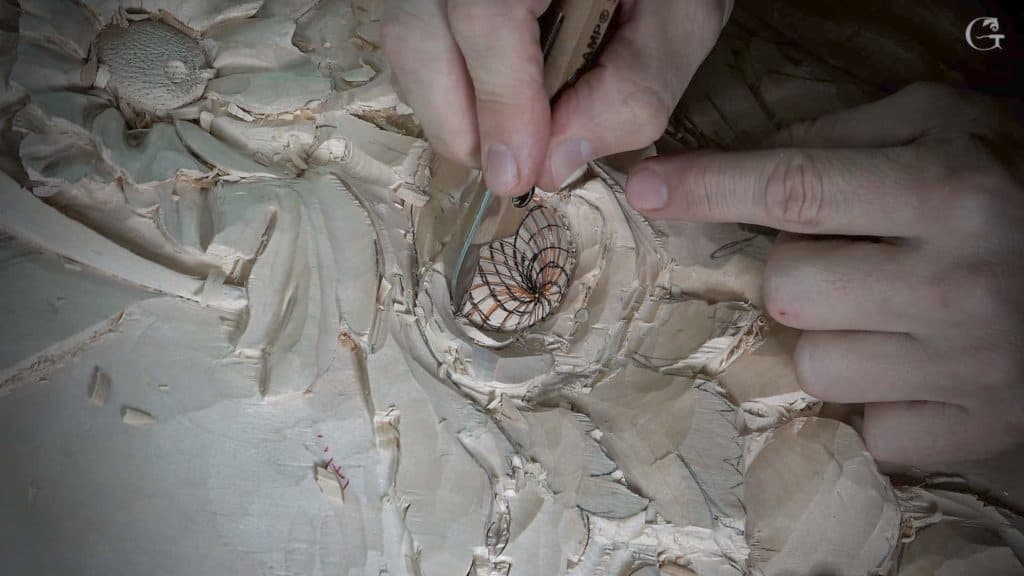
The video opens on "Cut number two." The arch would run in a different direction and not be as slight, and the shape was meant to be "more like a golden ratio arch, if you wish." Then came "See how I just swirl it" followed by the line about nature. After that: "And looks like I am doing okay."

"I'm just eyeballing it," I told you. It would give me "the true three dimensions" and "really nice lines movement," I thought, and I offered a look from above. One of a few different ways to hit it was a V tool. Still, "it's not going to be authentic to the period," so I planned on just a skew. "Skew knife. Skew chisel, I should say." Those words about nature got no more explanation in that video.
How did the orange lines go?
I planned to start my orange first, with a straight-down cut, maybe slightly angled. Color helps me: "Just because I use different colors, it makes it easier for me to see." On depth I said "I don't need to do deep cut, but still deep enough."

"And all of those orange lines." Afterward: "I don't see which one I cut, which one I didn't." The heel of the tool was another way to make that cut. Chipping showed up. "See, I'm chipping, so I've got to be more careful right now."

A small knife was one more option, and I told you its brand is German but "this one is Swiss-made." Any knife you own works: "Whatever knife you have." You follow all of the lines we just created. Grain matters here, too. "The grain changes direction. So I have to be really careful with that." Also: "I don't want to miss any" and "So that is cut number one."

How wide is the V cut near the center?
"I really have to get approximately one millimeter away and angle it and create a V cut close to all of them." That is 1 mm (0.04 in). Then "almost nothing when we get closer to the center."

The magnifier came up right here. "If you do have a magnifier glass, that would help a lot." To change direction, "just change the direction. That's it." Then "Essentially, it is a V cut" and "I really need to see better." Pulling my light was the plan, "Otherwise, I can't just see."
The opposite direction follows the same idea. The first cut would go on all of those lines, and the secondary would be "exactly the same, one millimeter away, and it's a V cut and the V cut in opposite direction." Off camera was my plan for that part, "because I really need to see better, otherwise I'm going to make mistake."

Did I carve the arch to perfection?
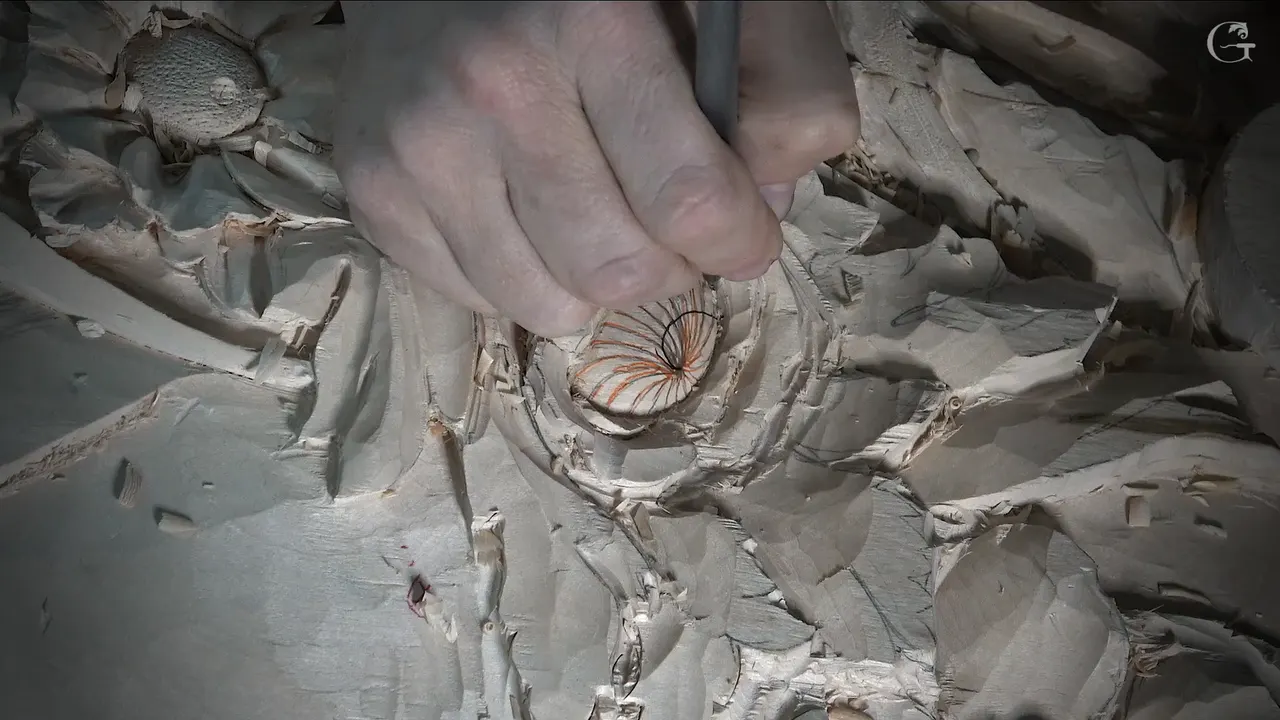
I had "pretty much done both directions my cut." Then: "I could spend a lot longer, definitely, and just to get that to the perfection, but I really don't need to." My reason: "I also want to texture it, okay, inside of here, same like what I did right here, by using my punch." That way I would not spend too long on it.

Texture would "look more realistic," I said, and "You're still going to detect those movements." After a different angle for you: "You still see those lines. You still can detect them, but the texture what I've done, it just blends those designs together."

"So the same texture goes inside of this flower." My closing words: "There is multiple ways to do that, but I decided to do that way, to blend all three. It just makes much quicker, and I think it just does a great job."
Where else did I say "in nature"?
In my Hashemi flowers, Venice Room 74 and 134, Chamomile rosette, Furniture Panel, Modern Acanthus, Lily Box, Maine class and Tray of Blessing lessons, and in two of my design courses. Each passage below belongs to its own video.
Is any flower perfect in nature?
Hashemi flowers 30 opens its first video on that point. "Well, first of all, we have to understand there's no such a thing as perfection in nature." The flower would be divided in five petals, "Approximately five" and "You can divide in seven if you wish, or eight." The idea was "to make it look like you're drawing a flower on a piece of paper, and you make those petals just semi same. They're not the same, but just approximately."

Video 4 of that lesson comes back to it. "Try not to make it perfect. Make it some waviness." Then "Because in nature, you're not going to see a perfect round." On some spots, maybe "number nine or number eight, just to create even more beautiful look or more shadow lines."

In Hashemi flowers 24, video 2, I said they do not need to be perfectly round, just "Looking round." Then "Like in nature, sometimes when you look at the berry, it looks like it's round, but when you look closer, it's not really rounded. So it's not true round berry." The tool: "number seven and 10 millimeters or three-eighths." That is 10 mm (0.39 in), and 3/8 in comes to 9.5 mm. On one side, "I don't like how it looks," I said, and "I do know it takes a long time."
Variety is the other side, and Hashemi flowers 33 has it in video 1. "There's many different types in nature." On that carving I wanted "just maybe a few varieties, not too many varieties of the flowers." The plan was to divide a flower in five, with a different pencil, and to take "probably V tool first, parting tool."

A flower body was under my hands in Venice Room 74, video 3. Perfect shape? "I don't want to create perfect shape because it's never happens in nature." The count of divisions "could be five, it could be eight, if you just follow the Fibonacci sequence." I made it five, and the divisions did not need to match exactly. One would be the widest, one "like a medium," one a little smaller, and one the smallest. I also asked "Can you see a flower?"

Advice comes in the first Chamomile and Bow Rosette lesson, video 2. "It doesn't have to be perfect. Quite the opposite. I highly encourage you not to be perfect with those movements." Then "Because in nature, those flowers, they look perfect, but if you try to look closer, they're really not." The result will be "more organic if it's not perfect-ish."

Over in video 3 of Venice Room 134 the same thought shows up. On waviness: "I really like the idea of being wavy when I'm carving flowers, because you're never going to find any perfect shape in nature, in creation." The tool was number seven at 14 millimeters, or 0.55 in. About half an inch (12.7 mm) from the upper part down below was "good for this type of flower."

Is there a straight line in nature?
Furniture Panel 8, video 2, says no. "In nature, in a creation, you can't find any straight lines. Everything has an arc or a sweep or a curl." Only two elements, "lots of dots and lots of different curls or curves or arcs." Art adds three more: "vertical line, horizontal line, and diagonal lines." I called the mix a unity of human and divine.

Inside an acanthus leaf, Modern Acanthus 5 gives the rule in video 1. "Don't create the straight line. Remember, nothing is straight in nature. Everything curves." The cut was to be "just the curvature and you excavate slightly." A flat version sits in the Law of Creation lesson of my design principles course: "Nothing in nature is straight. Nothing."

Do I copy nature, or go past it?
In the Tray of Blessing, lesson 3, video 3, I said "You exaggerate those pipes, you exaggerate those veins," so that way it looks really nice. And "You really don't see huge pipes like that" in real life. "But it looks natural on the wood carving." A question about the classical approach followed, and my answer included "it's more exaggeration of the nature than anything else."

A story sits in Byzantine Acanthus 3, video 1. I had been reading a book about old masters of the 16th, 17th century. One person asked whether artists who carve stone and wood try to be as good as nature, to replicate it. The master said no, and "be even more than nature." My next words: "not everything connects to the same line" and "So it's actually exaggeration process of nature."

Acanthus over Moldings 7, video 1, takes the other side. My words: "I don't have to do exactly the same all around overlap. I can just play and some of them gonna be the same, some of them gonna be different." In nature, I mentioned before, the middle part "usually just repeats the same pattern," but once it opens, "they can just create all different variations of movements."
How does a petal grow in nature, and what does the cut do about it?
The Maine class gives the longest answer. In class 12, video 2, I wanted a "smaller cut maybe the 1/16 of an inch concave," which is 1.6 mm. "in a real life in nature those flowers those petals they grow." At the start, "they're all folded like this and when they grow outward" then it "just opens up like that." But "right in the middle in those spots, it's always like concave" and "not all flowers, but a lot."
"Does it really matter? I think it's gonna give me a little more natural look. If I gonna follow this rule. And this flower gonna look much better." Sharp tools came up in that lesson as well: "Sharp Tools really important." A golden ratio came up in that lesson too, one I did not need in that case.
Lily Box 10, video 8, has the lily. Of the lily: "the real-life flower, a lily flower, it's just divided in two sections. Two triple sections." And "So that is, for some reason, in nature how it's created."
The Principles of Design course has a Fibonacci lesson, and in it I said "In nature, everything is in the Fibonacci sequence." Look at a flower and count its petals, I said: it is "always going to be on the Fibonacci sequence." Then "five petals, eight petals, 13, or thousands."
Acanthus over Moldings 8, video 2, puts a number on it. "It's like a golden ratio. To simplify. That's a 62% versus 38%." Beyond that, "everything fights everything in nature." Three petals "probably conquer 62% of overall space and those two guys conquered 38%."
Does the color of a carving follow nature too?
In Lily Box 13, video 8, I blended color and said "The upper part is always darker versus the stems itself. So I want to make sure it's distinguishable." Of the darker color I said it would be "more authentic-looking" and added "Okay? Just like in nature."

Which sizes did I name in these lessons?
They change with the flower, and here is what I named in each video, side by side.
| Lesson | What I said about nature | Tool or size I named in that video |
|---|---|---|
| Venice 139, part 3 | The arch in video 3 | About 1 mm (0.04 in) away, as a V cut |
| Hashemi 24, video 2 | A berry that looks round but is not a true round berry | Number seven, 10 millimeters (0.39 in) or three-eighths (9.5 mm) |
| Hashemi 30, video 4 | A perfect round, not seen in nature | Number one at 8 millimeters (0.31 in) |
| Venice 134, video 3 | You are never going to find any perfect shape in nature | Number seven, 14 millimeters (0.55 in) |
| Maine class 12, video 2 | Petals fold, then grow outward, with a concave in the middle | A concave of 1/16 in (1.6 mm) |
| Moldings 7, video 1 | Overlaps that are not all alike | Number five, a quarter inch (6.4 mm); I also said 6 millimeters (0.24 in) |
| Byzantine 3, video 1 | Be even more than nature | A water-drop eye, five millimeters (0.2 in) the most, about 3/16 in (4.8 mm) |
Does your own relief have a round that is really round, or a line that is really straight? Every lesson named here opens with access to the school, paid monthly or yearly and renewed automatically until you stop it. Lesson 139 sits on the Part 12 course page, next to lesson 138 and lesson 140. The other courses live in the Hashemi flowers course, the Chamomile and Bow Rosette course, the design principles course and the Maine class. All of it is wood carving and ornament.
How it's done
- Start with orange. Orange came first in my plan, with a straight-down cut, maybe slightly angled.
- Pick a skew. One option was a V tool. I planned on a skew chisel instead.
- Watch the grain. Grain turns, I said, and that calls for being really careful.
- Go a millimeter away. The next cut goes about a millimeter (1/25 in) from the first, angled, as a V cut.
- Add texture. I wanted to texture it with my punch. The lines still show, though the texture "just blends those designs together."
Frequently asked questions
Which tool did I plan for the arch in lesson 139?
A skew chisel, I told you, out of a few different ways to hit it.
How far from each line did the V cut sit?
Approximately one millimeter, I said, about 1/25 in, and almost nothing when we get closer to the center.
Did I say a magnifier was needed?
I said a magnifier glass, if you have one, would help a lot. I also planned to pull my light.
Is a berry a true round in nature?
What to carve next