
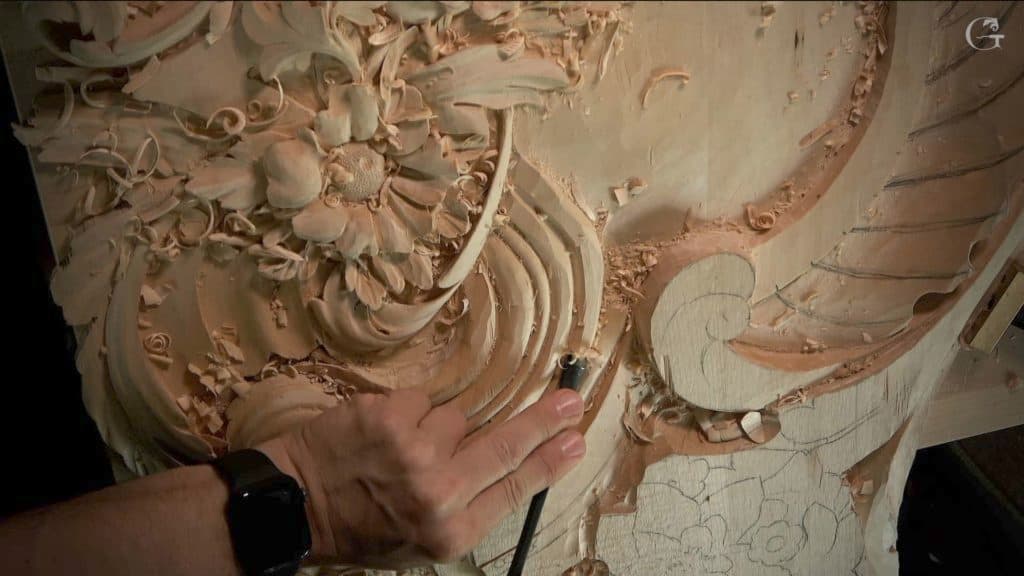
Alexander Grabovetskiy, woodcarver, School of Woodcarving · Published 2021
What does a wood carver mean by "radius"?
Quick answer: A back bent of number 7 can reach inside radiuses, I said in lesson 141, video 3. In my other lessons the word sits beside a true radius on a number nine, none on a flat chisel, and an inner and outer curve on a leaf.
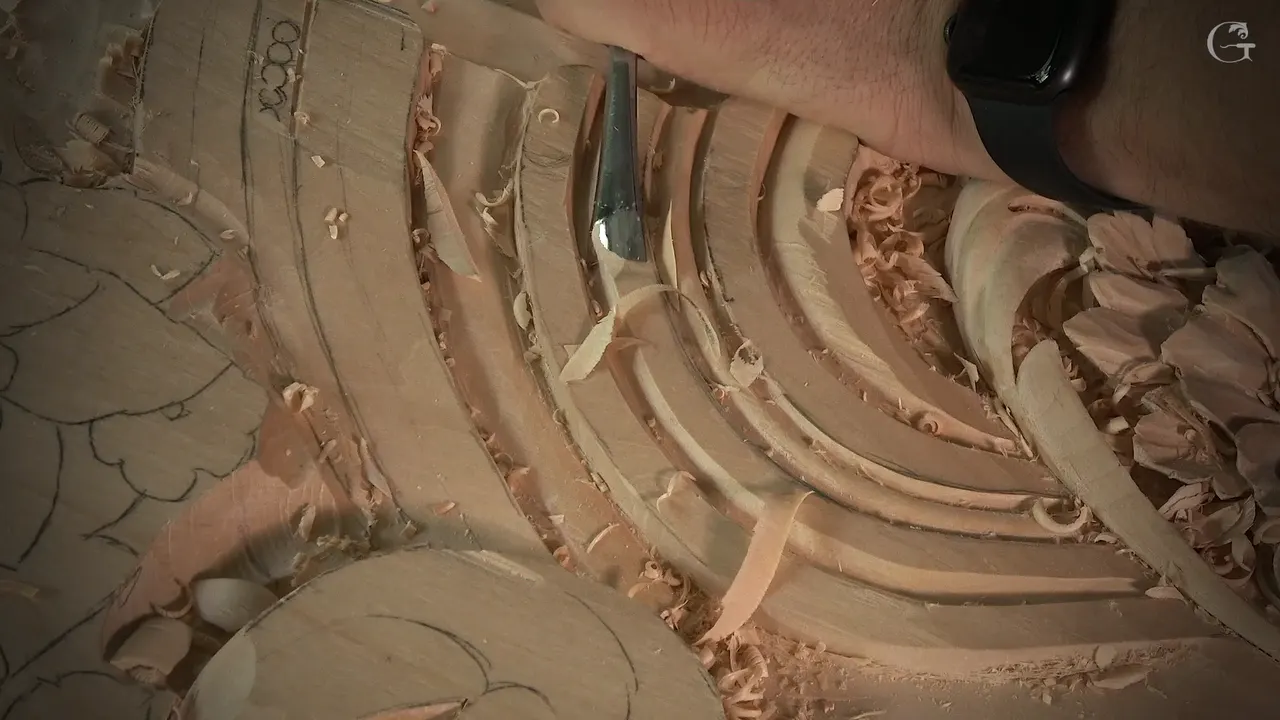

In part 3 of Venice Room 141 I said a back bent reaches inside radiuses for me. My other lessons use the same word for the curve of a gouge, for the two curves at the end of a leaf, for a rounded inside corner and for a circle drawn with a compass. First below is part 3, and then each lesson, named and linked.
Ever laid a straight gouge into a tight curve and felt the steel stop short of the wood? Did you wonder if another tool would have reached it? Then you know the trouble, and part 3 is about what I did with it.
What did I say in part 3 about inside radiuses?
The video opens with a change of side: "So I'm going to have to attack from opposite side." Later comes a line about the wood: "Again, have to keep an eye what my grain does." Next came the fix: "I mean, the grain of the wood, not my grain."

The tool is the point of the part. "And yes, back bent would help much better in this case." Then the line I come back to most: "But even with the straight tools, it's still possible to do a good job. Just to change the position and attack that from opposite side."
Later I said it again, with more weight: "if you do have a back bent, it is always better to have a back bent." With one you can "just attack with the right angle and so on" and it is "so much easier" with one. Where the grain meets, I said, I have to attack from the opposite side and blend it.
Which number 7 was in my hand, and how big?
Part 2 ends on two lines of plan: "I need to convex it." Next comes "Let me use number seven upside down, 14 millimeters" (about 9/16 in). In part 3 the tool gets named: "It's still number seven back bent, maybe a little smaller than 14 millimeters, about maybe 12 millimeters or so." Twelve millimeters is a little under 1/2 in.

The line that carries the word follows at once: "But still, I can get on inside radiuses with no problem with the back bent." Near the end of the video came my plan: I would spend a little more time to "make my cuts somewhat cleaner and nicer, I should say" and then: "But that is the idea."
A doubt shows up in part 3 as well: "Maybe it's little too deep cut." I did not know yet, I said, and we would see. My way out was "I can always make my kind of axis little lower." I would check "little later how it looks in overall" and if I did not like it, "make it lower with no problem."
What does a true radius mean on a gouge?
In Venice Room 52, video 10, a number nine was the tool. It is "a half a circle," I said, "a true half a circle." Then the test: place it and rotate the tool, I said, and "it's going to end up at the same position." The same goes for the whole family. "All of the gouges, actually, doesn't matter how big or how small, it's a true radius." The example was number 5, "about 16 millimeters, about five-eighths of an inch."

The number 11 sits on the other side of that line. "They are not true radiuses," I said. And "like a Latin letter U." You cannot place one and "create perfect hole," so you "can't cut plug." Then: "So that's the big difference" and the shape was "a letter U." For the plug cut I was using a number nine, about 10 millimeters, three-eighths of an inch. A number eight would do, I said, but "number nine is better."
Venice Room 49, video 9, has me using a number 11 for the relief cut: "a gouge is always the true radius. This is not." The size I named for that tool was seven millimeters, "a little bigger than a quarter inch."
The radius of a circle is the distance between its middle and its edge, and a half circle is half of one. On the steel, number nine follows that half. A flat tool has none.

Does a flat tool have a radius at all?
In Floral and Molding for the Panel 2, video 3, the spoon tool comes first: "let me get, again, my spoon." After that: "it's a spoon chisel because it's number one." Of a flat tool I said "As you know, a chisel is always flat. It's the absence of radius, absence of sweep." And of a tool that has a sweep: "then it's a gouge." A chisel and a gouge part ways at that line, and the sweep decides.
Is radius the same word as sweep in my lessons?
I put them side by side more than once. In How to Sharpen Skew Bent Gouge, video 1, The skew, I said, had "nothing complicated about this tool," because "you're still actually pretty much working just that radius or sweep." And it did not matter, I said, "what shape you're making at the edge, if it's skew or not skew."

Over in Flower Rosette 3, video 1, the line was "I need to find even smaller radius or smaller sweep," to work "this direction right here." I guessed at "probably even number seven or even number nine or eight" then "Let me check if I'll be able to use my number eight." The words that came next were "And yes, number eight does look good."

My words got fixed aloud in the table apron course, workshop 8: "just different sweeps. I mean, different diameters." Then: "Radiuses, if you wish."
How do I find the right radius for a spot?
I look for it with the tool. In workshop 9 of the apron the line was "I need to find the right radius" and next came "A little smaller" then "Even smaller inside radius" and last "And outside."

The right sweep on a gouge helps, I said in workshop 8. "You just kind of rotate around the main radius, and it helps a lot." This is why I have so many sweeps, I said, and it makes my work "a lot quicker." A perfect fit is not required: "It doesn't have to be just a perfect fit." What I was doing was using "just the edge of it" and "follow along the profile, just little by little." Then: "This one looks like a number five will do a really good job right here."
Can one gouge follow more than one radius?
One can, and I said how in Furniture Panel 16, video 7. Number two again was the plan, following the outline or the initial curvature. "I'm not making my cut straight down. I'm actually kind of angle it a little bit, my tool." Then: "you can control also the curvature itself." And: "See? The radius of this section is different from this section, but I'm still able to use the same tool because I'm using only pretty much corner of it." Then: "Part of a tool."

A little later in that video came "Let me get the cleaner cut and try number seven and 14 millimeters." And: "looks like it fits just perfectly." I gave the size as "a half an inch, little more than a half an inch" and then "14 millimeters." Part 2 of lesson 141 ends with a plan to try a number 7 at 14 mm.
The bigger gouge came up in workshop 9 of the apron. My gouge there was "the same gouge, what I used to establish my radiuses." A bigger gouge, I said, can do work beyond its main radius. "You can use just the one part of the gouge, and just to get to the corners or just to use it as a small gouge."

What are the inner and outer radius on a leaf?
Two curves, on the oak apron. Of an acanthus leaf I said "it's never like a flower leaf" then "Sometimes it does, but almost never." So "most of the time you can find two radiuses." One was the inner radius and one the outer, in my words. Then why: "that always makes a kind of 3D look of the end of the acanthus leaf." And: "wherever I can find a spot to utilize that, I do that. That gives more interest to the design."

Later in the same video it came up over the wood. "Number five again, but small. So that is the inner, and this is going to be number five, bigger one." Then: "Our outside radius. This one's inside, and this one is on outside." The apron lesson is linked above, and this page stays with the word.
How does radius work on an inside corner?
A rounded one. In video 3 of Lily Box 5 I followed a line "to one millimeter and also on inside right here" with a number 11. "I really don't want to see a really sharp point right there inside. I want to make sure it's round." Right after it came "So it has some radius on inside." Last: "That way, it's going to look much cleaner."

In Venetian Flowers Rosette 5, video 3, a rounding comes up too. I had to make it like, "I don't know, fillet and fillet on both sides." Then: "It's not supposed to have the true radius, but somewhat." My plan was to chop down those sections first and go about maybe two thirds of the way to the background, and "No more than that."
What is a fillet with a big radius?
In video 5 of Lily Box 7 I said: "When I'm saying fillet, just give some roundness. That's what I mean by to give a fillet. It's like a chamfer, but with the radius." After that: "Take a half a millimeter, number 11, and kind of undercut underneath of this detail." A half millimeter is about 0.02 in.

The fourth video of Lily Box 4 plans a bigger one. It would be "just like a fillet with a bigger radius this way," I said, and I would need "a flatter gouge, maybe like number two and 12 millimeters" (about 1/2 in). Number three will work also, I said, and number four, and I would use number two. I also said I don't want to touch my edge.

Its fifth video came with "some radius right there. Convex and convex." My words next were "That would be good idea to use a back bend for the operations like that." The tool was "Same number five and a quarter inch, but back bend." And why a back bend? "Because this side is in my way, okay? And with back bend, I can get closer to the areas." I added "it's the same sweep, same size, six millimeters, quarter inch. It's just bends it backward."
Where does a compass radius come in?
On paper. In Furniture Panel 7, video 1, I drew a square by hand and said "if you divide this square right in the middle, and you take this point and that point, and that would become my radius." The compass would then make "the real true phi rectangle, which is the golden ratio, 1.62." Another point, I said, gives root two, and root three after it. That drawing was "just the concept," I said. The golden ratio is a ratio of about 1.62.

The word turns up again in Greek Acroterion 1, video 5, where I named a molding "like ogee on a radius or even more, just a complicated rococo form." The only way you could do it, I said, was "with your gouges, with your chisels. They just carved it."
Where does each radius show up?
The table keeps one row for each place I said the word, with the size I named.
| Where I said it | What the radius was in that place | Size named |
|---|---|---|
| Workshop 141, third video | Inside radiuses reached with a back bent, which I called always better | About 12 mm number 7 (0.47 in) |
| Furniture Panel 16, video 7 | One gouge, using only the corner of it, for a section with a different radius | A 14 mm number 7 (9/16 in) |
| Venice 52, video 10 | Number nine as a true half circle, number 11 as a letter U | About 16 mm number 5 (5/8 in) |
| Workshop 49, video 9 | True radius for any gouge, and not for the number 11 | 7 mm (a little over 1/4 in) |
| Flower Rosette 3, video 1 | Even smaller radius or smaller sweep for the petals | Number 8, which looked good |
| Table Apron, workshop 8 | An inner radius and an outer radius at the end of a leaf | Mostly number 5 gouges |
| Lily Box 5, third video | Some radius on the inside, so the sharp point reads round | A 1 mm number 11 (about 0.04 in) |
| Lily Box 7, video 5 | A fillet in my words is just some roundness | Half a millimeter (0.02 in) |
| Fourth video of Lily Box 4 | A bigger radius on the fillet, flatter gouge planned | Number 2 at 12 mm (0.47 in), planned |
| Furniture Panel 7, video 1 | A compass radius that makes the golden ratio rectangle, 1.62 | Ratio 1.62 |
| Venetian Rosette 5, third video | A rounding that is not supposed to have the true radius | About two thirds of the way |
Which radius would you look for first on your own board: a groove, an inside corner or a leaf tip? Every lesson named here opens with access to the school, paid monthly or yearly and renewed automatically until you stop it. Lesson 141 sits on the Part 12 course page, with lesson 140 before it and lesson 142 after. The Venice panel, the apron, the Lily Box and the Furniture Panel are all wood carving.

How it's done
- Change the side you attack from. Change sides, I said, and do the same where the grain meets.
- Watch the grain. The grain of the wood needs watching again, I said, and then "not my grain."
- Reach for a back bent. It is always better, I said, to work with a back bent in the hand.
- Name the size. Number 7 back bent, a bit under 14 mm (0.55 in), about 12 mm (nearly 0.5 in).
- Check how deep it went. Maybe a little too deep, I said, and I can always make my axis a little lower after a look at the whole.
- Take time to clean. More time, I said, so the passes come out somewhat cleaner and nicer.
Frequently asked questions
Which back bent did I name in the third part of lesson 141?
Number 7, a bit under 14 mm (about 0.55 in), about maybe 12 mm (about 15/32 in) or so. Part 2 ends with a plan for a number seven of 14 mm. Here, I said, it is still number 7 back bent, and I can reach inside radiuses with it.
Can a straight gouge still do a good job on a tight curve?
Still possible with the straight tools, I said, if you change the position and come at it from the opposite side. A back bent, I said in the same part, is the better tool in that spot, and I said so more than once.
What is a true radius?
Every gouge has one, however big or small, I said in lesson 52. Place a number nine and rotate it, and it ends at the same position, as a true half circle does. Number 11, I said, is like a letter U, so it does not.
What to carve next