
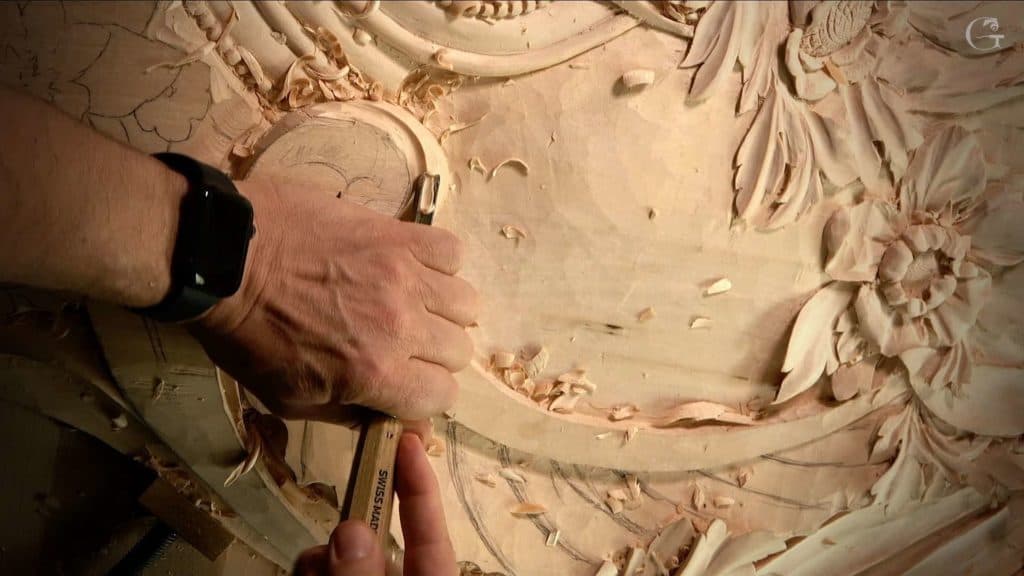
Alexander Grabovetskiy, woodcarver, School of Woodcarving · Published 2021
What does a wood carver mean by "I just think"?
Quick answer: In the first video of Venice Room 142 I said it after I moved my division lines and did not follow the 60/40 rule. In other lessons the same words sit beside a deeper cut, a volute, a back bend, a bead or a small detail I did not have to carve.
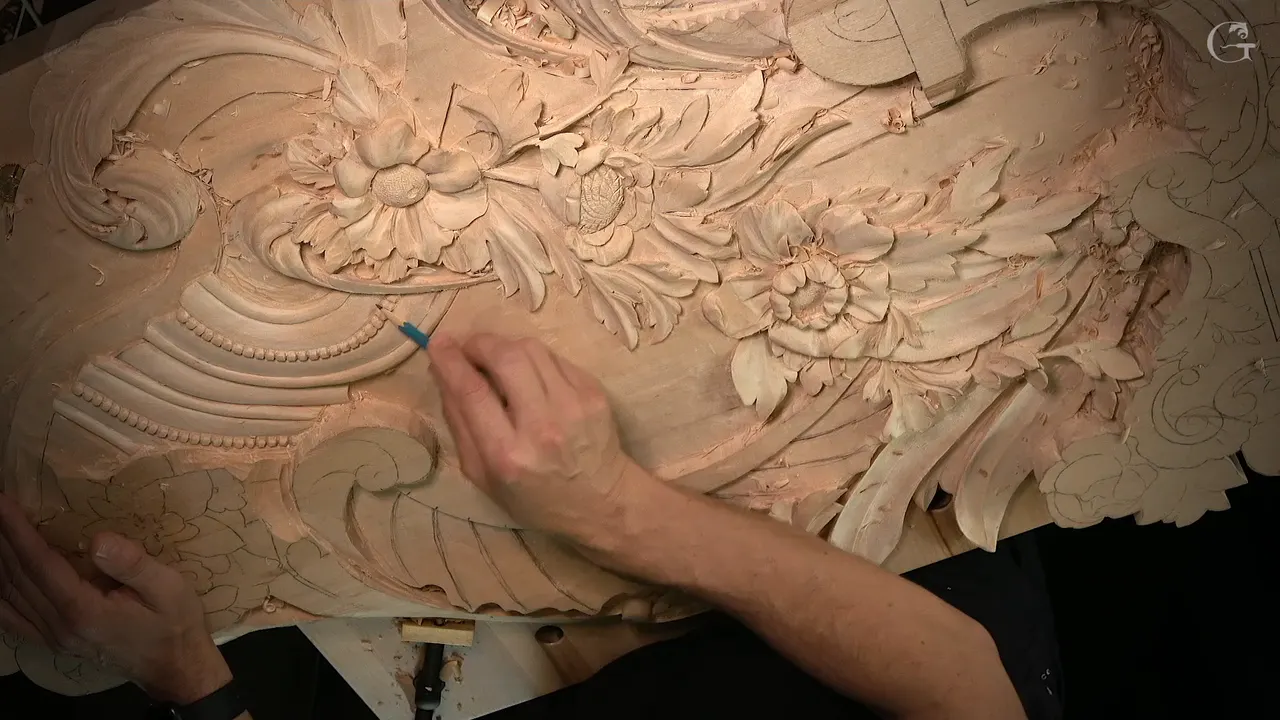

"I just think" is what I said in Venice Room 142, video 1, right after I moved my division lines slightly to the sides and did not follow the 60/40 rule: "I just think it's going to look better that way." The same three words come back in my Lily Box, Venice Room, Furniture Panel, Roman acanthus, Grape Onlay, Gibbons and cutting board videos. Below, lesson 142 comes first, and the other lessons follow in groups.
Ever moved a line by eye, when no rule told you where it goes? Did you wonder if the wood would let you? Then you know the spot I was in, and below is what I said each time.
What changed on the panel before those words?
Video 1 opens with "Okay, so I'm pretty much done with that part." I did some changes, and the camera was "already rearranged" for the next element.

Here is what I had done on this side. The lines had shifted a little, and the rule stayed out "in this case." Then I "just played around and decided to lower down the overall depth." The beads went "a little higher." "In overall, it looks much better," I said, though the panel still needed me to "just clean it and get to the final shape."
How did I weigh the next element?
One element came next, and I wanted to "concentrate right now" on it. A "couple ways" to approach it came to mind, I said. A double volute was one, "with some kind of acanthus moving this way" plus a secondary volute and an upper volute. The other was a double acanthus head, with the second leaf secondary, below the main one.
The second way I called "probably, I would say, most logical." I wanted, though, "some kind of opening in this area to give some lighter feel" and no exact copy of the opposite side. "But we'll see," I said. This part would sit higher than that part. "So that decision is made," I said, and the first pass would run "around this line."

Which gouges did I name for the dome and the second leaf?
I named "number 12, and that would be 12 millimeters, like half an inch or so" with the note "Doesn't really have to be that." A bigger tool was another way in, "like 30 millimeters" (roughly 1.2 in). Depth was the trouble. "When I look from the side, I don't really have enough depth to work around."

"So let me think what I can do," I said. Maybe the movements would be "more shallower." My wish was to "just round that side" and "create a dome." Seeing "double" was another wish. Was it needed? No, I said, but I thought "it's a really good area to show you one more acanthus movement." That movement "used to be common" in the Venetian style I work in.

Next came a plan: a "smaller number 11" and "maybe about seven millimeters" (roughly 0.28 in) for another cut at that section. "I wish I have a lot more material to the surface." Lowering the middle part of the carving was possible, but "I really don't think it's a good idea."

A plan followed: lower the cut "all the way," so that it "feels like it's growing from underneath." That would give "that feel that is double leaf or secondary leaf, so it's not a part of the same movement." My words: "I really, really want to do that. Maybe I can actually go even lower."
The video ends on a plan: a flat gouge, used upside down, "maybe number three." Any flat gouge will work, I said. Working against the grain calls for care, I said. And walking around to "attack that from the opposite side" is, in my words, "always a good idea."
When did I say it about a detail nobody needs?
In a Lily Box video, lesson 2, number 10, I said missing small details is "not the end of the world." My own reason was "just probably for my own sake." My "I just think" there: it looks "much better" when you do them, "even if nobody else is going to see them." And: "Even if it's going to be just you, it's still nice." I planned to use "1 millimeter, number 11" (about 0.04 in).

A separation in Venice Room 16, video 9, needed to be chopped out "right away pretty much," or it would "give me a problem." Once I could see it, I was "still not too happy." One side needed to go down more underneath. "Ask me why," I said. "I have no answer." What I had was "just my opinion" and the detail was "Just extra detail." That detail was not needed, but "something extra like that makes me happy. It's not boring every day, the same thing."

Downhill ran a movement in Venice Room 17, video 7, and all the waste had to go. "Number seven upside down," I said, "but I could use probably number nine. Number nine and a quarter inch" (about 6 mm). I thought the detail would look really nice, I said: "That's why I'm doing it." Otherwise, I said, I need not do it.
More followed. It was "still not giving me the detail yet what I want to see," so I needed another separation. You do not see that detail from above, I said, "but you will see that small detail right here."

A deep excavation on the inside sits in Venice Room 42, video 7. "Don't get me wrong, it's not really necessary." The panel would do without it. Yet the excavation looks really nice, I said, "especially if I'm not losing strength." Sometimes, I said, "it's possible to overdo," but this time "I think I'll be able to excavate." I called it "the plug cutting motion with the number nine." Then: "That's already too weak. No good." And: "I didn't break it completely, but I made it loose."

Video 9 of Venice Room 78 has "Maybe I'll just leave it like that." Then: "this doesn't look too good, this side," so I wanted to "open up this section maybe." Nothing forced me, I said, and it should look really good. My tools "absolutely must be super sharp." The plan was "maybe a two millimeters, number 11" (about 0.08 in), a little deeper in that area. Even "like that," I said, it "would look really nice."
Why did I pick one gouge over another?
A tool I tried shows up in Venice Room 92, video 6: "a back bend. Number eight in 10 millimeters" (0.39 in). I checked and said it was too big, and the size I needed was "just a quarter inch." A back bend was not required, I said, yet I thought it would bring "a really nice movement." The pick was "Six millimeters," for "that bead effect."

I named a back bend in Lily Box 11, video 8, "let's say number five profile and 3 millimeters" (0.12 in), for "even more roundness." Ask me why back bend and my answer is "safer." The part "is just a goose necks, and it just raises above that one." A regular gouge works too, I said: "Still going to work."
Number 16 is the tool in Gibbons class 18, video 2, in the Grinling Gibbons class in Maine. A number 11 would do, I said. My pick was number 16 at 35 millimeters (1.38 in). It "expedites the job," I said, and "makes it much quicker for me." The opposite side would get the same, but a too complex layering might be "too much I guess."

How did it go with depth and shape?
Going around an outline was next in Furniture Panel 22, video 10, where "I do have plenty of depth right here, plenty of the material." My reason was a much better result, "to be honest with you." No mallet was required, either: "I could just do on a push cut, just push my tool just like that and just go around the outline."

Roman Acanthus 7, video 2, in lesson 7, was about doing "exactly the same on this side," "A little deeper." Better that way, I thought. Next: "Let me fix this side to make it look same. Maybe I could use a bigger one, about 10 millimeters" (about 3/8 in), "still number nine." A ridge was there that "should not be there" and a number five could refine the movement.

An eye is the subject of Venice Room 47, video 9. "Kind of want to get a little bigger, maybe three millimeters or even four millimeters" (about 1/8 to 5/32 in). "Let me see if four millimeters will be better because I really need to see this eye a little bigger." I said it would look "much better."

In Lily Box 5, video 8, I called a part waste: "That's going to be waste. I don't need it right here, I just think." Another movement also goes downhill, and "right now it's kind of in my way." My plan was a number seven at "a quarter inch" to "move it below a little bit." Still: "this part goes underneath, so I can't go too low right here. I still have to create that illusion."
Later in that video I called a detail "the volute" and gave my "I just think" about it: "much better if we're going to give that volute right here." It would "repeat those three volutes," I said, and I still had "to create the relief cuts." After that I moved toward the volute and went "right away undercutting."

A slip comes before the volute in Cutting Board 14, video 2: "I've got a little deeper because my angle, my bevel was too sharp." I should use a little less bevel, I said. Then a volute "should almost touch this edge" and I wanted that for a better look. "Okay, let's clean it. And I am happy, at least for now."

What came with it when the job was bigger than one spot?
Lily Box 2, video 5, has a word on order. You could work one small area until it's done and then move to the next, I said, and "It's no problem whatsoever." Then came my own word: "I just think it's much better if you just concentrate on the overall picture, okay, on the main big idea." Reasons followed: "you can visualize all together" and a tool already in your hand does not need changing, which saves "some time." A straight down cut, I said, was "not the final cut yet" and "I'm happy how deep I went."

Grape Onlay 6, video 1, has me about to start on one area. "Honestly, you don't have to do it," I said. Pushing yourself to "pull really thin carving like that" from a solid piece is, in my words, an "excellent idea." That was the really high rise areas, "not that easy to do." I had "plenty of the material," maybe about "seven eights of an inch" (22 mm).
I also drew movements on that area. Why? I wanted to make it "close to life," because "in the real life you do see those movements." In my honest opinion, I said, it "does not overwhelm" and "you still detect the leaf."

Every cut is "just like a painter's brush," I said in Cutting Board 10, video 2, and "has to leave a right type of mark on the piece of wood." I started with a low bevel and planned to "raise my knife and finish it with the sharper bevel," for a much better look. Next, I had "to organically connect low bevel with the higher bevel" and the only way was "multiple passes." I was watching what the knife "leaves after it finishes." Later: "you can see it's not flying out," which "means I have to refine my curl."

I showed a shape in Gibbons class 15, video 2, and said it looks nice. The shape need not be perfect, I said. Then: "they don't have to be on a flat spot." Some "can curl up slightly" and some "can curl down like I do have some of the material on this side." About "1/8 of an inch thickness" (3 mm) stood on one side for "the rolling down slightly."
In Furniture Panel 10, video 3, I wanted to "develop the same idea right here, too." "Maybe I'll just hit this line, not that one." Then: "I just think this is not going to look as nice." And: "if I'll just continue this line and get this corner established and make my same movement like this."

Where does each "I just think" sit?
The table keeps one row for each of nine videos, with what I did next and any size I named.
| Where I said it | What I did right after I said it | Size named |
|---|---|---|
| Workshop 142 | Moved the lines slightly to the sides and left the rule behind | None named |
| Lily Box 2 | Planned a 1 millimeter number 11 for small details nobody else may see | One millimeter (0.04 in) |
| Venice 92 | Picked the smaller gouge after the first one looked too big | A quarter inch (6 mm) |
| Furniture Panel 22 | Said a push cut could go around the outline, with no mallet needed | No size given |
| Grape Onlay 6 | A really thin carving from a solid piece of wood was the plan | Seven eights of an inch (22 mm) |
| Roman Acanthus 7 | Wanted the second side a little deeper, with a bigger number nine | Ten millimeters (about 0.4 in) |
| Gibbons class 18 | Chose the bigger number 16 for speed, though a number 11 would do | The 16, at 35 mm (1.38 in) |
| Cutting Board 10 | A low bevel finished with a sharper bevel, in multiple passes | Size left out |
| Venice 47 | Wanted the eye a little bigger and asked if four millimeters would do it | Four millimeters (0.16 in) |
Which line on your own bench could you move by eye this week? Every lesson named here opens with access to the school, paid monthly or yearly and renewed automatically until you stop it. You find 142 on the Part 12 course page, with lesson 141 before it and lesson 143 after. The Venice panel, the lily box, the grape onlay, the cutting board and the Grinling Gibbons class are all wood carving.
How it's done
- Shift the lines. I shifted the dividing lines a little and left that rule out, saying I just think it looks better like that.
- Lower one side. I played around, lowered the overall depth on that side and popped the beads a little higher.
- Weigh two ways. A double volute or a double acanthus head came to mind, and I called the second probably the most logical.
- Start with a 12. Number 12 was the tool I said I would use, which is 12 millimeters, like half an inch or so.
- Make a dome. My wish was a rounded side, a dome.
- Lower the cut. My plan was to take one cut all the way down, so the leaf feels like it grows from underneath.
Frequently asked questions
Which rule did I leave behind in lesson 142?
The one named 60/40 stayed out of that side. The lines that divide it shifted a little toward each side, and my reason was that I just think the result looks better. I also lowered the overall depth there, and the beads went up a little.
Did I need a back bend for the bead in Venice Room 92?
A back bend was not a must, I said, though I thought one would bring a really nice movement. I checked a number eight at 10 millimeters, about 3/8 inch, and called it too big. Six millimeters, roughly a quarter inch, was my size for the bead effect.
Why did I call a back bend safer in Lily Box 11?
Safer, I said, because the part is a goose neck that just raises above the other one. A regular gouge, I said, works too, and is still going to work. For the example I gave, a number five profile, the aim was even more roundness.
What to carve next